
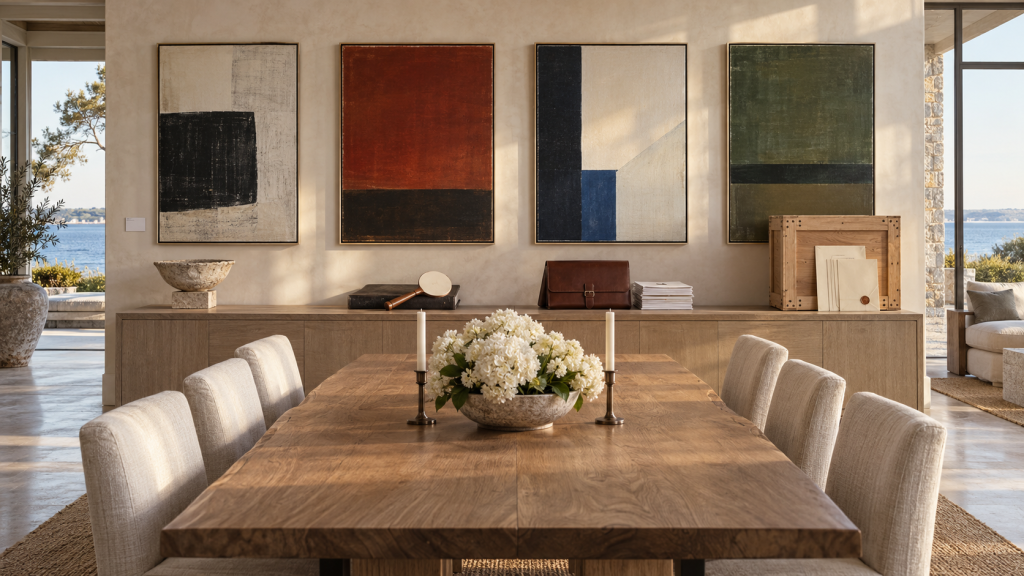
In a Bridgehampton back room on a Friday before Market Art + Design, that weather has four different origins. One number was set in a studio six months ago and is not allowed to move. One was discovered under a hammer in May and still has the buyer’s premium stuck to it. One was negotiated in a fair booth with a clock on the wall. One is doing social work: it exists so nobody at Saturday dinner has to ask what the painting is for.
What an art price says is the dinner-table version. This page is the machinery. There is no single formula. There are four regimes that share a wall and do not share a brain.
Which Model Is in Force
| If you are looking at… | Model | Who sets it | What breaks it |
|---|---|---|---|
| First sale, living artist, gallery invoice | Administered primary | Gallery + artist | A public hammer that humiliates the invoice |
| Same artist at Christie’s next season | Discovered secondary | The room | Bought-in / guarantee that fakes discovery |
| “Price on request” at a fair | Private / hybrid | Dealer as agent or principal | Not knowing which |
| “We don’t discuss it here” | Signal (Velthuis) | Ritual | A discount spoken in the front room |
| Specified interior, Memorial Day delivery | Brief / artisan | The PDF | Calling it a collection |
How collectors buy art already split object, display, story, institution, and hour. Pricing models attach to the first four rows. The fifth row still has no formula.
1. Primary: the administered price
First sale. Access is rationed. A walk-in does not get the good canvas. The point of the number is not to clear the room tonight. It is to keep a career walkable in a quiet year.
Studios still use a size index because they need a starting grid:
\[ (\text{height} + \text{width}) \times \text{index} = \text{asking price} \]
A 40-by-60 at an emerging dollar index near 35 lands around $3,500 before the gallery’s half. That is a first-show number, not a Further Lane number. Square-inch math is for production work. Cost-plus (materials, hours, a modifier) is a floor. Serious dealers treat it as bookkeeping, not as value.
Career is the real index. New graduates live in a low band. Museum exhibitions push the multiplier up. A normal year bumps 5 to 15 percent. A real break can take 30 to 50. Jump the primary too fast and you strand the artist when demand cools. Trail the secondary too far and the auction writes a sentence the studio cannot defend.
The 2020–22 figurative spike is the recent scar: primary under $100,000 printed $500,000 to $1 million at auction inside eighteen months, then snapped back. That gap stains every later invoice.
Split on primary is still mostly 50/50. You almost never negotiate the number down. Ask, and the next allocation can vanish. Consistency across fair, website, and back room is the credibility test. Wildly different prices read as amateur — or as a flip in progress.
Josh Baer’s 2025 rule for ultra-emerging at a first reputable solo: $15,000 max for a large work, $5,000 for a small one. Above that you are already mid-tier on price with an emerging résumé. The market scrambled the signals: $30,000 now buys a thin CV; $300,000 can buy mid-career work nobody can flip.
Money follows here only if the index tracks the work. Money leads if the next invoice is written by last season’s hammer.
2. Secondary: the discovered price
Resale. The artist is usually out of the check. Three tools do the discovering.
Comps. Same artist, size, medium, date, subject, condition. Then adjust. This is how specialists talk. It is real-estate appraisal with better lighting.
Hedonic models. Economists turn comps into a regression: price as a bundle of traits. Artprice’s Indicator lives here. It uses every sale. It misses the unmeasured thing — the surface, the hour, the room it came from.
Repeat-sales indices. Track the same object across two hammers. Mei–Moses, now inside Sotheby’s, is the Case–Shiller of art. Quality cancels because it is the same canvas. Bias: only works that resell enter the sample, and those are not random.
A 2022 study in Management Science priced two traits collectors already perform at dinner: a recorded exhibition history raised hammer prices by about 42 percent; a mention in the scholarly literature by as much as 54 percent. Provenance is not romance. It is a line item.
Auction language is not gallery language. Low and high estimates are marketing bands. The reserve is the secret floor. Hammer is the last bid. Buyer’s premium sits on top and is the tax most dinner speeches forget. A guarantee or irrevocable bid means someone already ate the downside. Discovery is then partly theater.
Recent auction weather: more tickets under $10,000; a working band at $10,000–$50,000; strain above $50,000 except trophies. Ultra-contemporary volume fell hard after the frenzy. The public number is not the private number, and neither is the primary invoice.
3. Private sale and the fair clock
A booth at Basel or a quiet call in July can be either market wearing the other market’s clothes.
Primary at a fair: gallery still splits with the artist. Secondary consignment: a cut for the dealer. Owned inventory: the gallery is principal, not agent, and keeps the whole check. Eight-figure material is mostly secondary. Collectors use the fair when they want a clock and a closed room instead of a public hammer.
“Price on request” is not mystery. It is a filter. Ask which of the three you are in before you admire the lighting.
4. Signal pricing: the number as a sentence
Olav Velthuis sat with dealers and watched them split the building so art and commerce would not make eye contact. Front room chapel, back room calculator is that architecture. The price itself is the sentence.
- High and firm: you arrived late on purpose.
- Fast discount beside the work: the piece is stuck, or the ritual is dead.
- Silence in the front room: you have not been admitted to the arithmetic.
- First-buyer “consideration,” never called a discount: you are being enrolled. Obligation later.
- Museum-promise premium: you are buying the institution row, not the hour.
A public cut on a living artist writes a new comp. Every other owner takes a mark. That is why primary looks “unreasonable” to people who think like auctions. It is not a failed discovery. It is a protected path.
Hamptons residue
Phillips in the old Southampton town hall and the six galleries on Bridgehampton’s four blocks run all four models in a single afternoon. The Chelsea collector upstairs who has not spoken in twenty minutes is trying to see which brain produced the number. Her husband downstairs on email is already in the discovered-price column.
Further Lane adds the bilingual neighbor. Gagosian lives among the people who hang what he moves. Chapel face and arithmetic fluency in one address. Springs still offers the ratio the models cannot price: a $5,000 house, an hour on a barn floor, a later nine-figure residue. The index never enters the barn. It only prices what left.
A Memorial Day delivery date on a chimney-breast PDF is not any of these four. It is the brief that already voted. Budget, not market.
Decoder
- If the invoice cannot move and the allocation can disappear, you are in primary. Do not bargain like an auction.
- If the number includes premium and a May catalogue page, you are in secondary. Strip the tax before you compare.
- If nobody will say whether the work is inventory or consignment, you do not yet have a price. You have a booth.
- If the first sentence is the number, Velthuis has the mic.
- Never let a secondary print write a primary price you cannot defend in a quiet year. That is the only rule that keeps both the artist and the dining-room sentence intact.
- If the date of delivery arrived before the problem in the work, you are not in an art market. You are in décor.
FAQ
Is there a correct formula for a living painter? There is a starting grid (united inch × career index). The gallery then administers. The grid is not the market.
Why won’t they take 10 percent off primary? Because the cut becomes the next comp and stains every other owner.
Are auction indices useful for a single canvas? They are weather. Repeat-sales beat hedonic for quality control and lose on sample bias. Neither is your painting.
What is a good deal? A number that can be explained by comps, career stage, size, medium, and provenance — and that will not embarrass the studio next year.
Does a museum show automatically raise primary? It supports the next index bump. It does not print a multiple by itself.
Should I wait for auction if primary feels high? Only if you want a public number and can live with premium, condition risk, and a possible buy-in. Access and condition are different products.
What model is “price on request”? A door. Behind it: administered, discovered, or inventory. Ask.
The CassWorld Take
A collector who can name which brain produced the number stops paying chapel prices for auction weather and auction prices for a specified sofa, and that fluency is the whole craft. Advisors, dealers, and founders who still keep primary paths walkable in a quiet year can reach Social Life through the contact page or submit a paid feature; the 82,000-reader list, Polo Hamptons 2026, and the print subscription are the rooms where those four models already share a wall. Written by CassWorld. Cass Almendral is Head of Business Development at Social Life Magazine and Co-Founder of Polo Hamptons. Reach editorial at [email protected].
Author

Written by
Recent Posts

Sculpting Chic

Inside the Year-Round Hot Yoga Spot Quietly Becoming the Hamptons’ Real Club
How to Choose Useful Tech Gifts for Employees and Clients in 2026
The Garage Question: Which Car Goes South for the Season?
VandS Clinic Review Treatment: How Seoul Injectable and Laser Options Compare for US Patients
Categories
- Art
- Articles
- Business of Luxury
- Celebrities
- Culture
- Entertainment
- Events
- Faces of Summer 2026
- Fashion
- Fashion & Style
- Featured
- Finance
- Food, Spirits, Wine
- Hamptons
- Hamptons Celebrities
- Health
- Health & Beauty
- Lifestyle
- Luxury Lifestyle
- Press
- Profiles
- Real Estate
- Technology
- The Chronicles
- Travel
- Uncategorized
- Weddings