
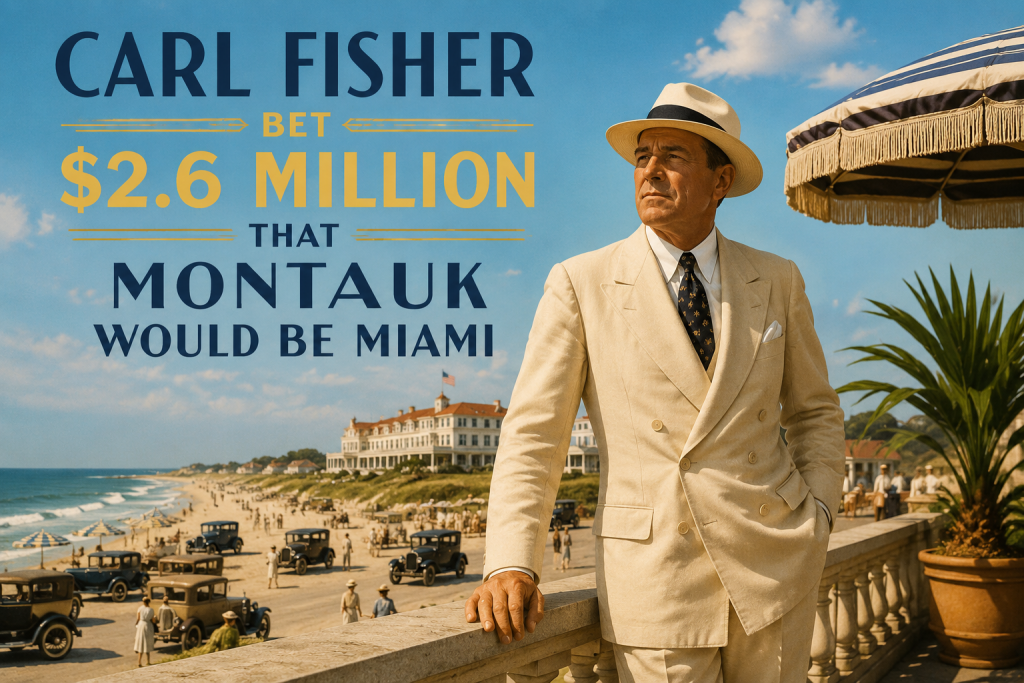
In 1925, a promoter named Carl Fisher paid $2.6 million for the empty end of Long Island. Then he announced his plan. He would turn Montauk into the Miami Beach of the North, a glittering resort city built from grazing land in a few short years. Of course, the bet was enormous. The timing was fatal. And the bones of it still frame your summer, whether you know it or not.
Most people who rent in Montauk have no idea they are vacationing inside a failed empire. The story of Carl Fisher belongs to the same decade that raised the Chrysler Building, told from the side that lost. It is the East End’s own Roaring Twenties gamble. For any brand or any renter who wants the place to mean something, it is also the most useful history on the South Fork.
The Promoter Who Willed Cities Into Existence
Carl Fisher was a born promoter from Indiana, and subtlety was never his style. As a teenager he dropped a bicycle off the tallest building in town, just to prove his shop sold tough bikes. The stunt worked. After that, people remembered the name, which was always the point.
His real fortune came from light. Fisher bought the patent on sealed automobile headlights and made millions, since every car on every dark road suddenly needed a set. Then he co-founded the Indianapolis Motor Speedway and championed the Lincoln Highway, the first road to cross the country. By his forties he had money, fame, and a taste for the impossible.
Then Florida came next, and it made him a legend. Fisher took a mosquito-ridden mangrove swamp near Miami and willed Miami Beach into being, riding the 1920s land boom to staggering wealth. He sold sunshine to the rich, and the rich bought all of it. By 1925 he wanted a summer bookend to his winter kingdom.
The $2.6 Million Bet
Initially, Montauk fit the dream perfectly. The land was cheap, the beaches were wide, and the Long Island Rail Road already ran trains nearly to the door. So Fisher bought more than 9,500 acres for $2.6 million, the largest single real estate purchase the East End had ever seen.
His ambition was not a hotel. It was a city. Fisher’s plans imagined a resort town of roughly 140,000 people, a place meant to rival Newport and Palm Beach at once. He even sketched boat lines running from Montauk to Manhattan, to New London, and up to Boston.
The vision had a brutal logic. Montauk sat at the very tip of the island, with a deep harbor at Fort Pond Bay and a rail link to the city. In Fisher’s mind, that made it the natural gateway between New York and the open sea. Of course the math only worked if the boom never stopped.
Watch the Dirt Fly
Fisher did not build cautiously. He hired some 800 laborers and raised an entire town at once, because he loved, in his own words, to watch the dirt fly. Between 1925 and 1927 his crews laid out the downtown street grid that Montauk still uses today.
Then he reshaped the land itself. Fisher dynamited a gap in the shoreline to connect a landlocked pond to the sea, creating the harbor now called Lake Montauk. After that, he renamed the water after the town. Few developers in history have rearranged geography with such cheerful nerve.
The Resort He Actually Built
In a handful of feverish years, the dream took physical form. A yacht club rose on Star Island, complete with a casino. Tennis courts, a polo field, and a European-style Grand Prix racetrack soon followed. Along the ocean, Fisher built a beach club with cabanas, lockers, a cafe, and an Olympic-size saltwater pool set on a wooden boardwalk.
Two structures anchored the whole fantasy, and both still stand. One crowned a hill. The other rose, absurdly, from a field.
The Manor on the Hill
Montauk Manor opened in 1927 on a rise above the harbor, designed by the architects Schultz and Weaver. It was a Tudor palace, all gabled rooflines, leaded windows, and chandeliered lobbies. From its terraces, guests looked down on the resort Fisher was conjuring below. In effect, the Manor was the showroom for the entire enterprise.
The Tower and the Bathroom Trick
Down in the new downtown, Fisher raised a six-story office tower, the so-called Montauk skyscraper. A tall building in a field of grazing land made no obvious sense, until you understood the sales pitch. Fisher carried prospective buyers up to the top-floor lounge, where the view let them choose a parcel on the spot.
The tower hid one more trick. He installed a bathroom up there too, so a hesitant buyer had no excuse to leave before signing. Specifically, he engineered the building to close deals. It was a sales machine disguised as architecture.
The Wrong Bet on Beauty
Here is the twist that makes Montauk the perfect Art Deco footnote. Fisher built his northern resort in English Tudor style, all half-timber and old-world cosplay. He was selling a fantasy of aristocratic England beside the Atlantic. Miami Beach, by contrast, became the greatest Art Deco district on earth.
So the same developer placed two opposite aesthetic bets in a single decade. One resort looked backward to a borrowed old world. The other looked forward to a chrome-and-sunburst future. The pastel geometry that now defines South Beach actually rose mostly in the rebuilding after the 1926 hurricane, after Fisher’s heyday. Still, it was his city that the future chose to redecorate.
In fact, the contrast is the whole moral of the story. Miami’s bet on tomorrow made it immortal. Montauk’s bet on a fake yesterday became a beautiful, stranded curiosity, which is exactly why it is so much more interesting to stand inside.
How the Dream Died
Fisher ran out of time and luck at the same moment. In September 1926 a brutal hurricane smashed Miami Beach, draining his Florida cash exactly when Montauk needed more of it. Then came the larger blow.
The stock market crash of 1929 caught Fisher hopelessly overextended, with his money buried in a half-finished resort at the end of the world. The Montauk Beach Development Corporation slid into receivership. Within a few years, the man who had built two coastlines lost nearly everything.
He retired to a modest cottage in the city he had invented, Miami Beach, where he died in 1939. For years the downtown tower stood empty above the plaza. Locals gave it a cruel nickname. They called it the White Elephant.
The Ruins You Vacation In
Almost all of it survived, repurposed beyond recognition. Montauk Manor sat abandoned for decades, then it was restored and reborn as a condominium resort. The golf course at Montauk Downs became a celebrated public course inside a state park.
Today the yacht club, the harbor, and the beaches Fisher engineered form the backbone of the town’s economy. The streets you crawl through in August traffic are his streets, drawn a century ago for a city of 140,000 that never arrived. So you are not really visiting old Montauk. Instead, you are visiting Carl Fisher’s unfinished blueprint, lightly disguised as a fishing village.
Montauk Was the First Brand Activation
Now strip away the nostalgia and look at what Fisher actually did, because it should sound familiar. He took an unknown stretch of coast and gave it a story. Then he built rooms designed to make visitors feel chosen. After that, he sold them the feeling of belonging to something rare and new. That is a brand activation, run in 1926 at the scale of an entire city.
The tools have changed, but the play has not. A modern luxury label that lands in Montauk for a summer weekend is doing exactly what Fisher did, only faster and with better lighting. Both are buying the same thing, which is borrowed permanence. Both want the place to lend its lineage to the name on the door.
What a Brand Buys When It Buys Montauk
This is why the East End remains the most valuable backdrop in American marketing. A label can rent a beach almost anywhere. What Montauk offers is a century of accumulated meaning, the quiet sense that everyone who matters has already stood on this sand. In the end, a guest forgets the product. A guest remembers feeling like part of the story.
The same logic drives the summer rental at the very top of the market. A house on the water is not really selling square footage. It is selling a season inside the myth, a place to host the weekend everyone else hears about on Monday. Fisher grasped that in 1925, and the smartest operators on the South Fork grasp it now.
The Lineage Is the Product
Social Life Magazine has spent twenty-three summers turning that lineage into platforms. The Social Life Guest House activation model and the crowd at Polo Hamptons both run on the engine Fisher built. Give the room a story, and the story does the selling. A sponsor who understands this is not buying a logo placement. Instead, a sponsor is buying a place in a hundred-year narrative the rest of the market only rents by the day.
What the Gamble Teaches the Ambitious
The deeper lesson is sharper than any rental pitch. Carl Fisher had the vision, the capital, and the labor to build a future on schedule. What he lacked was timing, and timing is the one thing money cannot buy. The boom that funded the Chrysler’s spire and the Gold Coast’s parties also funded Montauk. The same crash ended all three within a season of one another.
So Montauk stands as a monument to ambition and its limits, which is a more honest souvenir than most places offer. The full arc of that decade lives in our pillar on the last future we agreed on. The Manhattan version of the same nerve plays out in the race to the sky, and the society it served is mapped in the Gatsby Coast. For the deeper local history, our Montauk dossier walks it street by street.
Where The Conversation Continues
Every time you pass the tower in Montauk plaza, you pass the ruin of one man’s certainty that he could build the future on schedule. He was early, and early is just another word for wrong, until the timing turns. Social Life Magazine has spent twenty-three summers reading that timing for the people who would rather be right.
If your brand wants a place inside the myth instead of a weekend renting it, this is the conversation to be in. Join the room at sociallifemagazine.com, where the season’s hosts and sponsors already gather. Become a patron of the archive here. A yes is a seat in the story. A no is a tower you keep driving past, never knowing whose dream you are parked beneath.
Author

Written by
Recent Posts

Sculpting Chic

Inside the Year-Round Hot Yoga Spot Quietly Becoming the Hamptons’ Real Club

How to Choose Useful Tech Gifts for Employees and Clients in 2026
The Garage Question: Which Car Goes South for the Season?
VandS Clinic Review Treatment: How Seoul Injectable and Laser Options Compare for US Patients
Categories
- Art
- Articles
- Business of Luxury
- Celebrities
- Culture
- Entertainment
- Events
- Faces of Summer 2026
- Fashion
- Fashion & Style
- Featured
- Finance
- Food, Spirits, Wine
- Hamptons
- Hamptons Celebrities
- Health
- Health & Beauty
- Lifestyle
- Luxury Lifestyle
- Press
- Profiles
- Real Estate
- Technology
- The Chronicles
- Travel
- Uncategorized
- Weddings