
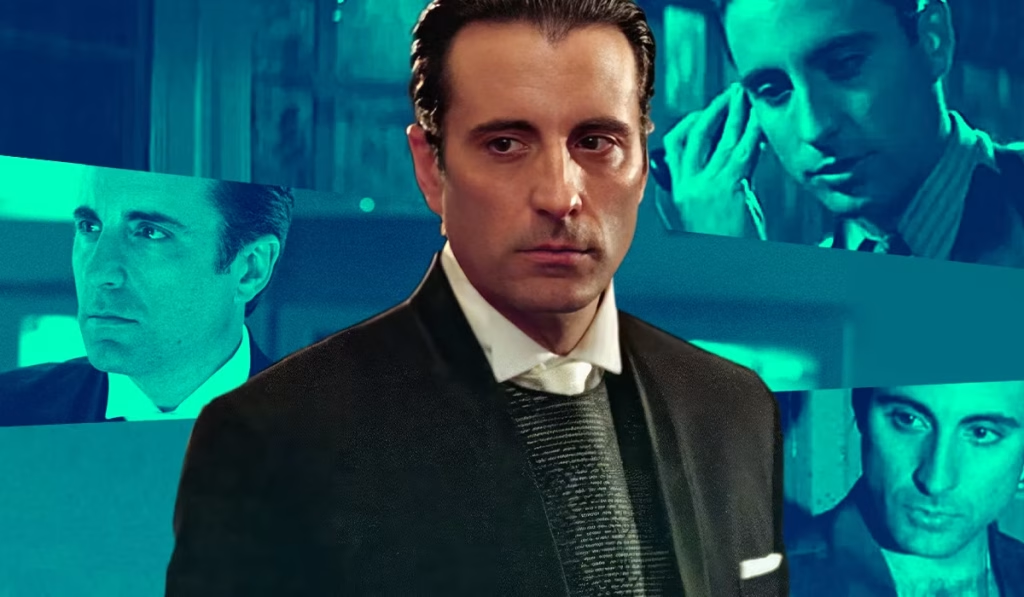
His family fled Havana when he was five years old. The Andy Garcia net worth conversation begins in that 1961 emigration, because the Castro revolution that destroyed his family’s Cuban estate produced the kind of immigrant working-class architecture Hollywood would later recognize across his entire filmography. Specifically, his father René Garcia Núñez had been an attorney and agricultural land owner in Cuba before the regime nationalized his holdings. Furthermore, the family arrived in Miami with virtually nothing. Notably, the Garcias would rebuild their financial position through a perfume business his parents launched in their adopted city.
The Cuban kid who grew up watching his parents rebuild their lives in Miami was the same kid who would later refuse to soften his anti-Castro political position across four decades of Hollywood pressure. Specifically, Garcia’s outspoken advocacy against the Cuban communist regime has shaped every public statement of his career. Furthermore, his political clarity reflected the working knowledge that his family’s economic catastrophe in 1961 was not a natural disaster. Notably, the lesson he absorbed from watching his parents rebuild informed every subsequent project decision he made.
By early 2026, the Andy Garcia net worth had stabilized at approximately $20 million per Celebrity Net Worth. Specifically, the figure reflects four decades of working-actor compensation plus his Key Biscayne Florida real estate plus his music production career. Furthermore, his cumulative filmography includes The Untouchables, The Godfather Part III, Ocean’s Eleven trilogy, Internal Affairs, When a Man Loves a Woman, The Mule, and Mamma Mia! Here We Go Again. He earned Academy Award and Golden Globe nominations for Best Supporting Actor in 1990. Notably, he won a Primetime Emmy for For Love or Country in 2000. The discipline that built the catalog is the architecture.
The Havana Childhood And The 1961 Emigration
Andrés Arturo Garcia Menéndez was born April 12, 1956 in Havana, Cuba. His father René Garcia Núñez worked as an attorney with significant agricultural land holdings across pre-revolutionary Cuba. Specifically, the family’s Roman Catholic household had been established in the Cuban professional class for two generations. Furthermore, his mother Amelie Menéndez worked as an English teacher across Havana schools.
The family fled Cuba in 1961 when Garcia was five years old. Specifically, the Castro regime had nationalized the family’s land holdings and professional practices following the 1959 revolution. Furthermore, the Garcias joined the broader Cuban exile community that resettled across Miami across the early 1960s. Notably, the emigration represented the kind of structural family catastrophe that few Hollywood working-actor biographies share.
His parents rebuilt their economic position through an entrepreneurial perfume business launched in Miami. Specifically, the small business represented the immigrant-economic pattern that defined the Cuban-American community of the 1960s. Furthermore, the family ledger ran on perfume revenue plus minor side income across his early adolescence. Notably, the working-class Miami household instilled the kind of disciplined relationship with money that would later inform Garcia’s entire approach to project negotiation.
His childhood was further complicated by hepatitis. Specifically, Garcia was diagnosed with the disease at age 11. Furthermore, the illness kept him bedridden for nearly a year. Notably, the period of forced reflection during that illness produced his earliest interest in performance, theater, and storytelling. The Andy Garcia net worth at age zero was structurally precarious through the family’s emigration. Specifically, the position would compound across decades of careful working-class economic discipline.
Miami Beach Senior High And The Jay W. Jensen Apprenticeship
Garcia attended Miami Beach Senior High School across his teenage years. Specifically, the school’s drama program was directed by legendary teacher Jay W. Jensen, who would later be credited with launching the careers of multiple Hollywood actors of Garcia’s generation. Furthermore, Jensen’s methodology emphasized classical theater technique, voice work, and performance discipline. Notably, Garcia studied under Jensen alongside future stars including Mickey Rourke and Brett Ratner.
His high school basketball career added another dimension to his early teenage years. Specifically, Garcia developed the kind of physical discipline that would later inform his on-screen presence across action and dramatic registers. Furthermore, the basketball experience reinforced the disciplined-physicality work ethic that distinguished him from peers training only in classical theater technique.
He enrolled at Florida International University after his Miami Beach Senior High graduation. Specifically, Garcia studied drama before eventually leaving the program to pursue professional acting work full-time. Furthermore, the FIU enrollment reflected the broader pattern of working-class Cuban-American academic ambition that defined his immigrant generation. Notably, his decision to leave the program rather than complete the degree represented the same risk-tolerance that would later define his project choices.
What the Miami years taught him was the same lesson Luke Grimes’s parallel pre-fame trajectory demonstrated a generation later. Specifically, working-class youth performance training compounded faster than prestige conservatory programs. Furthermore, both actors learned their craft through working teachers rather than through institutional credentials. Notably, the Cuban-American Miami pipeline that produced Garcia would later parallel the Pentecostal-Ohio pipeline that produced Grimes.
The Hill Street Blues Breakthrough
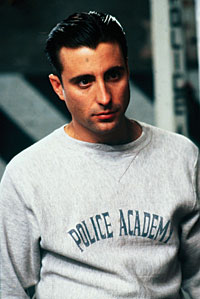
Garcia relocated from Miami to Hollywood in the late 1970s. Specifically, the move represented the same risk-tolerance his parents had demonstrated when they fled Cuba in 1961. Furthermore, the early years in Los Angeles produced the kind of working-actor scale-wage compensation that defined his entire generation of pre-fame performers. Notably, his first paying screen work came as gang members and henchmen in network television series across the late 1970s.
His breakthrough television role came on NBC’s Hill Street Blues in the early 1980s. Specifically, Garcia played a gang member across multiple episodes of the prestige police drama. Furthermore, the show’s reputation for realistic urban crime drama provided the kind of credibility that conventional commercial-television work could not have produced. Notably, the Hill Street Blues visibility opened the casting doors for his subsequent film work.
His marriage to Marivi Lorido Garcia in 1982 anchored the personal architecture across his entire career. Specifically, the couple has remained married for 44 consecutive years as of 2026, making it one of the longest-running unions in modern Hollywood. Furthermore, Marivi later produced multiple Garcia films and provided the kind of working-partner foundation that his career architecture required. Notably, the couple has four children: Dominik (later an actress), Daniella, Alessandra, and Andrés.
What the early Hollywood years produced was a working-actor reputation built on consistency rather than marquee visibility. Specifically, Garcia took every paying role he could secure across 1979 through 1985. Furthermore, his work in The Mean Season with Kurt Russell in 1985 and Eight Million Ways to Die with Jeff Bridges in 1986 placed him alongside leading men whose career compensation he could not yet match. Notably, the patience he developed across this period would later compound through his Untouchables breakthrough.
The Untouchables And The George Stone Decision
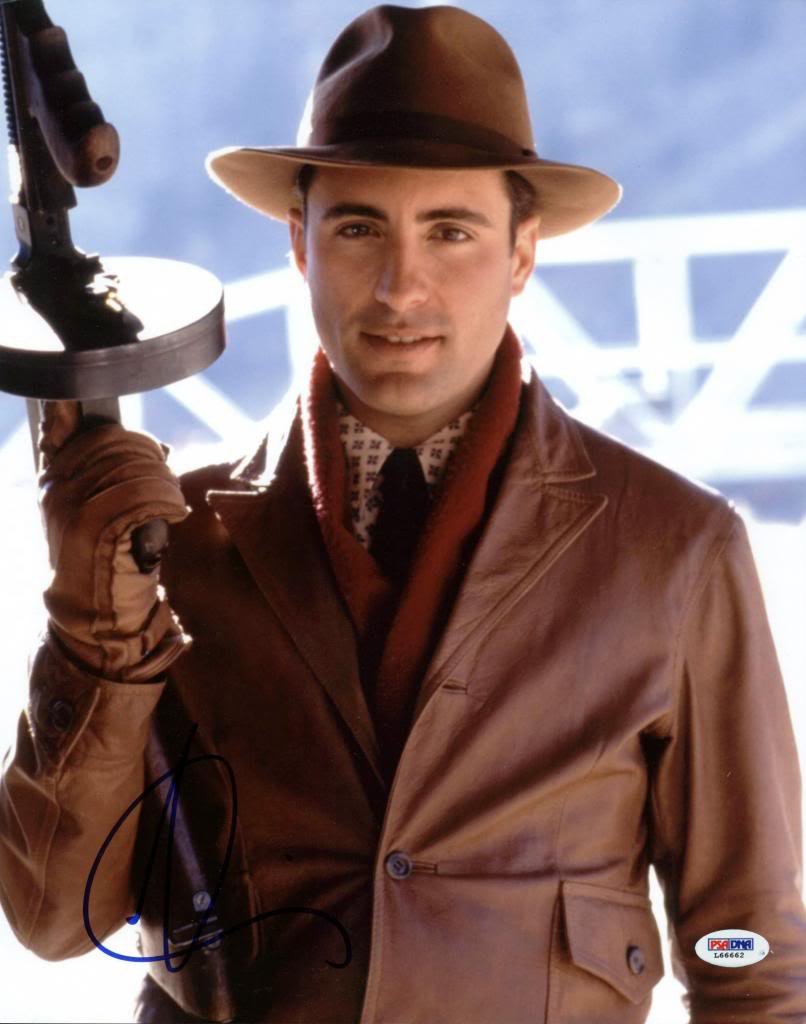
Brian De Palma cast Garcia in The Untouchables in 1987. Specifically, De Palma originally offered him the role of Capone enforcer Frank Nitti. Furthermore, Garcia pushed back during the audition process and requested instead to play federal agent George Stone. Notably, the change reflected his desire to work directly opposite Sean Connery, his childhood hero from the Bond films. The complete production architecture of that performance is documented in the Untouchables Cast hub.
His preparation for the role included studying the historical record of the actual federal agents who had pursued Al Capone. Specifically, Garcia’s methodology defined the kind of methodical character work that distinguished his entire register of acting. Furthermore, his Cuban-American immigrant identity informed his approach to George Stone, the Italian-American federal agent who had been similarly an outsider in early-1930s Chicago.
His compensation for The Untouchables was approximately $200,000 across the production schedule. Specifically, the rate reflected his pre-stardom market value plus the supporting-role compensation tier. Furthermore, the film grossed $106 million worldwide on a $25 million budget. Notably, the film earned four Academy Award nominations including Connery’s eventual Best Supporting Actor win at the 60th ceremony.
What the Untouchables proved structurally was the same lesson Sean Connery’s career-resetting Untouchables Oscar had proven for the elder actor. Specifically, prestige-ensemble casting could reset a working-actor’s market value into permanent leading-man territory. Connery hit that inflection point at 56 with Officer Jim Malone. Garcia hit it at 31 with George Stone. Both actors used The Untouchables to negotiate significantly higher compensation across the subsequent decade.
The Godfather Part III And The 1990 Oscar Nomination
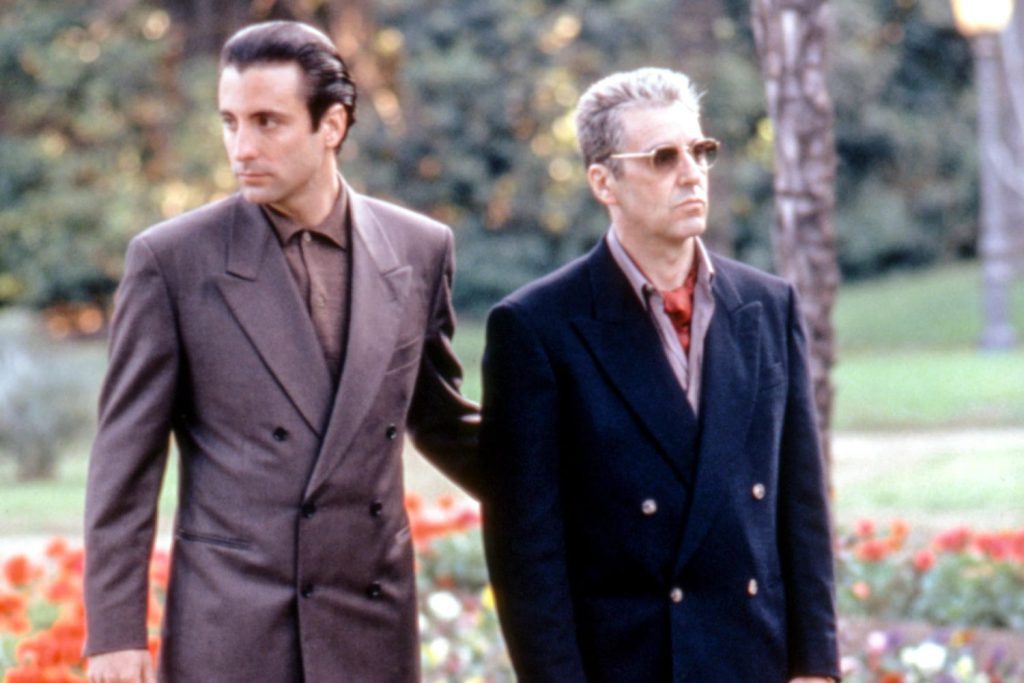
Francis Ford Coppola cast Garcia as Vincent Mancini in The Godfather Part III in 1990. Specifically, the role required Garcia to portray Michael Corleone’s illegitimate nephew, the volatile young heir whose succession to the Corleone family business anchored the film’s central narrative. Furthermore, the casting carried personal significance for Garcia. Notably, the original Godfather had been the film that inspired him to pursue acting in his late teens.
His compensation for The Godfather Part III reportedly reached approximately $1.2 million across the production schedule. Specifically, the rate represented the first seven-figure payday of his career. Furthermore, the film grossed $136 million worldwide on a $54 million budget. Notably, while the third installment is generally considered the weakest entry in the trilogy, the film earned seven Academy Award nominations including Best Picture.
The Academy nominated Garcia for Best Supporting Actor at the 63rd ceremony in March 1991. Specifically, he lost to Joe Pesci’s Goodfellas victory, but the nomination converted his profile from supporting character actor to leading-man candidate within 12 months. Furthermore, he earned a parallel Golden Globe nomination at the same season. Notably, the recognition placed him in the top tier of working Latino actors of his generation.
His subsequent work in Internal Affairs in 1990, Hero in 1992, and When a Man Loves a Woman with Meg Ryan in 1994 extended the prestige credibility that The Godfather Part III had established. Specifically, the post-Oscar-nomination working-rate reached approximately $3 to $5 million per major film across his peak earning years. Furthermore, the cumulative compensation across this period reached approximately $20 to $30 million in gross before agent fees, manager fees, and taxes.
The Ocean’s Eleven Trilogy And The Terry Benedict Architecture

Steven Soderbergh cast Garcia as casino owner Terry Benedict in Ocean’s Eleven in 2001. Specifically, the role required Garcia to play the urbane antagonist whose casino empire George Clooney’s heist crew systematically defrauds across the entire film. Furthermore, the casting placed Garcia alongside Clooney, Brad Pitt, Matt Damon, and Julia Roberts in one of the most commercially successful ensemble heist franchises in modern American cinema.
His compensation for Ocean’s Eleven was approximately $5 million plus participation rights. Specifically, the rate reflected his post-Godfather established leading-man tier. Furthermore, the film grossed $450 million worldwide on an $85 million budget. Notably, Clooney negotiated unusually generous backend participation for the entire principal cast, which compounded Garcia’s eventual cumulative trilogy compensation significantly above his upfront fees.
His reprises in Ocean’s Twelve in 2004 and Ocean’s Thirteen in 2007 each produced compensation increases above the original trilogy installment. Specifically, the cumulative trilogy compensation across all three films reached approximately $20 to $25 million in gross plus participation rights that continue generating residual income. Furthermore, the franchise visibility extended his reach into the global commercial-cinema audience.
What the Ocean’s Eleven trilogy added to his net worth architecture was the kind of franchise-supporting compensation that George Clooney’s parallel Casamigos exit demonstrated as one structural strategy. Specifically, both actors used the Ocean’s franchise to fund creative projects that paid significantly less than their commercial-cinema rates. Clooney funded prestige indie projects. Garcia funded directorial and music production work.
The Lost City And The Cuban Cinema Authority
Garcia directed, produced, and starred in The Lost City in 2005. Specifically, the film was a labor-of-love project celebrating pre-revolutionary Cuban culture and the impact of the 1959 revolution on Havana’s social architecture. Furthermore, Garcia had developed the project across nearly two decades before securing financing through his Ocean’s Eleven compensation.
The film cast Bill Murray, Dustin Hoffman, and Inés Sastre alongside Garcia’s lead performance as nightclub owner Federico Aguilar. Specifically, the production featured legendary Cuban bassist Israel “Cachao” López performing original compositions. Furthermore, the score honored the Cuban musical tradition that Garcia had absorbed across his Miami childhood. Notably, the film grossed approximately $4 million on a $9 million budget.
The commercial performance disappointed the production. Specifically, distribution challenges and limited theatrical release prevented the film from finding its target audience. Furthermore, the box-office return represented a significant capital loss for Garcia personally. Notably, the loss did not derail his subsequent commercial work because the Ocean’s Eleven trilogy compensation had insulated his net worth across the same period.
His parallel music production work generated additional creative authority. Specifically, Garcia produced Cachao’s ¡Ahora Sí! album in 2005. Furthermore, the project won both the Grammy Award for Best Traditional Tropical Latin Album and the Latin Grammy for Best Tropical Album that year. Notably, the dual recognition placed Garcia in the top tier of Latin music producers of his generation while his acting career continued compounding through major studio projects.
The Key Biscayne Cuban Architecture Estate
Garcia acquired his Key Biscayne, Florida property in 1991. Specifically, the original 9,084 square-foot residence represented his post-Godfather Part III investment in his adopted Miami home. Furthermore, Hurricane Andrew completely destroyed the property in 1992, just one year after the acquisition. Notably, the structural loss became the foundation of one of the most distinctive celebrity homes in South Florida.
Garcia and his wife Marivi rebuilt the residence with explicit Cuban architectural styling. Specifically, the new construction incorporated colonial Cuban design elements, including period-appropriate ironwork, courtyard architecture, and tropical garden integration. Furthermore, the four-bedroom property features a large pool, extensive patio space, and the kind of Cuban heritage details that anchor his cultural identity. Notably, the property valuation has reached approximately $4 million as of early 2026.
The Key Biscayne estate represents the structural celebration of his Cuban heritage that informed his entire career architecture. Specifically, Garcia could have invested the post-Hurricane Andrew settlement in conventional Miami waterfront real estate. Furthermore, he chose instead to rebuild the estate in the architectural tradition of pre-revolutionary Havana. Notably, the choice mirrored every other major decision of his cultural identity.
His San Fernando Valley California home anchors his West Coast residential architecture. Specifically, Garcia purchased the property from actor Henry Winkler at a previous transaction. Furthermore, the residence reflects the practical need for Los Angeles presence during major studio production schedules. Notably, the dual-coast residential architecture has insulated his daily life from the conventional Hollywood social orbit while remaining accessible to both production hubs.
The Mamma Mia And The Mule Late-Career Work
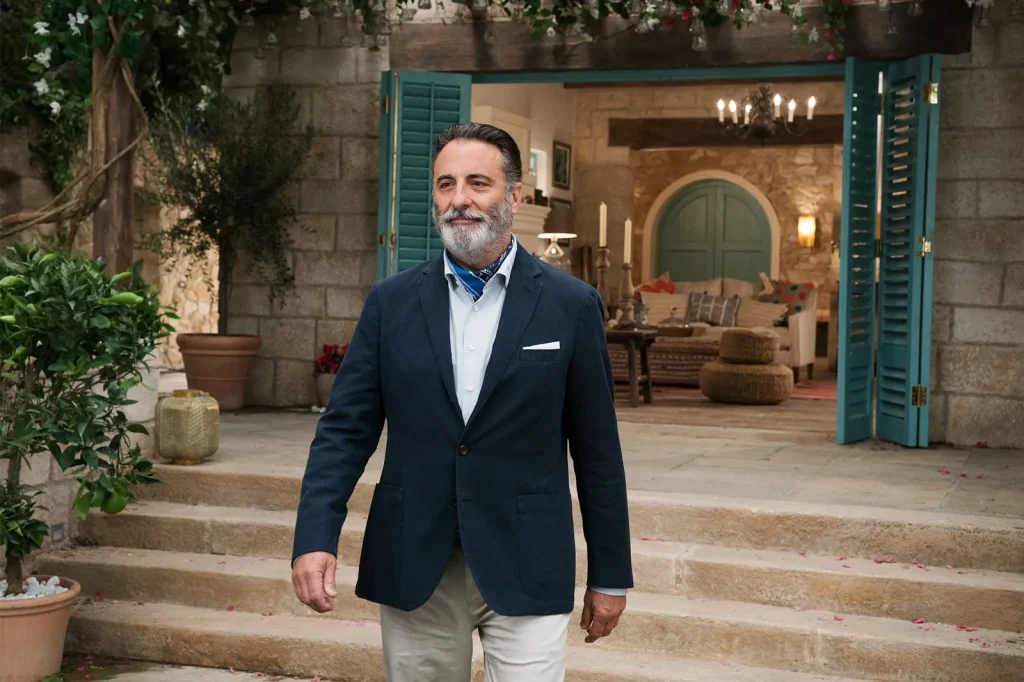
Universal Pictures cast Garcia in Mamma Mia! Here We Go Again in 2018. Specifically, the role required Garcia to portray Mr. Cienfuegos, the hotel manager whose connection to Cher’s Ruby Sheridan anchors one of the film’s central romantic threads. Furthermore, the production paid approximately $1 to $2 million across the schedule. Notably, the film grossed $402 million worldwide on a $75 million budget.
Clint Eastwood cast him in The Mule in 2018. Specifically, Garcia played a drug cartel boss whose patronage of Eastwood’s elderly mule character provides one of the film’s central dramatic threads. Furthermore, the film grossed $174 million worldwide on a $50 million budget. Notably, the role confirmed his late-career villain register following decades of leading-man and supporting work.
His subsequent work across Father of the Bride in 2022 (Warner Bros. remake) and ongoing television guest appearances has continued generating working-actor compensation across his late sixties. Specifically, Garcia has averaged approximately three to four major projects per year across the post-2018 period. Furthermore, the consistent working pattern has produced approximately $5 to $8 million in cumulative gross across the past five years.
What the late-career renaissance proves structurally is the same lesson Sissy Spacek’s parallel Bloodline streaming-era trajectory demonstrates. Specifically, prestige actors who maintained their craft discipline across the streaming transition extended their commercial relevance well into their seventh decade. Furthermore, both actors used selective late-career project choices to compound their respective net worth structures faster than traditional film work alone could have produced.
The Real Andy Garcia Net Worth Math In 2026
Celebrity Net Worth lists the Andy Garcia net worth at $20 million as of early 2026. Furthermore, multiple secondary sources place the figure in the $20 million to $30 million range when accounting for his Key Biscayne estate appreciation, his Ocean’s Eleven trilogy participation rights, and his ongoing residual income across four decades of working-actor credentials.
The compositional breakdown looks roughly like this. Specifically, his career acting earnings across 47 years of working-actor compensation generated approximately $80 to $120 million in cumulative gross before agent fees, manager fees, and taxes. Notably, his Ocean’s Eleven trilogy participation alone produced approximately $20 to $25 million across the three installments. Furthermore, his Godfather Part III $1.2 million in 1990 dollars represented one of the largest single-project payouts of his peak earning years.
His real estate concentration represents approximately $5 to $7 million in equity value. Specifically, the Key Biscayne estate plus the San Fernando Valley California property produce the dual-coast residential architecture. Furthermore, both properties have appreciated significantly across his multi-decade holding periods. Notably, the real estate diversification has insulated his portfolio from any single market disruption.
His structure echoes the patterns documented in Social Life Magazine’s celebrity net worth rankings 2026. Specifically, his holdings concentrate in real estate, residual income, and music production royalties rather than in trophy investments. Furthermore, the conservative portfolio diversification has insulated his wealth across multiple decades of industry change. Notably, the discipline that built the catalog has been the discipline that protected the estate.
What He Built That No Castro Regime Could Take Back
The catalog will outlast every Ocean’s Eleven retrospective, every Mamma Mia anniversary, every Godfather Part III streaming season, and every estate-planning consultation. Specifically, The Untouchables will play forever. The Godfather Part III will play forever. Internal Affairs will play forever. When a Man Loves a Woman will play forever. The Ocean’s Eleven trilogy will play forever. The Lost City will play forever. Notably, his cumulative filmography across 47 years includes more than 100 acting credits plus directing and producing work that compounds across the next several decades.
The George Stone To Vincent Mancini Compounding
His willingness to leave Cuba at 5 with his family, study at Miami Beach Senior High under Jay W. Jensen, push for the George Stone role in The Untouchables specifically to work with Connery, accept the Vincent Mancini role in The Godfather Part III despite the franchise’s diminished reputation, and rebuild his Key Biscayne home in pre-revolutionary Cuban architectural style after Hurricane Andrew became the Garcia signature across six decades. He took the Hill Street Blues scale fee. Subsequently, the Untouchables George Stone $200,000 followed. Notably, The Godfather Part III $1.2 million broke him into the leading-man tier. Furthermore, the Ocean’s Eleven trilogy compensation funded his Cuban-cinema directorial ambitions. Consequently, the cumulative consequence of those choices was a career that earned him approximately $20 million while preserving his political and cultural identity across five decades of Hollywood pressure.
Most actors at 70 are managing decline. Specifically, Garcia at 70 is anchoring late-career studio projects, producing Latin music, mentoring his daughter Dominik’s acting career, maintaining the Key Biscayne Cuban heritage estate, and continuing his outspoken anti-Castro political advocacy. Notably, the Andy Garcia net worth at $20 million on the public ledger and $25 to $30 million on the actual ledger represents only the financial residue of a career that mattered to American cinema in ways the Havana accountants of his childhood could never have measured.
The CassWorld Take
For Brands Reading Between The Lines
A fish does not notice the water. A reader does not notice the architecture. That is the entire point. Furthermore, that is the entire opportunity for the brand founder, fund manager, or fashion house creative director who has just read this far. Consequently, the reader is, without having fully realized it yet, about to scroll down and click one of the following links.
Are you a brand, a founder, a creative director, or an in-house marketing lead who has read this far? Moreover, would you like to be considered for an editorial feature in Social Life Magazine’s print or digital ecosystem? The editorial team reviews brand submissions year-round. Reach out via the Social Life editorial contact page.
Submit A Paid Feature
Are you a Cuban heritage cigar brand, a prestige rum portfolio, or a Miami luxury hospitality house? Specifically, the kind that recognizes a pre-revolutionary Havana aesthetic when they see one? Then the Submit A Paid Feature page is the fastest entry point. Furthermore, our editors build the placement to fit your audience, not ours.
The 82,000-Reader Email List
Join the 82,000+ readers who receive the Social Life Magazine email digest weekly. The list reaches the affluent New York and Out East audience that drives luxury brand purchase decisions across beauty, spirits, hospitality, finance, and fashion. Sign up via the Social Life Magazine email signup form.
Polo Hamptons 2026
Some brands are ready to be present in front of the right demographic. Specifically, the readers who quote Vincent Mancini dialogue at dinner parties. Notably, the kind who consider The Untouchables a foundational text. Consequently, Polo Hamptons 2026 is the marquee summer activation for that audience. Title sponsor BMW returns for its eighth consecutive year. Tickets, cabanas, and remaining sponsorship packages are available now.
Print Subscription
Subscribe to the print edition of Social Life Magazine and hold 23 years of Out East cultural authority in your hands. Five summer issues delivered Memorial Day through Labor Day, plus the Fall and Winter editions reaching Upper East Side doorman buildings. Print subscriptions are available at the Social Life subscription page.
Support Independent Journalism
If this article sharpened your thinking, consider supporting independent luxury journalism. Donate $5 and keep the signal clean. Buy us a coffee here.
The Andy Garcia net worth story is a rare 47-year career document. Specifically, the Cuban kid whose family fled Havana at age 5, who pushed for the George Stone role in The Untouchables to work with Connery, who earned an Oscar nomination at 34 for Vincent Mancini, who rebuilt his Hurricane Andrew-destroyed Miami home in pre-revolutionary Cuban architectural style, and who quietly built a $20 million estate across decades of working-actor discipline proves that the catalog is the asset and the heritage is the architecture. Print the Andy Garcia net worth architecture. Bookmark this page.
Written by CassWorld. Cass Almendral is Head of Business Development at Social Life Magazine and Co-Founder of Polo Hamptons. Reach editorial at [email protected].
Author

Written by
Recent Posts

Victoria Justice Kicks Off Halloween Early with Love Zombie Bash in Hollywood

Planning an Arizona Road Trip? Practical Details to Handle Before You Leave

Short Homecoming Dresses That Feel Polished, Not Overdone
Men’s Health After 40: Important Changes to Pay Attention To
What You Need to Know About Spray Tanning
Categories
- Art
- Articles
- Business of Luxury
- Celebrities
- Culture
- Entertainment
- Events
- Faces of Summer 2026
- Fashion
- Fashion & Style
- Featured
- Finance
- Food, Spirits, Wine
- Hamptons
- Hamptons Celebrities
- Health
- Health & Beauty
- Lifestyle
- Luxury Lifestyle
- Press
- Profiles
- Real Estate
- Technology
- The Chronicles
- Travel
- Uncategorized
- Weddings