
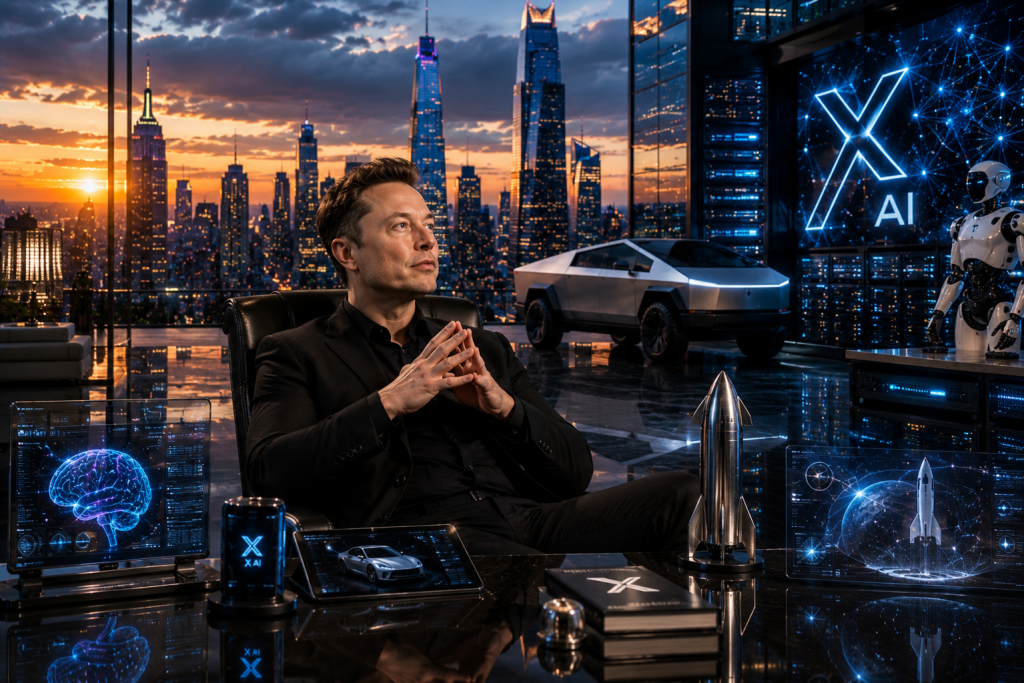
Elon Musk AI Empire Net Worth 2026: How xAI Made Him the Near-Trillionaire
Elon Musk AI wealth reached approximately $844 to $852 billion by February 2026, making him the first person in history to surpass $800 billion and positioning him as the probable first trillionaire on earth. The primary engine was not Tesla. It was the February 2, 2026, merger between SpaceX and xAI, his artificial intelligence company, which created a combined entity valued at $1.25 trillion. Musk owns approximately 42-43% of that entity. He is the most contradictory figure in the AI billionaires reshaping American wealth: the man who warned humanity that AI would kill us all, then built an AI company, then merged it with his rocket company, then became richer from AI than from electric vehicles.
The SpaceX-xAI Merger: $1.25 Trillion Under One Roof
On February 2, 2026, SpaceX acquired xAI in an all-stock transaction that valued SpaceX at $1 trillion and xAI at $250 billion. The combined entity brought together SpaceX’s rocket launch services and Starlink satellite internet, xAI’s Grok AI platform and Colossus supercomputer, and the X social media platform (which xAI had acquired in March 2025 for $33 billion). Forbes declared Musk the first person to surpass $800 billion, pegging his net worth at $852 billion.
The strategic rationale was vertical integration at planetary scale. Starlink’s thousands of satellites generate massive datasets. xAI’s Grok models can process those datasets. SpaceX’s launch capability can deploy the infrastructure. Musk described the goal as building “orbital data centers,” AI compute infrastructure in space. The practical motivation was simpler: xAI was burning $1 to $2 billion annually trying to compete with OpenAI and Anthropic, and SpaceX had the balance sheet to absorb the losses.
From AI Skeptic to AI Billionaire
Musk’s relationship with artificial intelligence is a timeline of reversals. He co-founded OpenAI in 2015 alongside Sam Altman as a nonprofit research laboratory dedicated to ensuring AI benefits humanity. By 2018, he had left OpenAI’s board, reportedly over disagreements about the company’s direction. Then in 2023, he founded xAI to build Grok, a chatbot designed to compete directly with ChatGPT. A year later, he sued OpenAI for abandoning its nonprofit mission. In 2026, he merged his AI company with his rocket company and became richer from AI than from any other source.
The contradictions are not footnotes to his story. They are the story. Musk signed open letters calling for a pause on AI development. He testified before governments about existential risk. He described AI as “more dangerous than nukes.” Then he built an AI company, hired away talent from the companies he criticized, and structured a merger that made artificial intelligence the primary driver of his fortune. Tesla’s proxy filing acknowledged the shift: “a majority of Mr. Musk’s wealth is now derived from other business ventures.”
See also: model builders.
The Money: $852 Billion in Moving Parts
Musk’s fortune is a composite of interconnected holdings. SpaceX-xAI represents approximately two-thirds of his net worth, with his 42-43% stake valued at roughly $530 billion based on the merger valuation. Tesla contributes an estimated $200 to $263 billion, depending on the stock price and the status of his restored $115 billion compensation package. Additional value comes from Starlink, the Boring Company, Neuralink, and other ventures.
The critical fragility: less than 0.1% of Musk’s net worth is held in cash. Everything is equity. Everything moves with market sentiment. Forbes and Bloomberg disagree on his net worth by approximately $173 billion, primarily because they apply different valuation methods to private holdings. Forbes uses the full merger valuation. Bloomberg applies “liquidity haircuts” to positions that cannot be easily sold. That gap between those methodologies is larger than the entire net worth of most billionaires.
The Path to Trillionaire
A SpaceX IPO is widely expected in mid-to-late 2026 at a valuation of $1.5 trillion or higher. If the IPO prices at that level, Musk’s 42% stake alone would be worth approximately $630 to $735 billion. Combined with Tesla holdings, that puts his total net worth past $900 billion and within striking distance of $1 trillion. Whether he becomes the world’s first trillionaire in 2026 or 2027 depends on two variables: the SpaceX IPO price and Tesla’s stock trajectory. Neither is certain. Both are trending in his direction.
Thirteen Children and the Performance of Contradiction
Musk has thirteen children across multiple relationships. He has described declining birth rates as a greater threat to civilization than AI, climate change, or nuclear weapons. His personal life generates tabloid coverage at a volume that no other technology executive approaches. The contradictions between his public warnings about AI risk and his private acceleration of AI development, between his stated concern for humanity’s future and his accumulation of wealth that exceeds the GDP of most nations, define a public persona that resists coherent narrative.
That incoherence is, paradoxically, part of the brand. Musk is not performing consistency. He is performing ambition at a scale that makes consistency irrelevant. Building rockets, electric vehicles, brain-computer interfaces, tunnel-boring machines, social media platforms, and artificial intelligence simultaneously is not a strategy any business school would recommend. It is a temperament. And that temperament, whatever its logical contradictions, has produced $852 billion in personal wealth and counting.
The Insider Angle: When the Richest Man Arrives
Musk has not, to public knowledge, purchased property on the East End. He famously sold most of his real estate in 2020 and lived temporarily in a prefabricated house in Texas. But the AI wealth he represents, the SpaceX-xAI merger wealth, the Starlink wealth, the Tesla compensation wealth, is arriving on the South Fork through thousands of employees, investors, and partners whose financial lives are tethered to his companies.
At Polo Hamptons on July 18 and 25 at 900 Lumber Lane in Bridgehampton, the technology wealth in attendance includes people whose net worth is directly correlated with Musk’s empire. When SpaceX goes public, the liquidity event will create a new generation of multimillionaires and billionaires, many of whom will enter the ultra-luxury real estate market that the East End represents. The near-trillionaire may not buy on Further Lane himself. But his gravitational pull on the AI economy ensures that the money orbiting him will.
For related coverage, explore OpenAI boardroom crisis.
The Neurochemistry of Contradiction at Scale
There is a specific type of person, and the type is rare enough that studying it requires the kind of longitudinal dataset that does not exist outside of biographies written after the subject is dead, who derives energy from contradiction rather than resolution. Most humans seek coherence. They want their public positions to align with their private actions, their stated values to match their investment thesis, their warnings about existential risk to translate into restraint rather than acceleration. Musk operates on a different circuit. The warnings and the acceleration are not in tension for him. They are the same impulse expressed through different outputs. He warns about AI because he genuinely fears it. He builds AI because he genuinely believes that the only way to prevent bad AI is to build good AI, and the only person he trusts to build good AI is himself. That both of these positions can be true simultaneously and still produce behavior that looks, from the outside, like rank hypocrisy, is the essential feature of Musk’s psychology and the reason his fortune continues to compound while his critics continue to point out contradictions he has already priced in.
The Deeper Read
The SpaceX-xAI merger is the architectural expression of this psychology. Merging a rocket company with an AI company is not a strategy that any management consulting firm would recommend, any business school case study would endorse, or any institutional investor would celebrate if it were proposed by anyone other than the richest person on earth. But the logic, if you accept the premise that AI compute will eventually need to be deployed in orbit, and that the person who controls both the launch vehicles and the AI models will have a structural advantage that cannot be replicated by anyone who controls only one, is actually sound. It is sound in the way that buying a semiconductor company in 2016 because you believe AI will need chips in 2023 is sound, which is to say it is sound only in retrospect, and only to the people who had the conviction and the capital to act on a thesis that every reasonable person would have dismissed as science fiction. Jensen Huang had that conviction about chips. Musk has that conviction about orbital AI. Whether Musk is right will determine whether he becomes a trillionaire or a cautionary tale, and the market, as of February 2026, is betting on the trillionaire.
Where the Conversation Continues
You are reading this because the scale of concentrated wealth in AI is no longer theoretical. Elon Musk’s $852 billion fortune represents what happens when conviction, contradiction, and capital converge at the highest level the market has ever priced.
If your brand, property, event, or company belongs in this conversation, reach us through our contact page.
For premium editorial visibility, explore our paid feature submission process.
Subscribe at sociallifemagazine.com/enflyer for weekly updates.
Polo Hamptons returns July 18 and 25. BMW is the title sponsor. Details at polohamptons.com.
Subscribe at sociallifemagazine.com/subscription. Contributions help keep independent luxury journalism going.
Author

Written by
Recent Posts

How to Choose Useful Tech Gifts for Employees and Clients in 2026
The Garage Question: Which Car Goes South for the Season?

VandS Clinic Review Treatment: How Seoul Injectable and Laser Options Compare for US Patients
Before Buying a View Home: What a Sloped Lot Means for the Purchase

Powerful Strategies to Stay Ahead in a Fast-Moving Real Estate Market
Categories
- Art
- Articles
- Business of Luxury
- Celebrities
- Culture
- Entertainment
- Events
- Faces of Summer 2026
- Fashion
- Fashion & Style
- Featured
- Finance
- Food, Spirits, Wine
- Hamptons
- Hamptons Celebrities
- Health
- Health & Beauty
- Lifestyle
- Luxury Lifestyle
- Press
- Profiles
- Real Estate
- Technology
- The Chronicles
- Travel
- Uncategorized
- Weddings