
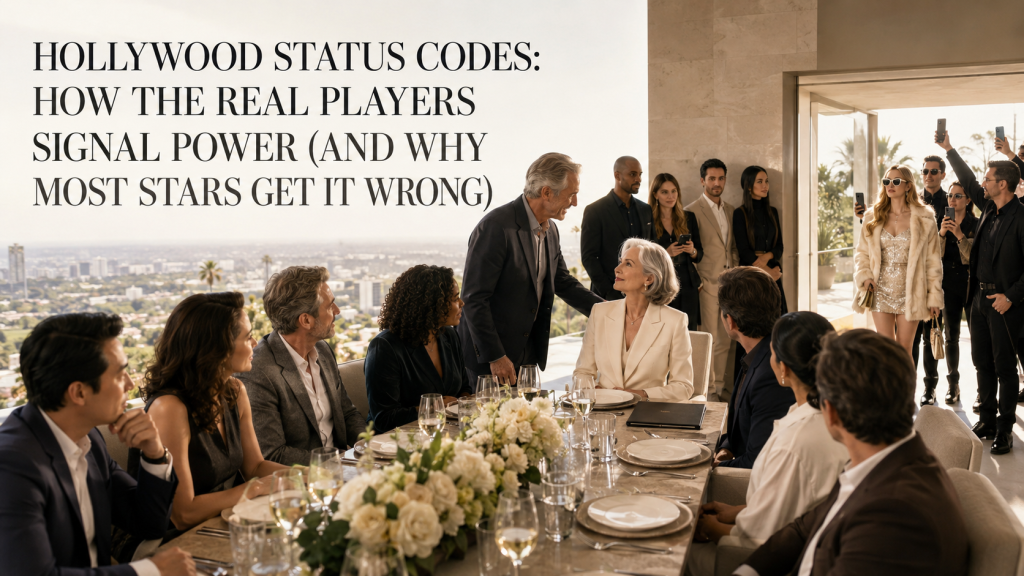
Private screening runs twenty minutes late when two cars arrive. A current-year matte-black Rolls-Royce Cullinan still carries that just-detailed sheen. Its driver is an actor whose last three roles cleared eight figures before backend. He steps out in a black baseball cap pulled low. Studied anonymity still manages to announce itself.
Beside it sits a 2013 Land Rover Defender in British racing green. However, a small crack marks the plastic cowl above the windshield. Dust sits in the wheel arches. Its owner holds a higher lifetime gross and more lasting credits. He shows almost no interest in being photographed getting out of a vehicle. He nods once to the valet and walks inside without looking back.
Both men are famous. Still, only one is playing the long game.
Hollywood runs on a hybrid status system that most outsiders never fully decode. Meanwhile, it mixes the loud display energy of new money with the quiet restraint and ownership logic of old money. Stars who last master a specific set of codes. Their net worth compounds after the roles slow down. Their names still open doors a decade after the peak heat. Everyone else just performs the codes. The performance can be dazzling. It simply does not compound.
This is the same distinction mapped across the New Money vs Old Money framework. In fact, it also appears in the long-term patterns inside the Movie Star Legends Net Worth data. Hollywood simply makes the tells more visible. The stakes are public. The timeline is compressed. An industry that never stops watching updates the scoreboard in real time.
The Core Divide: Addition Versus Subtraction
New-money Hollywood signals by addition. Newer car. Bigger watch. More visible logos. Constant documentation. The feed becomes the ledger. Meanwhile, every acquisition acts as a press release. Every appearance becomes a data point that says: I am still here, I am still winning, please notice.
Old-money Hollywood signals by subtraction. Older car. Inherited or deliberately understated watch. No logos. Meanwhile, almost no public record of the private life. The absence itself becomes the signal. The person who no longer needs to prove liquidity is the one who has already secured it.
Difference is not moral. It is strategic. However, attention is finite and expensive to maintain. Ownership and discretion compound. One approach buys the room for a night. The other buys the ability to leave the room whenever you want and still own the building.
You can watch the divide play out in any industry-town parking lot. However, you can see it at any private dinner. You can hear it in any conversation that lasts longer than the official agenda. The codes stay consistent enough to be predictive. Once you see them, you start seeing them everywhere.
Code One: The Vehicle
The parking lot is the most democratic status arena in Los Angeles because everyone has to arrive somehow. A current-model, fully optioned, frequently replaced luxury SUV remains a rational choice if the goal is attention. It simply stops being rational once the goal shifts to permanence.
The ten-year-old Defender tells a different story. So does the inherited Porsche 911 serviced by the same mechanic for fifteen years. So does the deliberately modest station wagon driven by someone whose quote could buy the dealership. These vehicles belong to people who have already decided the scoreboard sits elsewhere.
That tell is reliable because it is expensive to fake in the other direction. You can buy a new car in an afternoon. You cannot buy the absence of a need to impress. That absence only arrives after the need has been satisfied long enough that it begins to feel faintly embarrassing.
Full breakdown: Why the Biggest Stars Still Drive 10-Year-Old Cars.
Code Two: The Wrist
At a quiet dinner in the hills, two wrists rest on the same tablecloth. One wears a current-generation Rolex Daytona. It still looks bright. It still does conversational work. Meanwhile, the other wears a thin Patek Philippe Calatrava that belonged to a grandfather who never worked in entertainment. Both men hold seven-figure quotes. Only one needs the watch to confirm it.
A brand-new, highly recognizable sports watch still functions as a status receipt. It proves recent liquidity and a willingness to spend it visibly. An inherited or deliberately understated piece proves something else. The owner’s relationship to money has moved past proof. Among people who actually read wrists, the hierarchy stays clear and largely invisible to everyone else. That invisibility is part of the point.
Full breakdown: The Watch Code in Hollywood.
Code Three: The Off-Duty Uniform
The premiere look is a costume. The off-duty uniform is a tell. In fact, one is styled by committee for a single night of controlled images. The other is what the same person reaches for when the only audience is the grocery store, the school run, or a dinner where everyone already knows the net worth.
Lasting players tend toward a narrow, repetitive wardrobe. However, soft trousers stay in rotation for years. An old oxford or cashmere crewneck reappears. The same pair of suede loafers or clean sneakers returns. Logos stay absent. The pieces cost money in the way quality costs money, not in the way branding costs money. Once the need to prove arrival has been satisfied, clothing reverts to function and quiet recognition among the people who already matter.
Full breakdown: How A-Listers Actually Dress When the Cameras Are Off.
Code Four: The Ownership Move
Even so, two actors can earn the same quote for a decade and finish in completely different wealth tiers. The difference is almost never talent. It is whether they treated the paycheck as the prize or as the entry ticket to ownership.
Early in a career the rational move is to take the highest available fee. Once the fee is high enough to fund a life, the rational move flips. Meanwhile, trade some of that fee for points. Trade it for a production company. Trade it for a first-look deal. Trade it for equity in the projects that use your name. Stars who made that trade early are the ones whose net worth kept rising after the leading-man years ended. Stars who kept optimizing for the gross paycheck often discovered that the industry’s appetite for their face had a shorter half-life than their lifestyle costs.
Ownership buys residual cash flow that does not require another twelve-hour day on set. It buys negotiating leverage. Even so, it also buys the quiet status that comes from no longer needing the industry’s approval in order to remain solvent. That last form of status aligns with the old-money side of the entire system.
Full breakdown: The Ownership Move That Separates $100M Actors from $500M+ Moguls.
Code Five: Money Talk
In one conversation the fee appears within the first ten minutes. In fact, in another, the same subject never surfaces across a two-hour dinner. Both people are highly paid. Only one still needs the number to do work in the room.
Refusal to discuss money is not modesty. It is a status claim. Meanwhile, it says the speaker’s position is secure enough that the figure is irrelevant to the interaction. The person who volunteers the number, or circles it, or asks others for theirs, is still using money as social proof. Among the names that appear in the upper tiers of the long-term net-worth data, the pattern stays consistent. Once the ownership structures are in place and the lifestyle is no longer at risk, the public conversation about money largely stops. The private conversation continues with lawyers and managers. The social conversation moves on.
Full breakdown: Why Some Stars Never Talk About Money.
Code Six: The Rooms That Still Matter
Certain rooms in Los Angeles still keep a guest list more tightly controlled than any awards show. Photographs never leave the building. Membership is not primarily about leisure. However, it is about residual access to the people who decide what gets made and who gets paid. In an industry where almost everyone is selling something, the value of a space where selling is considered poor form stays high.
Lasting players treat these rooms as part of their operating system rather than as lifestyle perks. Once inside, the larger codes reassert themselves. Loud money talk is rare. Visible hierarchy stays muted. Even so, the people with the most leverage are often the least performative. The room itself becomes another environment in which old-money optics quietly outperform new-money display.
Full breakdown: Hollywood’s Private Clubs and the Rooms That Still Matter.
Code Seven: The House
One actor sells the canyon house every time a bigger role lands. He then buys the next one with better views and a more impressive gate. Even so, another has lived in the same relatively modest compound for twenty-five years. He upgrades systems and privacy rather than square footage. Both can afford either path. Only one is playing the longer game.
The held house removes transaction costs and emotional disruption from the lifestyle. It allows privacy systems, staff relationships, and neighborhood knowledge to deepen instead of resetting. In fact, it also quietly signals that the owner no longer needs the house to announce success. The opposite pattern—continuous upsizing and geographic hopping—keeps the owner in a permanent state of arrival. That state is expensive. Over decades it becomes visible in the net-worth trajectory.
Full breakdown: The Real Estate Tell: Why Legends Keep the Same House for Decades.
Code Eight: The Full Arc
Complete trajectory becomes visible only in retrospect. A young actor signs the early contracts and takes the highest available fees. He uses the first wave of capital to fund a life that still needs external validation. Then, at some point that is rarely announced, the priorities flip. Ownership begins to matter more than the next quote. Discretion begins to matter more than the next cover. The same person who once needed the industry to confirm status starts treating the industry as one input among several.
Most careers never complete the arc. They remain in the performance phase until the industry’s appetite moves on. The ones who finish it are the ones whose names still carry weight long after the premiere cycle has forgotten them. Their balance sheets still compound. That is the real dynasty outcome. It is built on the codes rather than on the roles.
Full breakdown: From Studio Contract to Dynasty.
Why the Codes Compound
Fame is a depreciating asset. The moment the industry decides it no longer needs your face, the only thing that remains is what you actually own and how quietly you have protected it. Meanwhile, stars who understood this early built the estates, the production companies, and the multi-generational structures that appear in the upper tiers of the net-worth tables. Stars who treated every premiere as a status performance often discovered, too late, that the performance had a closing night.
These codes are not about looking rich. They are about remaining solvent and influential after the spotlight moves. That is the same logic that separates old money from new money everywhere else. Here the laboratory is louder and the data is public. Once you learn to read the parking lot, the wrist, the off-duty uniform, the conversation about money, and the length of time someone has held the same house, the rest of the system becomes easier to see. The performance is still happening. You just stop mistaking it for the real scoreboard.
The CassWorld Take
A reader who has just mapped the quiet vehicle, the inherited watch, the ownership inflection point, and the full arc from studio contract to discretion is already seeing Hollywood as a status laboratory rather than a fame factory. That shift is the opening for any brand founder, fund manager, or creative director who recognizes these codes as the real operating system of prestige and wants to be considered for an editorial feature in Social Life Magazine’s print or digital ecosystem — reach the team via the editorial contact page or go directly to Submit a Paid Feature. The same room is reached weekly by the 82,000-reader email list (sign up here), in person at Polo Hamptons 2026, and in print through a subscription; those who want to keep the signal clean can support independent luxury journalism here. Written by CassWorld. Cass Almendral is Head of Business Development at Social Life Magazine and Co-Founder of Polo Hamptons. Reach editorial at [email protected].
Author

Written by
Recent Posts
Montauk Calls Itself The End Of The Road But Ushuaia Actually Is
How to Plan a Luxury City Break Around Boutique Hotels and Fine Dining
Can Mocktails Change the Way We Socialise? The Rise of Alcohol-Free Entertainment
Rebuilding Confidence After Addiction: The Role of Self-Care
How Stress Can Affect Your Skin – And What You Can Do About It
Categories
- Art
- Articles
- Business of Luxury
- Celebrities
- Culture
- Entertainment
- Events
- Faces of Summer 2026
- Fashion
- Fashion & Style
- Featured
- Finance
- Food, Spirits, Wine
- Hamptons
- Hamptons Celebrities
- Health
- Health & Beauty
- Lifestyle
- Luxury Lifestyle
- Press
- Profiles
- Real Estate
- Technology
- The Chronicles
- Travel
- Uncategorized
- Weddings