
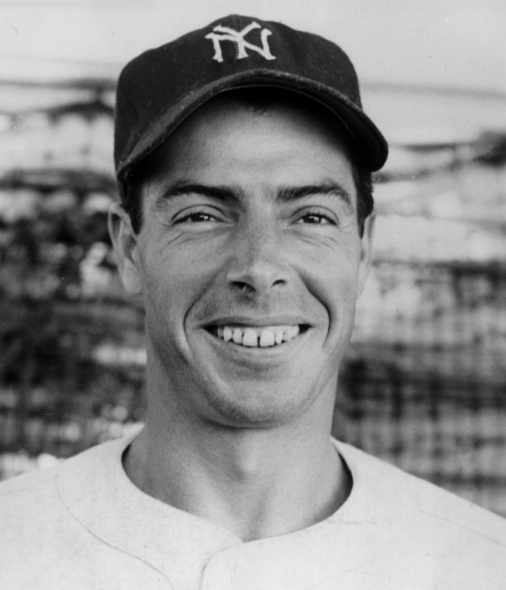
In March 1999, Joe DiMaggio died in Hollywood, Florida with an estate estimated at $50 million. The Yankee Clipper had not played a competitive game in 48 years. Joe DiMaggio net worth at death exceeded his peak annual salary multiplied by his entire 13-season Yankees career, several times over. He earned $100,000 in his best year on the field. He earned that figure every year from Mr. Coffee royalties through the 1980s without playing a single inning. The 56-game hitting streak was a baseball statistic. Mr. Coffee paid him for the cultural artifact. As an entry in the Movie Star Legends cluster, DiMaggio is the case study in symbolic capital hoarded through strategic scarcity. He was the first athlete to treat his own dignity as a financial instrument. He did it without ever appearing to try.
Joe DiMaggio Net Worth at a Glance
| Birth Name | Giuseppe Paolo DiMaggio (born November 25, 1914) |
|---|---|
| Net Worth | Approximately $50 million at death (March 8, 1999); credible peer estimates up to $70 million |
| Primary Income Source | Yankees salary 1936-1951; Mr. Coffee endorsement 1972-1987; Bowery Savings Bank ads; memorabilia and signing fees; Yankee Clipper licensing |
| Career Span | 1932 (Pacific Coast League) to 1999 (active brand stewardship) |
| Key Credits | 56-game hitting streak (1941); 9 World Series rings; 3 AL MVPs (1939, 1941, 1947); Hall of Fame inductee 1955 |
| Notable Achievements | First athlete to monetize retirement dignity at industrial scale; founded the modern celebrity-endorsement template; six red roses at Marilyn Monroe’s crypt three times a week, 1962 to 1982 |
| Residence at Death | Hollywood, Florida (final years); 2150 Beach Street, San Francisco (original family home) |
Before the Money: The Wharf, The Seals, And The First $8,500 Contract
Giuseppe Paolo DiMaggio arrived November 25, 1914 in Martinez, California, the eighth of nine children in a Sicilian immigrant family. His father Giuseppe Sr. crab-fished out of Fisherman’s Wharf in San Francisco. The family moved to North Beach the year Joe was born. His mother Rosalia worked dawn shifts cleaning the boats. The economic basis of childhood was the daily catch and what the wholesalers paid for it. Joe hated the boats. He cleaned tarp on the docks at six. He skipped school by twelve to play sandlot ball at North Beach Playground. Older brother Vince made it to the Pacific Coast League first and got Joe a tryout with the San Francisco Seals in 1932.
DiMaggio hit safely in 61 consecutive games for the Seals in 1933, a Pacific Coast League record. He earned $225 a month and sent most of it home. New York Yankees scouts watched him through 1934 despite a knee injury that scared Detroit and Boston off. Yankees general manager Ed Barrow paid the Seals $25,000 plus five players for DiMaggio’s contract in November 1934. He arrived in New York at 21. The salary on the contract read $8,500 for his rookie season. The wholesalers on the wharf had paid his father less for a year of fishing.
The Yankee Clipper Years: $100K Peak, $7M Lifetime
Nine Rings, Three MVPs, And A Streak That Outearned The Salary
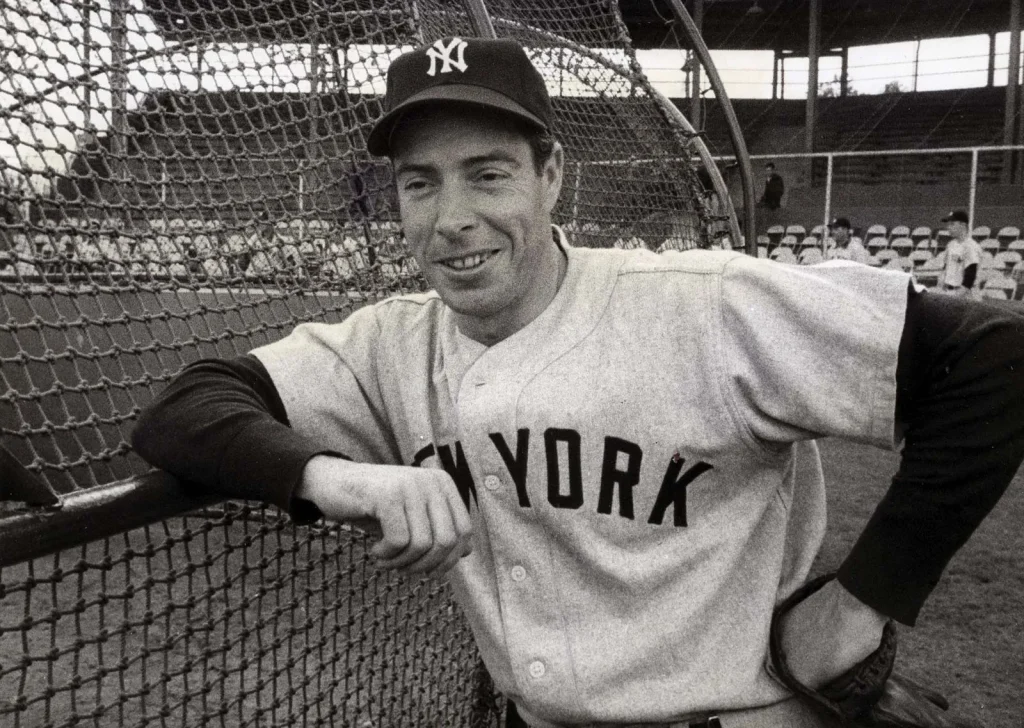
The Yankees signed DiMaggio in 1936 at $8,500 for his rookie year. He hit .323, drove in 125 runs, and led the team to the first of four straight World Series titles. Salary stepped up annually: $15,000 by 1938, $25,000 by 1939, $32,000 by 1941. By 1942 DiMaggio held out for $43,000 and won. Owners hated him for it. Fans loved him for it. The holdouts were the first public sign that DiMaggio understood his market value better than the team did.
The 56-game hitting streak ran from May 15 to July 16, 1941. He hit safely in every single game across two months. No player has come within ten games of the record in the eighty-four years since. The streak gave DiMaggio a cultural identity beyond the box score. He was no longer just a great hitter. He was a national event the country watched in the newspaper every morning before going to work. Les Brown and his Band of Renown recorded “Joltin’ Joe DiMaggio” while the streak was still active. The song peaked at number 12 on the Billboard chart.
Military service consumed 1943, 1944, and 1945. DiMaggio enlisted in the Army Air Forces and lost three peak seasons to physical-training assignments stateside. He returned in 1946 and posted three more strong years before his body began to fail. Peak salary hit $100,000 in 1949, equivalent to roughly $1.3 million today. He played his final season in 1951 at age 36 with a torn heel and a partial Achilles. Lifetime Yankees salary across thirteen active seasons totaled approximately $700,000, roughly $7.5 million adjusted. The endorsement era would pay him more than that across the next thirty years without ever leaving the house.
The Wilderness Years: Marilyn, The Crypt, And The Pause Between Careers
$0 Income From Baseball, $250K In Roses At Westwood Memorial
DiMaggio retired in December 1951 at 36 with a torn heel, partial Achilles, and the most-photographed retirement in sports history. He had no degree, no broadcasting deal, no obvious second act. The Yankees offered him a coaching job. He refused. Television beckoned with NBC sports gigs. He took a few and quit fast. The 1952 and 1953 seasons passed in a kind of high-profile drift. Events, models, and a man trying to figure out what to do with a life that had peaked at 36.
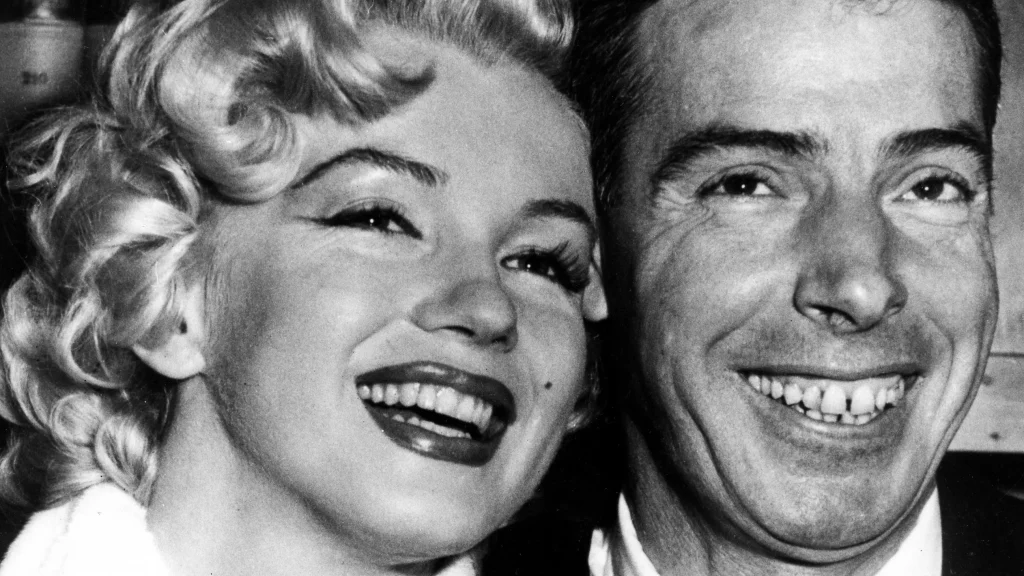
He met Marilyn Monroe on a blind date arranged by a journalist in March 1952. They married at San Francisco City Hall on January 14, 1954. The marriage lasted 274 days. Monroe filed for divorce on October 5, 1954, citing mental cruelty. DiMaggio had wanted her to stop working. Monroe had wanted her career. The marriage failed on terms that defined the next decade of American gender politics. They remained close until Monroe’s death.
Monroe died on August 5, 1962. DiMaggio took control of the funeral and arranged a small private service at Westwood Village Memorial Park. He blamed the studio system, the press, and the Kennedys for her death. He never spoke publicly about her again. From 1962 to 1982 he had six red roses delivered to her crypt three times a week. The arrangement cost roughly $250,000 across twenty years. The gesture generated more cultural mileage than any endorsement deal he ever signed. JFK got a song and a presidential affair. DiMaggio got the roses and the grief. America chose its side.
The Mr. Coffee Era: $3.5M From A Coffee Maker
How Strategic Scarcity Became The Endorsement Playbook
The Mr. Coffee endorsement deal landed in 1972. DiMaggio had been quietly accepting bank ad work for years through the Bowery Savings Bank campaign on Manhattan television. Mr. Coffee was different. Cleveland-based North American Systems had launched the first automatic drip coffee maker the prior year. The company needed national brand authority for a category that did not exist yet. DiMaggio negotiated through his agent Bill Phillips. The terms: $50,000 per year base, escalating above $200,000 by the late 1970s, plus per-appearance fees. Total payout across 15 years totaled an estimated $3 to 4 million, roughly $15 million adjusted.
The endorsement worked because DiMaggio refused to do what every other retired athlete did. He would not sign baseballs for under $150 a piece at a time when most peers signed for $20. The contract with Mr. Coffee included a clause that he be introduced last at every event and only by the phrase “the greatest living ballplayer.” Talk shows were avoided. Monroe stories were refused. Rumors and affairs were neither confirmed nor denied. The brand strategy was scarcity. The product was the man himself withdrawn from public consumption.
Mr. Coffee sales reached an estimated $200 million per year by 1979 with DiMaggio as the face of the company. The Yankee Clipper trademark migrated from a baseball nickname into a registered intellectual property. DiMaggio sued unauthorized memorabilia dealers throughout the 1980s. He won most cases. The legal posture sent a market signal: signatures were worth what he said they were worth, and the price moved only one direction. Supreme would build a billion-dollar streetwear brand on the same principle thirty years later. DiMaggio invented the playbook.
The Memorabilia Empire And The Estate
$150 An Autograph, $50M Estate, And The Posthumous Brand
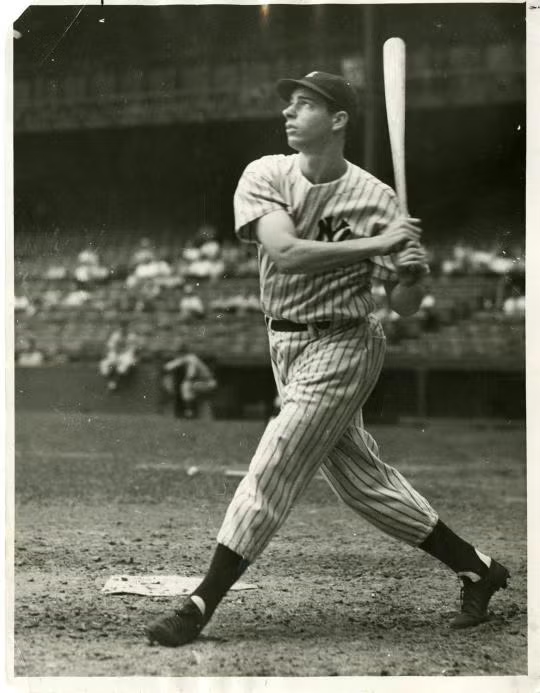
The 1990s converted DiMaggio’s brand discipline into pure cash. He charged $150 for an autograph by 1990. Most peer Hall of Famers signed for $20. Bid prices for signed memorabilia at Sotheby’s and Christie’s climbed steadily through the decade. A signed bat from the 56-game streak era could move for $30,000. DiMaggio appeared at maybe two card-show signings per year. He kept the supply tight. The market priced accordingly. Each authenticated signature became a small certificate of cultural legitimacy.
He retreated to a private home in Hollywood, Florida in his last years. Licensing ran through his attorney Morris Engelberg. The Yankee Clipper trademark generated steady revenue across baseball memorabilia categories. DiMaggio sat for a few interviews, signed a few endorsement deals (Bowery Savings continued, plus minor licensing through Topps), and stayed otherwise invisible. Cancer was diagnosed in 1998. He died March 8, 1999 at 84 in Hollywood, Florida.
The estate inventory put the figure at approximately $50 million. Credible peer estimates run as high as $70 million when image-rights assets are factored. Engelberg managed the executor responsibilities through complicated litigation with DiMaggio’s grandchildren over the next decade. Compare the outcome to Mickey Mantle, who died in 1995 with an estate of approximately $30 million after years of alcoholism damaged his commercial value. Ted Williams had his body frozen at Alcor Life Extension by his children, a tabloid spectacle that vaporized his memorabilia value. DiMaggio’s estate held its value because the brand held its dignity.
How Joe DiMaggio’s $50M Estate Compounds On Scarcity
The estate at death ran $50 million, conservatively. The figure understates the underlying asset. DiMaggio earned roughly $700,000 across thirteen Yankees seasons. Mr. Coffee paid him an estimated $3 to 4 million across fifteen years of endorsement. Bowery Savings paid in the high six figures across two decades of television campaigns. Card show appearances generated a few hundred thousand per year at peak. Real estate in San Francisco and Florida appreciated steadily. Combined economic capital across the career exceeded $20 million in earned income, roughly $80 million inflation-adjusted. He spent very little.
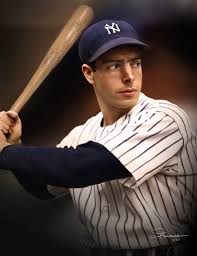
The brand asset compounds posthumously through the Yankee Clipper trademark, MLB image-rights licensing, and ongoing Mr. Coffee historical campaigns. The estate generates an estimated $1 to 2 million annually in residual revenue. Compare to the Monroe estate at $13 million per year, or the Hepburn estate at $8 to 10 million. DiMaggio’s posthumous brand earns less than the Hollywood cases but compounds reliably and quietly. Licensors and trademark holders captured value. The Engelberg-led estate has retained majority control. The man himself is not famous in 2026 in the way Monroe is. Dignity was the strategy that made him valuable in 1972. The attention economy now favors extractable images. His Hollywood peers, with looser brand controls in life, generate more posthumous traffic.
Where Joe DiMaggio’s Money Stands Now
The DiMaggio estate operates through Yankee Clipper Enterprises. Licensing runs across MLB Properties, Topps, and a handful of memorabilia authentication networks. PSA/DNA authenticates DiMaggio signatures at $40 to $60 per item. Forgeries circulate broadly given the asset’s price discipline. The estate pursues a steady litigation strategy against unauthorized merchandise. The posture is the same one DiMaggio took personally during his lifetime. Annual residual income to the estate runs an estimated $1 to 2 million. Hollywood-class estates dwarf the figure but it remains solid for an athlete whose career ended in 1951.
The Movie Star Legends cluster places DiMaggio at the intersection of sports and entertainment money. He sits inside the hub because his fame ran on the same symbolic-capital grid as Hollywood. The cross-cluster bridge to a future Sports Money cluster runs through DiMaggio. His $150 autograph standard scaled into Michael Jordan’s $3 billion brand by the 2020s. JFK represented one form of borrowed Monroe glamour. DiMaggio represented the other. The country chose DiMaggio’s quieter version. The estate continues to earn on that choice three decades after his death. Modern athlete brand operators study the DiMaggio template even when they do not name it. LeBron James, Roger Federer, and Tom Brady all run versions of the strategic-scarcity playbook. The Yankee Clipper was the first to write it down through his actions.
Joe DiMaggio Net Worth FAQ
What was Joe DiMaggio’s net worth at death?
Joe DiMaggio net worth at death on March 8, 1999 totaled approximately $50 million. Credible estimates run as high as $70 million when image-rights and trademark assets are included. The figure compounded slowly across a career that earned roughly $700,000 in Yankees salary. Mr. Coffee endorsements added an estimated $3 to 4 million across the 1970s and 1980s. Decades of disciplined memorabilia pricing added the rest. DiMaggio earned more in retirement than he earned playing baseball.
How much did Joe DiMaggio earn from Mr. Coffee?
DiMaggio’s Mr. Coffee endorsement deal ran from 1972 to 1987. The contract paid an estimated $3 to 4 million across fifteen years, equivalent to roughly $15 million in 2026 dollars. Terms started at $50,000 per year and escalated above $200,000 by the late 1970s. Mr. Coffee sales reached approximately $200 million per year by 1979 with DiMaggio as the brand’s national authority figure.
How long were Joe DiMaggio and Marilyn Monroe married?
Joe DiMaggio and Marilyn Monroe married on January 14, 1954 at San Francisco City Hall. They divorced 274 days later on October 27, 1954. The marriage failed because DiMaggio wanted Monroe to retire from acting. Monroe refused to leave the work. They remained close until her death in 1962. DiMaggio arranged her funeral and sent six red roses to her crypt three times a week for twenty years.
What was Joe DiMaggio’s lifetime Yankees salary?
DiMaggio earned approximately $700,000 across thirteen active seasons with the New York Yankees from 1936 to 1951. His peak salary hit $100,000 in 1949, equivalent to roughly $1.3 million in 2026 dollars. He held out for raises in 1942 and won. Military service in 1943, 1944, and 1945 reduced his career earnings during three peak years he otherwise would have played.
Where The Conversation Continues
Social Life Magazine covers the intersection of wealth, culture, and influence from the Hamptons to Manhattan. Our celebrity net worth coverage traces the economics, the leverage, and the decisions that built the fortune.
Our readers are family office principals, exit founders, fashion executives, and the advisors who serve them. For premium editorial placement and integrated advertising across print and digital, submit a paid feature or contact our business development team.
Want insider access to the events, launches, and gatherings that define the Hamptons social calendar? Sign up for Event Invites & Specials and never miss a moment.
Social Life Magazine. Twenty-three years of covering the people and places that define luxury in America.
Author

Written by
Recent Posts
Legal Options for Investment Fraud Claims

How Custom DTF Printing Adds Ease and Color to Your Boutique
How Often Should You Actually Replace Your Towels?
Apartment Pet Policies: What to Know as a Pet-Owning Tenant
Why Reliable Airport Transportation Matters for Modern Travelers
Categories
- Art
- Articles
- Business of Luxury
- Celebrities
- Culture
- Entertainment
- Events
- Faces of Summer 2026
- Fashion
- Fashion & Style
- Featured
- Finance
- Food, Spirits, Wine
- Hamptons
- Hamptons Celebrities
- Health
- Health & Beauty
- Lifestyle
- Luxury Lifestyle
- Press
- Profiles
- Real Estate
- Technology
- The Chronicles
- Travel
- Uncategorized
- Weddings