
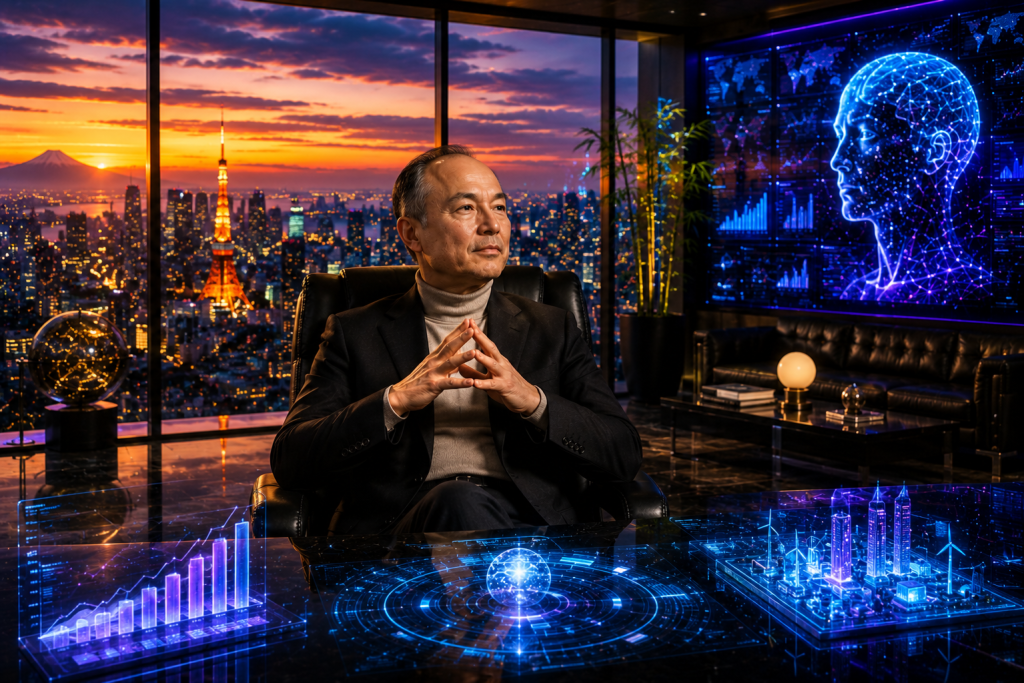
Masayoshi Son Net Worth 2026: The $69 Billion Comeback Through AI
Masayoshi Son net worth 2026 stands at approximately $69.4 billion according to Forbes, making him Japan’s richest person and the 27th wealthiest in the world. That number represents the most dramatic financial resurrection in modern technology: from briefly being the world’s richest person during the dot-com bubble, to losing over $70 billion when it burst, to rebuilding through telecommunications, to nearly destroying his credibility with the Vision Fund’s WeWork disaster, to pivoting everything into artificial intelligence and emerging with a fortune larger than at any point in his career. Son is the Cautionary Tale in the AI billionaires narrative, not because he lost, but because he lost, survived, and came back richer than before.
The Vision Fund Era: $70 Billion in Lessons
Son raised the SoftBank Vision Fund in 2017, a $98.6 billion vehicle backed primarily by Saudi Arabia’s Public Investment Fund ($45 billion) and SoftBank itself ($28 billion). It was the largest technology investment fund in history. The thesis was bold: identify the companies that would define the next decade and back them at unprecedented scale. The execution was catastrophic. WeWork. Wirecard. Oyo. Billions evaporated in write-downs and collapsed valuations. Son’s personal fortune cratered from over $20 billion to under $3 billion during the worst of it.
Those lessons were expensive in the way that only SoftBank’s lessons can be expensive, which is to say at a scale that makes individual billion-dollar losses feel like rounding errors in a spreadsheet that only Masa himself fully comprehends.
The AI Pivot: $180 Billion War Chest
Son sold everything that was not AI. He divested fully from Alibaba by mid-2024, sold T-Mobile US positions, and liquidated Vision Fund holdings to fund the pivot. SoftBank now deploys a $180 billion war chest focused entirely on artificial intelligence. The investments are staggering in scale: $41 billion into OpenAI (giving SoftBank an approximately 11% stake), $6.5 billion to acquire chipmaker Ampere Computing, $5.375 billion for ABB’s robotics division. SoftBank secured a $40 billion bridge loan in March 2026 to support further AI investment.
The Stargate project, a joint initiative with OpenAI and Oracle, envisions up to $500 billion in AI infrastructure investment across the United States, with Son suggesting expansion to Japan and other countries. Arm Holdings, which SoftBank owns approximately 90% of, has become central to the AI chip strategy. SoftBank’s “Project Izanagi” aims to build a dedicated AI chip operation. SB OpenAI Japan, a joint venture with Sam Altman, brings AI services to Japanese enterprise customers.
See also: Marc Andreessen’s $20 billion AI fund.
The Man Behind the Numbers
Son was born in Japan to a Korean family, a minority status that shaped his entire worldview. “He was brought up pretending to be Japanese,” according to his biographer Lionel Barber. “He’s living a lie. He’s undercover.” At sixteen, he read a business book by Den Fujita, who brought McDonald’s to Japan, and made sixty long-distance phone calls to beg for a meeting. That relentlessness, the willingness to call sixty times until someone answers, defines every subsequent decision in his career.
During the dot-com bubble, Son’s paper net worth briefly exceeded $75 billion, making him the wealthiest person on earth for a few weeks in early 2000. The bubble burst. SoftBank’s portfolio collapsed by over 90%. Son rebuilt through telecommunications, acquiring Vodafone Japan and transforming SoftBank into Japan’s third-largest wireless carrier. Then he bought Arm Holdings for $32 billion in 2016 before anyone understood that AI would make chip architecture the most strategically important technology on earth.
The Deeper Read
The Arm Holdings position deserves its own analysis. SoftBank owns approximately 90% of Arm, the chip architecture company whose designs are embedded in virtually every smartphone, tablet, and an increasing number of AI accelerators on earth. At Arm’s current market capitalization exceeding $170 billion, SoftBank’s 90% stake is worth over $155 billion, which means the Arm position alone is worth more than twice Son’s total personal net worth of $69.4 billion. The discrepancy reflects the leverage inherent in SoftBank’s corporate structure: Son controls assets worth multiples of his personal fortune through the holding company, and the holding company’s value depends on the market’s willingness to assign full value to a conglomerate structure that most analysts find difficult to parse. When Arm stock rises, Son’s fortune rises. When Arm stock falls, Son’s fortune falls. The 90% ownership stake is both the engine and the vulnerability of his financial position.
That Insider Angle: When the Gambler Goes All-In
Son’s career is a continuous exercise in scale. The bets are always bigger than anyone expects, and the outcomes are always more extreme than anyone predicts. His SoftBank CFO, asked during an earnings call whether the AI investments represented a bubble, said he could not answer the question. That honesty, or that uncertainty, captures the essence of Son’s position: the most aggressive AI investor on earth, deploying more capital into artificial intelligence than any other individual, with no certainty that the bet will pay off and a personal history that includes both the world’s largest fortune and the world’s largest loss.
For the investor class of the AI economy, Son represents the maximum expression of conviction. Andreessen deploys $20 billion. Khosla deploys $15 billion. Son deploys $180 billion and borrows $40 billion more. The scale is not comparable. The risk is not comparable. And the outcome, whether Son’s AI pivot produces the comeback of the century or the most expensive double-or-nothing bet in financial history, will not be known for years.
The Psychology of Betting at Maximum Scale
There is a type of investor, and the type is so rare that it may consist of a single living practitioner, who does not experience risk the way normal investors experience risk. Normal investors calculate expected returns, adjust for probability, discount future cash flows, and make decisions that optimize for risk-adjusted performance. Son does not do this. Son identifies a thesis, develops a conviction about the thesis, and then deploys capital at the maximum scale the market will absorb, regardless of whether the expected return justifies the position size. Sometimes the thesis is right (Alibaba, where a $20 million investment in 2000 became worth $50 billion) or wrong (WeWork, where an $18.5 billion investment became worth approximately nothing), but the position size is always the same: the maximum possible given the available capital.
The Long Game and the Short Memory
For related coverage, explore Vinod Khosla’s early OpenAI wager.
This approach to capital allocation is not strategy. It is temperament. And the temperament, forged in the specific crucible of being a Korean minority in Japan who pretended to be Japanese, who read a business book at sixteen and made sixty phone calls to meet the author, who built and lost the world’s largest fortune and then built it back, is not replicable by anyone who has not lived the specific psychological arc that produces the willingness to bet $180 billion on a single technology thesis after losing $70 billion on the previous thesis. Son’s critics, of whom there are many and who are frequently correct about the specific investments they criticize, miss the larger point: Son is not optimizing for the accuracy of individual bets. He is optimizing for exposure to the upside of bets that, when they work, produce returns so extreme that they compensate for all the bets that do not work. Alibaba compensated for WeWork. If AI compensates for the Vision Fund’s remaining losses, the strategy, such as it is, will be vindicated. If AI does not compensate, Son will have executed the most expensive double-or-nothing in financial history, and the CFO who could not answer whether this is a bubble will have received his answer.
The Deeper Read
The Stargate project, at $500 billion, is the ultimate expression of this psychology. Half a trillion dollars in AI infrastructure. Five hundred billion. The number is so large that it has the quality of abstraction, like a distance measured in light-years rather than miles. Nobody can visualize $500 billion. Nobody can map $500 billion against their personal experience of what money means. The number exists at a scale where it stops being economics and starts being geology: a tectonic force reshaping the landscape through sheer mass rather than strategic precision. Son is not investing $500 billion because the risk-adjusted return justifies the allocation. He is investing $500 billion because he believes AI is the most important technology in human history, and when you believe something is the most important thing in human history, the correct position size is everything you can get your hands on plus everything you can borrow.
Where the Conversation Continues
You are reading this because the scale of capital flowing into AI is not theoretical. It is $69.4 billion in one man’s fortune, $180 billion in one firm’s war chest, and $500 billion in one infrastructure project.
If your brand, property, event, or company belongs in this conversation, reach us through our contact page. For premium editorial visibility, explore our paid feature submission process. Subscribe at sociallifemagazine.com/enflyer. Polo Hamptons returns July 18 and 25 at 900 Lumber Lane, Bridgehampton. BMW is the title sponsor. Details at polohamptons.com. Subscribe at sociallifemagazine.com/subscription.
Author

Written by
Recent Posts

AI for personal finance: where PennyGuard fits
How to Pick a Homecoming Dress for Your Body Type (and Feel Amazing in It)

World Cup Injury Attorney for Vancouver Events
What a 3-Carat Engagement Ring Actually Costs in 2026: The Real Numbers
The Skincare Habits That Make a Real Difference Over Time
Categories
- Art
- Articles
- Business of Luxury
- Celebrities
- Culture
- Entertainment
- Events
- Faces of Summer 2026
- Fashion
- Fashion & Style
- Featured
- Finance
- Food, Spirits, Wine
- Hamptons
- Hamptons Celebrities
- Health
- Health & Beauty
- Lifestyle
- Luxury Lifestyle
- Press
- Profiles
- Real Estate
- Technology
- The Chronicles
- Travel
- Uncategorized
- Weddings