
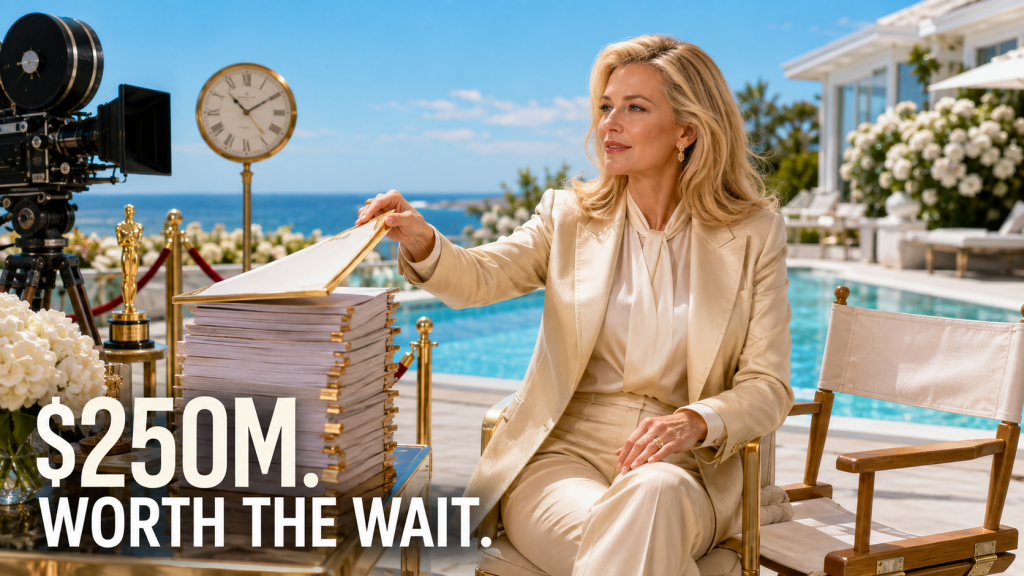
On March 14, 2026, Paramount+ dropped three episodes of The Madison. Overnight, the Michelle Pfeiffer net worth conversation changed shape. Celebrity Net Worth pegs her fortune at $250 million, a figure shared with her husband, television super-producer David E. Kelley. Yet the number is less interesting than the method behind it. Pfeiffer spent two decades rationing herself, saying no to almost everything, and Taylor Sheridan just paid retail for the scarcity. Television was once a demotion for movie stars. Now it is the exit window, and she timed hers perfectly.
What Is Michelle Pfeiffer’s Net Worth in 2026?
Celebrity Net Worth places the Michelle Pfeiffer net worth figure at $250 million, and the fine print matters. That total is a combined household number with Kelley. He built Ally McBeal, The Practice, and Big Little Lies. In other words, one house holds two separate television fortunes, assembled thirty years apart.
Kelley printed money in the network era, when a hit procedural ran nine seasons and syndication paid forever. Pfeiffer is collecting in the streaming era, when prestige limited series pay movie stars movie rates for six episodes. Together they bracket the entire modern economics of Hollywood, one marriage covering both business models.
Her placement among the Hollywood actor net worth rankings tells its own story. Plenty of her peers worked twice as often for half the pile. Pfeiffer’s ledger rewards restraint, because restraint kept the price high every time she resurfaced. Scarcity is a pricing strategy, and she ran it longer than anyone in her generation.
Before Scarface: The Vons Checkout Counter and Miss Orange County
The origin is aggressively unglamorous. Born in Santa Ana in 1958, Pfeiffer rang groceries at a Vons supermarket and trained for court stenography. In 1978 she entered the Miss Orange County pageant. She won, picked up an agent, and started booking commercials. Grease 2 arrived in 1982 and flopped so hard it nearly ended her before she began.
Then came Scarface. Brian De Palma cast her as Elvira Hancock in 1983 over the studio’s objections, and the paycheck was reportedly modest. But the role paid in a different currency. Elvira became permanent cultural collateral, the platinum bob and the backless dress quoted by four decades of rappers and Halloween parties.
Every hip-hop video that referenced Scarface was, in effect, unpaid marketing for her brand. By the time the checks got big, the myth had already compounded. That is the quiet lesson threaded through her whole balance sheet: the roles that paid least built the equity that priced everything after.
The 90s A-List Run: What Michelle Pfeiffer Earned Per Film
The documented salary history reads like a staircase. Celebrity Net Worth lists $3 million for 1991’s Frankie and Johnny, then $3 million more for Batman Returns. Dangerous Minds brought $6 million in 1995. The climb topped out at $12 million for The Deep End of the Ocean in 1999, her reported career high. What Lies Beneath paid $10 million the following year.
Those five checks alone total $34 million, and they sit on top of the run that made them possible. Dangerous Liaisons, The Fabulous Baker Boys, and Love Field delivered three Oscar nominations in four years. Studio heads in that window treated her as the default answer to any script with a complicated woman in it.
The Catwoman Premium
Batman Returns deserves its own line item. Pfeiffer was sewn into the vinyl catsuit each day and performed her own whip work. Then she turned a comic-book sidekick into the most quoted screen performance of 1992. The $3 million fee looks small now, especially against modern franchise math. Still, Catwoman did for her forties what Elvira did for her twenties, minting iconography that studios would pay to borrow decades later. Icon status is the asset that never needs refinancing.
The Semi-Retirement: Two Decades of Priced Scarcity
Here is where the wealth psychology gets interesting. After White Oleander in 2002, Pfeiffer essentially left the market to raise her two children with Kelley. She surfaced briefly in 2007 for Stardust and Hairspray, then went quiet again for most of a decade. Hollywood kept calling, and she mostly kept declining.
The refusals were legendary before the retirement even started. She reportedly passed on Clarice Starling in The Silence of the Lambs, then on Pretty Woman and Basic Instinct. Three franchises’ worth of fees stayed on the table. An accountant would call that lost income. A brand manager would call it inventory control.
Because she never flooded the market, the market never marked her down. Aging actresses who worked constantly through the 2000s watched their quotes erode with every direct-to-cable thriller. Pfeiffer’s quote simply went dormant, preserved like the pageant sash in a drawer, waiting for a buyer who valued rarity. Sheridan, as it turned out, values almost nothing else.
The David E. Kelley Merger
The 1993 marriage deserves its own line in the ledger, because it changed her risk profile. Kelley was network television’s most bankable creator, with Picket Fences and Chicago Hope already on the air. His syndication money kept compounding while she stepped back. As a result, Pfeiffer never faced the pressure that pushes aging stars into bad paydays. She could refuse work indefinitely, since the household had a second engine running. Diversification made the scarcity strategy affordable in the first place.
Marvel Money: The Janet van Dyne Annuity
The comeback was staged in careful increments. First came mother! and Murder on the Orient Express in 2017, prestige assignments that reintroduced the face. Then Marvel called. She took Janet van Dyne in Ant-Man and the Wasp in 2018 and returned for Quantumania in 2023. That sequel grossed a reported $476 million worldwide.
Marvel keeps its salaries sealed, so her fee stays undisclosed. Franchise veterans in her tier reliably command seven figures plus back-end sweeteners. The strategic value ran deeper than the check, though. A Marvel credit certified her bankability to a generation of executives who were in grade school during The Fabulous Baker Boys. In effect, Disney paid her to update her own comps.
Franchise work also behaves like an annuity rather than a wage. Ant-Man and the Wasp grossed a reported $622 million worldwide in 2018, and sequels tend to trigger escalators. Two Marvel appearances in five years kept her quote current without costing her the scarcity premium. That balance, rare and precise, is the whole game.
Henry Rose: The Founder-Equity Subplot
While the acting quote sat in cold storage, Pfeiffer built something rarer: a company she actually owns. In April 2019 she launched Henry Rose, a fragrance house named for her children. She had spent years, she told Forbes, hunting a perfume that disclosed every ingredient.
She self-funded the launch, an almost unheard-of move in celebrity beauty. Stars typically license their name for a royalty and walk away. By contrast, Henry Rose became the first fine fragrance brand certified by both the Environmental Working Group and Cradle to Cradle. Competitors still have not crossed that compliance moat.
Then, in May 2023, the company closed a Series A led by Sandbridge Capital. That firm backed Rothy’s and Youth to the People. Terms were undisclosed, but the structure is the story. Founder equity converts fame into an asset that appreciates while she sleeps. A per-picture fee can never perform that trick. The celebrity fragrance graveyard is full of licensing deals. Ownership is the old-money move.
Why the Wellness Aisle Wanted Her
Timing did half the work. Henry Rose arrived just as the ingredient-literate customer, the one who reads an INCI list like a term sheet, became the fragrance industry’s growth segment. Certification became the status signal, because anyone can buy a celebrity name but almost nobody clears an EWG audit. Pfeiffer’s brand equity, four decades of never overexposing herself, mapped perfectly onto a category built on restraint. A trust-based product needed a trust-rich founder, and she had been compounding trust since 1983.
The Madison: Taylor Sheridan’s Prestige-TV Liquidity Event
Which brings the ledger to Montana. The Madison premiered March 14, 2026 on Paramount+, dropping three episodes at once and the final three the following Saturday. Pfeiffer stars as Stacy Clyburn, a New York City matriarch moving her grieving family to the Madison River valley. Kurt Russell plays her husband Preston, with Matthew Fox, Patrick J. Adams, and Will Arnett in support.
It is her first television series lead ever, four decades into the career. The show slots her into the Taylor Sheridan Universe, the one-man studio behind television’s biggest wealth-transfer machine. That machine runs on Taylor Sheridan’s $200 million fortune and a reported $1 billion-plus NBCUniversal deal.
Her episode fee is unreported, so treat any number floating around as gossip. But the comps are public. Sheridan shows made the Yellowstone cast’s combined $350 million possible. Harrison Ford and Helen Mirren reportedly cleared seven figures per episode on 1923. For the full ensemble breakdown, The Madison cast’s payday ledger runs the numbers name by name.
Why Sheridan Pays Retail for Scarcity
Sheridan casts movie stars the way collectors buy blue-chip art: the rarer the signature, the higher the premium. Pfeiffer arrives with twenty years of accumulated scarcity, so her signature costs more than any working actress who never left. Russell ran a parallel play, and Kurt Russell’s net worth story shows the same late-career conversion happening one trailer over. In particular, both prove the new rule: the streaming era pays for absence, not output. She priced the drought, and he is writing the check.
How the Pfeiffer Fortune Stacks Up Against Sheridan’s Other Stars
Context sharpens the number. Kevin Costner banked six seasons of Yellowstone paychecks, a reported seven-figure episode fee near the end, on the way to Kevin Costner’s $250 million pile. Pfeiffer matches him at a reported $250 million while working a fraction of his hours. Kelly Reilly sits near $20 million and Cole Hauser near $10 million, solid television money but a different weight class.
Nicole Kidman is next through the Sheridan door, and Sylvester Stallone already collects on Tulsa King. In fact, the pattern holds across every show. Sheridan pays movie-star rates precisely because the streaming wars made prestige faces the scarcest commodity in television. Pfeiffer is simply the purest case, since her scarcity was deliberate rather than circumstantial.
Real Estate: The Quiet Side of the Pfeiffer-Kelley Ledger
The property file reads like a couple that treats houses as a rotating portfolio, not a flex. In British Columbia they assembled a 340-acre coastal estate, listed for $28 million in 2017. Down in Woodside, California, they bought 8.7 acres across two parcels for $20.6 million. The exit came in 2020 at $22 million, a tidy trade in a soft window.
That same February they paid $22.25 million for an estate in Pacific Palisades, adding to holdings acquired there since 2016. Notably, there is no Aspen trophy, no Tribeca penthouse with a publicist-approved photo spread. The portfolio behaves like the career: enter quietly, hold patiently, sell only when the price clears. Real estate is simply the Michelle Pfeiffer net worth strategy expressed in acreage.
Michelle Pfeiffer’s Net Worth: The Short Ledger
Strip the story down and the architecture shows. Reported net worth: $250 million, held jointly with Kelley. Documented film salaries climb from $3 million on Batman Returns to $12 million on The Deep End of the Ocean. Add a Marvel franchise stipend, a Series A-backed fragrance company, and roughly $70 million in tracked real estate positions.
Now add The Madison, her first series lead, inside television’s most generous payroll. Every line follows the same rule. She sold rarely, so she sold high. Most Hollywood fortunes are built on volume. Hers is built on refusal, and refusal turned out to be the better business.
Where The Conversation Continues
The people who understood Pfeiffer’s math early tend to end up in the same rooms each summer. The patient-money crowd knows scarcity is the only moat left. Social Life Magazine’s print issue reaches the Hamptons houses where these ledgers get discussed over rosé. Polo Hamptons in Bridgehampton is where the discussion happens in person, ponies and all. Our running celebrity net worth rankings for 2026 track who converts fame into fortune with Pfeiffer’s discipline, and who is still selling volume. The July issue will name names. Being in the room when it lands is, of course, the whole point.
Author

Written by
Recent Posts

Von Dutch, Women’s Magazine and Reserve Jets Celebrate NYFW With Adriatique
Best House Cleaning Services in Alpharetta, GA
The Ultimate Guide to Moving into New York’s Most Exclusive Neighborhoods

Medical Malpractice Cases Chicago: Understanding Your Legal Rights

Legal Rights and Remedies Following Sexual Assault by a Police Officer
Categories
- Art
- Articles
- Business of Luxury
- Celebrities
- Culture
- Entertainment
- Events
- Faces of Summer 2026
- Fashion
- Fashion & Style
- Featured
- Finance
- Food, Spirits, Wine
- Hamptons
- Hamptons Celebrities
- Health
- Health & Beauty
- Lifestyle
- Luxury Lifestyle
- Press
- Profiles
- Real Estate
- Technology
- The Chronicles
- Travel
- Uncategorized
- Weddings