
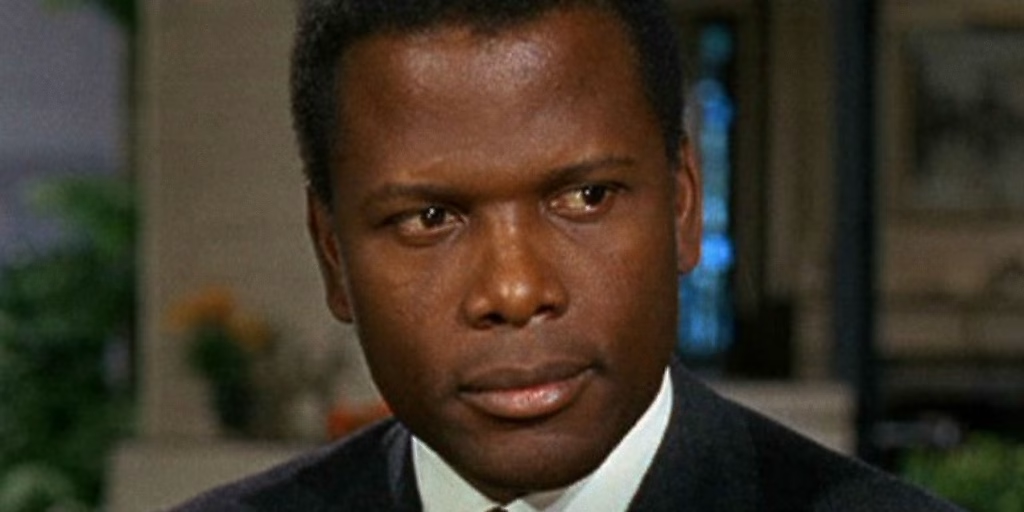
Sidney Poitier net worth stood at approximately $20 million when he died on January 6, 2022 at the age of 94. The figure undersells the asset he actually controlled. Poitier converted a Bahamian tomato farmer’s son into the first Black man to win a Best Actor Oscar, then leveraged that symbolic capital across six decades of films, directing credits, ambassadorships, and an honorary British knighthood that no Hollywood peer had earned. Peer estimates run higher for actors with smaller catalogs and shorter careers. As an entry in the Movie Star Legends cluster, Poitier sits at the founding end of a category his peers entered after him. The dollar figure was never the point. The door was.
Sidney Poitier Net Worth at a Glance
| Full Name | Sir Sidney Poitier, KBE |
|---|---|
| Net Worth | $20 million (at death, January 2022) |
| Primary Income Source | Acting fees, directing salaries, percentage participations, book royalties, diplomatic stipends |
| Career Span | 1950 to 2001 (acting); 1972 to 1990 (directing); ambassador 1997 to 2007 |
| Key Films / Credits | Lilies of the Field, In the Heat of the Night, Guess Who’s Coming to Dinner, To Sir, with Love, The Defiant Ones, Stir Crazy |
| Notable Achievements | First Black Best Actor Oscar (1964), Honorary Oscar (2002), Presidential Medal of Freedom (2009), Honorary British Knighthood (1974), Bahamian Ambassador to Japan (1997 to 2007) |
| Residence | Beverly Hills, California (primary); Stuart, Florida (secondary) |
Before the Money: Cat Island to a Harlem Tar-Paper Roof
Sidney Poitier was born February 20, 1927 in Miami while his Bahamian parents Reginald and Evelyn Poitier were selling tomatoes from their Cat Island farm. The premature birth weighed three pounds. His father bought a small coffin and prepared a funeral. Evelyn refused to bury her son and walked to a soothsayer who predicted the child would travel the world and walk with kings.
The family returned to Cat Island, a strip of British Bahamas without electricity, running water, or paved roads. Young Poitier did not see a mirror until age ten or a car until the family moved to Nassau when he was eleven. At fifteen his father put him on a boat to Miami with three dollars and an aunt’s address. Within a year he had drifted north to New York, washing dishes at a Harlem barbecue restaurant and sleeping on a tar-paper rooftop through the winter of 1943.
The American Negro Theatre on West 127th Street rejected him at his first audition for his Bahamian accent and his inability to read English fluently. Poitier bought a radio for fourteen dollars, mimicked the announcers for six months, and persuaded a Jewish waiter at the restaurant to drill him on pronunciation between shifts. The theatre cast him on his second audition. The accent that opened American doors was manufactured in a dishwasher’s bunk room in 1944. Cultural capital, in Poitier’s case, was learned line by line before any economic capital arrived.
Poitier’s Hollywood Debut Pays $750 and Rewrites the Studio Rulebook (1950 to 1959)
From Blackboard Jungle to The Defiant Ones
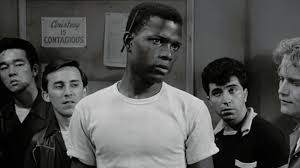
Poitier’s first feature, No Way Out (1950), paid him $750 for three weeks of work. Twentieth Century-Fox cast him as a Black doctor treating a white racist played by Richard Widmark. The script asked the rookie to absorb slurs without retaliating on camera. He absorbed them. Studio bookers had no category for the performance, so they built one.
Cry, the Beloved Country (1951) followed in apartheid-era South Africa, where Poitier had to be smuggled across racial checkpoints under Zoltan Korda’s protection. Blackboard Jungle (1955) cast him opposite Glenn Ford as a high-school rebel with intellect intact. The film grossed $5.2 million on a $1.2 million budget and made Poitier’s face known in every drive-in from Pasadena to Pittsburgh.
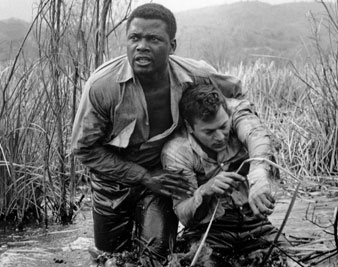
Edge of the City (1957) paired him with John Cassavetes in a longshoreman drama that critics treated as social realism. The Defiant Ones (1958) brought the first Oscar nomination, the first Best Actor nod ever given to a Black man. Poitier and Tony Curtis played chain-gang escapees shackled together. The optics were the entire point of the production. United Artists paid Poitier $75,000, more than his previous five films combined.
By the close of the decade his fee had climbed from $750 to $75,000, a hundredfold escalation that tracked precisely with the cultural capital he was banking one role at a time. Other Black actors of the era worked chorus lines and uncredited bits. Poitier was negotiating with the seven studios on terms reserved for white leading men.
The Oscar, the Number One Box Office Year, and the $200K Paydays (1960 to 1969)
From Lilies of the Field to Guess Who’s Coming to Dinner
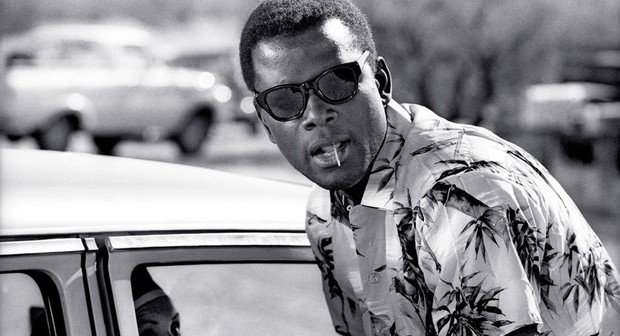
A Raisin in the Sun (1961) brought Poitier back to the role he had originated on Broadway as Walter Lee Younger. Columbia paid $50,000 for the screen version. Two years later Lilies of the Field (1963) earned him the Best Actor Oscar, the first ever awarded to a Black man. The budget was a thin $240,000. Poitier had taken $50,000 plus a participation. The film grossed $7 million on theatrical release. His back-end check ran into six figures, and his quote tripled overnight.
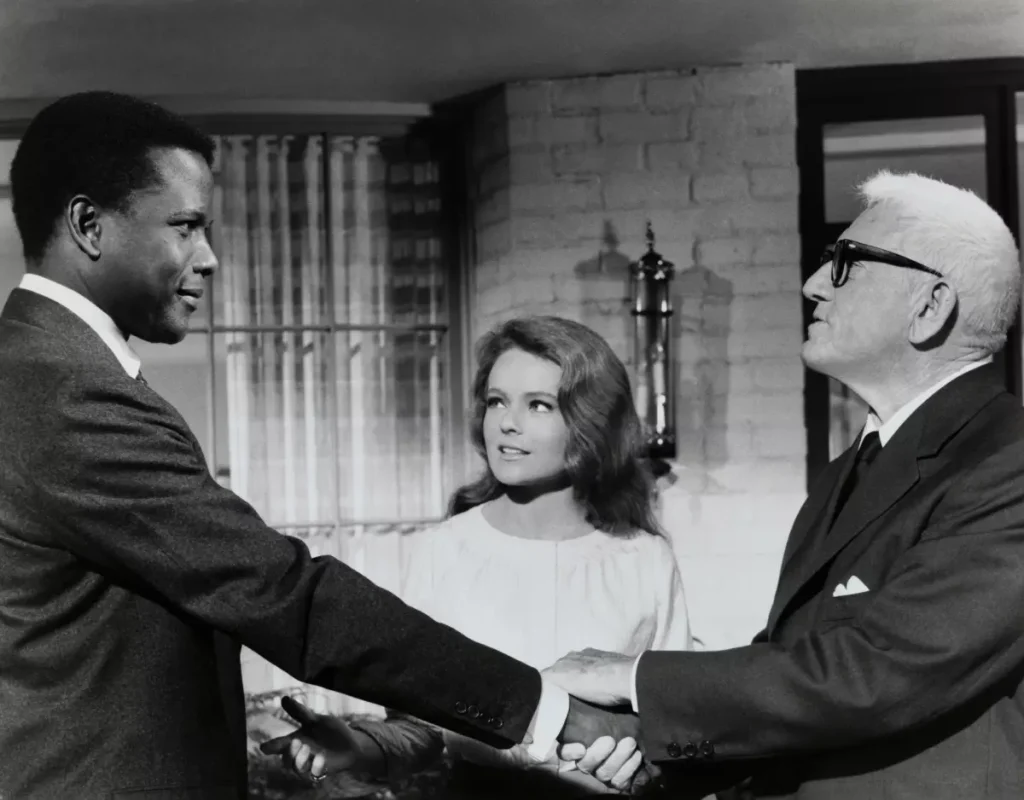
In 1967 Poitier became the top box-office star in the United States, ahead of Paul Newman and Steve McQueen. Three films released within six months drove the number. To Sir, with Love grossed $42 million on a $640,000 budget. In the Heat of the Night won five Oscars including Best Picture. Guess Who’s Coming to Dinner paired him with Spencer Tracy and Katharine Hepburn in a film Tracy completed seventeen days before his death. Each of the three projects paid Poitier upwards of $200,000 plus participation.
By 1968 his per-film fee topped any Black actor in Hollywood history and most of his white peers. The math was unprecedented. The leverage was the Oscar and the box office combined. Critics like Pauline Kael accused him of playing only saints. Poitier read the criticism as the price of building the category. Every contract he signed in the sixties contained morality clauses no white star would have tolerated. Each clause was negotiated down. The decade closed with Poitier holding more leverage in studio rooms than any Black performer had ever held, and more than most would hold for the next forty years.
Poitier Walks Behind the Camera and Banks $40M in Box Office (1970 to 1989)
From Buck and the Preacher to Stir Crazy
The seventies began with Poitier directing his first feature, Buck and the Preacher (1972), a Western co-starring Harry Belafonte. Columbia Pictures had budgeted $2 million for the project. The finished film grossed $4.5 million. For the first time Poitier collected director and star salaries on a single project, a structural advantage he would compound for the rest of the decade.
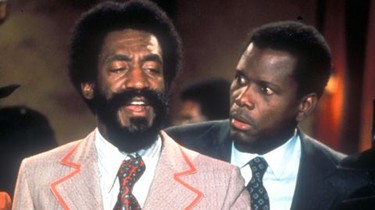
A trilogy with Bill Cosby followed: Uptown Saturday Night (1974), Let’s Do It Again (1975), and A Piece of the Action (1977). The three films grossed a combined $48 million against budgets that never broke $5 million. Studio executives nicknamed the trilogy the Black Ocean’s Eleven and tried to copy the format. None of the copies worked. Poitier and Cosby were directing chemistry the studios could not script.
Stir Crazy (1980), starring Richard Pryor and Gene Wilder under Poitier’s direction, grossed $101 million on a $10 million production budget. The film was the highest-grossing project ever directed by a Black filmmaker until Eddie Murphy‘s Coming to America in 1988. Poitier’s directing fee on Stir Crazy was $750,000. His back-end participation eventually pushed his take past $3 million from that single project.
Hanky Panky (1982) and Ghost Dad (1990) closed the directing run with mixed commercial results, but the financial position by 1989 was already secure. Two decades behind the camera had generated a backlist that paid annual residuals into the seven figures. Poitier’s economic capital by the late eighties no longer depended on his being cast.
The Honorary Oscar, the Knighthood, and the $20M Final Position (1990 to 2022)
Ambassador, Author, Inheritance
Poitier mostly retired from acting in the late eighties but continued cashing honorary checks for the next thirty years. Sneakers (1992) and The Jackal (1997) paid scale-plus-bump fees that totaled under $4 million combined. Real income now came from the back catalog and the ancillary rights on films he had taken percentage points on in the sixties and seventies.
In 1997 the Bahamian government appointed him ambassador to Japan, a post he held until 2007. The role paid modestly but added diplomatic capital to the symbolic stack he had been building since 1963. Queen Elizabeth II granted him an honorary British knighthood in 1974 that he could not use as a formal title because of his American citizenship, but the recognition opened doors his peers could not access. The Academy presented him an honorary Oscar in 2002 with a tribute speech delivered by Denzel Washington, who won Best Actor for Training Day the same night, the second Black man to do so in Academy history. President Barack Obama awarded Poitier the Presidential Medal of Freedom in 2009.
His memoir The Measure of a Man (2000) sold over a million copies and won a Grammy for spoken word. Three subsequent books followed. At his death on January 6, 2022, Poitier’s estate held Beverly Hills real estate valued near $8 million, a smaller residence in Stuart, Florida, royalty streams from a sixty-year catalog, and an annuity portfolio that estate auditors valued at approximately $20 million. The figure was modest by Hollywood standards. Symbolic capital, in his case, had compounded faster than the cash, and the cash had been engineered for stability rather than display.
How Sidney Poitier’s $20M Fortune Breaks Down
Poitier’s $20 million resolved into four predictable buckets at the end. Real estate accounted for roughly $8 million, anchored by the Beverly Hills home he had occupied since 1976 and a Stuart, Florida residence purchased in the late nineties. Royalty streams from his sixties and seventies catalog generated $400,000 to $600,000 annually in his final decade, with Lilies of the Field, In the Heat of the Night, and Stir Crazy carrying the largest participation points. The Measure of a Man and three subsequent books contributed another $200,000 a year in residual rights. Diplomatic stipends, board fees, and selective speaking engagements rounded out the income column.
The expense side ran lower than peer estimates would predict. Poitier did not collect contemporary art, did not race horses, did not operate a vanity foundation that consumed capital faster than it deployed. His widow Joanna Shimkus and six daughters inherited an estate engineered for stability rather than display. Robert De Niro built a hospitality empire. George Clooney built a tequila brand. Poitier built a vault. Each model produced a different number. His was the smallest by an order of magnitude, the most resistant to dilution, and the only one anchored entirely in symbolic capital rather than brand extension. The portfolio his daughters inherited contains no licensing risk, no celebrity-brand exposure, and no operational headcount to absorb in a downturn.
Where Sidney Poitier’s Capital Stands in 2026
Four years after his death the Poitier estate continues to compound quietly. Joanna Shimkus controls the residual income through a trust that benefits the six Poitier daughters from his two marriages. Sydney Tamiia Poitier, the actress, manages the literary rights and licensing requests. The Beverly Hills residence was quietly listed in 2023 at $14 million but withdrawn when the family decided to retain it as a generational asset.
The harder accounting is the cultural one. Poitier did not generate a De Niro-style hospitality dynasty or a Clooney-style production-company empire. What he generated was a precedent. Every Black actor who has signed a major studio contract since 1963 has done so on terms Poitier negotiated first, including Louis Gossett Jr., whose 1983 Best Supporting Actor win extended Poitier’s breakthrough into a second Oscar category. The Movie Star Legends cluster reads Poitier as the founding member of a category his peers entered after him, on doors he had already pried open. Twenty million is the receipt. Robert Redford built Sundance. The receipt for what Poitier built is harder to price and impossible to liquidate. The door is still open in 2026 because Poitier kept his foot in it for sixty years.
Where The Conversation Continues
Social Life Magazine covers the intersection of wealth, culture, and influence from the Hamptons to Manhattan. Our celebrity net worth coverage traces the economics, the leverage, and the decisions that built the fortune.
Our readers are family office principals, exit founders, fashion executives, and the advisors who serve them. For premium editorial placement and integrated advertising across print and digital, submit a paid feature or contact our business development team.
Want insider access to the events, launches, and gatherings that define the Hamptons social calendar? Sign up for Event Invites & Specials and never miss a moment.
Social Life Magazine. Twenty-three years of covering the people and places that define luxury in America.
Sidney Poitier Net Worth FAQ
Author

Written by
Recent Posts

Galina Breslav: From Pension Fund to Executive Presence

Hermès Fake Authenticator: A Monopoly Mistaken for Expertise
A Real Gift: How La Scala Found Its Community in New York Through the Teatro alla Scala Association of America (TASAA)

He Sold His Company, Got Everything He Wanted, but Lost His Purpose

OUT OF LINE
Categories
- Art
- Articles
- Business of Luxury
- Celebrities
- Culture
- Entertainment
- Events
- Faces of Summer 2026
- Fashion
- Fashion & Style
- Featured
- Finance
- Food, Spirits, Wine
- Hamptons
- Hamptons Celebrities
- Health
- Health & Beauty
- Lifestyle
- Luxury Lifestyle
- Press
- Profiles
- Real Estate
- Technology
- The Chronicles
- Travel
- Uncategorized
- Weddings