
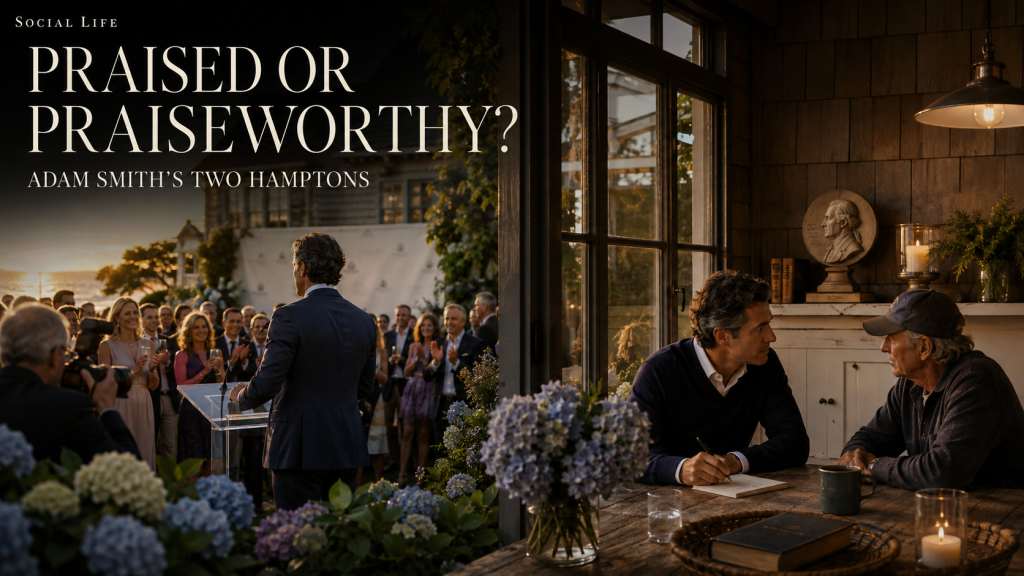
Every August, two people stand ten feet apart at a Water Mill benefit holding the same drink. One of them bought the table. Another wrote a check twice the size, yet stayed home in Sagaponack with a book. Both names print in the program. Still, only one of them gets the call in February. Adam Smith explained the gap in 1759, so the word to watch is praiseworthy.
Call it the Adam Smith praiseworthy problem, because it sorts eight miles of coastline into two economies that share a parking lot. One runs on being seen, and the ledger is public. Meanwhile the other runs on deserving the thing whether anyone looks or not. Both are real, both spend heavily, yet only one compounds.
Smith was not a scold about any of this. In fact he thought the hunger for approval built roads, ports, and most of what we call civilization. Still, he wanted you to know which appetite you were feeding, particularly at nine on a Saturday night.
So here is the practical version. Praise is a market with posted prices, and out here at least the prices are public. Praiseworthiness has no market at all. Indeed that is exactly why it holds its value.
The Sentence Smith Buried in 1759
Although the passage sits in Part III, almost nobody quotes it. Man naturally desires, not only to be loved, but to be lovely, Smith writes. He then restates the claim in the version that travels: we want praise, and we also want to deserve it.
Those two wants feel identical until pressure separates them. Praise is a verdict delivered from outside, so it depends on an audience. Praiseworthiness is a property you either hold or lack. It sits there quietly, even if nobody in the tent ever notices.
Nothing about the distinction is academic. Every guest list is a praise mechanism, while every quiet decision about who to help is the other thing. Both run at once, generally inside the same person.
Smith’s argument is that a healthy person wants both, yet will take the second when forced. Vanity takes the first. Since vanity knows the difference, it never fully enjoys the win.
He revised the book five times over thirty-one years. Rather than softening that passage, he sharpened it, and the 1790 edition added a whole new part on how status corrupts judgment. He treated the appetite as fuel instead of a defect. The longer case for what that fuel actually builds runs through both of his books.
Praise Has a Price List Out Here
Consider the market that at least posts its numbers. A table at a summer benefit runs from fifteen thousand dollars to six figures, depending on the cause. The step-and-repeat is free. So is the tag, though the tag has a price nobody prints.
Praise moves fast because it was designed to. Also, it arrives as an invitation, a seat, a photograph, a line in a column that three people forward. Every piece of it reads at forty feet, which is precisely the point.
The trouble with a priced market is that price is the only barrier. Anyone with a wire can buy the table, so the barrier is not taste. Since the purchase is visible and the motive is invisible, the room fills in the motive on its own.
That inference is the tax. Out here it gets assessed within eleven minutes of the seating chart going up, generally by someone who bought a table herself two summers ago.
None of this makes the buyer a fraud. Smith would say, of course, that the purchase is ordinary and useful, and the money is real money. Yet the buyer wants a second thing the purchase cannot deliver. Call it the belief that the check would have been written with the lights off.
Smith’s Test Still Works at Dinner
He gave a way to tell the appetites apart. In fact praise for something you did not do produces no pleasure, only unease. The applause lands on a person who is not you, so you hear it as noise.
Run the test on any Saturday. If the mention were deleted tomorrow, would the gift still happen? Would the board seat still interest you if the letterhead never printed your name?
Most people answer honestly on the second question, yet flinch on the first. Smith predicted the flinch. Because both appetites live in the same body, the honest answer is a mix. That mix is the entire diagnosis.
Notice what the test does not ask. It never asks whether you enjoy praise. Of course you do, and Smith assumed as much about every reader he had.
Smith built a character to run this audit, an internal observer he called the impartial spectator. He is not your board, your mother, or your comment section, though he borrows their voices. Once installed, he does not leave. The version of him who takes the chair beside you at a benefit deserves separate study.
Why Founders Feel the Gap Fastest
Nobody feels this split more sharply than a founder after an exit. The praise arrives all at once, and it arrives too fast to sort. Invitations, a table, a board approach, a call from a magazine. All of it lands in one summer, and none of it is calibrated.
So the founder does the reasonable thing and accepts. Then a quiet doubt sets in around the second August. He knows the exit involved timing, a co-founder, and a market that moved. Still, the applause is addressed to him alone.
Smith described that exact discomfort. Praise for what you did not do lands on someone else, and you can feel the misdelivery. Because the feeling is unpleasant, most people either dismiss it or drink through it.
The better response costs less than a table. Find one thing you did entirely, and one thing you can do now that nobody will report. Fund both. Ultimately that is the whole method, and it works in any zip code.
The founder who does this stops needing the room to agree. Once that happens, the room generally agrees, which is the joke Smith never quite told.
Two Hamptons, One Guest List
So put the distinction on a map. One Hamptons photographs well. It runs from Memorial Day to Labor Day, and it is loud because loudness is the product. Another Hamptons never appears in a slideshow at all.
The quiet one keeps different hours. Picture a Tuesday in October on Further Lane. Picture a forty-year beach club membership nobody posts about. Also picture a family that has funded the same volunteer ambulance corps since before the building existed.
Both Hamptons attend the same benefit. Both write checks, too, and both names print at the same point size. Yet the two groups read that program differently, since one of them is checking for who is missing.
The sorting happens later. In February, when a committee needs someone to take an unglamorous chair, the calls go to the second group. Nobody announces the rule. Still, everyone who moved out here in the last decade eventually learns it.
Neither group is the villain. The loud Hamptons pays for much of what the quiet Hamptons approves of, particularly the scholarships and the land trusts.
What the Room Is Actually Measuring
Money alone, of course, is not the scoreboard. Everyone in the tent has money, so money has stopped working as information. What the room measures instead is whether your generosity survives the removal of the audience.
That is harder to fake than a table. You can buy the seat in an afternoon. Building a record of showing up when nothing is photographed takes years instead.
Anonymity, of all things, has become a status move out here. A gift listed as anonymous still gets read correctly by the people who matter, because they already know. So the anonymity is not really anonymous, and Smith would have laughed at that.
He was a realist about mixed motives. Nobody acts from one clean impulse in his system, or at least nobody he had met. What he asked was that you keep the internal audit honest, even if the external one is going well.
The measurement runs constantly and nobody publishes results. Ultimately it shows up as a phone call, a seat on a small board, an introduction that would not otherwise have happened.
How Old Money Sequences the Same Move
Old families, generally, solve this with an order of operations. Discretion comes first. The unwritten rules come second, and they get learned by watching rather than asking. The named building comes last, if it comes at all.
That sequence is not modesty. It is a strategy about timing. A gift announced early reads as a purchase, while the same gift announced late reads as a record. In fact both gifts are the same size.
Smith arranged the virtues in a similar order and gave his reason. Prudence protects you. Justice holds a society together, and beneficence, the warm one, is the ornament rather than the foundation. That ranking, applied to the East End calendar, explains more invitations than any broker can.
New money inverts the order. It leads with the gift, because the gift is the fastest legible signal available. Then it waits for a call that never comes. Nobody explains why, since explaining would be rude.
None of this is a conspiracy. Instead it is a different clock, and the clock can be learned in one season by anyone paying attention.
The New Money Version That Actually Works
Here is the part nobody says out loud. The move is not to hide the money. Rather, spend a portion of it where the spending cannot be photographed. Do that before anyone invites you to.
Local works better than global out here. Consider also the Bridgehampton food pantry, the volunteer fire department in Amagansett, or the Sag Harbor school district. Those are the receipts the room reads without anyone asking.
Second rule: give twice before you mention it once. A single gift is an event, while a repeated gift is a character reference. Since character references take time, start the year you buy the house rather than the year you want the seat.
Third rule: take the boring job. Committees need someone to handle insurance, permits, and the tent vendor, and nobody wants that chair. Whoever takes it is remembered for a decade, especially by the families who have been doing it since the seventies.
A private bank’s philanthropy desk will tell you the same thing in a nicer font. So will any trust and estate lawyer who has watched three generations of this. Ultimately the advice is Smith’s, given in 1759 and repriced for the East End.
In Defense of the Man Who Bought the Table
But the argument has a limit. The table buyer funds things. His fifty thousand dollars pays for scholarships that admiration does not pay for. The students, at least, do not care about his motive.
Smith saw this clearly, so he never told anyone to stop wanting praise. The desire to be admired also builds hospitals, endows chairs, and fills tents. Vanity, in his account, is a public utility with terrible manners.
He did want you to see the bill, though. The same instinct that funds the scholarship also teaches a society to admire wealth and overlook everyone without it. Smith called that the great corrupter of our moral judgment, and he meant it as description rather than sermon.
So the honest position is not purity. It is awareness, which costs nothing and changes almost everything about how the season feels from the inside.
Anyone can hold both ideas at once. Buy the table, enjoy the photograph, and still write the second check nobody will hear about. Smith would call that a well-run interior.
Where The Conversation Continues
Social Life Magazine reaches 25,000 print readers each summer and 82,000 email subscribers year round. Notably, that list overlaps almost entirely with the people who decide which names get read twice.
For a private bank, a philanthropy advisory, or a heritage jeweler, this is the useful part. Your buyer is not shopping for a product. He is shopping instead for a way to be praiseworthy in a room that already knows the number.
That is not an ad buy. Rather, it is a position inside a story the East End is already telling itself. The July issue, the Polo Hamptons lawn, and the Sag Harbor guest house are three doors into one room.
All three are finite, and so is the number of brands that can credibly claim this ground. Once a category is taken for a season, it is taken. The alternative is reading about a competitor in the issue you passed on, which is a specific kind of July.
Partnerships for the 2027 season are open now, and they generally close before the invitations print. That conversation starts quietly, which Smith would have appreciated.
Author

Written by
Recent Posts

The New York Women’s Foundation’s 2026 Neighborhood Dinner

Marco Maranghello

The Baker House 1650
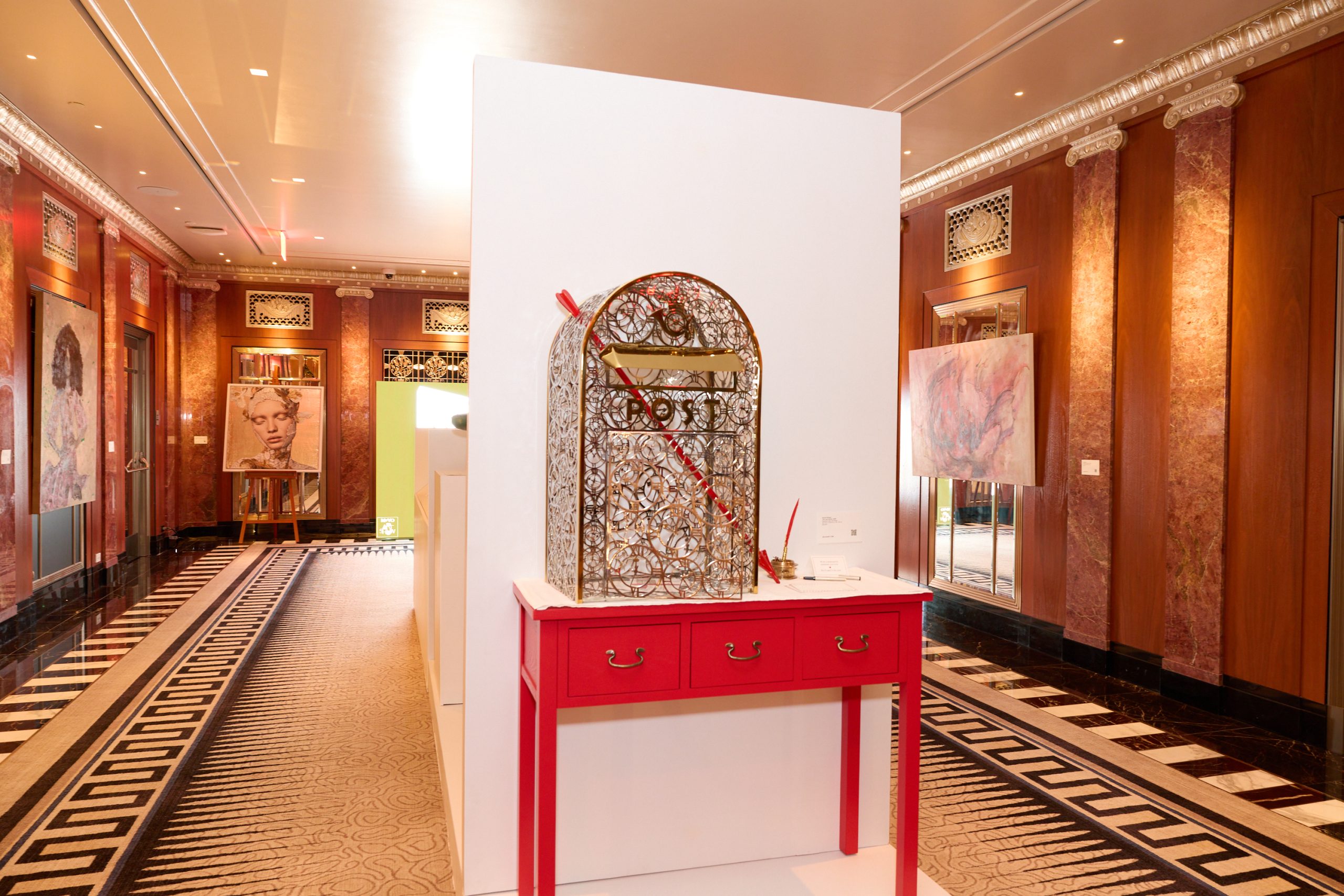
MvVO ART Show

Casita Maria Center for Arts and Education
Categories
- Art
- Articles
- Business of Luxury
- Celebrities
- Culture
- Entertainment
- Events
- Faces of Summer 2026
- Fashion
- Fashion & Style
- Featured
- Finance
- Food, Spirits, Wine
- Hamptons
- Hamptons Celebrities
- Health
- Health & Beauty
- Lifestyle
- Luxury Lifestyle
- Press
- Profiles
- Real Estate
- Technology
- The Chronicles
- Travel
- Uncategorized
- Weddings