
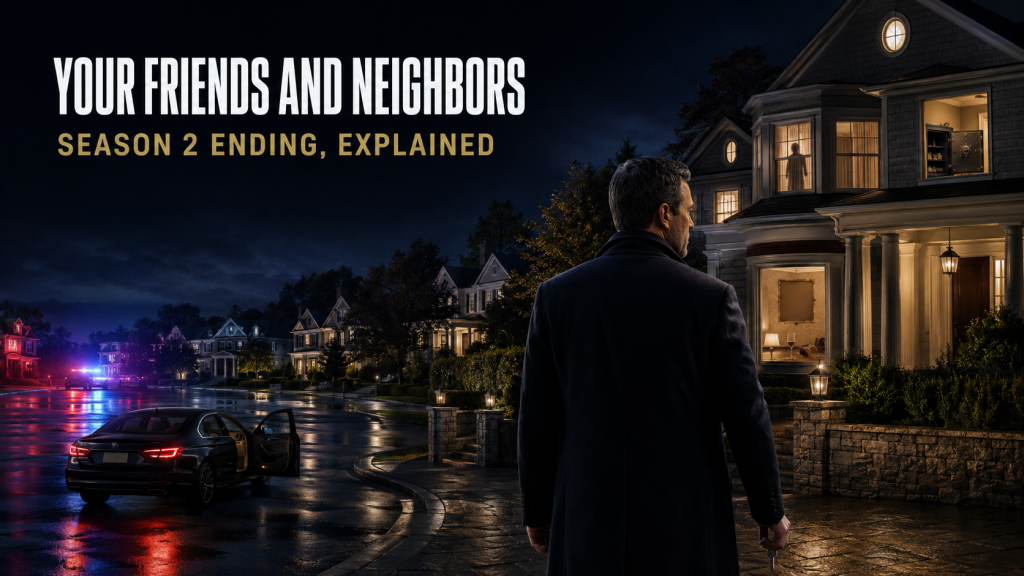
The Your Friends and Neighbors season 2 ending puts a billionaire at the bottom of a lake and a fishing rod in the final shot. Apple has never been subtle about wanting a season three.
SPOILER WARNING. This piece discusses the entire second season, including who dies and how the finale ends. Stop here if you are still working through it.
Season two ran ten episodes, from April 3 through June 5, 2026. Jonathan Tropper created the show and runs it, and he spent the year building toward a death that almost nobody predicted correctly. The man who dies is not the one the season kept threatening.
Here is what happened, who is holding what, and why the last thirty seconds matter more than the previous ninety minutes.
How Owen Ashe Actually Died
James Marsden’s billionaire spends the season as the most entertaining problem in Westmont. He arrives loud, hosts constantly, and pulls every man on the block into business he should have stayed out of.
The break comes in episode nine, “Propaganda from the Cowardly.” Coop tells Ashe that he returned the laundered money to Jack, which is not information Ashe receives well.
What follows is not a murder. Ashe, deep into a ketamine night, threatens the families of the men in his house, produces a gun, and fires. Coop, Barney and Nick run. Ashe chases them across his own floor, loses his footing, and cracks his skull on the marble.
So the richest man in the neighborhood is killed by his own flooring. A better joke than the show admits to making, and a fairly precise one about what these houses are actually for.
The Cover-Up Was the Real Crime
Three men in a room with a dead billionaire and a clean self-defense case. Ketamine in his system, his gun, his shots fired, his floor. Call it in and the story mostly tells itself.
They do not call it in. Instead they load him into a car.
Then Ashe wakes up. There is a struggle while the vehicle is moving. Nick, who is driving, crashes into a lake, and Ashe drowns. The men push his body into the driver’s seat and stage the whole thing as a drunk driving accident.
Sam Levitt sees enough of it to be horrified, though she agrees to help once she works out that she would be a suspect too. That calculation, made in about four seconds, is the most Westmont moment of the season.
Nothing here was necessary. Every single one of them chose exposure over an uncomfortable conversation with a detective, because the conversation would have been public and the crime could stay private.
The Fisherman
The finale is called “The Night of the Hunter,” and it closes on a man fishing that lake who suddenly has something on his line. Recaps differ on whether the body actually surfaces on screen. Either way, the intent is unmistakable.
That is the whole cliffhanger. No dialogue, no reveal, just a bite.
It works because the audience already knows what is down there. Season three does not need to explain itself, since the entire neighborhood now has a shared liability sitting in twenty feet of water with a body arranged in the driver’s seat.
Of course, the show has a plot hole it does not address. Ashe had visible security cameras all season. Critics noticed, and readers of this piece will notice too. Consider it a thread season three will either resolve or quietly hope you forgot.
Coop Gave Back the Money
The quieter turn is financial. Coop returns roughly $600 million to Ashe’s estate, the money tied to the Excelsior account that drove the kidnapping plot. He also intends to restore a further $400 million.
Read that against season one and it is a genuine character shift. The man who stole a Patek out of a bedroom drawer just handed back a nine-figure sum he could have kept, since the only person who could have contested it was underwater.
Still, this is not a redemption. Coop gives back money because money stopped being the problem. He is not broke anymore, he is implicated, and no amount of liquidity fixes the thing three men did in a car.
The show has been arguing this since the pilot. The status economy runs on what people know about you, not on what you hold.
Nick and Barney, and the Friendship That Broke
Nick Brandes takes the death hardest. The former NBA star fires Barney once he understands the full picture of what he was pulled into.
The firing happens at a Father’s Day gathering, in front of the neighborhood, which is the most Westmont possible venue for it. Barney has been Coop’s best friend and business manager since the first episode, so this lands harder than any of the season’s romantic wreckage. His wife Grace confronts him the same day and tells him to leave their house.
Watch what actually breaks these men. Not the body. The lying to each other about the body.
Because in a neighborhood built on managed appearances, the friendships were always the load-bearing structure. Take away the ability to be honest inside the group and there is no group, only witnesses.
Elena Is Still Owed
Elena spends two seasons being the most competent person on the show and finishes the season in the worst position of anyone.
She is still waiting on the gym money she was promised. Now she owes a loan shark named Felix, who robs her house and strikes her so the theft reads as an ordinary burglary. Men connected to that world also raid Nick’s basement.
Nobody in Westmont is going to solve this for her. The rich characters end the season protected by mutual complicity, an arrangement available only to people who can afford lawyers and each other. Elena has neither, so she carries the actual risk.
That asymmetry is the show’s sharpest observation and the one it makes most quietly.
Sam Leaves, Mel Starts Writing
Sam sells her house and leaves Westmont entirely. On the way out she gives Coop his sister’s address. After two seasons of being the story’s most dangerous person, she exits without ceremony.
Mel does something more interesting. She turns toward writing an account of the Coop and Sam scandal herself.
Think about what that means in a place like this. The woman who lost the marriage in public is now the person deciding how the story gets told, and every neighbor who watched it happen is about to become a character.
Ali, meanwhile, remains the household’s only honest voice and the only adult who never had a stake in the cover-up. Her position at season’s end is unresolved on purpose.
What the Ending Says About Money
Strip out the crime and the season makes one argument. Wealth at this level does not buy safety, it buys the ability to postpone consequences. Coop’s own postponement began with the clause that ended his career.
Ashe postpones by hosting. Coop postpones by stealing, later by returning. Nick postpones by trusting people who bill him. Every character has a mechanism for pushing the reckoning to next quarter.
The lake is what happens when the postponement runs out. Not a punishment, just an arrival.
Anyone who has watched a summer person get quietly frozen out Out East knows this rhythm. The whole thing takes about two seasons, nobody says a word, and then one June the invitations simply stop.
Season Three, and What We Know
Apple renewed the show in February 2026, before season two had even premiered. That is unusual confidence, and it means the fisherman was written with a landing already booked.
Joshua Jackson joined the cast in June. No premiere date has been announced as of August, so the reasonable expectation is another spring window.
Critics split badly on this season. One outlet gave the finale a 3 out of 10 and called the cover-up contrived, while another gave it a 9. That gap is itself informative, since the show is either a satire of these people or an advertisement for them depending entirely on who is watching.
Our reading of what the series actually gets right about money sits in the Westmont Village files.
The Detail Most Recaps Skipped
Go back and watch what Coop wears through the last three episodes.
The stolen pieces come off. By the finale he is not signaling anything to anyone, which is the first time in two seasons that has been true of him. A man who no longer needs to be read has either given up or grown up, and the show refuses to tell you which.
We priced every watch in the series, including the ones that mark each turn in his arc, in the $360,000 watch closet.
The other thread worth tracking into season three is the neighborhood itself. Three families now share a secret, and shared secrets are the strongest social bond money has ever failed to buy. Whether that reads as friendship or hostage-taking is the question season three exists to answer. The cast and where each of them actually stands is broken down in the cast, priced against East End comparables.
The Title Is a Spoiler
“The Night of the Hunter” is not a random borrow. Charles Laughton’s 1955 film carries one of the most famous images in American cinema, and it is a body in a submerged car.
In that film, Shelley Winters’ character ends up at the bottom of a river, still seated in the Model T, hair moving in the current. A boy sees her down there. The whole town keeps not looking.
So Tropper named the finale after the exact shot he was building toward, weeks before anyone could have known why. Anyone who caught the reference on the title card knew a car was going in the water before the cold open finished.
Notably, the 1955 film is also about money hidden where nobody will look, and about a community that would rather believe a charming man than examine him. Westmont has been running that same arrangement for two seasons.
The Questions Season Three Has to Answer
Five threads are left hanging, and not all of them are equally load-bearing.
- The fisherman. Does the body surface, or does the show stall it for half a season? Either choice sets the tone.
- The cameras. Ashe recorded everything all season. Somebody has that footage, or somebody is about to find it.
- Elena and Felix. She is owed money by people who will not pay and owes money to a man who will collect. Of all the open threads, this one carries real danger.
- Mel’s memoir. A book about the scandal means a woman with a publisher and total recall living four doors from everyone involved in a homicide cover-up.
- Nick and Barney. The firing was emotional rather than final. These men are still financially entangled, so the split cannot hold.
Notice that only two of those are crime plots. The rest are social, which is where this show has always been strongest. Tropper writes neighborhoods better than he writes conspiracies.
Why This Season Reads Differently Out East
Watch the finale in Manhattan and it is a thriller. Watch it in Bridgehampton in August and it is uncomfortably close to a documentary about the week you are currently having.
Everything that drives the plot is native to a seasonal community. Houses that empty out. Staff who know everything. Business done between men who also share a tee time, so a bad deal costs a friendship and a club table at once. Secrets held by four families who cannot afford to let each other fail.
That last part is the show’s real subject. Complicity as a social structure, and how efficiently money converts a group of neighbors into a group of accomplices.
Anyone who has sat at a Southampton dinner where two guests are mid-litigation and everyone passes the salt understands the mechanism perfectly. Nobody mentions it. Everybody knows. The evening proceeds, and the arrangement holds because it must.
Where The Conversation Continues
Social Life Magazine covers the people this show is written about. Not from a distance, but from inside the same rooms, the same clubs and the same summer.
The summer issue reaches 25,000 East End homes. The list runs 82,000 deep. On July 24 and July 31, 2027, everything converges on a lawn in Bridgehampton for Polo Hamptons, where the tents hold the exact audience this series keeps describing.
If your brand belongs in that room, start the conversation now. The 2027 season is placed through the fall, and a few categories are already spoken for.
Author

Written by
Recent Posts

How to Choose Useful Tech Gifts for Employees and Clients in 2026
The Garage Question: Which Car Goes South for the Season?

VandS Clinic Review Treatment: How Seoul Injectable and Laser Options Compare for US Patients
Before Buying a View Home: What a Sloped Lot Means for the Purchase

Powerful Strategies to Stay Ahead in a Fast-Moving Real Estate Market
Categories
- Art
- Articles
- Business of Luxury
- Celebrities
- Culture
- Entertainment
- Events
- Faces of Summer 2026
- Fashion
- Fashion & Style
- Featured
- Finance
- Food, Spirits, Wine
- Hamptons
- Hamptons Celebrities
- Health
- Health & Beauty
- Lifestyle
- Luxury Lifestyle
- Press
- Profiles
- Real Estate
- Technology
- The Chronicles
- Travel
- Uncategorized
- Weddings