
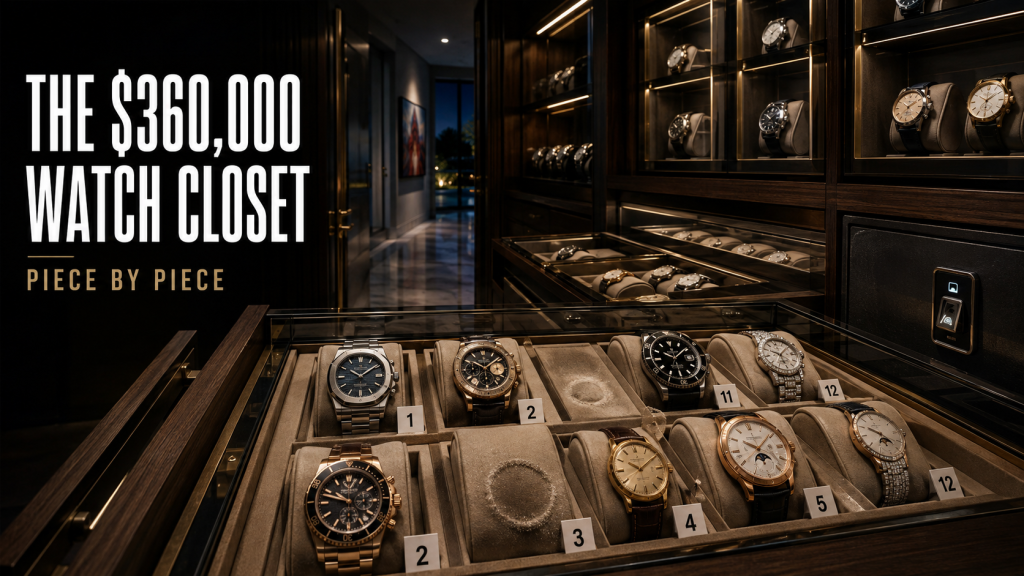
The Your Friends and Neighbors watches are not set dressing. They are the script.
Apple’s series follows Andrew Cooper, a fired hedge fund manager who starts robbing houses in his own neighborhood. Jon Hamm narrates the thefts like auction copy. Reference numbers, case materials, movement details, all delivered in the flat voice of a man who used to be able to buy these things.
Three watches carry the whole arc. Together they run to roughly $360,000, and each one marks a different rung on a ladder that most people at the club could not describe out loud but recognize instantly across a tent.
Watch forums identified every reference within a week of the premiere. But nobody wrote the version that matters to people who actually buy at these numbers, which is what each watch says about the man wearing it and who exactly is meant to read the message.
Here is the closet, piece by piece, with what each one actually signals and what it actually costs.
The Cartier Drive: Four Thousand Dollars of Honest Work
Coop’s own watch, before everything falls apart, is a steel Cartier Drive de Cartier. Reference WSNM0004. Call it four thousand dollars.
That is a serious watch by any normal standard, but it is not a status watch in the world the show is describing. Cartier’s cushion case reads as taste rather than money. It says the wearer has an eye, a decent salary, and no particular need to prove anything at brunch.
Of course, that is exactly why the show gives it to him. The Drive is the last honest object in his wardrobe. He bought it with money he earned, back when the money was arriving on schedule.
Out East, the Cartier crowd is easy to spot and largely admirable. Tank on a leather strap, Santos on steel, the Drive on a man who reads. These are the people who never needed the wrist to do the talking, usually because their last name already did it.
Notably, Coop never sells the Cartier. He steals watches worth fifty times more and keeps the cheap one, which is the most revealing thing the character does all season.
The Patek Philippe Nautilus: The Watch That Makes Him a Thief
The first real theft is a Patek Philippe Nautilus, and the show is specific about which one.
Coop calls it an 18K Nautilus. That points to the white gold 5811/1G rather than the steel reference everyone photographs at the airport. Value sits around $156,000, though the honest answer is whatever a determined buyer will pay this month.
The distinction matters more than any dollar figure. Steel Nautilus is the famous one, the one with the waiting list and the resale mythology. White gold is heavier, quieter, and almost invisible to anyone outside the conversation. So the man wearing white gold is not showing off. He is signaling to about nine other people in the room, and ignoring everyone else entirely.
That is the purest form of status there is. A signal only legible to the people whose opinion you actually want.
Coop steals it because it is portable, liquid, and sitting in a drawer instead of a safe. He keeps it because the wearing of it feels like a correction. In his head, the watch was always supposed to be his.
The Richard Mille RM 011: Two Hundred Thousand Dollars of Not Caring
Later comes the Richard Mille RM 011 Felipe Massa in rose gold, and the camera stops moving to let you look at it.
Roughly $200,000. Skeletonized flyback chronograph, tonneau case, rubber strap, the whole racing-derived vocabulary. Richard Mille built an entire house on the idea that a watch can be simultaneously ugly, enormous, and impossible to argue with.
Because here is the thing about an RM. It communicates nothing about taste, history, or connoisseurship. It communicates liquidity, immediately, at a distance of thirty feet. That is not a criticism. It is the product specification.
Watch the polo tents in Bridgehampton in July and you will run the census yourself. Old money wears a thin gold dress watch or nothing at all. New money wears Richard Mille, and new money is having a considerably better time.
The show understands the difference perfectly. Coop steals the RM from a house that belongs to exactly the kind of person he spent twenty years telling himself he was better than.
The Ladder, Priced
Three watches, three rungs, one arc.
- Cartier Drive de Cartier, WSNM0004. Around $4,000. Translation: employed, tasteful, unbothered.
- Patek Philippe Nautilus 5811/1G. Around $156,000. Translation: arrived, and speaking only to those already inside.
- Richard Mille RM 011 Felipe Massa, rose gold. Around $200,000. Translation: liquid, and not asking permission.
Total closet: roughly $360,000, which is less than a single season of carrying costs on a decent Sagaponack house. Keep that number in mind while watching. The show is quietly making the same point.
The Props Are Replicas. The Signal Is Not.
Watch collectors identified the pieces within days of the premiere, and the consensus is that production used replicas on screen. That is standard practice and nobody should be scandalized.
Still, the choice of which watches to replicate was a real decision made by real people with a real understanding of status. Somebody in that costume department knows exactly what a white gold Nautilus means. That person deserves a raise.
Compare this to most prestige television, where a rich character simply gets a big gold watch and the audience is expected to nod. Here the watches carry plot. The Patek converts Coop from a man with a problem into a criminal. The Richard Mille marks the moment he stops feeling bad about it.
What a Stolen Watch Is Actually Worth
Coop moves his takings through a fence, and the show is refreshingly honest about the economics.
A serialized watch from a major house is one of the hardest luxury objects to sell quietly. Papers, service records and serial numbers all follow the case. Auction houses check. Dealers check. Insurers maintain lists, and the enthusiast internet is relentless about spotting a stolen reference in a listing.
So the fence pays a fraction. Not a discount, a fraction. Every hour of screen time Coop spends congratulating himself on a $200,000 pull is undercut by what he actually collects, and the show lets that irony sit without underlining it.
This is precisely why serious collectors Out East are quietly moving toward art and away from wrists. The reasoning is covered in the painting he steals, which is the smartest theft of the whole series.
How to Buy the Ladder Without the Felony
If the show has you thinking about your own wrist, a few honest notes.
Buy the piece you would still want if nobody ever asked about it. That single filter removes about eighty percent of bad watch purchases, especially the ones made in a good year.
Get a rider. Homeowner’s policies usually cap jewelry at a number that will insult you, so a scheduled personal property rider is the actual answer. Photograph the papers. Store the boxes somewhere other than the closet the watches live in.
Buy from someone who will still take your call in five years. Grey market saves money once. A relationship with a dealer saves money permanently, particularly on the allocated pieces that never reach a public listing.
And if the house sits empty from October to May, understand that the watch drawer is the first place anyone looks. That problem is bigger than watches, which is why we wrote nine months empty.
The Hamptons Wrist Index
A field guide, offered without judgment and with considerable affection.
Steel sports Rolex on a man over sixty usually means he bought it new in 1988 and has never thought about it since. That is the most enviable position in the entire hobby.
Patek Nautilus in steel, worn with a quarter-zip, generally means finance and generally means recent. Nautilus in white gold means the same finance, several years further along, and a wife who told him to stop with the steel one.
Royal Oak means he had a very specific 2021. Richard Mille means the exit cleared. A vintage Cartier Tank on a woman at a Southampton lunch means she does not need to be here, which is why everyone is watching her.
The tell is never the brand. It is whether the wearer checks that you noticed, and once you start looking for that, you cannot stop. The larger version of this argument is in quiet luxury is over.
The Watch Every Founder Buys First
There is a predictable sequence after a liquidity event, and it runs on a schedule you could set a watch by.
First comes the steel Daytona or the steel Nautilus, usually at a premium, usually bought fast. Because the point is not the watch. The point is proof that the thing actually happened, worn somewhere the old boss might see it.
Then comes a second phase, roughly eighteen months later, where the same buyer quietly regrets the premium. He starts reading. He discovers complications, independents, and the entire universe of watches that other collectors respect but nobody at the gym recognizes.
By phase three he is wearing something in white gold or platinum that looks, to a civilian, like a forty dollar watch. That is the tell of a man who has stopped buying for the room. Coop’s white gold Nautilus sits exactly there, which is why it stings so much that he had to steal it.
If you are in phase one right now, no shame. Just do not buy at auction until you have handled the reference in person, and do not buy anything because a founder you admire wears it. Taste borrowed from another man’s wrist never survives the second year.
The Watches Nobody Steals
Notice what Coop leaves behind. He takes the loud things and the liquid things, since those are the only ones a fence will touch.
Meanwhile the genuinely rare pieces sit untouched in the same drawers. A. Lange & Söhne in white gold. An early Grand Seiko. Vintage Cartier from the right decade, or an independent maker with a two-year book and no public price list.
These are harder to sell precisely because they are harder to explain. A thief needs a buyer who does not ask questions, and the market for a watch nobody recognizes is a market full of people who ask nothing but questions.
So the collectors who sleep best Out East tend to own the least legible collections. Their watches are worth more and attract less attention, which is the closest thing to a free lunch this hobby offers.
That principle scales past watches, of course. Illegible wealth is safer wealth, and the East End has been quietly relearning that lesson for a decade.
Watch It Again, With the Sound Off
Run the series a second time and pay attention only to wrists. Coop’s arc reads perfectly without a single line of dialogue.
Steel Cartier while he is employed. Bare wrist while he is falling. Stolen white gold once he decides who he is now.
Costume design carried that entire story, and almost nobody wrote about it. The broader read on what the show gets right about people like us is in the Westmont Village files.
Where The Conversation Continues
Social Life Magazine reaches the wrists described above. Not people who read about them, but readers who own them, insure them, and wear them to the tent in July.
The summer issue lands in 25,000 East End homes. The list runs 82,000 deep. On July 24 and July 31, 2027, it converges on a lawn in Bridgehampton for Polo Hamptons, where a watch table is not an advertisement. It is a fitting room with champagne.
One dealer per season, because category exclusivity is the entire point. The 2027 lawn is being placed now, and the summer issue closes months ahead of it. Reach the editorial desk and we will tell you what is still open.
Author

Written by
Recent Posts

How to Choose Useful Tech Gifts for Employees and Clients in 2026
The Garage Question: Which Car Goes South for the Season?

VandS Clinic Review Treatment: How Seoul Injectable and Laser Options Compare for US Patients
Before Buying a View Home: What a Sloped Lot Means for the Purchase

Powerful Strategies to Stay Ahead in a Fast-Moving Real Estate Market
Categories
- Art
- Articles
- Business of Luxury
- Celebrities
- Culture
- Entertainment
- Events
- Faces of Summer 2026
- Fashion
- Fashion & Style
- Featured
- Finance
- Food, Spirits, Wine
- Hamptons
- Hamptons Celebrities
- Health
- Health & Beauty
- Lifestyle
- Luxury Lifestyle
- Press
- Profiles
- Real Estate
- Technology
- The Chronicles
- Travel
- Uncategorized
- Weddings