
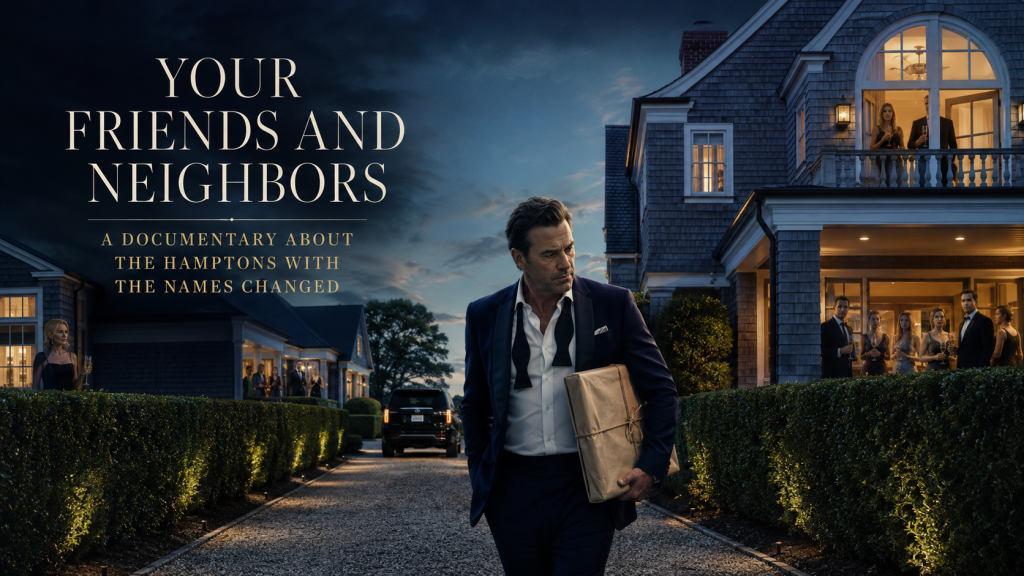
Your Friends and Neighbors opens with a man in a very good suit standing over a body. Apple initially sold the series as a thriller. Still, it plays like a documentary.
Jon Hamm plays Andrew Cooper, and everyone calls him Coop. He runs money until a false accusation ends that, and a non-compete clause finishes the job. After that, he starts robbing his neighbors. Their houses are full and, of course, their alarms are off. He already knows what time they leave for the club.
The setting is Westmont Village, a fictional suburb north of the city. But an East End reader recognizes the room within four minutes. Same watches. The same divorces. An identical calendar of obligations that nobody remembers agreeing to. Only the hedges are shorter, and the ocean is missing.
Two seasons in, with a third already ordered, this is the most accurate show about affluent American life since Mad Men. Critics still keep arguing about whether it is satire. That argument misses what the show is actually doing.
The Show Is About Carrying Cost, Not Money
Coop does not go broke. That is the part most reviews get wrong. He loses his income while keeping every single obligation that income was built to service.
Tuition stays. The house stays too. So does the ex-wife’s house, the club dues, the lease on the car nobody drives in winter, and the standing order at the wine merchant. In fact, wealth at this altitude is not a cushion. It is a subscription, and the renewal date does not care about your quarter.
Anyone who has bought Out East understands this in their spine. Of course the house was never the expensive part. Pool service, landscaping, the caretaker, storm shutters, flood insurance, and the guy who opens the place in May all arrive as a fixed monthly number. That number does not blink when a deal falls through.
So Coop steals. Not because he wants more, but because stopping would be visible. The moment the lawn goes brown, the neighborhood knows. In this world, the real currency is not cash at all. It is the appearance of never having to think about cash.
Westmont Village Is Westchester. The Feeling Is East End.
The production shot across Westchester County. Purchase, West Harrison, Briarcliff Manor, Rye, Tuckahoe and Yonkers all stand in for Westmont. Club scenes were filmed at Sleepy Hollow Country Club, Old Oaks Country Club and Westchester Country Club.
The location scout said something revealing about how those streets were chosen. They deliberately avoided neighborhoods where houses hide behind gates and long drives. The story needed neighbors who could see each other.
That single production note explains the difference between Westchester money and East End money. Westchester is proximity. Everyone is close enough to notice a new car in the driveway. Out here, we bought the hedges specifically so nobody could notice anything.
But the hedge is a lie we agree to together. Everyone still knows. Word travels faster on Ocean Road than it ever did on a Rye cul-de-sac, because the population is smaller and the season is short. Privacy Out East is not actually privacy. It is a shared performance of privacy, and the performance costs about eighty thousand a year in landscaping alone.
The Watch Is the Entire Thesis
Coop’s first real theft is a Patek Philippe Nautilus, and the show is careful about which one. He calls it an 18K Nautilus, which points to the white gold 5811/1G reference, not the steel piece everyone photographs. That distinction is the whole point. Steel is the watch people recognize. White gold is the watch people who matter recognize.
Later he takes a Richard Mille RM 011 Felipe Massa in rose gold, and the camera stops moving. The specifications come up on screen like an auction lot. Roughly two hundred thousand dollars of skeletonized titanium and rubber, worn by a man who cannot make his own tuition payment.
His own watch, before the fall, is a steel Cartier Drive. Four thousand dollars. It is the last honest object he owns, and the show knows it.
Read together, the three watches map the entire status ladder in about ninety seconds of screen time. Cartier says employed. Patek says arrived. Richard Mille says nothing at all about taste, because it was never meant to. It says liquidity, immediately legible from across a tent.
We broke the full closet down piece by piece in the $360,000 watch closet, including what each one actually resells for.
Everyone Who Works in Your House Knows Your Calendar
The show’s real engine is not greed. It is information.
Coop only succeeds because Elena, a housekeeper who works across several houses in the neighborhood, knows which families are away and where the safes sit. She is the most competent person on the show by a wide margin. She is also the only one who has ever been genuinely poor, which is presumably related.
Out East, this hits close. The season is public. Closing weekend is a published event. Your caterer, your dockhand, your pool company and your Thursday cleaning crew all hold a calendar of exactly when your house is empty, and that emptiness runs nine months long.
Nobody in the Hamptons wants to talk about this, so nobody does. Instead we buy cameras and call it done. The uncomfortable truth is that almost every serious East End loss involves information rather than force, and information does not trip an alarm. We wrote the version nobody else will publish in nine months empty.
Owen Ashe and the End of Quiet Luxury
Season two brings James Marsden in as Owen Ashe, a billionaire who moves into Westmont and refuses to behave. He throws parties, and not small ones. He is charming in the way that makes careful people nervous. Old Westmont despises him and attends everything he hosts.
That contradiction is the most honest thing in the season. Quiet luxury was never a taste preference. It was a rule enforced by people who already had everything, aimed at people who had just arrived.
Ashe breaks the rule and suffers no social penalty, because the rule only ever applied to people who needed permission. A man with enough money does not whisper. He simply hosts, and the whisperers arrive at eight.
Anyone who has watched a new arrival buy on Meadow Lane and immediately throw the best party of the summer has seen this exact sequence. The old guard writes him off in June. By August they are on the list, and by Labor Day they are explaining that they always liked him.
The Non-Compete Is the Real Monster
Coop is not destroyed by a murder or a robbery. Rather, a clause destroys him.
He is pushed out after a junior colleague makes a false accusation, and then his non-compete blocks him from doing the only job he knows. No income, no legal path back into his own industry, and a household burn rate built for a managing director. That is the horror movie. Everything else is plot.
Half the men at any Bridgehampton lunch have signed one of these. Most have not read it since the day it went in the drawer. They assume seniority protects them, but seniority is exactly what makes the clause worth enforcing.
The show treats this as background. In fact it is the load-bearing wall, and it is the single most relatable thing about a series otherwise concerned with stolen watches and bodies in pools.
What Season Two Left at the Bottom of the Lake
Spoilers follow, so skip ahead if you are still working through the season.
Season two runs ten episodes, from April 3 through June 5, 2026. Ashe does not survive it. His car ends up in a lake, and a group of Westmont’s finest end up holding a secret that binds them together far more tightly than any friendship did.
The finale, titled “The Night of the Hunter,” refuses to resolve much. Jonathan Tropper, who created the show and runs it, leaves the neighborhood more divided than he found it. As one recap put it, the real split in Westmont is not between good people and bad people. It runs between those willing to look at the truth and those committed to not looking.
Apple renewed the series for a third season back in February, before season two even aired. Joshua Jackson joined the cast in June. Nobody out here should be surprised that a show about wealthy people covering something up got picked up early.
Why Jon Hamm Keeps Playing the Man Who Cannot Afford Himself
Hamm has now built two career-defining roles out of the same anxiety, though the roles sit forty years apart. Don Draper sold an identity he did not own. Coop maintains a life he can no longer fund.
Both men are extremely good at the performance and completely unequipped for the moment it stops working. Both are surrounded by people who would rather not know. Casting Hamm here was not lazy, it was precise.
The difference is generational. Draper’s secret was where he came from. Coop’s secret is what he currently owes, and that shift says more about the last fifteen years of American wealth than any think piece has managed.
His face does a specific thing in both shows, a half second of calculation before the charm arrives. Watch for it, especially in the kitchen scenes. Once you notice it, you will start seeing it at dinner parties, which is the least comfortable gift this series gives you.
The Women Are Running a Second Economy
Coop gets the voiceover, but the women in Westmont are running the more interesting operation.
Mel, played by Amanda Peet, keeps the house and the standing. She has an affair with a retired NBA star who lives four doors down, which is less scandal than logistics. Nick Brandes has the one asset nobody in Westmont can manufacture, namely fame that arrived before the money did.
Sam, played by Olivia Munn, is deep in a divorce and doing considerably worse than she lets on. Without spoiling the first season, her solution to a private catastrophe is an insurance solution. That detail alone tells you what she was actually married to.
Then there is Ali, Coop’s sister, a working singer with bipolar disorder who moves in and functions as the household’s only honest voice. She is broke in a neighborhood where nobody admits to being anything, so she says the quiet parts at dinner.
Out East, this second economy is entirely familiar. Appearance maintenance is a real line item, and it is almost always managed by women while the men handle the part that shows up on a statement. Aesthetics appointments, the trainer, the tennis pro, the right table, the right school, the right committee. None of that lands in a portfolio review, yet all of it protects the family’s standing more reliably than any position does.
The show is smart enough to treat that labor as labor. Very few series about rich people bother.
The Westmont Village Files
We built nine pieces around this show, because one was never going to hold it. Start anywhere, since each one stands on its own.
- The $360,000 watch closet, priced and ranked
- Westmont Village decoded, every house and club
- Nine months empty, the theft nobody reports
- The painting is the smartest thing he steals
- Season two, fully explained
- The clause that ends careers
- The cast, priced against East End comparables
- Quiet luxury is over, and Marsden proves it
Where The Conversation Continues
Social Life Magazine reaches the people this show is about. Not people who watch them, but the readers sitting in the tents, on the boards, and in the houses that go dark in October.
The summer issue lands in 25,000 homes between Southampton and Montauk. The list runs 82,000 deep. Next summer it converges on a lawn in Bridgehampton for Polo Hamptons, running July 24 and July 31, 2027, where the tents hold exactly the audience described above.
If your brand belongs in that room, the conversation starts now. Partners for the 2027 season are placed through the fall, and the summer issue closes months before anyone sets up a tent. Reach the editorial desk directly and we will tell you what is still open. Some categories are already spoken for.
Author

Written by
Recent Posts

How to Choose Useful Tech Gifts for Employees and Clients in 2026
The Garage Question: Which Car Goes South for the Season?

VandS Clinic Review Treatment: How Seoul Injectable and Laser Options Compare for US Patients
Before Buying a View Home: What a Sloped Lot Means for the Purchase

Powerful Strategies to Stay Ahead in a Fast-Moving Real Estate Market
Categories
- Art
- Articles
- Business of Luxury
- Celebrities
- Culture
- Entertainment
- Events
- Faces of Summer 2026
- Fashion
- Fashion & Style
- Featured
- Finance
- Food, Spirits, Wine
- Hamptons
- Hamptons Celebrities
- Health
- Health & Beauty
- Lifestyle
- Luxury Lifestyle
- Press
- Profiles
- Real Estate
- Technology
- The Chronicles
- Travel
- Uncategorized
- Weddings