
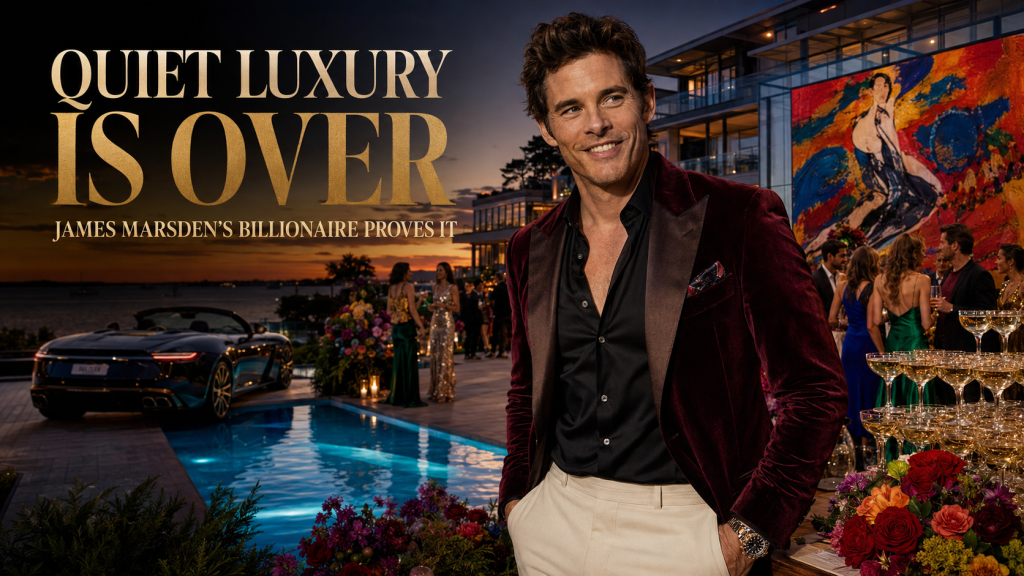
Quiet luxury is over, and it did not die of a change in taste. It was never a taste. It was a rule, written by people who already had everything, aimed squarely at people who had just arrived.
Season two of Your Friends and Neighbors hands the argument to James Marsden. He plays Owen Ashe, a billionaire who moves into Westmont, throws parties, spends loudly, and declines to pretend any of it is inherited.
Old Westmont despises him. Yet Old Westmont attends everything he hosts.
That contradiction is the most honest thing in the season, and it is the end of a decade-long fashion argument in about four episodes.
Ashe Breaks Every Rule and Pays Nothing
Run the list of quiet luxury commandments and watch him violate every one in turn.
Do not announce. Still, he announces. Do not host at scale. He hosts constantly instead. Do not appear to be new. He is visibly, cheerfully new. Do not let anyone see the price. Everyone sees the price.
Certainly by the old rules he should be frozen out within a summer. Instead the neighborhood arrives at eight, drinks his wine, and complains about him on the drive home.
Because the rules were never enforceable against someone who does not want in. Ashe is not applying for membership. He is running a competing venue, and the old guard cannot afford to boycott the better party.
Quiet Luxury Was Never About Taste
The whole aesthetic sold itself as restraint. Better materials, no logos, an unbranded coat that costs more than a car. But that was the pitch, not the function.
We mapped how those signals actually worked in the status signals guide. Read it honestly and the aesthetic was a filtering device. An unlabeled cashmere coat only communicates status to people trained to recognize the cut, which is a very specific and very small group.
So the point was never subtlety. The point was building a signal that new money could not read, and therefore could not copy.
Of course new money learned to read it almost immediately, mostly from the internet, and the whole thing collapsed the moment the code became searchable.
The Rule Only Applied to People Who Needed Permission
Here is the mechanism nobody says out loud.
Restraint is compulsory for anyone who still requires acceptance. The new arrival dresses down, hosts modestly, and waits, because the cost of being seen as loud is exclusion.
By contrast, people who need nothing behave differently. They wear what they like, host what they want, and absorb the commentary without consequence, since there is no committee left with power over them.
That is why the loudest people in any wealthy room are usually the very top and the very bottom. The anxious middle does the whispering, and the anxious middle is where quiet luxury actually lived.
The Watch Test
The show makes this argument in objects, since objects work faster than dialogue.
Initially Coop steals a Patek Philippe Nautilus in white gold. That piece is the purest quiet luxury object in the series. Heavier than the steel version, quieter, and almost invisible to anyone outside the conversation.
Then he takes a Richard Mille RM 011 in rose gold, and the camera stops to show the specifications. An RM communicates nothing about taste or connoisseurship. It communicates liquidity, at thirty feet, immediately.
Both are correct. They are simply addressed to different audiences, and the second audience is much larger. We broke down the full ladder in the $360,000 watch closet.
What Actually Changed
Something shifted underneath the aesthetic, though it was not fashion.
Quiet luxury depended on a stable hierarchy where old money set the terms. That arrangement assumed the people at the top had been there long enough to write rules and enforce them socially.
Then a decade of very fast fortunes arrived. Founders, funds, crypto, private credit, a long run in public markets. Suddenly there were people whose money is real and whose lineage is four years long.
Rules only bind when the people being ruled need something, which is the mechanism behind how generational wealth actually holds. This cohort mostly does not, so the rules stopped binding.
The Same Fight, Out Here
Every version of this argument has already played out on the East End, usually on one specific lane, and usually inside a single summer.
A new arrival buys well. Initially the old guard writes him off in June. He throws the best party of the season in July. By August the same people are on his list, and by Labor Day they are explaining that they always liked him.
Nobody who has watched this cycle three or four times still believes in the gatekeeping, of course. It has become a formality, performed for one season and then quietly abandoned.
What replaced it is simpler and slightly colder. Money still gets you in. It just gets you in faster now, and nobody pretends otherwise. The full read on the show that dramatized it is in the Westmont Village files.
How to Tell Old From New in Four Seconds
Still, the tells survive even where the rules did not.
- The car. Old money drives something ten years old and immaculate. New money drives something current and clean.
- The house in February. Old money knows what their house looks like in winter. New money has never seen it.
- The staff. Old money has had the same caretaker for nineteen years. New money has an agency.
- The reaction to a compliment. This is the real test. Old money changes the subject. New money explains where it came from.
None of these are moral distinctions, and the new arrivals are frequently more interesting company. But the tells are real, and everyone at the table is reading them.
The Maintenance Economy Nobody Calls Loud
One category escaped the whole quiet luxury argument untouched, and it is worth noticing.
Specifically, aesthetics, wellness and longevity spending sits outside the visibility rules entirely. Nobody accuses a woman of being showy for looking rested. The result is invisible by design, which makes it the most quiet luxury purchase available.
So while the coat argument raged, the actual status spending moved to the face, the body and the bloodwork. Peptides, protocols, a very good injector, and a longevity clinic with a waiting list.
That spending is enormous and almost entirely unremarked. Because the one rule that never broke is this. Anything that reads as effortless is permitted, regardless of cost.
Loud Money Is More Fun
The unspoken reason quiet luxury lost is that it was boring.
A decade of beige, of unlabeled knitwear, of parties nobody photographed. Restraint is a fine principle. As an evening, though, it is a poor one.
Ashe brings a party. The show is honest that everyone enjoys it, including the people who spend the next morning describing him as vulgar. That gap between behavior and commentary is the whole comedy of the season.
Out here the same verdict came in a while ago. The lawn in July, the tents, the music, the boats. None of it is quiet, all of it is oversubscribed, and the people complaining are on the list.
What Comes After
The next code is already forming, and it is not about volume at all.
Eventually access replaced restraint. The signal now is what you can get into rather than what you are wearing to it. A table nobody can book, a house nobody can rent, a room with a door and a person at it.
Objects are democratic in a way experiences are not, after all. Anyone with money can buy the coat, so the coat stopped working. Nobody can buy the invitation, which is why the invitation became the product.
That is the argument Polo Hamptons has been making on a lawn in Bridgehampton for years, and how the cast of this show would sort inside that room is in the cast, priced against East End comparables.
The Logo Came Back
Look at what actually sells now and the verdict is already in.
Monogram is visible again. Hardware is bigger. Colour returned, and so did the kind of piece that photographs from across a room. Even the houses that spent a decade selling restraint have quietly reintroduced the loud line, because the loud line is what moves.
Because restraint only reads as luxury when everyone agrees on the code. Once the code leaked, the unbranded coat stopped saying anything at all, and a silent signal that nobody decodes is just an expensive coat.
Still, nobody at the top will say this out loud. So the industry performs restraint in the campaign and sells volume in the store.
Who Actually Lost
Every fashion cycle has a casualty, and this one had a specific one.
The people hurt by the end of quiet luxury are the ones who bought entirely into it. Anyone who spent a decade assembling a wardrobe designed to be illegible now owns a closet that communicates nothing to a room that stopped reading.
Meanwhile the woman who kept wearing what she liked is fine. She was always fine, since her position never depended on the code in the first place.
That is the lesson underneath the whole cycle. Anyone who can be embarrassed out of their own taste was never secure to begin with, and the rules exist mainly to find those people.
Ashe is not a fashion statement. He is a stress test, and Westmont fails it in about four episodes.
Where The Conversation Continues
Social Life Magazine has covered this argument from inside the room since long before anyone gave it a name.
The summer issue reaches 25,000 East End homes. The list runs 82,000 deep. On July 24 and July 31, 2027, it converges on a lawn in Bridgehampton for Polo Hamptons, where old money and loud money share a tent and pretend not to be counting.
Fashion houses, fine jewelry, spirits, hospitality and aesthetics each get one seat in this cluster. Reach the editorial desk before the 2027 season is placed, since the summer issue closes months ahead of the lawn.
Author

Written by
Recent Posts
How to Choose Useful Tech Gifts for Employees and Clients in 2026
The Garage Question: Which Car Goes South for the Season?
VandS Clinic Review Treatment: How Seoul Injectable and Laser Options Compare for US Patients
Before Buying a View Home: What a Sloped Lot Means for the Purchase

Powerful Strategies to Stay Ahead in a Fast-Moving Real Estate Market
Categories
- Art
- Articles
- Business of Luxury
- Celebrities
- Culture
- Entertainment
- Events
- Faces of Summer 2026
- Fashion
- Fashion & Style
- Featured
- Finance
- Food, Spirits, Wine
- Hamptons
- Hamptons Celebrities
- Health
- Health & Beauty
- Lifestyle
- Luxury Lifestyle
- Press
- Profiles
- Real Estate
- Technology
- The Chronicles
- Travel
- Uncategorized
- Weddings