
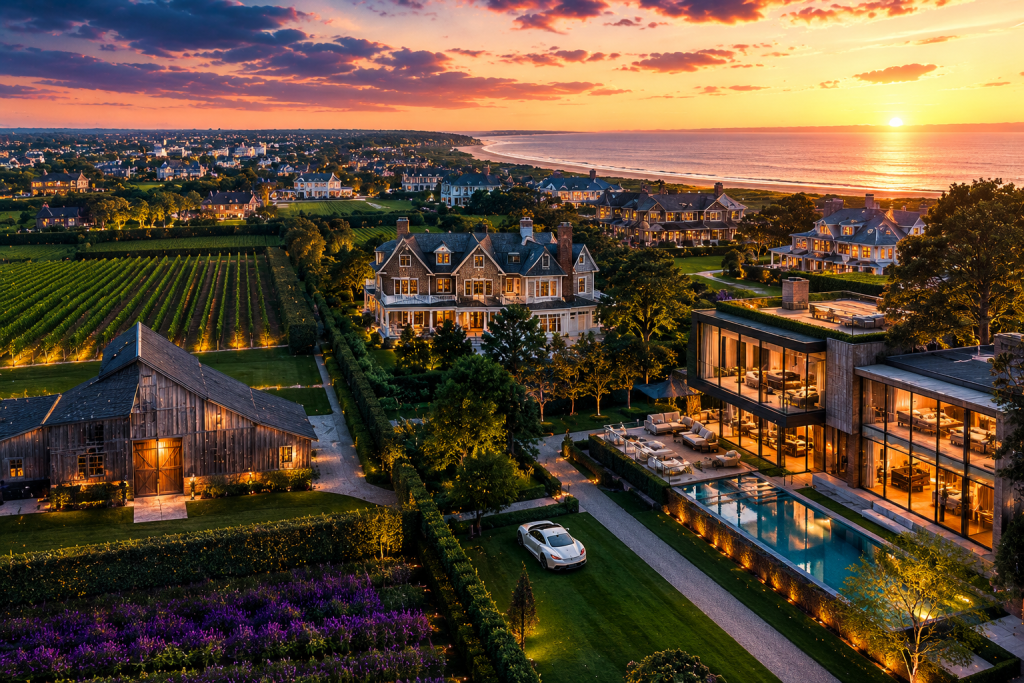
The Bridge is Bridgehampton in miniature. Take something that was one thing (a race circuit), make it another thing (a golf club), and in the conversion, produce something that looks nothing like the institutions that came before it. Southampton’s Bathing Corporation has existed since 1891. The Bridge has existed since 2002 and costs more to join.
Who Joins The Bridge
A Tribeca tech founder who made his money in crypto and wears backward caps to board meetings feels at home here. So does the Greenwich hedge fund manager who keeps a vintage Porsche in the clubhouse garage feels at home here. Pedigree is irrelevant here. What matters is whether you can write the check and whether you’re interesting at dinner. Southampton’s clubs ask who your grandfather was. The Bridge asks what you drive.
Atlantic Golf Club: The Other Private Option
Atlantic Golf Club, also in Bridgehampton, offers a second private option. Rees Jones designed this course too, on Scuttle Hole Road. It opened in 1992 with a links-like character that recalls Shinnecock Hills nearby. Golf Digest named it Best New Private Course that year. Between Atlantic and The Bridge, Bridgehampton holds two of the most exclusive (and expensive) golf memberships on the East End, neither of which existed before 1992.
Sunday Afternoon: Sagaponack and the Most Expensive Dirt in America
Sagaponack is technically within the Town of Southampton, but culturally it belongs to Bridgehampton. The zip code, 11962, has been one of the three most expensive in the United States for over a decade. In 2025, the median sale price sat just below $6 million. Atherton, California has held the national number-one spot for years. Sagaponack consistently holds number two or three.
Peter Brant’s estate is here. So is the Tribeca hedge fund founder who spent $13 million on a historic parcel last year because his real estate broker (a woman who wears Hermes scarves to closings and drives a black G-Wagon) explained that the agricultural reserve overlay means the field next to his house will never become a subdivision. He is paying for the view, the privacy, and the guarantee that nobody will build a spec mansion within eyeshot. The West Village art advisor who owns a cottage on Sagg Main Street bought at $2.8 million in 2019 and has watched her equity grow by 60 percent without lifting a paintbrush. She walks to Sagg Main Beach in the morning, works from the porch in the afternoon, and hosts dinner parties at which the only acceptable conversation topic is which Dia Bridgehampton exhibition is currently worth seeing. Property scale runs toward the astronomical: multi-acre parcels, oceanfront, agricultural reserve overlays that paradoxically increase values by guaranteeing that the field next to your $15 million house will never become a subdivision. Sagg Main Beach, at the end of Sagg Main Street, offers one of the most dramatic beach approaches on the South Fork. Dunes run high. Crowds stay thin. Parking requires a town permit, which functions as a soft velvet rope.
The Price Corridor
Water Mill (11976), immediately west of Bridgehampton, posted a $5.5 million median in 2025, making it the second most expensive zip code in the Northeast. Bridgehampton itself (11932) sits at $3.05 million. Together, this corridor represents the most expensive residential real estate concentration outside of California in the United States, and it all orbits the crossroads village with the four-block Main Street.
For a deeper look at how Hamptons real estate works (and what it costs), see our 2026 real estate guide and power rankings.
The Persona Map: Who Comes to Bridgehampton and Why
The Battery Park Founder Who Needs a Stage
He sold his fintech company for $120 million and moved to a condo on South End Avenue because he likes looking at the Statue of Liberty while he plans what’s next. What’s next is a family office, but a family office needs deal flow, and deal flow needs proximity to the right 500 people. He bought a house on Lumber Lane (not a coincidence) because it puts him a three-minute drive from Polo Hamptons, a ten-minute drive from the Hampton Classic, and a five-minute walk from Bobby Van’s. Relaxation is not the point. He comes because Bridgehampton is where the calendar happens, and the calendar is his pipeline.
The NoHo Gallery Director Who Pretends Not to Network
She visits Dia Bridgehampton the way other people visit church: regularly, reverently, with no need to perform the visit for anyone else. Her gallery represents three artists whose collectors attend Polo Hamptons, and she understands that casual proximity on a Saturday afternoon converts to studio visit invitations on Monday. A rental in Sagaponack or on Hayground Road, where studios cluster, may be hers. Provenance matters to her, which in Bridgehampton means farmland-to-vineyard stories and firehouse-to-museum stories. She tells everyone she finds polo derivative. She has photographed every match since 2022.
The Flatiron Medspa Founder Doing the Math
She runs three locations, an IV lounge, and a waitlist for Morpheus8. Her patients are the wives and partners of the men who sit in the cabanas. She sponsored Gold tier at Polo Hamptons last summer on a hunch. Three weeks later, a woman she recognized from the step-and-repeat booked a $14,000 package. Marketing decks were not needed to understand the return. What she needs is a field, a tent, and a room full of women who spend $8,000 a quarter on their faces. Bridgehampton is the only village on the South Fork that gives her all three in the same afternoon.
The Murray Hill PE Associate Mapping His Future
He bought in the Bridgehampton zip code three years from now. He just doesn’t know it yet. Right now he is taking the Jitney east for the first time, wearing boat shoes he bought on Tuesday, and holding a general admission ticket to Polo Hamptons that his MD mentioned at a team dinner. A regular stool at the Candy Kitchen is not yet his. Nobody has told him that Almond is the right restaurant on Wednesday and Bobby Van’s is the right restaurant on Saturday. But he is paying attention, and in Bridgehampton, paying attention is the entrance exam.
The Bridgehampton Thesis, Stated Plainly
Sag Harbor is the village that makes powerful people quiet down. Southampton is the village that wrote the rules everyone else pretends not to follow. Bridgehampton is the village that turned farmland into a stage and built the two most important equestrian events on the East End without inheriting a single institution from the Gilded Age.
Sag Harbor has the harbor. Southampton has the hedgerows. Bridgehampton has the field.
On the field, everyone can see everyone. That is the thesis. And the architecture. It is why Polo Hamptons works, why the Hampton Classic works, why the Candy Kitchen works, why Topping Rose House works, and why the most expensive zip code in New York State is a five-minute drive from a cash-only diner that has not changed its menu since 1981.
Bridgehampton does not hide. It does not conceal. Instead, it converts: potato fields to polo grounds, race circuits to private clubs, firehouses to museums, taverns to luxury hotels, and farmland to the most watched stage on the South Fork.
Where the Conversation Continues
Social Life Magazine has chronicled the Hamptons for 23 years. Five summer issues, 25,000 copies each, distributed from Westhampton to Montauk. Fall and winter issues reach 15,000 Upper East Side doorman buildings. We are in the restaurants, the hotels, the coffee shops, the bookstores, the marinas, the beach clubs, and the events that define this place.
If your brand serves the Bridgehampton audience (finance, luxury, fashion, beauty, wellness, hospitality, spirits, or automotive), we should talk. Our paid feature page is built for brands that want editorial positioning alongside the tastemakers, builders, and decision-makers who define East End culture. Submit a Paid Feature here.
Polo Hamptons 2026 runs July 18 and July 25 at 900 Lumber Lane, Bridgehampton, with BMW North America as title sponsor and Christie Brinkley as host. Cabanas, VIP tables, and sponsorship opportunities are still available. Audience: finance, fashion, media, and luxury. Setting: a polo field. Energy: visible, intentional, and impossible to replicate anywhere else on the East End. Visit polohamptons.com for details.
To receive Social Life Magazine, subscribe here.
Bridgehampton turned farmland into a stage. If you’re reading this, you already know what the stage is for. The question is whether you’re watching from the stands or standing on the field.
Bridgehampton Village Dossier: Spoke Map
| # | Spoke Title | Status | Target Keyword |
|---|---|---|---|
| 1 | [Best Restaurants in Bridgehampton 2026](/bridgehampton-restaurants-2026/) | PLANNED | Bridgehampton restaurants |
| 2 | [Bridgehampton Real Estate: The Farm-to-Fortune Market](/bridgehampton-real-estate/) | PLANNED | Bridgehampton real estate |
| 3 | [The History of Bridgehampton: From Potato Fields to Polo Fields](/bridgehampton-history/) | PLANNED | Bridgehampton history |
| 4 | [Polo Hamptons 2026: The Definitive Guide to July 18 and 25](/polo-hamptons-2026-guide/) | PLANNED | Polo Hamptons 2026 |
| 5 | [The Hampton Classic 2026: The Grand Finale of Hamptons Summer](/hampton-classic-2026/) | PLANNED | Hampton Classic 2026 |
| 6 | [Bridgehampton Wineries and the East End Wine Trail](/bridgehampton-wineries/) | PLANNED | Bridgehampton wineries |
| 7 | [The Art and Gallery Scene: Dia Bridgehampton to the Studios](/bridgehampton-art-galleries/) | PLANNED | Bridgehampton art |
| 8 | [Sagaponack: The Most Expensive Zip Code in America](/sagaponack-real-estate/) | PLANNED | Sagaponack |
| 9 | [72 Hours in Bridgehampton: A Weekend Itinerary](/bridgehampton-weekend-itinerary/) | PLANNED | Bridgehampton weekend |
| 10 | [Where to Stay in Bridgehampton: Hotels, Inns, and Rentals](/bridgehampton-hotels/) | PLANNED | Bridgehampton hotels |
| 11 | [The Bridgehampton Equestrian Corridor](/bridgehampton-equestrian/) | PLANNED | Bridgehampton equestrian |
| 12 | [Bridgehampton vs Southampton vs Sag Harbor](/bridgehampton-vs-southampton-vs-sag-harbor/) | PLANNED | Bridgehampton vs Southampton |
Cross-Links: The Modern Culture Hamptons Bible
Chapter 1: The Sag Harbor Village Dossier | 12 pieces, ~40,000 words Chapter 2: The Southampton Village Dossier | 13 pieces, ~44,800 words Chapter 3: The Bridgehampton Village Dossier (this cluster) | 13 pieces, in progress
Related Coverage:
- Hamptons Beaches: Complete Guide
- Hamptons Beach Clubs
- Hamptons Real Estate Guide 2026
- Hamptons Power Players 2026
- The Hamptons’ Most Exclusive Private Clubs
- Things to Do in the Hamptons
- Equestrian Delights in the Hamptons
- Hamptons Mansions 2026
Who Books the Barn and Why
An UES philanthropist books Topping Rose House for her daughter’s rehearsal dinner because the barn seats forty and the garden photographs like Provence. The Chelsea agency founder hosts a client retreat in the Poolside Studio because the word “retreat” sounds less transactional than “strategy session” and the setting makes people agree to things they would reject in a conference room. The Boerum Hill creative couple who just sold their startup books for a weekend in May, when rates drop and the village belongs to locals. They eat breakfast on the terrace, take the Lexus to Mecox Beach, and for forty-eight hours pretend they live here. By checkout, they are calling a broker.
Consider the progression: an 1842 mansion becomes a 20th-century inn becomes a 21st-century luxury hotel with a Jean-Georges restaurant. Bridgehampton doesn’t demolish. It converts.
Saturday: The Field
Polo Hamptons at 900 Lumber Lane
If you came to Bridgehampton and skipped Polo Hamptons, you missed the point. July 18 and July 25, 2026. 900 Lumber Lane, Bridgehampton. BMW North America as title sponsor. Christie Brinkley as host. This is not a sporting event with a social component. It is a social event with a sporting component. The distinction matters.
Polo Hamptons is the centerpiece of this village’s identity. Sag Harbor closes its summer with the Bay Street Theater gala. Southampton anchors to the Bathing Corporation and Shinnecock Hills. Bridgehampton anchors to the field at Lumber Lane, where the ponies run, the BMW fleet gleams, the cabanas fill with people whose net worth starts at eight figures and whose social strategy is visibility.
This is what the thesis means. On the field, everyone can see everyone. No hedgerows. No harbor fog. Not a single private beach with a membership committee that takes eleven months to respond. Polo Hamptons is, by design, a place where economic capital, social capital, and cultural capital collide in real-time, on grass, in July. Cabanas are status objects. VIP tables are status objects. Even the parking is a status object, because the car you drove announces your bracket before you reach the entrance.
Social Life Magazine has covered Polo Hamptons since its inception. (We would. It’s ours.) Five summer issues, 25,000 copies each, distributed Memorial Day through Labor Day from Westhampton to Montauk. If your brand serves the audience that attends Polo Hamptons (finance, luxury, fashion, beauty, hospitality, spirits), this is where you want to be. Cabanas, VIP tables, sponsorship packages, and brand activations are available. Details at polohamptons.com.
The Hampton Classic: How Summer Ends
Five weeks after Polo Hamptons, summer officially closes. The Hampton Classic Horse Show runs August 23 through 30, 2026, at 240 Snake Hollow Road. This is one of the largest outdoor horse shows in the United States. More than 1,300 horses. Over $300,000 in Grand Prix prize money. Eighty onsite shops. International food vendors. A VIP tent that seats 3,000 with white-coated waiters.
The Hampton Classic started in 1971 as a one-day show organized by the Topping Riding Club in Sagaponack. By 1976 it was a five-day rated show at Dune Alpin Farm in East Hampton. In 1982 it moved to Snake Hollow Road in Bridgehampton, and it has not left. This is the grand finale of Hamptons summer, and it happens in Bridgehampton because Bridgehampton is the village that gives its events enough room to breathe.
Socially, the Classic is its own economy. Sponsorships run the operation. Fashion brands set up shop. An equestrian corridor connecting Polo Hamptons in July to the Hampton Classic in August is the single most important sponsorship pipeline on the East End. If you sell luxury goods (and you found this page, so the odds are favorable), the July-to-August Bridgehampton window is where deals close, relationships form, and brand positioning happens at scale.
The Bridgehampton Polo Club and the Other Field
Separate from Polo Hamptons, the Bridgehampton Polo Club operates from Two Trees Farm, hosting six consecutive Saturdays between July and August. Peter Brant founded it. Mercedes-Benz Polo Challenge ran here for years. Club colors are navy and white. Social dynamics on this field skew toward the art-world-meets-finance intersection that Brant himself embodies: publisher, collector, polo patron, Sagaponack estate owner.
Two polo operations in one village. No other hamlet on the South Fork can claim that. Bridgehampton does not dabble in equestrian culture. It lives inside it.
Saturday Night: The Candy Kitchen Paradox
At some point during your Bridgehampton weekend you will end up at the Candy Kitchen, and this will confuse you. The Candy Kitchen opened on May 2, 1925, the same year F. Scott Fitzgerald published The Great Gatsby. A Greek immigrant named George Stavropoulos started it. The Parash family ran it for decades. Gus Laggis bought it in 1981, and three generations of the Laggis family operate it today. Cash only. Terrazzo floor. Formica countertops. Swivel stools. Homemade ice cream. A neon “soda” sign visible from Main Street.
From Succession to the National Register
The Candy Kitchen was added to the National Register of Historic Places in December 2023. It was name-dropped in the series finale of HBO’s Succession, when Kendall Roy recalls a childhood promise made “at the Candy Kitchen in Bridgehampton.” Howard Hughes ate here. Truman Capote ate here. Bette Davis ate here. The landscaper who mows the $45 million estate on Sagaponack Road eats here. The person who owns that estate eats here. They order the same grilled cheese.
She runs a PR agency in Chelsea. Twenty-three clients, four of them luxury real estate. She brings her daughter on Sunday morning. The line extends out the door. A man in a $2,400 Brunello Cucinelli linen shirt stands behind a teenager in a lifeguard tank top. Nobody cuts. Nobody name-drops. The daughter orders a banana split. The mother orders coffee and watches the room. She considers: every client she has pitched this summer would kill for this authenticity, and it cannot be manufactured. It can only be stood next to. The Candy Kitchen is the intermission between performances. Nothing here is for sale except the ice cream.
The Paradox in Numbers
This is the Candy Kitchen paradox. Bridgehampton is, by almost every financial metric, one of the most expensive places in America. The median home sale price in the Bridgehampton zip code (11932) was $3.05 million in 2024. Adjacent Sagaponack (11962) was $5.9 million, making it the third most expensive zip code in the country and the most expensive in New York State for a decade running. And yet, at the center of this wealth, sits a cash-only luncheonette where homemade ice cream costs less than the parking meter in Southampton Village. The Candy Kitchen is not a contradiction. It is the key. Bridgehampton does not conceal its wealth behind institutions the way Southampton does. It places its wealth next to its ordinariness and lets you stare at both.
Sunday: The Converted Landscape
From Potato Fields to Vineyards
Wolffer Estate Vineyard tells the Bridgehampton story in a single address: 139 Sagg Road, Sagaponack. Christian Wolffer, born in Hamburg, bought a potato farm in 1988 and planted 55 acres of vines. The soil was Bridgehampton loam, the same soil that grew potatoes for two centuries. The Atlantic Ocean sits 2.6 miles away, providing a maritime microclimate that critics have compared to Bordeaux. Winemaker Roman Roth has been there for three decades.
Wolffer produces over 50,000 cases annually. Summer in a Bottle rose accounts for over 70 percent of production and ignited the East End’s rose renaissance. The tasting room overlooks vines to the east and rolling Hamptons landscape to the west. The Wine Stand on Montauk Highway offers walk-in pours, charcuterie, and sunset views. Bottles start at $34 and climb past $120.
The 175-acre estate also includes boarding stables, 30 paddocks, an indoor jumping ring, and a Grand Prix field. Horses and wine, on the same property, on former potato fields. Bridgehampton, again, converting agricultural land into cultural capital.
Channing Daughters Winery adds a second voice to the Bridgehampton wine conversation, with a focus on experimental varietals and an irreverent approach that plays counterpoint to Wolffer’s polished refinement. Duck Walk Vineyards extends the trail further. Together they form an East End wine corridor that competitors on the North Fork watch with grudging respect.
Dia Bridgehampton and the Art of Conversion
At 23 Corwith Avenue sits a building that has been three things: a firehouse (built 1909), an African American Baptist church (1924 to 1979), and since 1983, a museum for the fluorescent light installations of Dan Flavin. Dia Art Foundation funded the renovation. Flavin himself directed the design. Nine works in fluorescent light, made between 1963 and 1981, fill the vestibule and second floor. The first floor hosts rotating exhibitions by artists who live or work on Long Island.
Dia Bridgehampton (renamed from the Dan Flavin Art Institute in 2020) is free. Open Friday through Sunday, 11 to 5. It is perhaps the most important art institution in Bridgehampton, and it lives inside a converted firehouse on a quiet side street. Previous exhibitions have included John Chamberlain, Andy Warhol, Keith Haring, Alice Neel, Louise Bourgeois, and Cy Twombly.
If Southampton’s cultural anchor is the Parrish Art Museum and Sag Harbor’s is Bay Street Theater, Bridgehampton’s is Dia. And Dia’s story is a conversion story, same as every story in this village. Buildings change purpose. Fields change crop. Race circuits become golf clubs.
The Bridge: Where the Racetrack Became the Club
Speaking of which. The Bridgehampton Race Circuit opened in 1957 on 500-plus acres of sandy hills overlooking Peconic Bay. Grumman engineers designed it. The track ran 2.85 miles with 13 turns. Stirling Moss called the first combination of turns the most challenging in North America. Mario Andretti said Turn One could “scare the bejesus out of anybody.” NASCAR ran here. Can-Am ran here. The Vanderbilt Cup was revived here. For four decades, Bridgehampton’s identity was partially defined by the roar of engines echoing across the fields.
The track closed in 1998 (some sources say 1999). Robert Rubin, a former commodities trader, bought the land and hired Rees Jones to design a golf course over the ruins. The Bridge opened in 2002. Initiation fee: reportedly approaching $1.5 million. Annual dues: approximately $20,000. The clubhouse is glass-walled, aggressively futuristic, described by the New York Times as looking “more like a contemporary art museum in Berlin.” Guardrails and flag stations from the old racetrack pop up around the fairways. Discarded tires line cart paths. The dress code is deliberately casual: jeans, cargo shorts, backward caps, all fine.
The Bridge is Bridgehampton in miniature. Take something that was one thing (a race circuit), make it another thing (a golf club), and in the conversion, produce something that looks nothing like the institutions that came before it. Southampton’s Bathing Corporation has existed since 1891. The Bridge has existed since 2002 and costs more to join.
Who Joins The Bridge
A Tribeca tech founder who made his money in crypto and wears backward caps to board meetings feels at home here. So does the Greenwich hedge fund manager who keeps a vintage Porsche in the clubhouse garage feels at home here. Pedigree is irrelevant here. What matters is whether you can write the check and whether you’re interesting at dinner. Southampton’s clubs ask who your grandfather was. The Bridge asks what you drive.
Atlantic Golf Club: The Other Private Option
Atlantic Golf Club, also in Bridgehampton, offers a second private option. Rees Jones designed this course too, on Scuttle Hole Road. It opened in 1992 with a links-like character that recalls Shinnecock Hills nearby. Golf Digest named it Best New Private Course that year. Between Atlantic and The Bridge, Bridgehampton holds two of the most exclusive (and expensive) golf memberships on the East End, neither of which existed before 1992.
Sunday Afternoon: Sagaponack and the Most Expensive Dirt in America
Sagaponack is technically within the Town of Southampton, but culturally it belongs to Bridgehampton. The zip code, 11962, has been one of the three most expensive in the United States for over a decade. In 2025, the median sale price sat just below $6 million. Atherton, California has held the national number-one spot for years. Sagaponack consistently holds number two or three.
Peter Brant’s estate is here. So is the Tribeca hedge fund founder who spent $13 million on a historic parcel last year because his real estate broker (a woman who wears Hermes scarves to closings and drives a black G-Wagon) explained that the agricultural reserve overlay means the field next to his house will never become a subdivision. He is paying for the view, the privacy, and the guarantee that nobody will build a spec mansion within eyeshot. The West Village art advisor who owns a cottage on Sagg Main Street bought at $2.8 million in 2019 and has watched her equity grow by 60 percent without lifting a paintbrush. She walks to Sagg Main Beach in the morning, works from the porch in the afternoon, and hosts dinner parties at which the only acceptable conversation topic is which Dia Bridgehampton exhibition is currently worth seeing. Property scale runs toward the astronomical: multi-acre parcels, oceanfront, agricultural reserve overlays that paradoxically increase values by guaranteeing that the field next to your $15 million house will never become a subdivision. Sagg Main Beach, at the end of Sagg Main Street, offers one of the most dramatic beach approaches on the South Fork. Dunes run high. Crowds stay thin. Parking requires a town permit, which functions as a soft velvet rope.
The Price Corridor
Water Mill (11976), immediately west of Bridgehampton, posted a $5.5 million median in 2025, making it the second most expensive zip code in the Northeast. Bridgehampton itself (11932) sits at $3.05 million. Together, this corridor represents the most expensive residential real estate concentration outside of California in the United States, and it all orbits the crossroads village with the four-block Main Street.
For a deeper look at how Hamptons real estate works (and what it costs), see our 2026 real estate guide and power rankings.
The Persona Map: Who Comes to Bridgehampton and Why
The Battery Park Founder Who Needs a Stage
He sold his fintech company for $120 million and moved to a condo on South End Avenue because he likes looking at the Statue of Liberty while he plans what’s next. What’s next is a family office, but a family office needs deal flow, and deal flow needs proximity to the right 500 people. He bought a house on Lumber Lane (not a coincidence) because it puts him a three-minute drive from Polo Hamptons, a ten-minute drive from the Hampton Classic, and a five-minute walk from Bobby Van’s. Relaxation is not the point. He comes because Bridgehampton is where the calendar happens, and the calendar is his pipeline.
The NoHo Gallery Director Who Pretends Not to Network
She visits Dia Bridgehampton the way other people visit church: regularly, reverently, with no need to perform the visit for anyone else. Her gallery represents three artists whose collectors attend Polo Hamptons, and she understands that casual proximity on a Saturday afternoon converts to studio visit invitations on Monday. A rental in Sagaponack or on Hayground Road, where studios cluster, may be hers. Provenance matters to her, which in Bridgehampton means farmland-to-vineyard stories and firehouse-to-museum stories. She tells everyone she finds polo derivative. She has photographed every match since 2022.
The Flatiron Medspa Founder Doing the Math
She runs three locations, an IV lounge, and a waitlist for Morpheus8. Her patients are the wives and partners of the men who sit in the cabanas. She sponsored Gold tier at Polo Hamptons last summer on a hunch. Three weeks later, a woman she recognized from the step-and-repeat booked a $14,000 package. Marketing decks were not needed to understand the return. What she needs is a field, a tent, and a room full of women who spend $8,000 a quarter on their faces. Bridgehampton is the only village on the South Fork that gives her all three in the same afternoon.
The Murray Hill PE Associate Mapping His Future
He bought in the Bridgehampton zip code three years from now. He just doesn’t know it yet. Right now he is taking the Jitney east for the first time, wearing boat shoes he bought on Tuesday, and holding a general admission ticket to Polo Hamptons that his MD mentioned at a team dinner. A regular stool at the Candy Kitchen is not yet his. Nobody has told him that Almond is the right restaurant on Wednesday and Bobby Van’s is the right restaurant on Saturday. But he is paying attention, and in Bridgehampton, paying attention is the entrance exam.
The Bridgehampton Thesis, Stated Plainly
Sag Harbor is the village that makes powerful people quiet down. Southampton is the village that wrote the rules everyone else pretends not to follow. Bridgehampton is the village that turned farmland into a stage and built the two most important equestrian events on the East End without inheriting a single institution from the Gilded Age.
Sag Harbor has the harbor. Southampton has the hedgerows. Bridgehampton has the field.
On the field, everyone can see everyone. That is the thesis. And the architecture. It is why Polo Hamptons works, why the Hampton Classic works, why the Candy Kitchen works, why Topping Rose House works, and why the most expensive zip code in New York State is a five-minute drive from a cash-only diner that has not changed its menu since 1981.
Bridgehampton does not hide. It does not conceal. Instead, it converts: potato fields to polo grounds, race circuits to private clubs, firehouses to museums, taverns to luxury hotels, and farmland to the most watched stage on the South Fork.
Where the Conversation Continues
Social Life Magazine has chronicled the Hamptons for 23 years. Five summer issues, 25,000 copies each, distributed from Westhampton to Montauk. Fall and winter issues reach 15,000 Upper East Side doorman buildings. We are in the restaurants, the hotels, the coffee shops, the bookstores, the marinas, the beach clubs, and the events that define this place.
If your brand serves the Bridgehampton audience (finance, luxury, fashion, beauty, wellness, hospitality, spirits, or automotive), we should talk. Our paid feature page is built for brands that want editorial positioning alongside the tastemakers, builders, and decision-makers who define East End culture. Submit a Paid Feature here.
Polo Hamptons 2026 runs July 18 and July 25 at 900 Lumber Lane, Bridgehampton, with BMW North America as title sponsor and Christie Brinkley as host. Cabanas, VIP tables, and sponsorship opportunities are still available. Audience: finance, fashion, media, and luxury. Setting: a polo field. Energy: visible, intentional, and impossible to replicate anywhere else on the East End. Visit polohamptons.com for details.
To receive Social Life Magazine, subscribe here.
Bridgehampton turned farmland into a stage. If you’re reading this, you already know what the stage is for. The question is whether you’re watching from the stands or standing on the field.
Bridgehampton Village Dossier: Spoke Map
| # | Spoke Title | Status | Target Keyword |
|---|---|---|---|
| 1 | [Best Restaurants in Bridgehampton 2026](/bridgehampton-restaurants-2026/) | PLANNED | Bridgehampton restaurants |
| 2 | [Bridgehampton Real Estate: The Farm-to-Fortune Market](/bridgehampton-real-estate/) | PLANNED | Bridgehampton real estate |
| 3 | [The History of Bridgehampton: From Potato Fields to Polo Fields](/bridgehampton-history/) | PLANNED | Bridgehampton history |
| 4 | [Polo Hamptons 2026: The Definitive Guide to July 18 and 25](/polo-hamptons-2026-guide/) | PLANNED | Polo Hamptons 2026 |
| 5 | [The Hampton Classic 2026: The Grand Finale of Hamptons Summer](/hampton-classic-2026/) | PLANNED | Hampton Classic 2026 |
| 6 | [Bridgehampton Wineries and the East End Wine Trail](/bridgehampton-wineries/) | PLANNED | Bridgehampton wineries |
| 7 | [The Art and Gallery Scene: Dia Bridgehampton to the Studios](/bridgehampton-art-galleries/) | PLANNED | Bridgehampton art |
| 8 | [Sagaponack: The Most Expensive Zip Code in America](/sagaponack-real-estate/) | PLANNED | Sagaponack |
| 9 | [72 Hours in Bridgehampton: A Weekend Itinerary](/bridgehampton-weekend-itinerary/) | PLANNED | Bridgehampton weekend |
| 10 | [Where to Stay in Bridgehampton: Hotels, Inns, and Rentals](/bridgehampton-hotels/) | PLANNED | Bridgehampton hotels |
| 11 | [The Bridgehampton Equestrian Corridor](/bridgehampton-equestrian/) | PLANNED | Bridgehampton equestrian |
| 12 | [Bridgehampton vs Southampton vs Sag Harbor](/bridgehampton-vs-southampton-vs-sag-harbor/) | PLANNED | Bridgehampton vs Southampton |
Cross-Links: The Modern Culture Hamptons Bible
Chapter 1: The Sag Harbor Village Dossier | 12 pieces, ~40,000 words Chapter 2: The Southampton Village Dossier | 13 pieces, ~44,800 words Chapter 3: The Bridgehampton Village Dossier (this cluster) | 13 pieces, in progress
Related Coverage:
- Hamptons Beaches: Complete Guide
- Hamptons Beach Clubs
- Hamptons Real Estate Guide 2026
- Hamptons Power Players 2026
- The Hamptons’ Most Exclusive Private Clubs
- Things to Do in the Hamptons
- Equestrian Delights in the Hamptons
- Hamptons Mansions 2026
A First Date at Table 6
He runs a venture studio in Tribeca. She founded a skincare line in Williamsburg that sells at Sephora. He takes her to Almond on their first real date, the one where both of them pretend it’s casual. She orders the roast chicken. He orders the escargot because he read somewhere that ordering escargot on a first date signals cultural confidence. The waiter, who has worked here for eleven years, does not react. By dessert they are sharing the creme brulee and he is telling her about the house he almost bought in Water Mill. She does not tell him she already looked it up. Price: $4.2 million. She decides he’s interesting enough for a second dinner.
Almond is where Bridgehampton’s social layers mix without friction. The Cobble Hill couple celebrating their anniversary sits three tables from the hedge fund partner entertaining his London-based LP. A gallery director from NoHo eats alone at the bar, working through the wine list with the confidence of someone who does not require company to enjoy herself. Nobody here is performing wealth. Wealth is the assumed baseline. What they are performing is taste, which in Bridgehampton means ordering what Jason Weiner put on the chalkboard today and trusting it.
Jean-Georges at Topping Rose House
Now walk to 1 Bridgehampton-Sag Harbor Turnpike, where Judge Abraham Topping Rose built a Greek Revival mansion in 1842 on the foundation of an 18th-century tavern he inherited from his father, a Revolutionary War surgeon. For most of the 20th century it was the Bull’s Head Inn. In 2011, Bill Campbell and Simon Critchell acquired the property. Tom Colicchio opened the restaurant in 2012. The hotel opened in 2013 with 22 rooms. Colicchio left in 2015. Jean-Georges Vongerichten took over in 2016, removed the white tablecloths, and updated the aesthetic.
Topping Rose House is the Hamptons’ only full-service luxury hotel that operates year-round. The rooms run on Frette linens and complimentary Lexus house vehicles. The restaurant runs on a one-acre farm behind the building. Chef Ryan Murphy runs the kitchen now, with Michelin-starred precision and a commitment to local sourcing that goes beyond menu copy. The Champagne Studio and Poolside Studio debuted in 2025. This is Bridgehampton’s institutional claim to luxury hospitality, and it was built, like everything else here, from an existing structure that was reimagined rather than inherited whole.
Who Books the Barn and Why
An UES philanthropist books Topping Rose House for her daughter’s rehearsal dinner because the barn seats forty and the garden photographs like Provence. The Chelsea agency founder hosts a client retreat in the Poolside Studio because the word “retreat” sounds less transactional than “strategy session” and the setting makes people agree to things they would reject in a conference room. The Boerum Hill creative couple who just sold their startup books for a weekend in May, when rates drop and the village belongs to locals. They eat breakfast on the terrace, take the Lexus to Mecox Beach, and for forty-eight hours pretend they live here. By checkout, they are calling a broker.
Consider the progression: an 1842 mansion becomes a 20th-century inn becomes a 21st-century luxury hotel with a Jean-Georges restaurant. Bridgehampton doesn’t demolish. It converts.
Saturday: The Field
Polo Hamptons at 900 Lumber Lane
If you came to Bridgehampton and skipped Polo Hamptons, you missed the point. July 18 and July 25, 2026. 900 Lumber Lane, Bridgehampton. BMW North America as title sponsor. Christie Brinkley as host. This is not a sporting event with a social component. It is a social event with a sporting component. The distinction matters.
Polo Hamptons is the centerpiece of this village’s identity. Sag Harbor closes its summer with the Bay Street Theater gala. Southampton anchors to the Bathing Corporation and Shinnecock Hills. Bridgehampton anchors to the field at Lumber Lane, where the ponies run, the BMW fleet gleams, the cabanas fill with people whose net worth starts at eight figures and whose social strategy is visibility.
This is what the thesis means. On the field, everyone can see everyone. No hedgerows. No harbor fog. Not a single private beach with a membership committee that takes eleven months to respond. Polo Hamptons is, by design, a place where economic capital, social capital, and cultural capital collide in real-time, on grass, in July. Cabanas are status objects. VIP tables are status objects. Even the parking is a status object, because the car you drove announces your bracket before you reach the entrance.
Social Life Magazine has covered Polo Hamptons since its inception. (We would. It’s ours.) Five summer issues, 25,000 copies each, distributed Memorial Day through Labor Day from Westhampton to Montauk. If your brand serves the audience that attends Polo Hamptons (finance, luxury, fashion, beauty, hospitality, spirits), this is where you want to be. Cabanas, VIP tables, sponsorship packages, and brand activations are available. Details at polohamptons.com.
The Hampton Classic: How Summer Ends
Five weeks after Polo Hamptons, summer officially closes. The Hampton Classic Horse Show runs August 23 through 30, 2026, at 240 Snake Hollow Road. This is one of the largest outdoor horse shows in the United States. More than 1,300 horses. Over $300,000 in Grand Prix prize money. Eighty onsite shops. International food vendors. A VIP tent that seats 3,000 with white-coated waiters.
The Hampton Classic started in 1971 as a one-day show organized by the Topping Riding Club in Sagaponack. By 1976 it was a five-day rated show at Dune Alpin Farm in East Hampton. In 1982 it moved to Snake Hollow Road in Bridgehampton, and it has not left. This is the grand finale of Hamptons summer, and it happens in Bridgehampton because Bridgehampton is the village that gives its events enough room to breathe.
Socially, the Classic is its own economy. Sponsorships run the operation. Fashion brands set up shop. An equestrian corridor connecting Polo Hamptons in July to the Hampton Classic in August is the single most important sponsorship pipeline on the East End. If you sell luxury goods (and you found this page, so the odds are favorable), the July-to-August Bridgehampton window is where deals close, relationships form, and brand positioning happens at scale.
The Bridgehampton Polo Club and the Other Field
Separate from Polo Hamptons, the Bridgehampton Polo Club operates from Two Trees Farm, hosting six consecutive Saturdays between July and August. Peter Brant founded it. Mercedes-Benz Polo Challenge ran here for years. Club colors are navy and white. Social dynamics on this field skew toward the art-world-meets-finance intersection that Brant himself embodies: publisher, collector, polo patron, Sagaponack estate owner.
Two polo operations in one village. No other hamlet on the South Fork can claim that. Bridgehampton does not dabble in equestrian culture. It lives inside it.
Saturday Night: The Candy Kitchen Paradox
At some point during your Bridgehampton weekend you will end up at the Candy Kitchen, and this will confuse you. The Candy Kitchen opened on May 2, 1925, the same year F. Scott Fitzgerald published The Great Gatsby. A Greek immigrant named George Stavropoulos started it. The Parash family ran it for decades. Gus Laggis bought it in 1981, and three generations of the Laggis family operate it today. Cash only. Terrazzo floor. Formica countertops. Swivel stools. Homemade ice cream. A neon “soda” sign visible from Main Street.
From Succession to the National Register
The Candy Kitchen was added to the National Register of Historic Places in December 2023. It was name-dropped in the series finale of HBO’s Succession, when Kendall Roy recalls a childhood promise made “at the Candy Kitchen in Bridgehampton.” Howard Hughes ate here. Truman Capote ate here. Bette Davis ate here. The landscaper who mows the $45 million estate on Sagaponack Road eats here. The person who owns that estate eats here. They order the same grilled cheese.
She runs a PR agency in Chelsea. Twenty-three clients, four of them luxury real estate. She brings her daughter on Sunday morning. The line extends out the door. A man in a $2,400 Brunello Cucinelli linen shirt stands behind a teenager in a lifeguard tank top. Nobody cuts. Nobody name-drops. The daughter orders a banana split. The mother orders coffee and watches the room. She considers: every client she has pitched this summer would kill for this authenticity, and it cannot be manufactured. It can only be stood next to. The Candy Kitchen is the intermission between performances. Nothing here is for sale except the ice cream.
The Paradox in Numbers
This is the Candy Kitchen paradox. Bridgehampton is, by almost every financial metric, one of the most expensive places in America. The median home sale price in the Bridgehampton zip code (11932) was $3.05 million in 2024. Adjacent Sagaponack (11962) was $5.9 million, making it the third most expensive zip code in the country and the most expensive in New York State for a decade running. And yet, at the center of this wealth, sits a cash-only luncheonette where homemade ice cream costs less than the parking meter in Southampton Village. The Candy Kitchen is not a contradiction. It is the key. Bridgehampton does not conceal its wealth behind institutions the way Southampton does. It places its wealth next to its ordinariness and lets you stare at both.
Sunday: The Converted Landscape
From Potato Fields to Vineyards
Wolffer Estate Vineyard tells the Bridgehampton story in a single address: 139 Sagg Road, Sagaponack. Christian Wolffer, born in Hamburg, bought a potato farm in 1988 and planted 55 acres of vines. The soil was Bridgehampton loam, the same soil that grew potatoes for two centuries. The Atlantic Ocean sits 2.6 miles away, providing a maritime microclimate that critics have compared to Bordeaux. Winemaker Roman Roth has been there for three decades.
Wolffer produces over 50,000 cases annually. Summer in a Bottle rose accounts for over 70 percent of production and ignited the East End’s rose renaissance. The tasting room overlooks vines to the east and rolling Hamptons landscape to the west. The Wine Stand on Montauk Highway offers walk-in pours, charcuterie, and sunset views. Bottles start at $34 and climb past $120.
The 175-acre estate also includes boarding stables, 30 paddocks, an indoor jumping ring, and a Grand Prix field. Horses and wine, on the same property, on former potato fields. Bridgehampton, again, converting agricultural land into cultural capital.
Channing Daughters Winery adds a second voice to the Bridgehampton wine conversation, with a focus on experimental varietals and an irreverent approach that plays counterpoint to Wolffer’s polished refinement. Duck Walk Vineyards extends the trail further. Together they form an East End wine corridor that competitors on the North Fork watch with grudging respect.
Dia Bridgehampton and the Art of Conversion
At 23 Corwith Avenue sits a building that has been three things: a firehouse (built 1909), an African American Baptist church (1924 to 1979), and since 1983, a museum for the fluorescent light installations of Dan Flavin. Dia Art Foundation funded the renovation. Flavin himself directed the design. Nine works in fluorescent light, made between 1963 and 1981, fill the vestibule and second floor. The first floor hosts rotating exhibitions by artists who live or work on Long Island.
Dia Bridgehampton (renamed from the Dan Flavin Art Institute in 2020) is free. Open Friday through Sunday, 11 to 5. It is perhaps the most important art institution in Bridgehampton, and it lives inside a converted firehouse on a quiet side street. Previous exhibitions have included John Chamberlain, Andy Warhol, Keith Haring, Alice Neel, Louise Bourgeois, and Cy Twombly.
If Southampton’s cultural anchor is the Parrish Art Museum and Sag Harbor’s is Bay Street Theater, Bridgehampton’s is Dia. And Dia’s story is a conversion story, same as every story in this village. Buildings change purpose. Fields change crop. Race circuits become golf clubs.
The Bridge: Where the Racetrack Became the Club
Speaking of which. The Bridgehampton Race Circuit opened in 1957 on 500-plus acres of sandy hills overlooking Peconic Bay. Grumman engineers designed it. The track ran 2.85 miles with 13 turns. Stirling Moss called the first combination of turns the most challenging in North America. Mario Andretti said Turn One could “scare the bejesus out of anybody.” NASCAR ran here. Can-Am ran here. The Vanderbilt Cup was revived here. For four decades, Bridgehampton’s identity was partially defined by the roar of engines echoing across the fields.
The track closed in 1998 (some sources say 1999). Robert Rubin, a former commodities trader, bought the land and hired Rees Jones to design a golf course over the ruins. The Bridge opened in 2002. Initiation fee: reportedly approaching $1.5 million. Annual dues: approximately $20,000. The clubhouse is glass-walled, aggressively futuristic, described by the New York Times as looking “more like a contemporary art museum in Berlin.” Guardrails and flag stations from the old racetrack pop up around the fairways. Discarded tires line cart paths. The dress code is deliberately casual: jeans, cargo shorts, backward caps, all fine.
The Bridge is Bridgehampton in miniature. Take something that was one thing (a race circuit), make it another thing (a golf club), and in the conversion, produce something that looks nothing like the institutions that came before it. Southampton’s Bathing Corporation has existed since 1891. The Bridge has existed since 2002 and costs more to join.
Who Joins The Bridge
A Tribeca tech founder who made his money in crypto and wears backward caps to board meetings feels at home here. So does the Greenwich hedge fund manager who keeps a vintage Porsche in the clubhouse garage feels at home here. Pedigree is irrelevant here. What matters is whether you can write the check and whether you’re interesting at dinner. Southampton’s clubs ask who your grandfather was. The Bridge asks what you drive.
Atlantic Golf Club: The Other Private Option
Atlantic Golf Club, also in Bridgehampton, offers a second private option. Rees Jones designed this course too, on Scuttle Hole Road. It opened in 1992 with a links-like character that recalls Shinnecock Hills nearby. Golf Digest named it Best New Private Course that year. Between Atlantic and The Bridge, Bridgehampton holds two of the most exclusive (and expensive) golf memberships on the East End, neither of which existed before 1992.
Sunday Afternoon: Sagaponack and the Most Expensive Dirt in America
Sagaponack is technically within the Town of Southampton, but culturally it belongs to Bridgehampton. The zip code, 11962, has been one of the three most expensive in the United States for over a decade. In 2025, the median sale price sat just below $6 million. Atherton, California has held the national number-one spot for years. Sagaponack consistently holds number two or three.
Peter Brant’s estate is here. So is the Tribeca hedge fund founder who spent $13 million on a historic parcel last year because his real estate broker (a woman who wears Hermes scarves to closings and drives a black G-Wagon) explained that the agricultural reserve overlay means the field next to his house will never become a subdivision. He is paying for the view, the privacy, and the guarantee that nobody will build a spec mansion within eyeshot. The West Village art advisor who owns a cottage on Sagg Main Street bought at $2.8 million in 2019 and has watched her equity grow by 60 percent without lifting a paintbrush. She walks to Sagg Main Beach in the morning, works from the porch in the afternoon, and hosts dinner parties at which the only acceptable conversation topic is which Dia Bridgehampton exhibition is currently worth seeing. Property scale runs toward the astronomical: multi-acre parcels, oceanfront, agricultural reserve overlays that paradoxically increase values by guaranteeing that the field next to your $15 million house will never become a subdivision. Sagg Main Beach, at the end of Sagg Main Street, offers one of the most dramatic beach approaches on the South Fork. Dunes run high. Crowds stay thin. Parking requires a town permit, which functions as a soft velvet rope.
The Price Corridor
Water Mill (11976), immediately west of Bridgehampton, posted a $5.5 million median in 2025, making it the second most expensive zip code in the Northeast. Bridgehampton itself (11932) sits at $3.05 million. Together, this corridor represents the most expensive residential real estate concentration outside of California in the United States, and it all orbits the crossroads village with the four-block Main Street.
For a deeper look at how Hamptons real estate works (and what it costs), see our 2026 real estate guide and power rankings.
The Persona Map: Who Comes to Bridgehampton and Why
The Battery Park Founder Who Needs a Stage
He sold his fintech company for $120 million and moved to a condo on South End Avenue because he likes looking at the Statue of Liberty while he plans what’s next. What’s next is a family office, but a family office needs deal flow, and deal flow needs proximity to the right 500 people. He bought a house on Lumber Lane (not a coincidence) because it puts him a three-minute drive from Polo Hamptons, a ten-minute drive from the Hampton Classic, and a five-minute walk from Bobby Van’s. Relaxation is not the point. He comes because Bridgehampton is where the calendar happens, and the calendar is his pipeline.
The NoHo Gallery Director Who Pretends Not to Network
She visits Dia Bridgehampton the way other people visit church: regularly, reverently, with no need to perform the visit for anyone else. Her gallery represents three artists whose collectors attend Polo Hamptons, and she understands that casual proximity on a Saturday afternoon converts to studio visit invitations on Monday. A rental in Sagaponack or on Hayground Road, where studios cluster, may be hers. Provenance matters to her, which in Bridgehampton means farmland-to-vineyard stories and firehouse-to-museum stories. She tells everyone she finds polo derivative. She has photographed every match since 2022.
The Flatiron Medspa Founder Doing the Math
She runs three locations, an IV lounge, and a waitlist for Morpheus8. Her patients are the wives and partners of the men who sit in the cabanas. She sponsored Gold tier at Polo Hamptons last summer on a hunch. Three weeks later, a woman she recognized from the step-and-repeat booked a $14,000 package. Marketing decks were not needed to understand the return. What she needs is a field, a tent, and a room full of women who spend $8,000 a quarter on their faces. Bridgehampton is the only village on the South Fork that gives her all three in the same afternoon.
The Murray Hill PE Associate Mapping His Future
He bought in the Bridgehampton zip code three years from now. He just doesn’t know it yet. Right now he is taking the Jitney east for the first time, wearing boat shoes he bought on Tuesday, and holding a general admission ticket to Polo Hamptons that his MD mentioned at a team dinner. A regular stool at the Candy Kitchen is not yet his. Nobody has told him that Almond is the right restaurant on Wednesday and Bobby Van’s is the right restaurant on Saturday. But he is paying attention, and in Bridgehampton, paying attention is the entrance exam.
The Bridgehampton Thesis, Stated Plainly
Sag Harbor is the village that makes powerful people quiet down. Southampton is the village that wrote the rules everyone else pretends not to follow. Bridgehampton is the village that turned farmland into a stage and built the two most important equestrian events on the East End without inheriting a single institution from the Gilded Age.
Sag Harbor has the harbor. Southampton has the hedgerows. Bridgehampton has the field.
On the field, everyone can see everyone. That is the thesis. And the architecture. It is why Polo Hamptons works, why the Hampton Classic works, why the Candy Kitchen works, why Topping Rose House works, and why the most expensive zip code in New York State is a five-minute drive from a cash-only diner that has not changed its menu since 1981.
Bridgehampton does not hide. It does not conceal. Instead, it converts: potato fields to polo grounds, race circuits to private clubs, firehouses to museums, taverns to luxury hotels, and farmland to the most watched stage on the South Fork.
Where the Conversation Continues
Social Life Magazine has chronicled the Hamptons for 23 years. Five summer issues, 25,000 copies each, distributed from Westhampton to Montauk. Fall and winter issues reach 15,000 Upper East Side doorman buildings. We are in the restaurants, the hotels, the coffee shops, the bookstores, the marinas, the beach clubs, and the events that define this place.
If your brand serves the Bridgehampton audience (finance, luxury, fashion, beauty, wellness, hospitality, spirits, or automotive), we should talk. Our paid feature page is built for brands that want editorial positioning alongside the tastemakers, builders, and decision-makers who define East End culture. Submit a Paid Feature here.
Polo Hamptons 2026 runs July 18 and July 25 at 900 Lumber Lane, Bridgehampton, with BMW North America as title sponsor and Christie Brinkley as host. Cabanas, VIP tables, and sponsorship opportunities are still available. Audience: finance, fashion, media, and luxury. Setting: a polo field. Energy: visible, intentional, and impossible to replicate anywhere else on the East End. Visit polohamptons.com for details.
To receive Social Life Magazine, subscribe here.
Bridgehampton turned farmland into a stage. If you’re reading this, you already know what the stage is for. The question is whether you’re watching from the stands or standing on the field.
Bridgehampton Village Dossier: Spoke Map
| # | Spoke Title | Status | Target Keyword |
|---|---|---|---|
| 1 | [Best Restaurants in Bridgehampton 2026](/bridgehampton-restaurants-2026/) | PLANNED | Bridgehampton restaurants |
| 2 | [Bridgehampton Real Estate: The Farm-to-Fortune Market](/bridgehampton-real-estate/) | PLANNED | Bridgehampton real estate |
| 3 | [The History of Bridgehampton: From Potato Fields to Polo Fields](/bridgehampton-history/) | PLANNED | Bridgehampton history |
| 4 | [Polo Hamptons 2026: The Definitive Guide to July 18 and 25](/polo-hamptons-2026-guide/) | PLANNED | Polo Hamptons 2026 |
| 5 | [The Hampton Classic 2026: The Grand Finale of Hamptons Summer](/hampton-classic-2026/) | PLANNED | Hampton Classic 2026 |
| 6 | [Bridgehampton Wineries and the East End Wine Trail](/bridgehampton-wineries/) | PLANNED | Bridgehampton wineries |
| 7 | [The Art and Gallery Scene: Dia Bridgehampton to the Studios](/bridgehampton-art-galleries/) | PLANNED | Bridgehampton art |
| 8 | [Sagaponack: The Most Expensive Zip Code in America](/sagaponack-real-estate/) | PLANNED | Sagaponack |
| 9 | [72 Hours in Bridgehampton: A Weekend Itinerary](/bridgehampton-weekend-itinerary/) | PLANNED | Bridgehampton weekend |
| 10 | [Where to Stay in Bridgehampton: Hotels, Inns, and Rentals](/bridgehampton-hotels/) | PLANNED | Bridgehampton hotels |
| 11 | [The Bridgehampton Equestrian Corridor](/bridgehampton-equestrian/) | PLANNED | Bridgehampton equestrian |
| 12 | [Bridgehampton vs Southampton vs Sag Harbor](/bridgehampton-vs-southampton-vs-sag-harbor/) | PLANNED | Bridgehampton vs Southampton |
Cross-Links: The Modern Culture Hamptons Bible
Chapter 1: The Sag Harbor Village Dossier | 12 pieces, ~40,000 words Chapter 2: The Southampton Village Dossier | 13 pieces, ~44,800 words Chapter 3: The Bridgehampton Village Dossier (this cluster) | 13 pieces, in progress
Related Coverage:
- Hamptons Beaches: Complete Guide
- Hamptons Beach Clubs
- Hamptons Real Estate Guide 2026
- Hamptons Power Players 2026
- The Hamptons’ Most Exclusive Private Clubs
- Things to Do in the Hamptons
- Equestrian Delights in the Hamptons
- Hamptons Mansions 2026
The Steakhouse That Replaced the Clubhouse
Bobby Van’s today is a proper steakhouse: rich wood bar, white wicker chairs in the dining room, photographs of the literary era on the walls. The porterhouse is excellent. A Saturday night reservation earns quiet bragging rights. The bar at 6 p.m. on a July Friday is a census of Manhattan’s financial district: the Greenwich Street fund manager who closes his laptop at noon and drives east in a Range Rover, the Park Avenue wealth advisor who books the same corner booth every summer, the Midtown PE partner who just discovered that Bridgehampton is not Southampton and prefers the correction. They drink Negronis and talk about deals that happened elsewhere. Bobby Van’s is not where deals close. It is where the people who closed them go to not talk about it.
But what Bobby Van’s really sells is the idea that Bridgehampton once ran on cultural capital before it ran on economic capital. The writers didn’t come here because it was expensive. They came because Bobby played piano and nobody bothered them.
Almond and the Anti-Hamptons Bistro
Walk south from Bobby Van’s to the intersection of Montauk Highway and Ocean Road and you hit Almond, which opened in 2001 and just celebrated its 25th anniversary with a one-night throwback to its original menu at original prices. Co-owners Jason Weiner (chef) and Eric Lemonides (wine) built something that should not work in the Hamptons and works perfectly. The room is too dimly lit. Deliberately noisy. Menu verbiage reads like an insider’s guest list: “Suzannah’s tat soi.” “Jayme’s venison sausage.” “Isabel’s warm baby carrots.”
Almond is the anti-Hamptons restaurant. It is the restaurant that the people who actually live here, year-round, twelve months, consider their living room. Weiner hangs his own charcuterie, grinds his own sausage, ferments his own kimchi, dry-ages his own steaks, smokes his own fish and bacon. Lemonides picks affordable wines. The steak frites is $31 to $50 range, which in Hamptons terms qualifies as practically subsidized.
A First Date at Table 6
He runs a venture studio in Tribeca. She founded a skincare line in Williamsburg that sells at Sephora. He takes her to Almond on their first real date, the one where both of them pretend it’s casual. She orders the roast chicken. He orders the escargot because he read somewhere that ordering escargot on a first date signals cultural confidence. The waiter, who has worked here for eleven years, does not react. By dessert they are sharing the creme brulee and he is telling her about the house he almost bought in Water Mill. She does not tell him she already looked it up. Price: $4.2 million. She decides he’s interesting enough for a second dinner.
Almond is where Bridgehampton’s social layers mix without friction. The Cobble Hill couple celebrating their anniversary sits three tables from the hedge fund partner entertaining his London-based LP. A gallery director from NoHo eats alone at the bar, working through the wine list with the confidence of someone who does not require company to enjoy herself. Nobody here is performing wealth. Wealth is the assumed baseline. What they are performing is taste, which in Bridgehampton means ordering what Jason Weiner put on the chalkboard today and trusting it.
Jean-Georges at Topping Rose House
Now walk to 1 Bridgehampton-Sag Harbor Turnpike, where Judge Abraham Topping Rose built a Greek Revival mansion in 1842 on the foundation of an 18th-century tavern he inherited from his father, a Revolutionary War surgeon. For most of the 20th century it was the Bull’s Head Inn. In 2011, Bill Campbell and Simon Critchell acquired the property. Tom Colicchio opened the restaurant in 2012. The hotel opened in 2013 with 22 rooms. Colicchio left in 2015. Jean-Georges Vongerichten took over in 2016, removed the white tablecloths, and updated the aesthetic.
Topping Rose House is the Hamptons’ only full-service luxury hotel that operates year-round. The rooms run on Frette linens and complimentary Lexus house vehicles. The restaurant runs on a one-acre farm behind the building. Chef Ryan Murphy runs the kitchen now, with Michelin-starred precision and a commitment to local sourcing that goes beyond menu copy. The Champagne Studio and Poolside Studio debuted in 2025. This is Bridgehampton’s institutional claim to luxury hospitality, and it was built, like everything else here, from an existing structure that was reimagined rather than inherited whole.
Who Books the Barn and Why
An UES philanthropist books Topping Rose House for her daughter’s rehearsal dinner because the barn seats forty and the garden photographs like Provence. The Chelsea agency founder hosts a client retreat in the Poolside Studio because the word “retreat” sounds less transactional than “strategy session” and the setting makes people agree to things they would reject in a conference room. The Boerum Hill creative couple who just sold their startup books for a weekend in May, when rates drop and the village belongs to locals. They eat breakfast on the terrace, take the Lexus to Mecox Beach, and for forty-eight hours pretend they live here. By checkout, they are calling a broker.
Consider the progression: an 1842 mansion becomes a 20th-century inn becomes a 21st-century luxury hotel with a Jean-Georges restaurant. Bridgehampton doesn’t demolish. It converts.
Saturday: The Field
Polo Hamptons at 900 Lumber Lane
If you came to Bridgehampton and skipped Polo Hamptons, you missed the point. July 18 and July 25, 2026. 900 Lumber Lane, Bridgehampton. BMW North America as title sponsor. Christie Brinkley as host. This is not a sporting event with a social component. It is a social event with a sporting component. The distinction matters.
Polo Hamptons is the centerpiece of this village’s identity. Sag Harbor closes its summer with the Bay Street Theater gala. Southampton anchors to the Bathing Corporation and Shinnecock Hills. Bridgehampton anchors to the field at Lumber Lane, where the ponies run, the BMW fleet gleams, the cabanas fill with people whose net worth starts at eight figures and whose social strategy is visibility.
This is what the thesis means. On the field, everyone can see everyone. No hedgerows. No harbor fog. Not a single private beach with a membership committee that takes eleven months to respond. Polo Hamptons is, by design, a place where economic capital, social capital, and cultural capital collide in real-time, on grass, in July. Cabanas are status objects. VIP tables are status objects. Even the parking is a status object, because the car you drove announces your bracket before you reach the entrance.
Social Life Magazine has covered Polo Hamptons since its inception. (We would. It’s ours.) Five summer issues, 25,000 copies each, distributed Memorial Day through Labor Day from Westhampton to Montauk. If your brand serves the audience that attends Polo Hamptons (finance, luxury, fashion, beauty, hospitality, spirits), this is where you want to be. Cabanas, VIP tables, sponsorship packages, and brand activations are available. Details at polohamptons.com.
The Hampton Classic: How Summer Ends
Five weeks after Polo Hamptons, summer officially closes. The Hampton Classic Horse Show runs August 23 through 30, 2026, at 240 Snake Hollow Road. This is one of the largest outdoor horse shows in the United States. More than 1,300 horses. Over $300,000 in Grand Prix prize money. Eighty onsite shops. International food vendors. A VIP tent that seats 3,000 with white-coated waiters.
The Hampton Classic started in 1971 as a one-day show organized by the Topping Riding Club in Sagaponack. By 1976 it was a five-day rated show at Dune Alpin Farm in East Hampton. In 1982 it moved to Snake Hollow Road in Bridgehampton, and it has not left. This is the grand finale of Hamptons summer, and it happens in Bridgehampton because Bridgehampton is the village that gives its events enough room to breathe.
Socially, the Classic is its own economy. Sponsorships run the operation. Fashion brands set up shop. An equestrian corridor connecting Polo Hamptons in July to the Hampton Classic in August is the single most important sponsorship pipeline on the East End. If you sell luxury goods (and you found this page, so the odds are favorable), the July-to-August Bridgehampton window is where deals close, relationships form, and brand positioning happens at scale.
The Bridgehampton Polo Club and the Other Field
Separate from Polo Hamptons, the Bridgehampton Polo Club operates from Two Trees Farm, hosting six consecutive Saturdays between July and August. Peter Brant founded it. Mercedes-Benz Polo Challenge ran here for years. Club colors are navy and white. Social dynamics on this field skew toward the art-world-meets-finance intersection that Brant himself embodies: publisher, collector, polo patron, Sagaponack estate owner.
Two polo operations in one village. No other hamlet on the South Fork can claim that. Bridgehampton does not dabble in equestrian culture. It lives inside it.
Saturday Night: The Candy Kitchen Paradox
At some point during your Bridgehampton weekend you will end up at the Candy Kitchen, and this will confuse you. The Candy Kitchen opened on May 2, 1925, the same year F. Scott Fitzgerald published The Great Gatsby. A Greek immigrant named George Stavropoulos started it. The Parash family ran it for decades. Gus Laggis bought it in 1981, and three generations of the Laggis family operate it today. Cash only. Terrazzo floor. Formica countertops. Swivel stools. Homemade ice cream. A neon “soda” sign visible from Main Street.
From Succession to the National Register
The Candy Kitchen was added to the National Register of Historic Places in December 2023. It was name-dropped in the series finale of HBO’s Succession, when Kendall Roy recalls a childhood promise made “at the Candy Kitchen in Bridgehampton.” Howard Hughes ate here. Truman Capote ate here. Bette Davis ate here. The landscaper who mows the $45 million estate on Sagaponack Road eats here. The person who owns that estate eats here. They order the same grilled cheese.
She runs a PR agency in Chelsea. Twenty-three clients, four of them luxury real estate. She brings her daughter on Sunday morning. The line extends out the door. A man in a $2,400 Brunello Cucinelli linen shirt stands behind a teenager in a lifeguard tank top. Nobody cuts. Nobody name-drops. The daughter orders a banana split. The mother orders coffee and watches the room. She considers: every client she has pitched this summer would kill for this authenticity, and it cannot be manufactured. It can only be stood next to. The Candy Kitchen is the intermission between performances. Nothing here is for sale except the ice cream.
The Paradox in Numbers
This is the Candy Kitchen paradox. Bridgehampton is, by almost every financial metric, one of the most expensive places in America. The median home sale price in the Bridgehampton zip code (11932) was $3.05 million in 2024. Adjacent Sagaponack (11962) was $5.9 million, making it the third most expensive zip code in the country and the most expensive in New York State for a decade running. And yet, at the center of this wealth, sits a cash-only luncheonette where homemade ice cream costs less than the parking meter in Southampton Village. The Candy Kitchen is not a contradiction. It is the key. Bridgehampton does not conceal its wealth behind institutions the way Southampton does. It places its wealth next to its ordinariness and lets you stare at both.
Sunday: The Converted Landscape
From Potato Fields to Vineyards
Wolffer Estate Vineyard tells the Bridgehampton story in a single address: 139 Sagg Road, Sagaponack. Christian Wolffer, born in Hamburg, bought a potato farm in 1988 and planted 55 acres of vines. The soil was Bridgehampton loam, the same soil that grew potatoes for two centuries. The Atlantic Ocean sits 2.6 miles away, providing a maritime microclimate that critics have compared to Bordeaux. Winemaker Roman Roth has been there for three decades.
Wolffer produces over 50,000 cases annually. Summer in a Bottle rose accounts for over 70 percent of production and ignited the East End’s rose renaissance. The tasting room overlooks vines to the east and rolling Hamptons landscape to the west. The Wine Stand on Montauk Highway offers walk-in pours, charcuterie, and sunset views. Bottles start at $34 and climb past $120.
The 175-acre estate also includes boarding stables, 30 paddocks, an indoor jumping ring, and a Grand Prix field. Horses and wine, on the same property, on former potato fields. Bridgehampton, again, converting agricultural land into cultural capital.
Channing Daughters Winery adds a second voice to the Bridgehampton wine conversation, with a focus on experimental varietals and an irreverent approach that plays counterpoint to Wolffer’s polished refinement. Duck Walk Vineyards extends the trail further. Together they form an East End wine corridor that competitors on the North Fork watch with grudging respect.
Dia Bridgehampton and the Art of Conversion
At 23 Corwith Avenue sits a building that has been three things: a firehouse (built 1909), an African American Baptist church (1924 to 1979), and since 1983, a museum for the fluorescent light installations of Dan Flavin. Dia Art Foundation funded the renovation. Flavin himself directed the design. Nine works in fluorescent light, made between 1963 and 1981, fill the vestibule and second floor. The first floor hosts rotating exhibitions by artists who live or work on Long Island.
Dia Bridgehampton (renamed from the Dan Flavin Art Institute in 2020) is free. Open Friday through Sunday, 11 to 5. It is perhaps the most important art institution in Bridgehampton, and it lives inside a converted firehouse on a quiet side street. Previous exhibitions have included John Chamberlain, Andy Warhol, Keith Haring, Alice Neel, Louise Bourgeois, and Cy Twombly.
If Southampton’s cultural anchor is the Parrish Art Museum and Sag Harbor’s is Bay Street Theater, Bridgehampton’s is Dia. And Dia’s story is a conversion story, same as every story in this village. Buildings change purpose. Fields change crop. Race circuits become golf clubs.
The Bridge: Where the Racetrack Became the Club
Speaking of which. The Bridgehampton Race Circuit opened in 1957 on 500-plus acres of sandy hills overlooking Peconic Bay. Grumman engineers designed it. The track ran 2.85 miles with 13 turns. Stirling Moss called the first combination of turns the most challenging in North America. Mario Andretti said Turn One could “scare the bejesus out of anybody.” NASCAR ran here. Can-Am ran here. The Vanderbilt Cup was revived here. For four decades, Bridgehampton’s identity was partially defined by the roar of engines echoing across the fields.
The track closed in 1998 (some sources say 1999). Robert Rubin, a former commodities trader, bought the land and hired Rees Jones to design a golf course over the ruins. The Bridge opened in 2002. Initiation fee: reportedly approaching $1.5 million. Annual dues: approximately $20,000. The clubhouse is glass-walled, aggressively futuristic, described by the New York Times as looking “more like a contemporary art museum in Berlin.” Guardrails and flag stations from the old racetrack pop up around the fairways. Discarded tires line cart paths. The dress code is deliberately casual: jeans, cargo shorts, backward caps, all fine.
The Bridge is Bridgehampton in miniature. Take something that was one thing (a race circuit), make it another thing (a golf club), and in the conversion, produce something that looks nothing like the institutions that came before it. Southampton’s Bathing Corporation has existed since 1891. The Bridge has existed since 2002 and costs more to join.
Who Joins The Bridge
A Tribeca tech founder who made his money in crypto and wears backward caps to board meetings feels at home here. So does the Greenwich hedge fund manager who keeps a vintage Porsche in the clubhouse garage feels at home here. Pedigree is irrelevant here. What matters is whether you can write the check and whether you’re interesting at dinner. Southampton’s clubs ask who your grandfather was. The Bridge asks what you drive.
Atlantic Golf Club: The Other Private Option
Atlantic Golf Club, also in Bridgehampton, offers a second private option. Rees Jones designed this course too, on Scuttle Hole Road. It opened in 1992 with a links-like character that recalls Shinnecock Hills nearby. Golf Digest named it Best New Private Course that year. Between Atlantic and The Bridge, Bridgehampton holds two of the most exclusive (and expensive) golf memberships on the East End, neither of which existed before 1992.
Sunday Afternoon: Sagaponack and the Most Expensive Dirt in America
Sagaponack is technically within the Town of Southampton, but culturally it belongs to Bridgehampton. The zip code, 11962, has been one of the three most expensive in the United States for over a decade. In 2025, the median sale price sat just below $6 million. Atherton, California has held the national number-one spot for years. Sagaponack consistently holds number two or three.
Peter Brant’s estate is here. So is the Tribeca hedge fund founder who spent $13 million on a historic parcel last year because his real estate broker (a woman who wears Hermes scarves to closings and drives a black G-Wagon) explained that the agricultural reserve overlay means the field next to his house will never become a subdivision. He is paying for the view, the privacy, and the guarantee that nobody will build a spec mansion within eyeshot. The West Village art advisor who owns a cottage on Sagg Main Street bought at $2.8 million in 2019 and has watched her equity grow by 60 percent without lifting a paintbrush. She walks to Sagg Main Beach in the morning, works from the porch in the afternoon, and hosts dinner parties at which the only acceptable conversation topic is which Dia Bridgehampton exhibition is currently worth seeing. Property scale runs toward the astronomical: multi-acre parcels, oceanfront, agricultural reserve overlays that paradoxically increase values by guaranteeing that the field next to your $15 million house will never become a subdivision. Sagg Main Beach, at the end of Sagg Main Street, offers one of the most dramatic beach approaches on the South Fork. Dunes run high. Crowds stay thin. Parking requires a town permit, which functions as a soft velvet rope.
The Price Corridor
Water Mill (11976), immediately west of Bridgehampton, posted a $5.5 million median in 2025, making it the second most expensive zip code in the Northeast. Bridgehampton itself (11932) sits at $3.05 million. Together, this corridor represents the most expensive residential real estate concentration outside of California in the United States, and it all orbits the crossroads village with the four-block Main Street.
For a deeper look at how Hamptons real estate works (and what it costs), see our 2026 real estate guide and power rankings.
The Persona Map: Who Comes to Bridgehampton and Why
The Battery Park Founder Who Needs a Stage
He sold his fintech company for $120 million and moved to a condo on South End Avenue because he likes looking at the Statue of Liberty while he plans what’s next. What’s next is a family office, but a family office needs deal flow, and deal flow needs proximity to the right 500 people. He bought a house on Lumber Lane (not a coincidence) because it puts him a three-minute drive from Polo Hamptons, a ten-minute drive from the Hampton Classic, and a five-minute walk from Bobby Van’s. Relaxation is not the point. He comes because Bridgehampton is where the calendar happens, and the calendar is his pipeline.
The NoHo Gallery Director Who Pretends Not to Network
She visits Dia Bridgehampton the way other people visit church: regularly, reverently, with no need to perform the visit for anyone else. Her gallery represents three artists whose collectors attend Polo Hamptons, and she understands that casual proximity on a Saturday afternoon converts to studio visit invitations on Monday. A rental in Sagaponack or on Hayground Road, where studios cluster, may be hers. Provenance matters to her, which in Bridgehampton means farmland-to-vineyard stories and firehouse-to-museum stories. She tells everyone she finds polo derivative. She has photographed every match since 2022.
The Flatiron Medspa Founder Doing the Math
She runs three locations, an IV lounge, and a waitlist for Morpheus8. Her patients are the wives and partners of the men who sit in the cabanas. She sponsored Gold tier at Polo Hamptons last summer on a hunch. Three weeks later, a woman she recognized from the step-and-repeat booked a $14,000 package. Marketing decks were not needed to understand the return. What she needs is a field, a tent, and a room full of women who spend $8,000 a quarter on their faces. Bridgehampton is the only village on the South Fork that gives her all three in the same afternoon.
The Murray Hill PE Associate Mapping His Future
He bought in the Bridgehampton zip code three years from now. He just doesn’t know it yet. Right now he is taking the Jitney east for the first time, wearing boat shoes he bought on Tuesday, and holding a general admission ticket to Polo Hamptons that his MD mentioned at a team dinner. A regular stool at the Candy Kitchen is not yet his. Nobody has told him that Almond is the right restaurant on Wednesday and Bobby Van’s is the right restaurant on Saturday. But he is paying attention, and in Bridgehampton, paying attention is the entrance exam.
The Bridgehampton Thesis, Stated Plainly
Sag Harbor is the village that makes powerful people quiet down. Southampton is the village that wrote the rules everyone else pretends not to follow. Bridgehampton is the village that turned farmland into a stage and built the two most important equestrian events on the East End without inheriting a single institution from the Gilded Age.
Sag Harbor has the harbor. Southampton has the hedgerows. Bridgehampton has the field.
On the field, everyone can see everyone. That is the thesis. And the architecture. It is why Polo Hamptons works, why the Hampton Classic works, why the Candy Kitchen works, why Topping Rose House works, and why the most expensive zip code in New York State is a five-minute drive from a cash-only diner that has not changed its menu since 1981.
Bridgehampton does not hide. It does not conceal. Instead, it converts: potato fields to polo grounds, race circuits to private clubs, firehouses to museums, taverns to luxury hotels, and farmland to the most watched stage on the South Fork.
Where the Conversation Continues
Social Life Magazine has chronicled the Hamptons for 23 years. Five summer issues, 25,000 copies each, distributed from Westhampton to Montauk. Fall and winter issues reach 15,000 Upper East Side doorman buildings. We are in the restaurants, the hotels, the coffee shops, the bookstores, the marinas, the beach clubs, and the events that define this place.
If your brand serves the Bridgehampton audience (finance, luxury, fashion, beauty, wellness, hospitality, spirits, or automotive), we should talk. Our paid feature page is built for brands that want editorial positioning alongside the tastemakers, builders, and decision-makers who define East End culture. Submit a Paid Feature here.
Polo Hamptons 2026 runs July 18 and July 25 at 900 Lumber Lane, Bridgehampton, with BMW North America as title sponsor and Christie Brinkley as host. Cabanas, VIP tables, and sponsorship opportunities are still available. Audience: finance, fashion, media, and luxury. Setting: a polo field. Energy: visible, intentional, and impossible to replicate anywhere else on the East End. Visit polohamptons.com for details.
To receive Social Life Magazine, subscribe here.
Bridgehampton turned farmland into a stage. If you’re reading this, you already know what the stage is for. The question is whether you’re watching from the stands or standing on the field.
Bridgehampton Village Dossier: Spoke Map
| # | Spoke Title | Status | Target Keyword |
|---|---|---|---|
| 1 | [Best Restaurants in Bridgehampton 2026](/bridgehampton-restaurants-2026/) | PLANNED | Bridgehampton restaurants |
| 2 | [Bridgehampton Real Estate: The Farm-to-Fortune Market](/bridgehampton-real-estate/) | PLANNED | Bridgehampton real estate |
| 3 | [The History of Bridgehampton: From Potato Fields to Polo Fields](/bridgehampton-history/) | PLANNED | Bridgehampton history |
| 4 | [Polo Hamptons 2026: The Definitive Guide to July 18 and 25](/polo-hamptons-2026-guide/) | PLANNED | Polo Hamptons 2026 |
| 5 | [The Hampton Classic 2026: The Grand Finale of Hamptons Summer](/hampton-classic-2026/) | PLANNED | Hampton Classic 2026 |
| 6 | [Bridgehampton Wineries and the East End Wine Trail](/bridgehampton-wineries/) | PLANNED | Bridgehampton wineries |
| 7 | [The Art and Gallery Scene: Dia Bridgehampton to the Studios](/bridgehampton-art-galleries/) | PLANNED | Bridgehampton art |
| 8 | [Sagaponack: The Most Expensive Zip Code in America](/sagaponack-real-estate/) | PLANNED | Sagaponack |
| 9 | [72 Hours in Bridgehampton: A Weekend Itinerary](/bridgehampton-weekend-itinerary/) | PLANNED | Bridgehampton weekend |
| 10 | [Where to Stay in Bridgehampton: Hotels, Inns, and Rentals](/bridgehampton-hotels/) | PLANNED | Bridgehampton hotels |
| 11 | [The Bridgehampton Equestrian Corridor](/bridgehampton-equestrian/) | PLANNED | Bridgehampton equestrian |
| 12 | [Bridgehampton vs Southampton vs Sag Harbor](/bridgehampton-vs-southampton-vs-sag-harbor/) | PLANNED | Bridgehampton vs Southampton |
Cross-Links: The Modern Culture Hamptons Bible
Chapter 1: The Sag Harbor Village Dossier | 12 pieces, ~40,000 words Chapter 2: The Southampton Village Dossier | 13 pieces, ~44,800 words Chapter 3: The Bridgehampton Village Dossier (this cluster) | 13 pieces, in progress
Related Coverage:
- Hamptons Beaches: Complete Guide
- Hamptons Beach Clubs
- Hamptons Real Estate Guide 2026
- Hamptons Power Players 2026
- The Hamptons’ Most Exclusive Private Clubs
- Things to Do in the Hamptons
- Equestrian Delights in the Hamptons
- Hamptons Mansions 2026
The Light Across Open Fields
First thing you notice is the light. Not the Sag Harbor light, which filters through maritime haze and mast lines, and not the Southampton light, which gets trapped behind privet walls and reflected off slate roofs. Bridgehampton light comes across open fields with nothing to stop it. Potato fields once, mostly. Vineyards now, some of them. Polo grounds, definitively. The geography is the thesis. Sag Harbor has the harbor. Southampton has the hedgerows. Bridgehampton has the field. And on the field, everyone can see everyone, which is the opposite of how Southampton works and exactly how Bridgehampton prefers it.
She parks on Main Street at 4 p.m. on Thursday, three hours ahead of the weekend traffic. The Candy Kitchen is still half-empty. She orders a chocolate malt and sits at the counter between a landscaper checking his phone and a woman in Celine sunglasses reading the East Hampton Star. Nobody looks up. Nobody performs. The malt costs $8.50. Cash only. She tips three dollars and thinks: this is the village that hasn’t figured out it’s supposed to be expensive. Then she checks the listing price on the house she saw on Lumber Lane and realizes it figured it out decades ago.
Settled in 1656: The Agricultural DNA
Bridgehampton was settled in 1656, when Josiah Stanborough built a homestead on Sagg Pond. The name came later, from the bridge that Ezekiel Sandford built across the pond in 1686, linking the settlements of Mecox and Sagaponack. Before the English called it anything, the Shinnecock knew this land. Before the bridge, they called the area Bullhead. Consider what happened next: three and a half centuries of farming, a brief detour into whaling (Sag Harbor took that business by 1730), and then potato fields as far as you could see in every direction. Polish families ran the farms. They met at 5 a.m. at the Candy Kitchen for coffee before heading out to the fields. Five potato packing barns employed migrant workers from the South every fall. Six gas stations on a four-block Main Street serviced farm equipment.
What Changed and What Remained
None of that infrastructure exists anymore, but the DNA remains. Bridgehampton is still, at its core, a place where things grow. What changed is what grows. Potatoes became vineyards (Wolffer Estate’s 55 acres of Bridgehampton loam sit on former potato fields). Farm stands became luxury provisions shops. And the flat open ground that made the farming possible? It turned out to be perfect for polo fields.
The Geographic Argument
Pull up a map of the South Fork. Bridgehampton sits at the geometric center. Southampton is ten minutes west. East Hampton is ten minutes east. Sag Harbor is five minutes north. Montauk is twenty minutes further east, doing its own thing entirely. This centrality is not incidental. It explains why the two biggest equestrian events on the East End chose Bridgehampton, why the most important vineyard on the South Fork planted its roots here, and why the village functions as a crossroads rather than a destination.
Southampton established itself through inheritance. Old money built estates on Gin Lane and Meadow Lane and then built institutions (the Bathing Corporation, the Meadow Club) to protect the social architecture around those estates. Sag Harbor established itself through culture. Its harbor attracted whalers, then writers, then the kind of people who want to be seen not-trying. Bridgehampton established itself through events. No inherited institution predates the 20th century here. Whaling fortunes never anchored the social hierarchy. Instead, Bridgehampton built from scratch: a race circuit in 1957, a polo club in the 1990s, Polo Hamptons in the 2000s, and the Hampton Classic, which has closed out Hamptons summers from Snake Hollow Road since 1982.
This is the village that didn’t inherit a single institution from the Gilded Age and built the two most important equestrian events on the East End anyway.
Friday: The Three Tables That Tell You Everything
Bobby Van’s and the Ghost of the Writers’ Bar
Bobby Van opened his restaurant on the north side of Montauk Highway in 1969. He was a Vietnam veteran, soft-spoken, and he played piano. That last detail matters because the people who came to hear him play were not the usual summer crowd. James Jones came. Peter Matthiessen. George Plimpton. Irwin Shaw. Truman Capote (who may or may not have finished In Cold Blood in a booth). Willie Morris. William Styron. Wilfrid Sheed. Charles Addams (yes, that Addams). John Knowles. Sometimes Kurt Vonnegut, when the mood struck.
Bobby played his Steinway baby grand in the middle of the room. On the wall leading to the bathrooms hung a floor-to-ceiling map of the world, because conversations about port cities in India required visual confirmation. The writers drank, argued, smoked, flirted, and stayed late. Bobby Van’s was their clubhouse for ten years, roughly 1969 to 1979. Then the lease expired. Bobby moved across the street to a larger building. By 1986 he had lost the restaurant entirely, spectacularly in debt. New owners kept the name. Time changed the atmosphere. Willie Morris had left and many of the writers had died.
The Steakhouse That Replaced the Clubhouse
Bobby Van’s today is a proper steakhouse: rich wood bar, white wicker chairs in the dining room, photographs of the literary era on the walls. The porterhouse is excellent. A Saturday night reservation earns quiet bragging rights. The bar at 6 p.m. on a July Friday is a census of Manhattan’s financial district: the Greenwich Street fund manager who closes his laptop at noon and drives east in a Range Rover, the Park Avenue wealth advisor who books the same corner booth every summer, the Midtown PE partner who just discovered that Bridgehampton is not Southampton and prefers the correction. They drink Negronis and talk about deals that happened elsewhere. Bobby Van’s is not where deals close. It is where the people who closed them go to not talk about it.
But what Bobby Van’s really sells is the idea that Bridgehampton once ran on cultural capital before it ran on economic capital. The writers didn’t come here because it was expensive. They came because Bobby played piano and nobody bothered them.
Almond and the Anti-Hamptons Bistro
Walk south from Bobby Van’s to the intersection of Montauk Highway and Ocean Road and you hit Almond, which opened in 2001 and just celebrated its 25th anniversary with a one-night throwback to its original menu at original prices. Co-owners Jason Weiner (chef) and Eric Lemonides (wine) built something that should not work in the Hamptons and works perfectly. The room is too dimly lit. Deliberately noisy. Menu verbiage reads like an insider’s guest list: “Suzannah’s tat soi.” “Jayme’s venison sausage.” “Isabel’s warm baby carrots.”
Almond is the anti-Hamptons restaurant. It is the restaurant that the people who actually live here, year-round, twelve months, consider their living room. Weiner hangs his own charcuterie, grinds his own sausage, ferments his own kimchi, dry-ages his own steaks, smokes his own fish and bacon. Lemonides picks affordable wines. The steak frites is $31 to $50 range, which in Hamptons terms qualifies as practically subsidized.
A First Date at Table 6
He runs a venture studio in Tribeca. She founded a skincare line in Williamsburg that sells at Sephora. He takes her to Almond on their first real date, the one where both of them pretend it’s casual. She orders the roast chicken. He orders the escargot because he read somewhere that ordering escargot on a first date signals cultural confidence. The waiter, who has worked here for eleven years, does not react. By dessert they are sharing the creme brulee and he is telling her about the house he almost bought in Water Mill. She does not tell him she already looked it up. Price: $4.2 million. She decides he’s interesting enough for a second dinner.
Almond is where Bridgehampton’s social layers mix without friction. The Cobble Hill couple celebrating their anniversary sits three tables from the hedge fund partner entertaining his London-based LP. A gallery director from NoHo eats alone at the bar, working through the wine list with the confidence of someone who does not require company to enjoy herself. Nobody here is performing wealth. Wealth is the assumed baseline. What they are performing is taste, which in Bridgehampton means ordering what Jason Weiner put on the chalkboard today and trusting it.
Jean-Georges at Topping Rose House
Now walk to 1 Bridgehampton-Sag Harbor Turnpike, where Judge Abraham Topping Rose built a Greek Revival mansion in 1842 on the foundation of an 18th-century tavern he inherited from his father, a Revolutionary War surgeon. For most of the 20th century it was the Bull’s Head Inn. In 2011, Bill Campbell and Simon Critchell acquired the property. Tom Colicchio opened the restaurant in 2012. The hotel opened in 2013 with 22 rooms. Colicchio left in 2015. Jean-Georges Vongerichten took over in 2016, removed the white tablecloths, and updated the aesthetic.
Topping Rose House is the Hamptons’ only full-service luxury hotel that operates year-round. The rooms run on Frette linens and complimentary Lexus house vehicles. The restaurant runs on a one-acre farm behind the building. Chef Ryan Murphy runs the kitchen now, with Michelin-starred precision and a commitment to local sourcing that goes beyond menu copy. The Champagne Studio and Poolside Studio debuted in 2025. This is Bridgehampton’s institutional claim to luxury hospitality, and it was built, like everything else here, from an existing structure that was reimagined rather than inherited whole.
Who Books the Barn and Why
An UES philanthropist books Topping Rose House for her daughter’s rehearsal dinner because the barn seats forty and the garden photographs like Provence. The Chelsea agency founder hosts a client retreat in the Poolside Studio because the word “retreat” sounds less transactional than “strategy session” and the setting makes people agree to things they would reject in a conference room. The Boerum Hill creative couple who just sold their startup books for a weekend in May, when rates drop and the village belongs to locals. They eat breakfast on the terrace, take the Lexus to Mecox Beach, and for forty-eight hours pretend they live here. By checkout, they are calling a broker.
Consider the progression: an 1842 mansion becomes a 20th-century inn becomes a 21st-century luxury hotel with a Jean-Georges restaurant. Bridgehampton doesn’t demolish. It converts.
Saturday: The Field
Polo Hamptons at 900 Lumber Lane
If you came to Bridgehampton and skipped Polo Hamptons, you missed the point. July 18 and July 25, 2026. 900 Lumber Lane, Bridgehampton. BMW North America as title sponsor. Christie Brinkley as host. This is not a sporting event with a social component. It is a social event with a sporting component. The distinction matters.
Polo Hamptons is the centerpiece of this village’s identity. Sag Harbor closes its summer with the Bay Street Theater gala. Southampton anchors to the Bathing Corporation and Shinnecock Hills. Bridgehampton anchors to the field at Lumber Lane, where the ponies run, the BMW fleet gleams, the cabanas fill with people whose net worth starts at eight figures and whose social strategy is visibility.
This is what the thesis means. On the field, everyone can see everyone. No hedgerows. No harbor fog. Not a single private beach with a membership committee that takes eleven months to respond. Polo Hamptons is, by design, a place where economic capital, social capital, and cultural capital collide in real-time, on grass, in July. Cabanas are status objects. VIP tables are status objects. Even the parking is a status object, because the car you drove announces your bracket before you reach the entrance.
Social Life Magazine has covered Polo Hamptons since its inception. (We would. It’s ours.) Five summer issues, 25,000 copies each, distributed Memorial Day through Labor Day from Westhampton to Montauk. If your brand serves the audience that attends Polo Hamptons (finance, luxury, fashion, beauty, hospitality, spirits), this is where you want to be. Cabanas, VIP tables, sponsorship packages, and brand activations are available. Details at polohamptons.com.
The Hampton Classic: How Summer Ends
Five weeks after Polo Hamptons, summer officially closes. The Hampton Classic Horse Show runs August 23 through 30, 2026, at 240 Snake Hollow Road. This is one of the largest outdoor horse shows in the United States. More than 1,300 horses. Over $300,000 in Grand Prix prize money. Eighty onsite shops. International food vendors. A VIP tent that seats 3,000 with white-coated waiters.
The Hampton Classic started in 1971 as a one-day show organized by the Topping Riding Club in Sagaponack. By 1976 it was a five-day rated show at Dune Alpin Farm in East Hampton. In 1982 it moved to Snake Hollow Road in Bridgehampton, and it has not left. This is the grand finale of Hamptons summer, and it happens in Bridgehampton because Bridgehampton is the village that gives its events enough room to breathe.
Socially, the Classic is its own economy. Sponsorships run the operation. Fashion brands set up shop. An equestrian corridor connecting Polo Hamptons in July to the Hampton Classic in August is the single most important sponsorship pipeline on the East End. If you sell luxury goods (and you found this page, so the odds are favorable), the July-to-August Bridgehampton window is where deals close, relationships form, and brand positioning happens at scale.
The Bridgehampton Polo Club and the Other Field
Separate from Polo Hamptons, the Bridgehampton Polo Club operates from Two Trees Farm, hosting six consecutive Saturdays between July and August. Peter Brant founded it. Mercedes-Benz Polo Challenge ran here for years. Club colors are navy and white. Social dynamics on this field skew toward the art-world-meets-finance intersection that Brant himself embodies: publisher, collector, polo patron, Sagaponack estate owner.
Two polo operations in one village. No other hamlet on the South Fork can claim that. Bridgehampton does not dabble in equestrian culture. It lives inside it.
Saturday Night: The Candy Kitchen Paradox
At some point during your Bridgehampton weekend you will end up at the Candy Kitchen, and this will confuse you. The Candy Kitchen opened on May 2, 1925, the same year F. Scott Fitzgerald published The Great Gatsby. A Greek immigrant named George Stavropoulos started it. The Parash family ran it for decades. Gus Laggis bought it in 1981, and three generations of the Laggis family operate it today. Cash only. Terrazzo floor. Formica countertops. Swivel stools. Homemade ice cream. A neon “soda” sign visible from Main Street.
From Succession to the National Register
The Candy Kitchen was added to the National Register of Historic Places in December 2023. It was name-dropped in the series finale of HBO’s Succession, when Kendall Roy recalls a childhood promise made “at the Candy Kitchen in Bridgehampton.” Howard Hughes ate here. Truman Capote ate here. Bette Davis ate here. The landscaper who mows the $45 million estate on Sagaponack Road eats here. The person who owns that estate eats here. They order the same grilled cheese.
She runs a PR agency in Chelsea. Twenty-three clients, four of them luxury real estate. She brings her daughter on Sunday morning. The line extends out the door. A man in a $2,400 Brunello Cucinelli linen shirt stands behind a teenager in a lifeguard tank top. Nobody cuts. Nobody name-drops. The daughter orders a banana split. The mother orders coffee and watches the room. She considers: every client she has pitched this summer would kill for this authenticity, and it cannot be manufactured. It can only be stood next to. The Candy Kitchen is the intermission between performances. Nothing here is for sale except the ice cream.
The Paradox in Numbers
This is the Candy Kitchen paradox. Bridgehampton is, by almost every financial metric, one of the most expensive places in America. The median home sale price in the Bridgehampton zip code (11932) was $3.05 million in 2024. Adjacent Sagaponack (11962) was $5.9 million, making it the third most expensive zip code in the country and the most expensive in New York State for a decade running. And yet, at the center of this wealth, sits a cash-only luncheonette where homemade ice cream costs less than the parking meter in Southampton Village. The Candy Kitchen is not a contradiction. It is the key. Bridgehampton does not conceal its wealth behind institutions the way Southampton does. It places its wealth next to its ordinariness and lets you stare at both.
Sunday: The Converted Landscape
From Potato Fields to Vineyards
Wolffer Estate Vineyard tells the Bridgehampton story in a single address: 139 Sagg Road, Sagaponack. Christian Wolffer, born in Hamburg, bought a potato farm in 1988 and planted 55 acres of vines. The soil was Bridgehampton loam, the same soil that grew potatoes for two centuries. The Atlantic Ocean sits 2.6 miles away, providing a maritime microclimate that critics have compared to Bordeaux. Winemaker Roman Roth has been there for three decades.
Wolffer produces over 50,000 cases annually. Summer in a Bottle rose accounts for over 70 percent of production and ignited the East End’s rose renaissance. The tasting room overlooks vines to the east and rolling Hamptons landscape to the west. The Wine Stand on Montauk Highway offers walk-in pours, charcuterie, and sunset views. Bottles start at $34 and climb past $120.
The 175-acre estate also includes boarding stables, 30 paddocks, an indoor jumping ring, and a Grand Prix field. Horses and wine, on the same property, on former potato fields. Bridgehampton, again, converting agricultural land into cultural capital.
Channing Daughters Winery adds a second voice to the Bridgehampton wine conversation, with a focus on experimental varietals and an irreverent approach that plays counterpoint to Wolffer’s polished refinement. Duck Walk Vineyards extends the trail further. Together they form an East End wine corridor that competitors on the North Fork watch with grudging respect.
Dia Bridgehampton and the Art of Conversion
At 23 Corwith Avenue sits a building that has been three things: a firehouse (built 1909), an African American Baptist church (1924 to 1979), and since 1983, a museum for the fluorescent light installations of Dan Flavin. Dia Art Foundation funded the renovation. Flavin himself directed the design. Nine works in fluorescent light, made between 1963 and 1981, fill the vestibule and second floor. The first floor hosts rotating exhibitions by artists who live or work on Long Island.
Dia Bridgehampton (renamed from the Dan Flavin Art Institute in 2020) is free. Open Friday through Sunday, 11 to 5. It is perhaps the most important art institution in Bridgehampton, and it lives inside a converted firehouse on a quiet side street. Previous exhibitions have included John Chamberlain, Andy Warhol, Keith Haring, Alice Neel, Louise Bourgeois, and Cy Twombly.
If Southampton’s cultural anchor is the Parrish Art Museum and Sag Harbor’s is Bay Street Theater, Bridgehampton’s is Dia. And Dia’s story is a conversion story, same as every story in this village. Buildings change purpose. Fields change crop. Race circuits become golf clubs.
The Bridge: Where the Racetrack Became the Club
Speaking of which. The Bridgehampton Race Circuit opened in 1957 on 500-plus acres of sandy hills overlooking Peconic Bay. Grumman engineers designed it. The track ran 2.85 miles with 13 turns. Stirling Moss called the first combination of turns the most challenging in North America. Mario Andretti said Turn One could “scare the bejesus out of anybody.” NASCAR ran here. Can-Am ran here. The Vanderbilt Cup was revived here. For four decades, Bridgehampton’s identity was partially defined by the roar of engines echoing across the fields.
The track closed in 1998 (some sources say 1999). Robert Rubin, a former commodities trader, bought the land and hired Rees Jones to design a golf course over the ruins. The Bridge opened in 2002. Initiation fee: reportedly approaching $1.5 million. Annual dues: approximately $20,000. The clubhouse is glass-walled, aggressively futuristic, described by the New York Times as looking “more like a contemporary art museum in Berlin.” Guardrails and flag stations from the old racetrack pop up around the fairways. Discarded tires line cart paths. The dress code is deliberately casual: jeans, cargo shorts, backward caps, all fine.
The Bridge is Bridgehampton in miniature. Take something that was one thing (a race circuit), make it another thing (a golf club), and in the conversion, produce something that looks nothing like the institutions that came before it. Southampton’s Bathing Corporation has existed since 1891. The Bridge has existed since 2002 and costs more to join.
Who Joins The Bridge
A Tribeca tech founder who made his money in crypto and wears backward caps to board meetings feels at home here. So does the Greenwich hedge fund manager who keeps a vintage Porsche in the clubhouse garage feels at home here. Pedigree is irrelevant here. What matters is whether you can write the check and whether you’re interesting at dinner. Southampton’s clubs ask who your grandfather was. The Bridge asks what you drive.
Atlantic Golf Club: The Other Private Option
Atlantic Golf Club, also in Bridgehampton, offers a second private option. Rees Jones designed this course too, on Scuttle Hole Road. It opened in 1992 with a links-like character that recalls Shinnecock Hills nearby. Golf Digest named it Best New Private Course that year. Between Atlantic and The Bridge, Bridgehampton holds two of the most exclusive (and expensive) golf memberships on the East End, neither of which existed before 1992.
Sunday Afternoon: Sagaponack and the Most Expensive Dirt in America
Sagaponack is technically within the Town of Southampton, but culturally it belongs to Bridgehampton. The zip code, 11962, has been one of the three most expensive in the United States for over a decade. In 2025, the median sale price sat just below $6 million. Atherton, California has held the national number-one spot for years. Sagaponack consistently holds number two or three.
Peter Brant’s estate is here. So is the Tribeca hedge fund founder who spent $13 million on a historic parcel last year because his real estate broker (a woman who wears Hermes scarves to closings and drives a black G-Wagon) explained that the agricultural reserve overlay means the field next to his house will never become a subdivision. He is paying for the view, the privacy, and the guarantee that nobody will build a spec mansion within eyeshot. The West Village art advisor who owns a cottage on Sagg Main Street bought at $2.8 million in 2019 and has watched her equity grow by 60 percent without lifting a paintbrush. She walks to Sagg Main Beach in the morning, works from the porch in the afternoon, and hosts dinner parties at which the only acceptable conversation topic is which Dia Bridgehampton exhibition is currently worth seeing. Property scale runs toward the astronomical: multi-acre parcels, oceanfront, agricultural reserve overlays that paradoxically increase values by guaranteeing that the field next to your $15 million house will never become a subdivision. Sagg Main Beach, at the end of Sagg Main Street, offers one of the most dramatic beach approaches on the South Fork. Dunes run high. Crowds stay thin. Parking requires a town permit, which functions as a soft velvet rope.
The Price Corridor
Water Mill (11976), immediately west of Bridgehampton, posted a $5.5 million median in 2025, making it the second most expensive zip code in the Northeast. Bridgehampton itself (11932) sits at $3.05 million. Together, this corridor represents the most expensive residential real estate concentration outside of California in the United States, and it all orbits the crossroads village with the four-block Main Street.
For a deeper look at how Hamptons real estate works (and what it costs), see our 2026 real estate guide and power rankings.
The Persona Map: Who Comes to Bridgehampton and Why
The Battery Park Founder Who Needs a Stage
He sold his fintech company for $120 million and moved to a condo on South End Avenue because he likes looking at the Statue of Liberty while he plans what’s next. What’s next is a family office, but a family office needs deal flow, and deal flow needs proximity to the right 500 people. He bought a house on Lumber Lane (not a coincidence) because it puts him a three-minute drive from Polo Hamptons, a ten-minute drive from the Hampton Classic, and a five-minute walk from Bobby Van’s. Relaxation is not the point. He comes because Bridgehampton is where the calendar happens, and the calendar is his pipeline.
The NoHo Gallery Director Who Pretends Not to Network
She visits Dia Bridgehampton the way other people visit church: regularly, reverently, with no need to perform the visit for anyone else. Her gallery represents three artists whose collectors attend Polo Hamptons, and she understands that casual proximity on a Saturday afternoon converts to studio visit invitations on Monday. A rental in Sagaponack or on Hayground Road, where studios cluster, may be hers. Provenance matters to her, which in Bridgehampton means farmland-to-vineyard stories and firehouse-to-museum stories. She tells everyone she finds polo derivative. She has photographed every match since 2022.
The Flatiron Medspa Founder Doing the Math
She runs three locations, an IV lounge, and a waitlist for Morpheus8. Her patients are the wives and partners of the men who sit in the cabanas. She sponsored Gold tier at Polo Hamptons last summer on a hunch. Three weeks later, a woman she recognized from the step-and-repeat booked a $14,000 package. Marketing decks were not needed to understand the return. What she needs is a field, a tent, and a room full of women who spend $8,000 a quarter on their faces. Bridgehampton is the only village on the South Fork that gives her all three in the same afternoon.
The Murray Hill PE Associate Mapping His Future
He bought in the Bridgehampton zip code three years from now. He just doesn’t know it yet. Right now he is taking the Jitney east for the first time, wearing boat shoes he bought on Tuesday, and holding a general admission ticket to Polo Hamptons that his MD mentioned at a team dinner. A regular stool at the Candy Kitchen is not yet his. Nobody has told him that Almond is the right restaurant on Wednesday and Bobby Van’s is the right restaurant on Saturday. But he is paying attention, and in Bridgehampton, paying attention is the entrance exam.
The Bridgehampton Thesis, Stated Plainly
Sag Harbor is the village that makes powerful people quiet down. Southampton is the village that wrote the rules everyone else pretends not to follow. Bridgehampton is the village that turned farmland into a stage and built the two most important equestrian events on the East End without inheriting a single institution from the Gilded Age.
Sag Harbor has the harbor. Southampton has the hedgerows. Bridgehampton has the field.
On the field, everyone can see everyone. That is the thesis. And the architecture. It is why Polo Hamptons works, why the Hampton Classic works, why the Candy Kitchen works, why Topping Rose House works, and why the most expensive zip code in New York State is a five-minute drive from a cash-only diner that has not changed its menu since 1981.
Bridgehampton does not hide. It does not conceal. Instead, it converts: potato fields to polo grounds, race circuits to private clubs, firehouses to museums, taverns to luxury hotels, and farmland to the most watched stage on the South Fork.
Where the Conversation Continues
Social Life Magazine has chronicled the Hamptons for 23 years. Five summer issues, 25,000 copies each, distributed from Westhampton to Montauk. Fall and winter issues reach 15,000 Upper East Side doorman buildings. We are in the restaurants, the hotels, the coffee shops, the bookstores, the marinas, the beach clubs, and the events that define this place.
If your brand serves the Bridgehampton audience (finance, luxury, fashion, beauty, wellness, hospitality, spirits, or automotive), we should talk. Our paid feature page is built for brands that want editorial positioning alongside the tastemakers, builders, and decision-makers who define East End culture. Submit a Paid Feature here.
Polo Hamptons 2026 runs July 18 and July 25 at 900 Lumber Lane, Bridgehampton, with BMW North America as title sponsor and Christie Brinkley as host. Cabanas, VIP tables, and sponsorship opportunities are still available. Audience: finance, fashion, media, and luxury. Setting: a polo field. Energy: visible, intentional, and impossible to replicate anywhere else on the East End. Visit polohamptons.com for details.
To receive Social Life Magazine, subscribe here.
Bridgehampton turned farmland into a stage. If you’re reading this, you already know what the stage is for. The question is whether you’re watching from the stands or standing on the field.
Bridgehampton Village Dossier: Spoke Map
| # | Spoke Title | Status | Target Keyword |
|---|---|---|---|
| 1 | [Best Restaurants in Bridgehampton 2026](/bridgehampton-restaurants-2026/) | PLANNED | Bridgehampton restaurants |
| 2 | [Bridgehampton Real Estate: The Farm-to-Fortune Market](/bridgehampton-real-estate/) | PLANNED | Bridgehampton real estate |
| 3 | [The History of Bridgehampton: From Potato Fields to Polo Fields](/bridgehampton-history/) | PLANNED | Bridgehampton history |
| 4 | [Polo Hamptons 2026: The Definitive Guide to July 18 and 25](/polo-hamptons-2026-guide/) | PLANNED | Polo Hamptons 2026 |
| 5 | [The Hampton Classic 2026: The Grand Finale of Hamptons Summer](/hampton-classic-2026/) | PLANNED | Hampton Classic 2026 |
| 6 | [Bridgehampton Wineries and the East End Wine Trail](/bridgehampton-wineries/) | PLANNED | Bridgehampton wineries |
| 7 | [The Art and Gallery Scene: Dia Bridgehampton to the Studios](/bridgehampton-art-galleries/) | PLANNED | Bridgehampton art |
| 8 | [Sagaponack: The Most Expensive Zip Code in America](/sagaponack-real-estate/) | PLANNED | Sagaponack |
| 9 | [72 Hours in Bridgehampton: A Weekend Itinerary](/bridgehampton-weekend-itinerary/) | PLANNED | Bridgehampton weekend |
| 10 | [Where to Stay in Bridgehampton: Hotels, Inns, and Rentals](/bridgehampton-hotels/) | PLANNED | Bridgehampton hotels |
| 11 | [The Bridgehampton Equestrian Corridor](/bridgehampton-equestrian/) | PLANNED | Bridgehampton equestrian |
| 12 | [Bridgehampton vs Southampton vs Sag Harbor](/bridgehampton-vs-southampton-vs-sag-harbor/) | PLANNED | Bridgehampton vs Southampton |
Cross-Links: The Modern Culture Hamptons Bible
Chapter 1: The Sag Harbor Village Dossier | 12 pieces, ~40,000 words Chapter 2: The Southampton Village Dossier | 13 pieces, ~44,800 words Chapter 3: The Bridgehampton Village Dossier (this cluster) | 13 pieces, in progress
Related Coverage:
- Hamptons Beaches: Complete Guide
- Hamptons Beach Clubs
- Hamptons Real Estate Guide 2026
- Hamptons Power Players 2026
- The Hamptons’ Most Exclusive Private Clubs
- Things to Do in the Hamptons
- Equestrian Delights in the Hamptons
- Hamptons Mansions 2026
Thursday: The Arrival Nobody Warned You About
You will miss Bridgehampton if you blink at the wrong moment. Somewhere between the farm stand selling $14 heirloom tomatoes and the antiques shop that opens whenever the owner feels like it, Montauk Highway narrows to a four-block Main Street and then opens back into fields. That is the whole village. Four blocks. A century-old diner, a steakhouse where Truman Capote played liar’s poker with James Jones, a luxury hotel built on the bones of an 1842 Greek Revival mansion, and a French bistro that just turned 25. If Southampton hides behind hedgerows and Sag Harbor tucks itself around a harbor, Bridgehampton stands in the open. Flat. Visible. Agricultural in its bones and theatrical in its calendar.
The Light Across Open Fields
First thing you notice is the light. Not the Sag Harbor light, which filters through maritime haze and mast lines, and not the Southampton light, which gets trapped behind privet walls and reflected off slate roofs. Bridgehampton light comes across open fields with nothing to stop it. Potato fields once, mostly. Vineyards now, some of them. Polo grounds, definitively. The geography is the thesis. Sag Harbor has the harbor. Southampton has the hedgerows. Bridgehampton has the field. And on the field, everyone can see everyone, which is the opposite of how Southampton works and exactly how Bridgehampton prefers it.
She parks on Main Street at 4 p.m. on Thursday, three hours ahead of the weekend traffic. The Candy Kitchen is still half-empty. She orders a chocolate malt and sits at the counter between a landscaper checking his phone and a woman in Celine sunglasses reading the East Hampton Star. Nobody looks up. Nobody performs. The malt costs $8.50. Cash only. She tips three dollars and thinks: this is the village that hasn’t figured out it’s supposed to be expensive. Then she checks the listing price on the house she saw on Lumber Lane and realizes it figured it out decades ago.
Settled in 1656: The Agricultural DNA
Bridgehampton was settled in 1656, when Josiah Stanborough built a homestead on Sagg Pond. The name came later, from the bridge that Ezekiel Sandford built across the pond in 1686, linking the settlements of Mecox and Sagaponack. Before the English called it anything, the Shinnecock knew this land. Before the bridge, they called the area Bullhead. Consider what happened next: three and a half centuries of farming, a brief detour into whaling (Sag Harbor took that business by 1730), and then potato fields as far as you could see in every direction. Polish families ran the farms. They met at 5 a.m. at the Candy Kitchen for coffee before heading out to the fields. Five potato packing barns employed migrant workers from the South every fall. Six gas stations on a four-block Main Street serviced farm equipment.
What Changed and What Remained
None of that infrastructure exists anymore, but the DNA remains. Bridgehampton is still, at its core, a place where things grow. What changed is what grows. Potatoes became vineyards (Wolffer Estate’s 55 acres of Bridgehampton loam sit on former potato fields). Farm stands became luxury provisions shops. And the flat open ground that made the farming possible? It turned out to be perfect for polo fields.
The Geographic Argument
Pull up a map of the South Fork. Bridgehampton sits at the geometric center. Southampton is ten minutes west. East Hampton is ten minutes east. Sag Harbor is five minutes north. Montauk is twenty minutes further east, doing its own thing entirely. This centrality is not incidental. It explains why the two biggest equestrian events on the East End chose Bridgehampton, why the most important vineyard on the South Fork planted its roots here, and why the village functions as a crossroads rather than a destination.
Southampton established itself through inheritance. Old money built estates on Gin Lane and Meadow Lane and then built institutions (the Bathing Corporation, the Meadow Club) to protect the social architecture around those estates. Sag Harbor established itself through culture. Its harbor attracted whalers, then writers, then the kind of people who want to be seen not-trying. Bridgehampton established itself through events. No inherited institution predates the 20th century here. Whaling fortunes never anchored the social hierarchy. Instead, Bridgehampton built from scratch: a race circuit in 1957, a polo club in the 1990s, Polo Hamptons in the 2000s, and the Hampton Classic, which has closed out Hamptons summers from Snake Hollow Road since 1982.
This is the village that didn’t inherit a single institution from the Gilded Age and built the two most important equestrian events on the East End anyway.
Friday: The Three Tables That Tell You Everything
Bobby Van’s and the Ghost of the Writers’ Bar
Bobby Van opened his restaurant on the north side of Montauk Highway in 1969. He was a Vietnam veteran, soft-spoken, and he played piano. That last detail matters because the people who came to hear him play were not the usual summer crowd. James Jones came. Peter Matthiessen. George Plimpton. Irwin Shaw. Truman Capote (who may or may not have finished In Cold Blood in a booth). Willie Morris. William Styron. Wilfrid Sheed. Charles Addams (yes, that Addams). John Knowles. Sometimes Kurt Vonnegut, when the mood struck.
Bobby played his Steinway baby grand in the middle of the room. On the wall leading to the bathrooms hung a floor-to-ceiling map of the world, because conversations about port cities in India required visual confirmation. The writers drank, argued, smoked, flirted, and stayed late. Bobby Van’s was their clubhouse for ten years, roughly 1969 to 1979. Then the lease expired. Bobby moved across the street to a larger building. By 1986 he had lost the restaurant entirely, spectacularly in debt. New owners kept the name. Time changed the atmosphere. Willie Morris had left and many of the writers had died.
The Steakhouse That Replaced the Clubhouse
Bobby Van’s today is a proper steakhouse: rich wood bar, white wicker chairs in the dining room, photographs of the literary era on the walls. The porterhouse is excellent. A Saturday night reservation earns quiet bragging rights. The bar at 6 p.m. on a July Friday is a census of Manhattan’s financial district: the Greenwich Street fund manager who closes his laptop at noon and drives east in a Range Rover, the Park Avenue wealth advisor who books the same corner booth every summer, the Midtown PE partner who just discovered that Bridgehampton is not Southampton and prefers the correction. They drink Negronis and talk about deals that happened elsewhere. Bobby Van’s is not where deals close. It is where the people who closed them go to not talk about it.
But what Bobby Van’s really sells is the idea that Bridgehampton once ran on cultural capital before it ran on economic capital. The writers didn’t come here because it was expensive. They came because Bobby played piano and nobody bothered them.
Almond and the Anti-Hamptons Bistro
Walk south from Bobby Van’s to the intersection of Montauk Highway and Ocean Road and you hit Almond, which opened in 2001 and just celebrated its 25th anniversary with a one-night throwback to its original menu at original prices. Co-owners Jason Weiner (chef) and Eric Lemonides (wine) built something that should not work in the Hamptons and works perfectly. The room is too dimly lit. Deliberately noisy. Menu verbiage reads like an insider’s guest list: “Suzannah’s tat soi.” “Jayme’s venison sausage.” “Isabel’s warm baby carrots.”
Almond is the anti-Hamptons restaurant. It is the restaurant that the people who actually live here, year-round, twelve months, consider their living room. Weiner hangs his own charcuterie, grinds his own sausage, ferments his own kimchi, dry-ages his own steaks, smokes his own fish and bacon. Lemonides picks affordable wines. The steak frites is $31 to $50 range, which in Hamptons terms qualifies as practically subsidized.
A First Date at Table 6
He runs a venture studio in Tribeca. She founded a skincare line in Williamsburg that sells at Sephora. He takes her to Almond on their first real date, the one where both of them pretend it’s casual. She orders the roast chicken. He orders the escargot because he read somewhere that ordering escargot on a first date signals cultural confidence. The waiter, who has worked here for eleven years, does not react. By dessert they are sharing the creme brulee and he is telling her about the house he almost bought in Water Mill. She does not tell him she already looked it up. Price: $4.2 million. She decides he’s interesting enough for a second dinner.
Almond is where Bridgehampton’s social layers mix without friction. The Cobble Hill couple celebrating their anniversary sits three tables from the hedge fund partner entertaining his London-based LP. A gallery director from NoHo eats alone at the bar, working through the wine list with the confidence of someone who does not require company to enjoy herself. Nobody here is performing wealth. Wealth is the assumed baseline. What they are performing is taste, which in Bridgehampton means ordering what Jason Weiner put on the chalkboard today and trusting it.
Jean-Georges at Topping Rose House
Now walk to 1 Bridgehampton-Sag Harbor Turnpike, where Judge Abraham Topping Rose built a Greek Revival mansion in 1842 on the foundation of an 18th-century tavern he inherited from his father, a Revolutionary War surgeon. For most of the 20th century it was the Bull’s Head Inn. In 2011, Bill Campbell and Simon Critchell acquired the property. Tom Colicchio opened the restaurant in 2012. The hotel opened in 2013 with 22 rooms. Colicchio left in 2015. Jean-Georges Vongerichten took over in 2016, removed the white tablecloths, and updated the aesthetic.
Topping Rose House is the Hamptons’ only full-service luxury hotel that operates year-round. The rooms run on Frette linens and complimentary Lexus house vehicles. The restaurant runs on a one-acre farm behind the building. Chef Ryan Murphy runs the kitchen now, with Michelin-starred precision and a commitment to local sourcing that goes beyond menu copy. The Champagne Studio and Poolside Studio debuted in 2025. This is Bridgehampton’s institutional claim to luxury hospitality, and it was built, like everything else here, from an existing structure that was reimagined rather than inherited whole.
Who Books the Barn and Why
An UES philanthropist books Topping Rose House for her daughter’s rehearsal dinner because the barn seats forty and the garden photographs like Provence. The Chelsea agency founder hosts a client retreat in the Poolside Studio because the word “retreat” sounds less transactional than “strategy session” and the setting makes people agree to things they would reject in a conference room. The Boerum Hill creative couple who just sold their startup books for a weekend in May, when rates drop and the village belongs to locals. They eat breakfast on the terrace, take the Lexus to Mecox Beach, and for forty-eight hours pretend they live here. By checkout, they are calling a broker.
Consider the progression: an 1842 mansion becomes a 20th-century inn becomes a 21st-century luxury hotel with a Jean-Georges restaurant. Bridgehampton doesn’t demolish. It converts.
Saturday: The Field
Polo Hamptons at 900 Lumber Lane
If you came to Bridgehampton and skipped Polo Hamptons, you missed the point. July 18 and July 25, 2026. 900 Lumber Lane, Bridgehampton. BMW North America as title sponsor. Christie Brinkley as host. This is not a sporting event with a social component. It is a social event with a sporting component. The distinction matters.
Polo Hamptons is the centerpiece of this village’s identity. Sag Harbor closes its summer with the Bay Street Theater gala. Southampton anchors to the Bathing Corporation and Shinnecock Hills. Bridgehampton anchors to the field at Lumber Lane, where the ponies run, the BMW fleet gleams, the cabanas fill with people whose net worth starts at eight figures and whose social strategy is visibility.
This is what the thesis means. On the field, everyone can see everyone. No hedgerows. No harbor fog. Not a single private beach with a membership committee that takes eleven months to respond. Polo Hamptons is, by design, a place where economic capital, social capital, and cultural capital collide in real-time, on grass, in July. Cabanas are status objects. VIP tables are status objects. Even the parking is a status object, because the car you drove announces your bracket before you reach the entrance.
Social Life Magazine has covered Polo Hamptons since its inception. (We would. It’s ours.) Five summer issues, 25,000 copies each, distributed Memorial Day through Labor Day from Westhampton to Montauk. If your brand serves the audience that attends Polo Hamptons (finance, luxury, fashion, beauty, hospitality, spirits), this is where you want to be. Cabanas, VIP tables, sponsorship packages, and brand activations are available. Details at polohamptons.com.
The Hampton Classic: How Summer Ends
Five weeks after Polo Hamptons, summer officially closes. The Hampton Classic Horse Show runs August 23 through 30, 2026, at 240 Snake Hollow Road. This is one of the largest outdoor horse shows in the United States. More than 1,300 horses. Over $300,000 in Grand Prix prize money. Eighty onsite shops. International food vendors. A VIP tent that seats 3,000 with white-coated waiters.
The Hampton Classic started in 1971 as a one-day show organized by the Topping Riding Club in Sagaponack. By 1976 it was a five-day rated show at Dune Alpin Farm in East Hampton. In 1982 it moved to Snake Hollow Road in Bridgehampton, and it has not left. This is the grand finale of Hamptons summer, and it happens in Bridgehampton because Bridgehampton is the village that gives its events enough room to breathe.
Socially, the Classic is its own economy. Sponsorships run the operation. Fashion brands set up shop. An equestrian corridor connecting Polo Hamptons in July to the Hampton Classic in August is the single most important sponsorship pipeline on the East End. If you sell luxury goods (and you found this page, so the odds are favorable), the July-to-August Bridgehampton window is where deals close, relationships form, and brand positioning happens at scale.
The Bridgehampton Polo Club and the Other Field
Separate from Polo Hamptons, the Bridgehampton Polo Club operates from Two Trees Farm, hosting six consecutive Saturdays between July and August. Peter Brant founded it. Mercedes-Benz Polo Challenge ran here for years. Club colors are navy and white. Social dynamics on this field skew toward the art-world-meets-finance intersection that Brant himself embodies: publisher, collector, polo patron, Sagaponack estate owner.
Two polo operations in one village. No other hamlet on the South Fork can claim that. Bridgehampton does not dabble in equestrian culture. It lives inside it.
Saturday Night: The Candy Kitchen Paradox
At some point during your Bridgehampton weekend you will end up at the Candy Kitchen, and this will confuse you. The Candy Kitchen opened on May 2, 1925, the same year F. Scott Fitzgerald published The Great Gatsby. A Greek immigrant named George Stavropoulos started it. The Parash family ran it for decades. Gus Laggis bought it in 1981, and three generations of the Laggis family operate it today. Cash only. Terrazzo floor. Formica countertops. Swivel stools. Homemade ice cream. A neon “soda” sign visible from Main Street.
From Succession to the National Register
The Candy Kitchen was added to the National Register of Historic Places in December 2023. It was name-dropped in the series finale of HBO’s Succession, when Kendall Roy recalls a childhood promise made “at the Candy Kitchen in Bridgehampton.” Howard Hughes ate here. Truman Capote ate here. Bette Davis ate here. The landscaper who mows the $45 million estate on Sagaponack Road eats here. The person who owns that estate eats here. They order the same grilled cheese.
She runs a PR agency in Chelsea. Twenty-three clients, four of them luxury real estate. She brings her daughter on Sunday morning. The line extends out the door. A man in a $2,400 Brunello Cucinelli linen shirt stands behind a teenager in a lifeguard tank top. Nobody cuts. Nobody name-drops. The daughter orders a banana split. The mother orders coffee and watches the room. She considers: every client she has pitched this summer would kill for this authenticity, and it cannot be manufactured. It can only be stood next to. The Candy Kitchen is the intermission between performances. Nothing here is for sale except the ice cream.
The Paradox in Numbers
This is the Candy Kitchen paradox. Bridgehampton is, by almost every financial metric, one of the most expensive places in America. The median home sale price in the Bridgehampton zip code (11932) was $3.05 million in 2024. Adjacent Sagaponack (11962) was $5.9 million, making it the third most expensive zip code in the country and the most expensive in New York State for a decade running. And yet, at the center of this wealth, sits a cash-only luncheonette where homemade ice cream costs less than the parking meter in Southampton Village. The Candy Kitchen is not a contradiction. It is the key. Bridgehampton does not conceal its wealth behind institutions the way Southampton does. It places its wealth next to its ordinariness and lets you stare at both.
Sunday: The Converted Landscape
From Potato Fields to Vineyards
Wolffer Estate Vineyard tells the Bridgehampton story in a single address: 139 Sagg Road, Sagaponack. Christian Wolffer, born in Hamburg, bought a potato farm in 1988 and planted 55 acres of vines. The soil was Bridgehampton loam, the same soil that grew potatoes for two centuries. The Atlantic Ocean sits 2.6 miles away, providing a maritime microclimate that critics have compared to Bordeaux. Winemaker Roman Roth has been there for three decades.
Wolffer produces over 50,000 cases annually. Summer in a Bottle rose accounts for over 70 percent of production and ignited the East End’s rose renaissance. The tasting room overlooks vines to the east and rolling Hamptons landscape to the west. The Wine Stand on Montauk Highway offers walk-in pours, charcuterie, and sunset views. Bottles start at $34 and climb past $120.
The 175-acre estate also includes boarding stables, 30 paddocks, an indoor jumping ring, and a Grand Prix field. Horses and wine, on the same property, on former potato fields. Bridgehampton, again, converting agricultural land into cultural capital.
Channing Daughters Winery adds a second voice to the Bridgehampton wine conversation, with a focus on experimental varietals and an irreverent approach that plays counterpoint to Wolffer’s polished refinement. Duck Walk Vineyards extends the trail further. Together they form an East End wine corridor that competitors on the North Fork watch with grudging respect.
Dia Bridgehampton and the Art of Conversion
At 23 Corwith Avenue sits a building that has been three things: a firehouse (built 1909), an African American Baptist church (1924 to 1979), and since 1983, a museum for the fluorescent light installations of Dan Flavin. Dia Art Foundation funded the renovation. Flavin himself directed the design. Nine works in fluorescent light, made between 1963 and 1981, fill the vestibule and second floor. The first floor hosts rotating exhibitions by artists who live or work on Long Island.
Dia Bridgehampton (renamed from the Dan Flavin Art Institute in 2020) is free. Open Friday through Sunday, 11 to 5. It is perhaps the most important art institution in Bridgehampton, and it lives inside a converted firehouse on a quiet side street. Previous exhibitions have included John Chamberlain, Andy Warhol, Keith Haring, Alice Neel, Louise Bourgeois, and Cy Twombly.
If Southampton’s cultural anchor is the Parrish Art Museum and Sag Harbor’s is Bay Street Theater, Bridgehampton’s is Dia. And Dia’s story is a conversion story, same as every story in this village. Buildings change purpose. Fields change crop. Race circuits become golf clubs.
The Bridge: Where the Racetrack Became the Club
Speaking of which. The Bridgehampton Race Circuit opened in 1957 on 500-plus acres of sandy hills overlooking Peconic Bay. Grumman engineers designed it. The track ran 2.85 miles with 13 turns. Stirling Moss called the first combination of turns the most challenging in North America. Mario Andretti said Turn One could “scare the bejesus out of anybody.” NASCAR ran here. Can-Am ran here. The Vanderbilt Cup was revived here. For four decades, Bridgehampton’s identity was partially defined by the roar of engines echoing across the fields.
The track closed in 1998 (some sources say 1999). Robert Rubin, a former commodities trader, bought the land and hired Rees Jones to design a golf course over the ruins. The Bridge opened in 2002. Initiation fee: reportedly approaching $1.5 million. Annual dues: approximately $20,000. The clubhouse is glass-walled, aggressively futuristic, described by the New York Times as looking “more like a contemporary art museum in Berlin.” Guardrails and flag stations from the old racetrack pop up around the fairways. Discarded tires line cart paths. The dress code is deliberately casual: jeans, cargo shorts, backward caps, all fine.
The Bridge is Bridgehampton in miniature. Take something that was one thing (a race circuit), make it another thing (a golf club), and in the conversion, produce something that looks nothing like the institutions that came before it. Southampton’s Bathing Corporation has existed since 1891. The Bridge has existed since 2002 and costs more to join.
Who Joins The Bridge
A Tribeca tech founder who made his money in crypto and wears backward caps to board meetings feels at home here. So does the Greenwich hedge fund manager who keeps a vintage Porsche in the clubhouse garage feels at home here. Pedigree is irrelevant here. What matters is whether you can write the check and whether you’re interesting at dinner. Southampton’s clubs ask who your grandfather was. The Bridge asks what you drive.
Atlantic Golf Club: The Other Private Option
Atlantic Golf Club, also in Bridgehampton, offers a second private option. Rees Jones designed this course too, on Scuttle Hole Road. It opened in 1992 with a links-like character that recalls Shinnecock Hills nearby. Golf Digest named it Best New Private Course that year. Between Atlantic and The Bridge, Bridgehampton holds two of the most exclusive (and expensive) golf memberships on the East End, neither of which existed before 1992.
Sunday Afternoon: Sagaponack and the Most Expensive Dirt in America
Sagaponack is technically within the Town of Southampton, but culturally it belongs to Bridgehampton. The zip code, 11962, has been one of the three most expensive in the United States for over a decade. In 2025, the median sale price sat just below $6 million. Atherton, California has held the national number-one spot for years. Sagaponack consistently holds number two or three.
Peter Brant’s estate is here. So is the Tribeca hedge fund founder who spent $13 million on a historic parcel last year because his real estate broker (a woman who wears Hermes scarves to closings and drives a black G-Wagon) explained that the agricultural reserve overlay means the field next to his house will never become a subdivision. He is paying for the view, the privacy, and the guarantee that nobody will build a spec mansion within eyeshot. The West Village art advisor who owns a cottage on Sagg Main Street bought at $2.8 million in 2019 and has watched her equity grow by 60 percent without lifting a paintbrush. She walks to Sagg Main Beach in the morning, works from the porch in the afternoon, and hosts dinner parties at which the only acceptable conversation topic is which Dia Bridgehampton exhibition is currently worth seeing. Property scale runs toward the astronomical: multi-acre parcels, oceanfront, agricultural reserve overlays that paradoxically increase values by guaranteeing that the field next to your $15 million house will never become a subdivision. Sagg Main Beach, at the end of Sagg Main Street, offers one of the most dramatic beach approaches on the South Fork. Dunes run high. Crowds stay thin. Parking requires a town permit, which functions as a soft velvet rope.
The Price Corridor
Water Mill (11976), immediately west of Bridgehampton, posted a $5.5 million median in 2025, making it the second most expensive zip code in the Northeast. Bridgehampton itself (11932) sits at $3.05 million. Together, this corridor represents the most expensive residential real estate concentration outside of California in the United States, and it all orbits the crossroads village with the four-block Main Street.
For a deeper look at how Hamptons real estate works (and what it costs), see our 2026 real estate guide and power rankings.
The Persona Map: Who Comes to Bridgehampton and Why
The Battery Park Founder Who Needs a Stage
He sold his fintech company for $120 million and moved to a condo on South End Avenue because he likes looking at the Statue of Liberty while he plans what’s next. What’s next is a family office, but a family office needs deal flow, and deal flow needs proximity to the right 500 people. He bought a house on Lumber Lane (not a coincidence) because it puts him a three-minute drive from Polo Hamptons, a ten-minute drive from the Hampton Classic, and a five-minute walk from Bobby Van’s. Relaxation is not the point. He comes because Bridgehampton is where the calendar happens, and the calendar is his pipeline.
The NoHo Gallery Director Who Pretends Not to Network
She visits Dia Bridgehampton the way other people visit church: regularly, reverently, with no need to perform the visit for anyone else. Her gallery represents three artists whose collectors attend Polo Hamptons, and she understands that casual proximity on a Saturday afternoon converts to studio visit invitations on Monday. A rental in Sagaponack or on Hayground Road, where studios cluster, may be hers. Provenance matters to her, which in Bridgehampton means farmland-to-vineyard stories and firehouse-to-museum stories. She tells everyone she finds polo derivative. She has photographed every match since 2022.
The Flatiron Medspa Founder Doing the Math
She runs three locations, an IV lounge, and a waitlist for Morpheus8. Her patients are the wives and partners of the men who sit in the cabanas. She sponsored Gold tier at Polo Hamptons last summer on a hunch. Three weeks later, a woman she recognized from the step-and-repeat booked a $14,000 package. Marketing decks were not needed to understand the return. What she needs is a field, a tent, and a room full of women who spend $8,000 a quarter on their faces. Bridgehampton is the only village on the South Fork that gives her all three in the same afternoon.
The Murray Hill PE Associate Mapping His Future
He bought in the Bridgehampton zip code three years from now. He just doesn’t know it yet. Right now he is taking the Jitney east for the first time, wearing boat shoes he bought on Tuesday, and holding a general admission ticket to Polo Hamptons that his MD mentioned at a team dinner. A regular stool at the Candy Kitchen is not yet his. Nobody has told him that Almond is the right restaurant on Wednesday and Bobby Van’s is the right restaurant on Saturday. But he is paying attention, and in Bridgehampton, paying attention is the entrance exam.
The Bridgehampton Thesis, Stated Plainly
Sag Harbor is the village that makes powerful people quiet down. Southampton is the village that wrote the rules everyone else pretends not to follow. Bridgehampton is the village that turned farmland into a stage and built the two most important equestrian events on the East End without inheriting a single institution from the Gilded Age.
Sag Harbor has the harbor. Southampton has the hedgerows. Bridgehampton has the field.
On the field, everyone can see everyone. That is the thesis. And the architecture. It is why Polo Hamptons works, why the Hampton Classic works, why the Candy Kitchen works, why Topping Rose House works, and why the most expensive zip code in New York State is a five-minute drive from a cash-only diner that has not changed its menu since 1981.
Bridgehampton does not hide. It does not conceal. Instead, it converts: potato fields to polo grounds, race circuits to private clubs, firehouses to museums, taverns to luxury hotels, and farmland to the most watched stage on the South Fork.
Where the Conversation Continues
Social Life Magazine has chronicled the Hamptons for 23 years. Five summer issues, 25,000 copies each, distributed from Westhampton to Montauk. Fall and winter issues reach 15,000 Upper East Side doorman buildings. We are in the restaurants, the hotels, the coffee shops, the bookstores, the marinas, the beach clubs, and the events that define this place.
If your brand serves the Bridgehampton audience (finance, luxury, fashion, beauty, wellness, hospitality, spirits, or automotive), we should talk. Our paid feature page is built for brands that want editorial positioning alongside the tastemakers, builders, and decision-makers who define East End culture. Submit a Paid Feature here.
Polo Hamptons 2026 runs July 18 and July 25 at 900 Lumber Lane, Bridgehampton, with BMW North America as title sponsor and Christie Brinkley as host. Cabanas, VIP tables, and sponsorship opportunities are still available. Audience: finance, fashion, media, and luxury. Setting: a polo field. Energy: visible, intentional, and impossible to replicate anywhere else on the East End. Visit polohamptons.com for details.
To receive Social Life Magazine, subscribe here.
Bridgehampton turned farmland into a stage. If you’re reading this, you already know what the stage is for. The question is whether you’re watching from the stands or standing on the field.
Bridgehampton Village Dossier: Spoke Map
| # | Spoke Title | Status | Target Keyword |
|---|---|---|---|
| 1 | [Best Restaurants in Bridgehampton 2026](/bridgehampton-restaurants-2026/) | PLANNED | Bridgehampton restaurants |
| 2 | [Bridgehampton Real Estate: The Farm-to-Fortune Market](/bridgehampton-real-estate/) | PLANNED | Bridgehampton real estate |
| 3 | [The History of Bridgehampton: From Potato Fields to Polo Fields](/bridgehampton-history/) | PLANNED | Bridgehampton history |
| 4 | [Polo Hamptons 2026: The Definitive Guide to July 18 and 25](/polo-hamptons-2026-guide/) | PLANNED | Polo Hamptons 2026 |
| 5 | [The Hampton Classic 2026: The Grand Finale of Hamptons Summer](/hampton-classic-2026/) | PLANNED | Hampton Classic 2026 |
| 6 | [Bridgehampton Wineries and the East End Wine Trail](/bridgehampton-wineries/) | PLANNED | Bridgehampton wineries |
| 7 | [The Art and Gallery Scene: Dia Bridgehampton to the Studios](/bridgehampton-art-galleries/) | PLANNED | Bridgehampton art |
| 8 | [Sagaponack: The Most Expensive Zip Code in America](/sagaponack-real-estate/) | PLANNED | Sagaponack |
| 9 | [72 Hours in Bridgehampton: A Weekend Itinerary](/bridgehampton-weekend-itinerary/) | PLANNED | Bridgehampton weekend |
| 10 | [Where to Stay in Bridgehampton: Hotels, Inns, and Rentals](/bridgehampton-hotels/) | PLANNED | Bridgehampton hotels |
| 11 | [The Bridgehampton Equestrian Corridor](/bridgehampton-equestrian/) | PLANNED | Bridgehampton equestrian |
| 12 | [Bridgehampton vs Southampton vs Sag Harbor](/bridgehampton-vs-southampton-vs-sag-harbor/) | PLANNED | Bridgehampton vs Southampton |
Cross-Links: The Modern Culture Hamptons Bible
Chapter 1: The Sag Harbor Village Dossier | 12 pieces, ~40,000 words Chapter 2: The Southampton Village Dossier | 13 pieces, ~44,800 words Chapter 3: The Bridgehampton Village Dossier (this cluster) | 13 pieces, in progress
Related Coverage:
Author

Written by
Recent Posts

AI for personal finance: where PennyGuard fits

How to Pick a Homecoming Dress for Your Body Type (and Feel Amazing in It)

World Cup Injury Attorney for Vancouver Events
What a 3-Carat Engagement Ring Actually Costs in 2026: The Real Numbers
The Skincare Habits That Make a Real Difference Over Time
Categories
- Art
- Articles
- Business of Luxury
- Celebrities
- Culture
- Entertainment
- Events
- Faces of Summer 2026
- Fashion
- Fashion & Style
- Featured
- Finance
- Food, Spirits, Wine
- Hamptons
- Hamptons Celebrities
- Health
- Health & Beauty
- Lifestyle
- Luxury Lifestyle
- Press
- Profiles
- Real Estate
- Technology
- The Chronicles
- Travel
- Uncategorized
- Weddings