
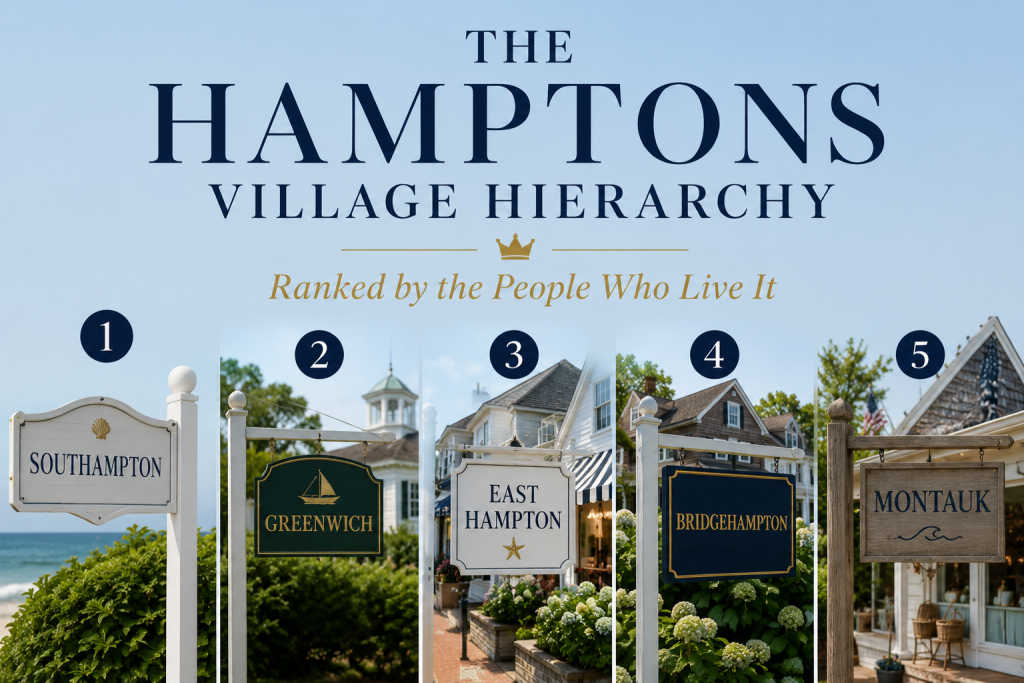
The Hamptons village hierarchy announces itself at dinner, not on a map. Last August in Springs, a guest mentioned she had “a place in the Hamptons.” The host corrected her before the salad arrived. “East Hampton,” he said. “Not the same thing.”
Everyone laughed. Still, the correction did real work. He had just placed her, gently, a rung below the table.
Outsiders hear one famous name. Locals hear a dozen villages, each ranked against the others with surgical care. The ranking is rarely spoken plainly, yet it governs almost everything out here.
Our larger map of who outranks whom covers the whole system. This guide zooms in on the geography, village by village. Because the gaps between towns are small, the policing of those gaps gets unusually sharp. Here is how the East End actually ranks itself.
The Map Outsiders Can’t See
To the rest of the country, “the Hamptons” is one glossy idea. To the people who summer here, it is a layered system of villages and hamlets. Each one carries its own rank, its own crowd, and its own quiet snobbery.
The ranking runs on history first. Towns with older money and longer pedigrees sit above the ones that boomed recently. Because age cannot be bought, the newer hot spots stay slightly suspect no matter how expensive they get.
Proximity to the ocean matters next. So does the highway line, which splits every town into a richer southern half and a humbler northern one. We break that divide down in our guide to the highway line.
Of course, the locals will deny any of this exists. That denial is itself part of the code. People secure at the top rarely discuss the rankings, while the climbers can recite them on command. So the loudest expert on village status is usually the most anxious about his own.
Southampton Sits at the Top
Southampton holds the oldest money on the East End, and it behaves accordingly. The estates hide behind privet hedges trimmed twelve feet high. The flex here is concealment, not display.
Down the road, the Bathing Corporation, the beach club locals call the Bath, keeps a waitlist measured in decades. Money cannot jump that line, since the line is the entire point. What the club sells is time, and time resists a wire transfer.
Gin Lane and Meadow Lane carry addresses that make brokers lower their voices. Yet the real signal here is restraint. A proper Southampton family drives a battered Wagoneer and never explains the dent.
For a newcomer, this is the hardest village to crack. You can buy the house on the lane. By contrast, you cannot buy the four generations who already know the gate code. The full story sits in our Southampton dossier, and its rivalry with the next town runs deep.
East Hampton’s Counter-Claim
East Hampton refuses to sit below Southampton, and it has a case. Where Southampton guards old fortunes, East Hampton courts artists, collectors, and the people who orbit them. The currency here is cultural rather than purely financial.
Knowing the painter matters more than owning the canvas. A scruffy dinner in Springs can outrank a polished gala on the ocean. Because taste is the local coin, the performance of taste never quite stops.
Further Lane and Lily Pond Lane hold the trophy houses. Still, the fluent residents downplay the trophies. They mention the historic windmill the way other towns mention the gas station.
The Southampton versus East Hampton rivalry is the oldest in the region. We settle the score, or try to, in our head-to-head breakdown. For now, treat them as co-leaders who genuinely cannot stand the comparison.
Bridgehampton in the Middle
Bridgehampton sits literally and socially between the two giants. The town has the farm stands, the polo fields, and a Main Street that gentrified fast. It reads as established without quite topping the chart.
Here the highway line does heavy lifting. South of the road you find the estate section and the ocean money. North of it the prices soften and the status cools. The same town, in other words, holds two different ranks at once.
Polo season gives Bridgehampton its loudest moment. The matches draw a crowd that wants to be seen, which is its own tell. People truly at the top tend to watch from a private box, not the general lawn.
Still, Bridgehampton is rising. New money likes its blend of farmland charm and easy access. So the village climbs slowly, even as the old guard pretends not to notice.
Sagaponack, Small and Pricey
Sagaponack is tiny, and it ranks among the most expensive zip codes in America. The potato fields gave way to mega-builds, and the per-acre prices went vertical. Few places pack this much money into so few roads.
The status here is newer than the price suggests. Much of the glossiest construction went up in the last two decades. Because the money arrived recently, the village carries a faint whiff of the parvenu despite the staggering numbers.
Old money tolerates Sagaponack more than it embraces it. The hedge-fund crowd loves the privacy and the ocean frontage. Meanwhile the older families a few miles west raise an eyebrow at the scale of it all.
For a striving newcomer, Sagaponack is the easiest top-tier address to buy into. That is precisely the problem. Anything money can purchase quickly tends to rank below the things money cannot.
Water Mill and Wainscott
Two smaller hamlets connect the giants without ever leading them. Water Mill sits between Southampton and Bridgehampton, quietly expensive and largely residential. Wainscott tucks between Bridgehampton and East Hampton, smaller still.
Neither hamlet tops the rankings, yet both hold real money. Water Mill in particular has drawn estate buyers who want acreage near Southampton without the Southampton spotlight. Because the names ring softer, the privacy runs deeper.
Wainscott plays a similar role on the eastern side. The hamlet stays low-profile by design, which suits buyers who prize discretion over recognition. So the quiet address becomes its own kind of flex.
For the newcomer, these in-between hamlets offer a useful lesson. Status is not only about the loudest village. Sometimes the smartest move is the address nobody thinks to envy.
Sag Harbor Opts Out
Sag Harbor plays a different game entirely. Once a whaling village, it now sells itself as the literate, tasteful alternative to the glossier towns. The bookstore stays open, and the marina fills with deliberate restraint.
The flex here is cultural capital worn lightly. Residents mention the writers who lived here and the history that predates the money. By rejecting the status contest, Sag Harbor cleverly scores within it.
Still, the village is changing under the same pressures. A captain’s cottage that sold for under a million in 2005 now trades several times higher. The newcomers buy the charm and slowly reshape it.
We unpack the whole “we are above all this” posture in our look at the Sag Harbor complex, with the deeper history in the Sag Harbor dossier. The short version is simple. Claiming not to play is the most advanced way to play.
Amagansett’s Studied Cool
Amagansett trades on effortless cool. Smaller and quieter than East Hampton next door, it draws a crowd that prizes the low-key over the grand. The vibe is barefoot money, not black-tie money.
The hamlet’s beaches do real status work. A stretch like Indian Wells carries cachet that the parking lot cannot explain. We rank the whole coast in our beach hierarchy guide.
Because Amagansett feels unpretentious, it attracts people who want status without seeming to want it. That is a delicate trick. The surf shacks and farm stands provide excellent cover for serious wealth.
Still, the secret is long out. Prices here now rival the bigger names, even if the sweatpants stay on. So the cool stays studied, and the cool stays expensive.
Montauk at the Edge
Montauk sits at the literal end of the island, and it insists it is not the Hamptons at all. For decades it was a working fishing town. Then the surfers came, then the brands came, and then the bottle service arrived.
That loud insistence on being different is the tell. A place secure in its rank feels no need to deny the label. By denying it, Montauk reveals how much the comparison still stings.
Today two economies sit side by side here. One remembers the fleet and wears a wetsuit. The other pays twenty-eight dollars for a cocktail at a hotel that did not exist ten years ago.
We trace that identity crisis in our Montauk status breakdown, and the longer history fills the Montauk dossier. For ranking purposes, Montauk is the rebel who still checks the scoreboard.
When the Old Order Shifts
The hierarchy is old, but it is not frozen. Prices have climbed so far across the region that the neat rankings keep getting scrambled. A modern build in a lesser hamlet can now outprice a tired cottage in a grand one.
Money is loosening the geography in real time. Buyers priced out of Southampton move east and bring their expectations with them. Because demand keeps spilling over, yesterday’s second-tier town becomes today’s contender.
Still, the old prestige lingers stubbornly. A village can lose its price advantage and keep its social one for years. So the smartest read tracks both the market and the memory, since the two no longer move together.
For a newcomer, this gap is an opening. The town that ranks just below the leader often offers the better value and the faster welcome. Sometimes the smart money buys the rung below the trophy.
How Brands Misread the Map
Brands chasing the Hamptons routinely pick the wrong village. They see one famous market and plant a flag without reading the ranks beneath it. The result often lands as tourism rather than belonging.
A label that activates in Montauk speaks to a young, loud, surf-adjacent crowd. The same label in Southampton meets old money that distrusts anything new. Because each village holds a different audience, the village choice is the strategy.
East Hampton rewards cultural fluency, while Bridgehampton rewards visibility during polo season. So a brand should match its message to the town, not just the region. A mismatch burns budget and signals outsider status at the same time.
This is exactly where a publication that knows the map earns its keep. We have placed brands in the right villages for over twenty years. The right town turns a spend into a welcome.
How to Read Your Own Rank
Now turn the map on yourself. Most readers land somewhere in the middle, with the money handled and the codes still loading. That is the common position, and it is workable.
Start by listening for how people place themselves. When a host names his village in the first ten minutes, he is handing you his coordinates. The very need to announce it tells you where he sits.
Next, watch the spending, since the loudest spend usually reads as the newest money. The deeper signals live in our companion guide to the new-money divide. Reading them correctly is the difference between fitting in and standing out the wrong way.
The good news is that village rank is not destiny. Cultural capital can be learned, even when it cannot be bought outright. So the goal is not the flashiest address. It is knowing exactly what your address says before you open your mouth.
Where The Conversation Continues
You now hold the map most people out here pretend not to consult. The Hamptons village hierarchy rewards the person who reads it and quietly sorts the one who does not. The choice is which of those you intend to be this season.
If you are a brand choosing where to activate, or a host choosing where to plant a flag, the village matters as much as the budget. Pick the wrong town and the spend reads as tourism. We have covered these gates for over twenty years, and we know which ones actually open.
The season is short, and the right rooms fill early. Tell us what you are building, and we will show you where it lands on the map. The ones who ask now are the ones placed well later.
Author

Written by
Recent Posts

The Activist Education: Board Seats, 13Ds, and the Decade That Built Friendly Activism
The Hamptons Village Hierarchy, Ranked by the People Who Live It

The Noodles & Company Campaign: A Friendly Activist Fight in Real Time

Inside Galloway Capital Partners: The Deep Value Machine, Documented

New Money vs Old Money: The Hamptons Status Divide Nobody Explains