
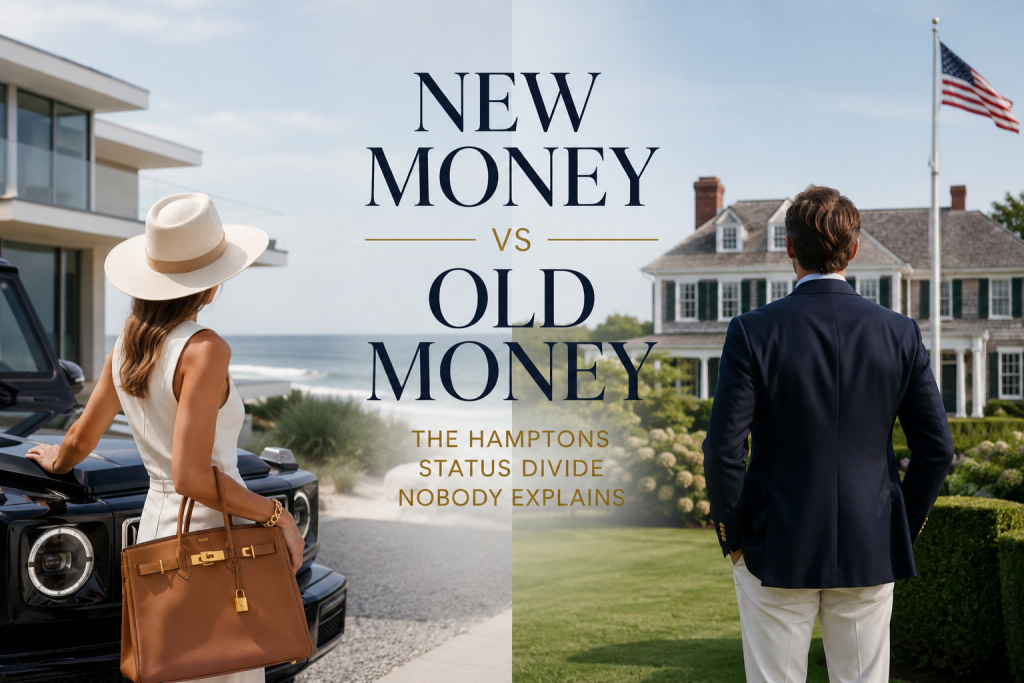
New money in the Hamptons arrives loud. Last summer a man parked a chrome-wrapped supercar outside a Bridgehampton farm dinner. He wanted the room to notice, and the room did. It noticed exactly the wrong thing.
Two tables over sat a woman worth ten times as much. She had driven a fifteen-year-old Wagoneer with a cracked dash. Nobody photographed her car, which was the entire point.
That contrast is the deepest fault line out here. Old money and new money read status through opposite lenses. One treats wealth as an achievement to display. The other treats it as weather it has always lived in.
Our broader map of the social order sets the scene. This guide drills into the single rift that matters most. Here is how the two tribes spend, signal, and silently judge each other.
Two Ways to Wear a Fortune
Old money and new money are not really about the size of the account. Plenty of new arrivals out-earn the old families by a wide margin. The divide is about how wealth is worn, not how much exists.
Old money treats money as a fact of life, like the tides. It needs no announcing, because it has always been there. New money treats wealth as a recent victory worth marking. The instinct is to show the world how far you have come.
Neither instinct is wrong, exactly. Still, only one of them writes the rules out here. The old guard set the codes generations ago, and they grade everyone else against them.
So the newcomer faces a quiet exam he did not sign up for. Every choice becomes an answer. The deeper system behind it sits in our pillar on the local hierarchy.
How Old Money Spends
Old money spends on permanence and ignores the rest. It repairs the roof, maintains the boat, and lets the kitchen stay charmingly dated. The goal is preservation, not impression.
Clothing follows the same logic. A frayed pair of Nantucket-red shorts and a decades-old barn jacket signal belonging better than anything new could. Because the wearer has nothing to prove, the wear itself becomes the flex.
Spending stays deliberately quiet. The membership, the land, and the education all cost enormous sums, yet none of it shouts. Money flows toward things that compound slowly and disappear from view.
This is cultural capital in its purest form. We catalog the specific signals in our field guide to money tells. The pattern underneath them all is restraint as a status weapon.
How New Money Spends
New money spends on proof. The instinct is to convert success into something visible, and fast. The car, the watch, and the renovation all broadcast a single message. I made it.
These choices skew toward the pristine and the labeled. A brand-new Range Rover, a logo handbag, and an imported-marble kitchen all read as recent arrival. Because the wealth is fresh, the urge to display it runs strong.
There is nothing shameful in any of this. In fact, the energy of new money keeps the whole region liquid. Still, the spending pattern stays legible from across the lawn.
The renovation is the loudest signal of all. We break down those choices in our renovation tells guide. The house, even more than the car, announces which tier you think you are joining.
The Car in the Driveway
Few objects sort people faster than the car out front. Old money favors the worn and the practical. A salt-faded Wagoneer or a dented Volvo wagon reads as belonging, not poverty.
New money favors the new and the conspicuous. A freshly leased supercar announces arrival before the driver says a word. By contrast, the old guard reads that same car as a confession.
The logic feels backward to outsiders. Spending more on the flashier car can move you down rather than up. Because the loudest purchase reads as the least secure, restraint quietly wins.
None of this is fair, and none of it is going away. The car is simply the first tell anyone sees. So the smart newcomer learns to read it before buying his own.
The House as Confession
If the car is the first tell, the house is the lasting one. Every renovation choice announces which tribe you think you are joining. The materials talk louder than the square footage.
Old money preserves. A 1920s porch stays, the original floors stay, and the quirks become points of pride. The message is that the house has history, and so does the family.
New money rebuilds. Out come the walls, in goes the marble, and the reveal lands on social media. Because the house is new to them, making it pristine feels like the natural move.
The deeper read is the one Bourdieu offered decades ago. The home is a statement of cultural capital, written in stone and tile. We decode the specifics in our renovation breakdown.
The Clothes Tell On You Too
Dress codes out here run on inversion. The more expensive the crowd, the more casual the uniform tends to look. A faded polo can outrank a designer outfit at the same lunch.
Old money dresses to disappear into its own kind. The pieces are good, quiet, and often old, since longevity is the entire signal. Logos are treated as something close to bad manners.
New money dresses to be recognized. The labels are visible, the pieces are current, and the effort shows. Because the wardrobe is meant to be read, it gets read instantly.
For a fashion brand chasing this market, the lesson is sharp. The Hamptons rewards quiet confidence over obvious flash. So the smartest labels whisper to this crowd rather than shout.
The Party Problem
Entertaining splits the two tribes as cleanly as the cars do. Old money hosts quietly, often at home, with a guest list that signals more than the menu. The point is who is in the room, not how it looks online.
New money hosts to be seen. The party is bigger, the production is glossier, and the photos circulate by morning. Because the event is partly a broadcast, the spectacle becomes the message.
Still, both kinds of party do real work. An invitation is social capital made visible, since it cannot be bought at the door. So the guest list quietly ranks everyone on it.
For the founder in our opening story, this was the trap. He threw the louder party and drew the smaller crowd that mattered. Of course, the room he wanted was busy at a quieter table down the lane.
Why Old Money Sets the Rules
Here is the part newcomers find unfair. The old guard wrote the codes, so the old guard keeps winning by them. The rules reward exactly what they already have.
This is what Bourdieu called symbolic power. The dominant group defines good taste in its own image, then treats that definition as natural. Everyone else ends up chasing a standard set against them.
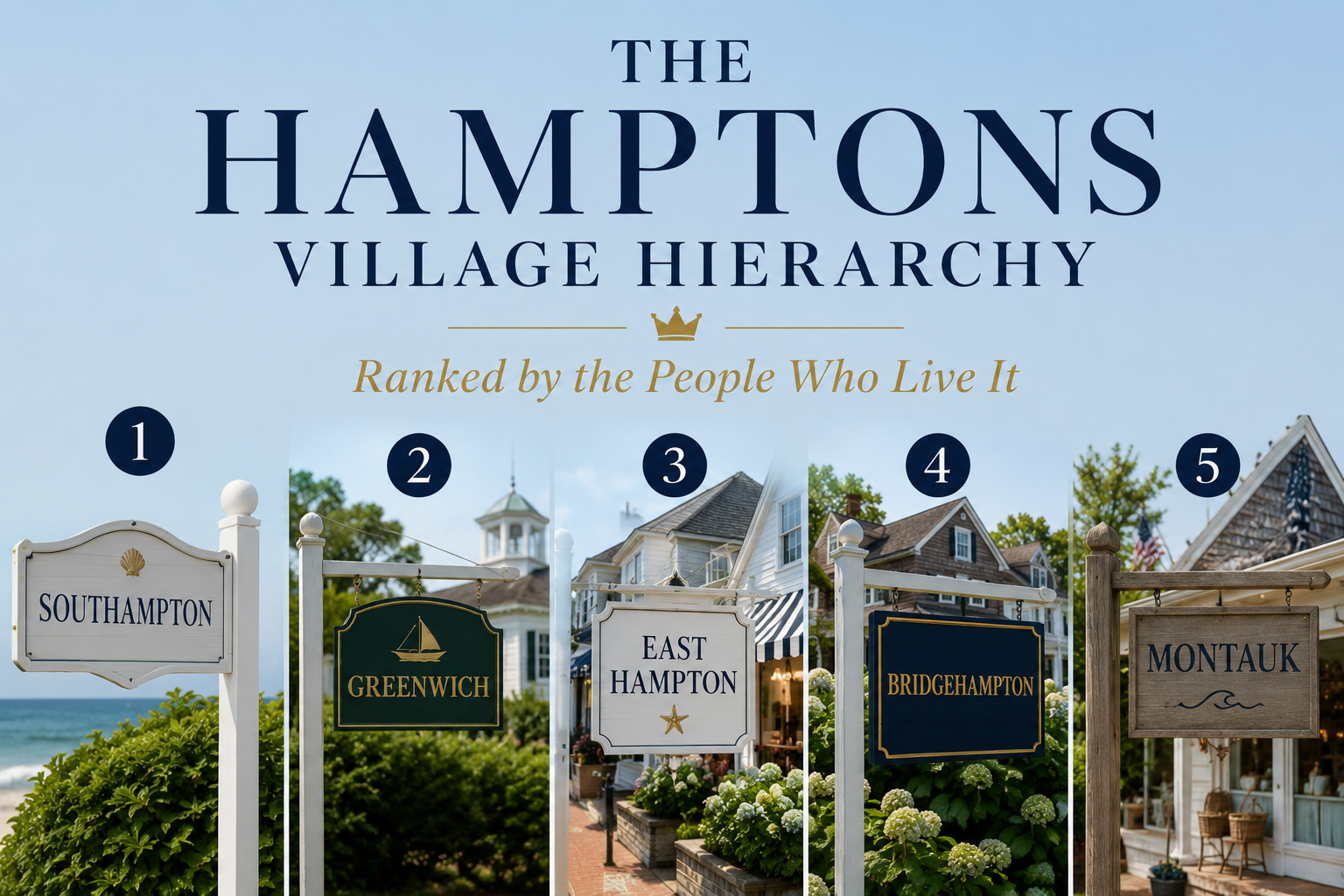
The villages reinforce it, since the oldest towns sit highest. Our guide to the village ranking maps that geography in detail. Place and tribe end up telling the same story.
Still, the monopoly is softer than it looks. Codes can be learned, even when bloodlines cannot. So the smart play is not to out-spend the old guard. It is to out-read them.
The Money You Cannot See
The loudest spending is rarely the most powerful. Old money pours real fortunes into things that never show up in a photo. The club dues, the land, and the quiet tuition all cost more than any car.
This invisible spending is the point. By routing money into things outsiders cannot see, the old guard keeps its status legible only to insiders. Because the signals stay private, they cannot be copied with a quick purchase.
New money tends to invert this pattern. The budget flows toward the visible, while the invisible memberships take years to access anyway. So the spending shows, even when the standing does not yet exist.
The lesson for a newcomer is counterintuitive. Sometimes the smartest dollar is the one nobody can see you spend. Quiet investment compounds into belonging faster than any flashy buy.
How New Becomes Old
The good news for newcomers is that the line is permeable. Today’s new money becomes tomorrow’s old money, given time and the right behavior. Every old family was new once.
The path runs through restraint and patience. The arrival who listens more than he spends climbs faster than the one who throws the biggest party. Quiet years build more standing than loud ones.
Institutions speed the process. Aligning with a club, a cause, or a publication the old guard already trusts transfers some of that trust to you. Borrowed legitimacy is the closest thing to a shortcut out here.
So the question is not whether you started as new money. Almost everyone did. The real question is whether you are learning the codes or just spending against them.
Where the Two Tribes Meet
For all the friction, old and new money do share certain rooms. The charity gala, the marquee match, and the right club event bring the tribes together under one tent. These crossover moments are where status actually gets traded.
Events do the mixing that daily life avoids. A well-placed sponsorship can put a newcomer beside the old guard for an evening, which is worth more than any ad. Because the setting confers legitimacy, the alignment matters as much as the money.
This is precisely where brands win or lose. Sponsor the right event and the association lifts you, while the wrong one marks you as an outsider with a budget. So the choice of room becomes the whole strategy.
We help brands pick those rooms with care. After more than twenty years out here, we know which tents confer status and which merely cost money. The right alignment turns a check into an introduction.
The Trap of Trying Too Hard
The most common error out here is effort that shows. Trying too visibly to look established is the surest sign you are not. The strain itself becomes the tell.
Old money reads visible effort as anxiety. The over-renovated house, the too-perfect outfit, and the name-dropped membership all signal a person working to belong. Because ease is the real currency, obvious labor reads as a deficit.
New money often mistakes more for better. Yet past a certain point, additional spending actively lowers the read. So the correction is not to do more, but to do less with more confidence.
This is the hardest lesson to absorb, since it runs against every instinct that built the fortune. Still, the people who learn it move up quietly. The ones who do not keep funding the gap.
Which One Are You
Most readers sit somewhere between the two poles. The money is handled, yet the codes are still loading. That middle is the most common spot out here, and the most workable.
Be honest about your tells. The car, the watch, the renovation, and the party all send signals whether you intend them or not. Reading your own signals is the first step toward controlling them.
The aim is not to fake old money, which never works. Instead, the aim is to spend with intention rather than for applause. We map the full signal set in our money tells guide and the old-money playbook.
Get this right and doors open quietly. Get it wrong and you become a story told at someone else’s dinner. The difference is rarely the budget. It is almost always the read.
Where The Conversation Continues
You now understand the rift that organizes everything out here. New money and old money are not about your balance, but about how you wear it. The choice is which signals you send this summer.
If you are a founder who wants the right room, or a brand chasing real relevance, the move is the same. You learn the codes and borrow the legitimacy before you try to buy it. We have spent over twenty years inside these gates, and we know how new becomes accepted.
The season is short, and the right alignments fill early. Tell us what you are building, and we will show you the quiet path in. The ones who ask now are the ones who belong later.
Author

Written by
Recent Posts

The Activist Education: Board Seats, 13Ds, and the Decade That Built Friendly Activism
The Hamptons Village Hierarchy, Ranked by the People Who Live It

The Noodles & Company Campaign: A Friendly Activist Fight in Real Time

Inside Galloway Capital Partners: The Deep Value Machine, Documented
New Money vs Old Money: The Hamptons Status Divide Nobody Explains