
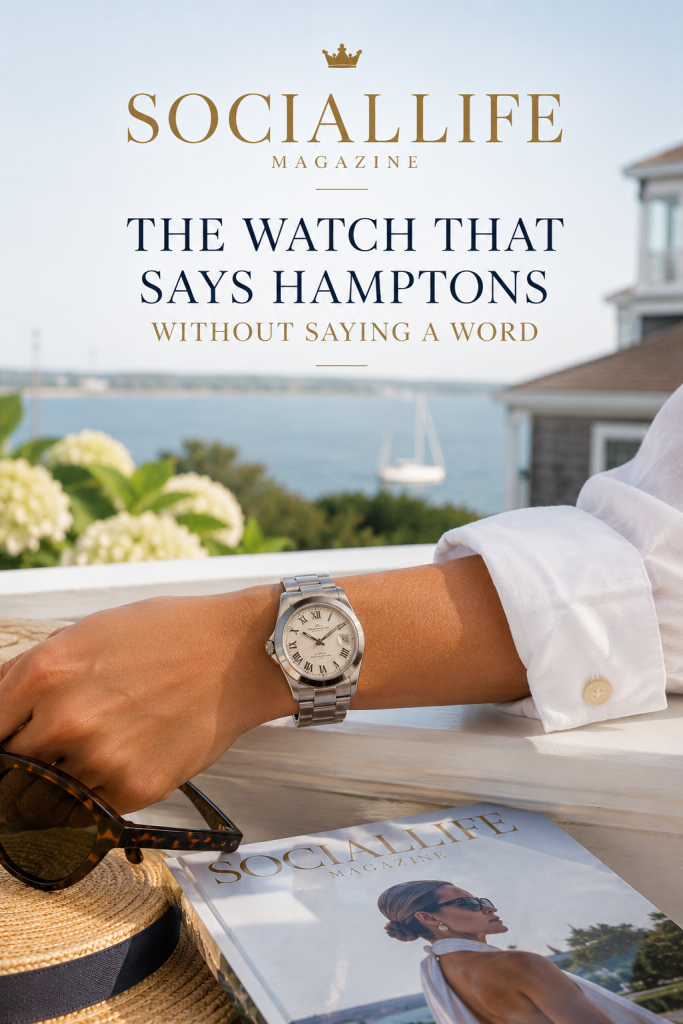
A man’s watch is the one loud allowance the Hamptons grant him, which is exactly why the luxury watch Hamptons men actually respect tends to whisper. He cannot wear a logo. He cannot flash a label. The watch is the single place his taste gets to speak, so it has to speak in the right register. And the right register out here is low, old, and almost embarrassingly understated.
This is counterintuitive to anyone new. The instinct of recent money is to buy the watch everyone recognizes, the one that announces its price across a room. But the fluent move runs the other way. The watch that wins out here is the one most people would not even clock, recognized only by the few who actually know.
The One Thing a Man Is Allowed to Spend On
Menswear in the Hamptons is a study in restraint. The clothes are quiet, the colors are muted, the labels are hidden. The watch is the exception, the one piece a man is permitted to obsess over.
Because it is the only outlet, the watch carries enormous weight. It is where a man signals his taste, his patience, and his understanding of the codes. A great watch on the wrong wrist still reads wrong. A modest one on the right wrist can read perfectly, because context is everything out here.
So the stakes are higher than the price tag suggests. The watch is a single sentence about who a man is, worn where everyone can read it. Get the sentence right and the room nods quietly. Get it wrong, too loud or too obvious, and the same room files him away before he has finished his drink.
Why Vintage Beats New
The fluent wrist almost always wears something old. A vintage piece carries a story a new watch cannot buy, and story is the currency that matters here.
An inherited watch is the gold standard, literally passed down, scratched in the right places, worn by a father first. Failing that, a carefully chosen vintage reference does the same work. It says the owner values time, history, and patience over the easy thrill of the brand-new. These are precisely the values old money likes to perform.
New money tends to buy the latest release, fresh from a waitlist, still gleaming. Yet gleam is the tell. The fluent wrist looks lived-in, because lived-in implies tenure, and tenure cannot be expedited at any price. A watch that looks like it has kept time for forty years says more than the most expensive thing released this morning.
Steel Over Gold
The metal matters, and the rule surprises people. Out here steel quietly outranks gold, which inverts the logic almost everywhere else.
Gold announces. It catches light, it photographs loud, it tells a room what it cost. Steel does the opposite. A steel sports watch reads as serious, sporting, unbothered by its own value, and that nonchalance is the whole point. The man in steel looks like he has better things to think about than his wrist.
There are exceptions, of course. A thin gold dress watch under a cuff at a black-tie benefit can be perfect, a Piaget Altiplano slipping out of sight as smoothly as it slipped into the sleeve, because the setting earns it. Still, for daylight, for the boat, for the long Hamptons Saturday, steel wins. So the lesson for a maison is simple. The piece this market reaches for is the understated steel reference, not the gleaming statement in gold.
The Price Is the Quietest Part
Money is the loudest thing nobody mentions, and the watch is where the silence gets most expensive. A quiet steel reference can cost more than a car and look like almost nothing on the wrist. The whole point of the spend is to make the spend invisible.
This inverts the usual logic of a luxury purchase. In most markets the price wants to be seen. Here the price wants to vanish, because vanishing is the more advanced move. The watch a stranger would never price is often the one that cost the most, and that gap is the entire game.
A maison should sit with that gap before it plans a Hamptons season. The customer here is not paying for recognition from the crowd. Instead he is paying for recognition from the few, and for the confidence of needing nothing from the rest. Build the piece that rewards the knowing eye, price the quality in, design the noise out, and you have made exactly the object this market respects.
The Refusal of the Obvious
The most fluent move of all is the refusal. The man who could buy the obvious grail and chooses something quieter is making the strongest statement in the room.
He skips the watch everyone wants and selects the one only collectors recognize. The smaller size appeals to him when the trend says large. And he passes on diamonds entirely, because set stones read as new money trying too hard. Each refusal is a flex disguised as modesty.
This is the deepest layer of the wrist code. Anyone with means can buy the famous watch. Only the truly fluent have the confidence to skip it for something better understood by fewer people. The refusal says the owner does not need the applause, and not needing the applause is the rarest signal a man can send out here.
The Strap Tells the Story
People obsess over the watch and forget the strap, but the strap is half the sentence. The fluent wrist treats the strap as a quiet lever, swapped to suit the day rather than left as the boutique sold it.
A worn leather strap, gone soft and dark with age, reads as years of wear. A simple fabric strap reads as ease, the watch dressed down for the beach on purpose. Notably, the metal bracelet stays for the city, a little formal for a barefoot Saturday. The strap is where a man shows he actually wears the thing rather than displaying it.
For a brand, the strap is an underrated opening. It is a small, low-cost way to let a customer make a serious watch his own. So offer the worn leather, the easy fabric, the options that let a piece dress up and down across a Hamptons day. The man who can adapt his watch to his life keeps it on his wrist far longer.
The Women Wear Watches Too
The wrist code is not only a men’s game, though it often gets framed that way. Women out here read and wear watches with the same fluency, and the rules rhyme.
The fluent woman often chooses a slim, classic piece, a Cartier Tank, a whisper-thin Piaget, or an inherited vintage reference, worn as jewelry rather than as a gadget. She may borrow from the men’s side entirely, a slightly oversized steel sports watch on a delicate wrist, which reads as confident and a little subversive. Either way, restraint wins. The diamond-crusted statement watch reads new, here as everywhere else.
For a maison, this is a quietly large opportunity. The women’s market for serious watches stays underserved and grows fast, full of buyers who want a real piece rather than a bedazzled accessory. So make the elegant reference for her too, keep it understated, and you reach a customer most of the industry still overlooks.
What the Watch Says at the Dinner Table
The wrist gets read everywhere, but nowhere more closely than at the dinner table. Reaching for a glass, resting a hand on the linen, a man shows his watch a hundred times an hour without meaning to.
The fluent read it instantly. They clock the reference, the patina, the choice of strap, and they form a quiet opinion before the first course. None of it gets said aloud. Yet the read is real, and it shapes how the table receives the man wearing it.
This is why the watch is never only about telling time. It is a credential worn in plain sight, decoded by exactly the people a man most wants to impress. The right watch opens a door before he speaks. The wrong one, too shiny or too obvious, quietly closes one, and he may never know it shut.
How the Watch Travels From Feed to Wrist
The wrist code does not form in a vacuum. It travels, the same way every other trend reaches the East End. A watch surfaces on a collector’s account, in the slow churn of horology videos, on the wrist of someone the culture cannot stop watching.
From there it moves to the people who notice such things first, then to the wider room, then to the Hamptons, where the look gets its final approval. By the time a reference is everywhere, the earliest adopters have already moved to the next quiet thing. So the fluent watch the conversation closely and act before it crests.
This matters for any maison reading the market. The wrist is the end of a long conversation that began somewhere louder and earlier. Watch that conversation, place the right reference into the right hands before the season, and you reach the Hamptons wrist already approved. Arrive late and you are merely the watch everyone already has.
The Wrist at the Polo
Nowhere is the wrist read more carefully than at the polo. A summer afternoon at Polo Hamptons is exactly the stage a sports watch was built for, all daylight, grass, and a crowd that knows the difference.
This is the watch’s native habitat. The steel sports reference, born for action and worn with ease, looks completely at home against a linen sleeve and a glass of something cold. A gold dress watch would feel wrong here, too formal for the grass, too eager for the hour. The field rewards the unbothered.
For a maison, the polo is the ideal room. The crowd is affluent, knowledgeable, and gathered in one place for an afternoon of looking closely at one another. A watch seen on the right wrist at the field travels by conversation for weeks afterward. So the smartest placement is never a banner at the edge of the grass. Instead it is the reference on the wrist that the whole tent quietly notices.
The Maisons That Win the Wrist
Here is the lesson for any watch or jewelry house plotting a Hamptons season. The wrist is not won with a billboard or a loud campaign. It is won by understanding the code and respecting it. A maison like Piaget grasps this, building the thin, discreet piece the fluent wrist reaches for instead of the loud one it avoids.
The maisons that win make the understated reference and let it speak quietly. They resist the urge to shout the price. They place the right piece on the right wrist at the right dinner, then let the collectors in the room carry the word outward. That word of mouth converts better than any ad, because it arrives as expertise rather than as marketing.
So the strategy is patience over volume. Make something quietly exceptional, place it where the fluent gather, and become the name the knowledgeable pass along. The houses that grasp this own the Hamptons wrist for decades. The houses still shouting their logo keep wondering why the most discerning customer in the country keeps choosing something quieter. We make exactly these introductions for a living.
Where The Conversation Continues
The watch is one fluent sentence in a much larger language. To read the rest, start with our pillar on the Hamptons summer style codes money can’t fake, then go deeper on the bag everyone will be carrying across Bridgehampton and what this year’s best-dressed list says about summer on Meadow Lane. The wrist code is already being read at every table out here. The only question is whether your maison is the one the room respects, or the one it politely overlooks.
Author

Written by
Recent Posts

AI for personal finance: where PennyGuard fits

How to Pick a Homecoming Dress for Your Body Type (and Feel Amazing in It)

World Cup Injury Attorney for Vancouver Events
What a 3-Carat Engagement Ring Actually Costs in 2026: The Real Numbers
The Skincare Habits That Make a Real Difference Over Time
Categories
- Art
- Articles
- Business of Luxury
- Celebrities
- Culture
- Entertainment
- Events
- Faces of Summer 2026
- Fashion
- Fashion & Style
- Featured
- Finance
- Food, Spirits, Wine
- Hamptons
- Hamptons Celebrities
- Health
- Health & Beauty
- Lifestyle
- Luxury Lifestyle
- Press
- Profiles
- Real Estate
- Technology
- The Chronicles
- Travel
- Uncategorized
- Weddings