
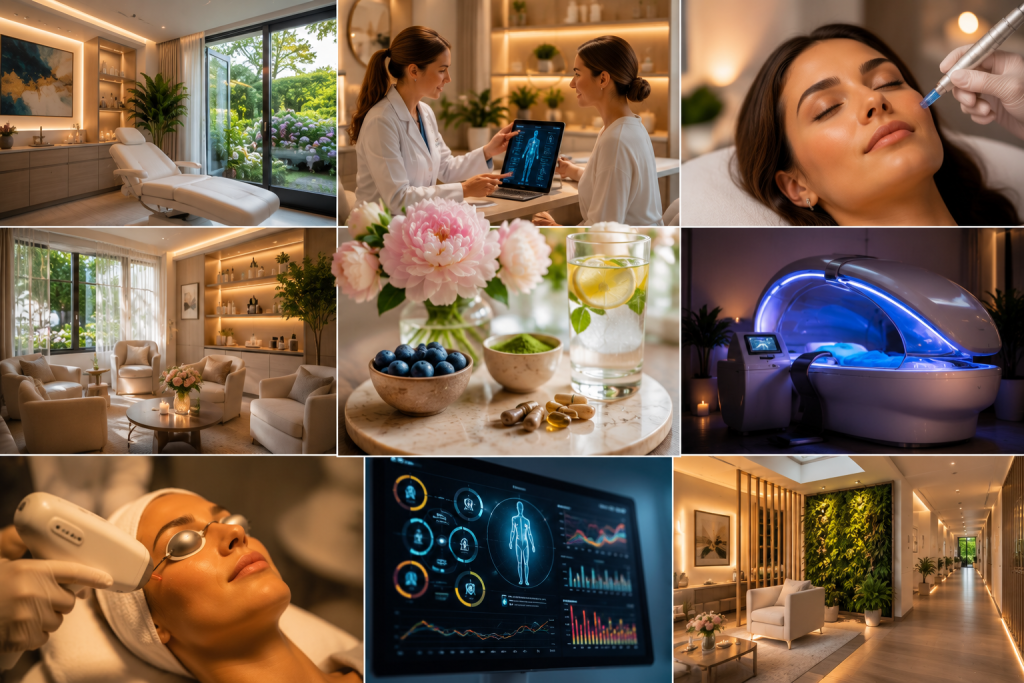
A medspa owner in Southampton called it the “menu creep.” First, a client asked about NAD+ drips after reading a Bryan Johnson post on X. Then another asked about peptide therapy after her concierge doctor mentioned it. Then three clients in one week asked about GLP-1 prescriptions for weight management. The requests kept coming, and none of them had anything to do with Botox, fillers, or laser resurfacing. They had everything to do with longevity. The medspa longevity clinic upgrade is not a theoretical pivot. It is already happening on the East End, and the operators who recognize it earliest will capture the largest share of a market projected to reach $83.9 billion by 2033.
The Global Wellness Institute confirmed in 2024 that longevity is the fastest-growing vertical in the wellness space. Technavio’s research shows that medspas integrating regenerative aesthetics report up to 15% higher average revenue per client. Those offering holistic wellness and preventative care see client retention rates 25% higher than centers providing standard procedures alone. The data is unambiguous. Clients are not leaving medspas. They are asking medspas to become something more. And the medspas that answer will own the next decade of the longevity economy.
The Pipeline: From Aesthetics to Optimization
Every successful medspa already possesses the infrastructure that a longevity clinic requires. A medical director with prescriptive authority. Clinical staff trained in injection protocols. A client base that trusts the practice with procedures involving needles, lasers, and prescription-grade compounds. Private consultation environments. Scheduling systems. Payment structures built for premium services. The medspa longevity clinic upgrade does not require tearing down the existing business. It requires adding a floor on top of it.
The upgrade path follows a predictable sequence. Tier one: add IV nutrient therapy and NAD+ infusions to the existing menu. These require minimal additional equipment (an IV pole, clinical-grade compounds, and a trained nurse) and generate $200 to $1,000 per session. Tier two: introduce peptide therapy consultations, hormone optimization, and GLP-1 weight management programs. These require a physician or nurse practitioner with prescriptive authority and generate $300 to $750 per consultation plus ongoing prescription revenue. Tier three: install a hyperbaric oxygen chamber, offer epigenetic testing, and develop comprehensive longevity assessment packages priced at $5,000 to $20,000.
Each tier builds on the previous one. Each generates higher revenue per client. And each attracts a client who is spending more, staying longer, and returning more frequently than the standard aesthetics customer. The math is not complicated. A client spending $500 on a quarterly filler appointment is worth $2,000 per year. That same client, upgraded to a longevity protocol that includes monthly NAD+ infusions, quarterly peptide consultations, and an annual comprehensive assessment, is worth $15,000 to $30,000 per year. The medspa longevity clinic upgrade does not replace the aesthetics revenue. It multiplies it.
What Your Clients Are Already Asking For
The demand side of this equation is not theoretical. The top medspa trends for 2026 center on personalization, performance, and prevention. IV therapy, GLP-1 weight management, hormone optimization, and male aesthetics are reshaping how modern medspas grow revenue and retain clients. These are not marginal additions. They are the categories driving the fastest growth across the industry.
GLP-1 receptor agonists (semaglutide, tirzepatide) represent the most visible demand signal. Clients who lost 30 pounds on these medications now need skin tightening, facial volume restoration, and body contouring. Some medspas bundle complementary treatments with weight loss plans, offering skin tightening sessions alongside GLP-1 prescriptions or facial fillers to address the facial volume loss that rapid weight reduction can cause. The weight management client becomes the aesthetics client becomes the longevity client. The pipeline feeds itself.
OpenLoop, a clinical infrastructure company built specifically for medspas, now enables practices to offer GLP-1 weight management, hormone replacement therapy, testosterone replacement therapy, and longevity programs without changing scope, staffing, or operations. Their pitch at the 2025 American Med Spa Association conference was direct: “Your patients know you. They trust you. And increasingly, they’re asking for more: weight, hormones, longevity, and whole-health support.” That “more” is the medspa longevity clinic upgrade in three words.
The Revenue Math That Changes Everything
The global medspa market reached $21.47 billion in 2025, up from $18.88 billion in 2024. By 2033, projections put the market at $83.9 billion, growing at 15.7% compound annual growth rate. That growth is not coming from more Botox. It is coming from the expansion of services into wellness, prevention, and longevity, the exact categories that the medspa longevity clinic upgrade opens.
Revenue per client tells the clearest story. A standard aesthetics client generates $1,500 to $3,000 annually through fillers, neurotoxins, and laser treatments. By contrast, a longevity-integrated client generates $8,000 to $30,000 annually. That total includes aesthetic treatments plus NAD+ infusions ($500 to $1,000 each, monthly), peptide protocols ($300 to $750 per consultation, quarterly), GLP-1 management ($300 to $500 monthly), and comprehensive assessments ($5,000 to $20,000 annually). A practice converting just 20% of its existing client base to longevity-integrated protocols can double its revenue without acquiring a single new customer.
Client retention reinforces the economics. Medspas offering holistic wellness services retain clients at rates 25% higher than those offering only standard procedures. The reason is structural: an aesthetics-only client visits quarterly. A longevity client visits monthly. More touchpoints mean more trust, more referrals, and more opportunities to introduce additional services. The lifetime value calculation shifts dramatically when the relationship extends beyond the injection chair.
Who Is Already Moving on the East End
Hamptons BioMed at 223 Hampton Road in Southampton made the full leap from day one. Their service menu includes NAD+ drips, peptide therapies, exosomes, hyperbaric oxygen, red light therapy, epigenetic counseling, and the Human Regenerator Bed. They opened a second location on the Upper East Side in January 2026. Their model is not a medspa that added longevity. It is a longevity clinic that was built from the ground up. For existing medspa operators, Hamptons BioMed represents both the competitive threat and the proof of concept.
LIVBETTER in Southampton blends aesthetics with wellness optimization. Rejuvalift Aesthetics offers non-invasive body sculpting alongside skin rejuvenation. Wave Social Wellness combines therapeutic treatments with community programming. Each of these operators occupies a different position on the medspa-to-longevity spectrum, and each is moving in the same direction. The category boundary between aesthetics and optimization is dissolving.
Mobile concierge providers like Wellness IV Hamptons and Concierge Wellness serve the overflow. When fixed-location clinics book out during the summer season, concierge services deliver IV drips, NAD+ infusions, and peptide injections directly to clients’ homes and rentals. The concierge tier does not compete with clinic-based medspas. It validates the demand thesis: there are more clients seeking longevity services on the East End than the current infrastructure can serve. For operators considering the upgrade, that supply-demand gap is the opportunity.
The Compliance Question
Adding longevity services to a medspa is not without regulatory complexity. NAD+ infusions, peptide prescriptions, and GLP-1 management all require physician oversight. Hormone optimization and testosterone replacement therapy carry additional compliance requirements. The 2025 American Med Spa Association conference made physician oversight, HIPAA adherence, informed consent, and documentation a central theme, reflecting both the opportunity and the responsibility that comes with expanding into clinical wellness.
The solution for most operators is not hiring a full-time physician. It is partnering with a medical director service or a clinical infrastructure platform. Companies like OpenLoop provide the physician oversight, compliance management, and prescriptive authority that enable medspas to offer longevity services within their existing operational framework. The model works because it separates the clinical expertise (which requires a physician) from the treatment delivery (which the medspa staff already handles). For operators who want the revenue without the regulatory headache, this is the path.
Social Life Magazine does not endorse specific medical services or compliance frameworks. What we report is that the operators succeeding in the medspa longevity clinic upgrade are those who take the regulatory requirements as seriously as the revenue opportunity. East End clients are sophisticated enough to ask questions about credentials, protocols, and oversight. Practices that answer those questions convincingly will win their trust and their business.
The 18-Month Window
Every market transition has a window. The medspa longevity clinic upgrade window is open now and will narrow as early movers establish client relationships and brand positioning that late entrants cannot easily replicate. Gwyneth Paltrow’s Goop launched a NAD+ moisturizer in January 2026. The consumer who bought that moisturizer will ask her aesthetician about NAD+ infusions by June. Daymond John’s Fortune profile in March 2026 introduced cold plunges and hyperbaric oxygen to millions of readers. Those readers are scheduling consultations right now.
The demand is not coming. It is here. For East End medspa operators, the question is whether your practice is positioned to capture it. Equipment investment for tier one (IV therapy and NAD+) is modest. Clinical partnerships required for tier two (peptides, hormones, GLP-1) are available through existing infrastructure providers. The revenue impact, based on industry data showing 15% higher revenue per client and 25% better retention, is documented. What remains is the decision.
Social Life Magazine reaches 25,000 readers per issue across five summer editions distributed from Westhampton to Montauk, plus Fall/Winter editions delivered to UES doorman buildings. The audience overlap between our readership and the premium wellness client base is structural. If your practice is making the upgrade, we want to tell the story.
Where The Conversation Continues
The medspa-to-longevity-clinic pipeline is not a trend piece. It is the defining business story of the wellness industry in 2026. Social Life Magazine covers the full spectrum, from the billionaires funding the science to the clinics delivering the treatments to the operators building the businesses that connect the two.
If you own or operate a medspa, regenerative clinic, or wellness practice on the East End and want editorial coverage, partnership opportunities, or advertising adjacency to this content, reach out at [email protected].
For brands seeking premium visibility, explore our Paid Feature options. A feature in Social Life Magazine positions your practice alongside the longevity conversation shaping the East End.
Stay current at sociallifemagazine.com.
Polo Hamptons returns July 18 and 25, 2026, at 900 Lumber Lane, Bridgehampton. BMW is the title sponsor. Wellness brand activations are open for partnership. For sponsorship inquiries, visit polohamptons.com.
Already a reader? Subscribe to Social Life Magazine for five summer issues and Fall/Winter editions.
Support independent East End journalism via PayPal.
Frequently Asked Questions
How can a medspa add longevity services?
The medspa longevity clinic upgrade follows a three-tier path. First, add IV nutrient therapy and NAD+ infusions (minimal equipment, $200 to $1,000 per session). Second, introduce peptide therapy, hormone optimization, and GLP-1 weight management (requires physician or NP oversight, $300 to $750 per consultation). Third, install a hyperbaric oxygen chamber, offer epigenetic testing, and develop comprehensive longevity assessment packages ($5,000 to $20,000). Each tier builds on the previous one and generates progressively higher revenue per client.
How much more revenue can longevity services generate for a medspa?
A standard aesthetics client generates $1,500 to $3,000 annually. A longevity-integrated client generates $8,000 to $30,000 annually through the same aesthetic services plus NAD+ infusions, peptide protocols, GLP-1 management, and comprehensive assessments. Research shows medspas integrating regenerative aesthetics report up to 15% higher average revenue per client and 25% better client retention. Converting 20% of an existing client base can potentially double practice revenue.
What compliance requirements apply to longevity services in a medspa?
NAD+ infusions, peptide prescriptions, GLP-1 management, and hormone optimization all require physician oversight. HIPAA adherence, informed consent, and proper documentation are required. Most operators partner with medical director services or clinical infrastructure platforms (such as OpenLoop) that provide physician oversight and compliance management, enabling the medspa to offer longevity services within its existing framework without hiring a full-time physician.
What longevity services are most in demand at medspas?
The fastest-growing longevity services at medspas in 2026 are GLP-1 weight management programs, IV nutrient therapy and NAD+ infusions, peptide therapy consultations, hormone optimization (HRT and TRT), and comprehensive wellness assessments. Industry data from the American Med Spa Association and multiple market research firms confirms that clients increasingly expect medspas to offer whole-health support beyond traditional aesthetics. Preventative care and biological optimization are the primary demand drivers.
Author

Written by
Recent Posts
Periorbital Biorevitalization: Top Methods for Combating Dark Circles

Why a Natural-Looking Hairline Matters More Than a Perfect Haircut

Melanotan 2 and the Regulatory Grey Zone: What Research Buyers Should Understand
Discovering the Elegance and Durability of Slate Roof Tiles
Montauk Calls Itself The End Of The Road But Ushuaia Actually Is
Categories
- Art
- Articles
- Business of Luxury
- Celebrities
- Culture
- Entertainment
- Events
- Faces of Summer 2026
- Fashion
- Fashion & Style
- Featured
- Finance
- Food, Spirits, Wine
- Hamptons
- Hamptons Celebrities
- Health
- Health & Beauty
- Lifestyle
- Luxury Lifestyle
- Press
- Profiles
- Real Estate
- Technology
- The Chronicles
- Travel
- Uncategorized
- Weddings