
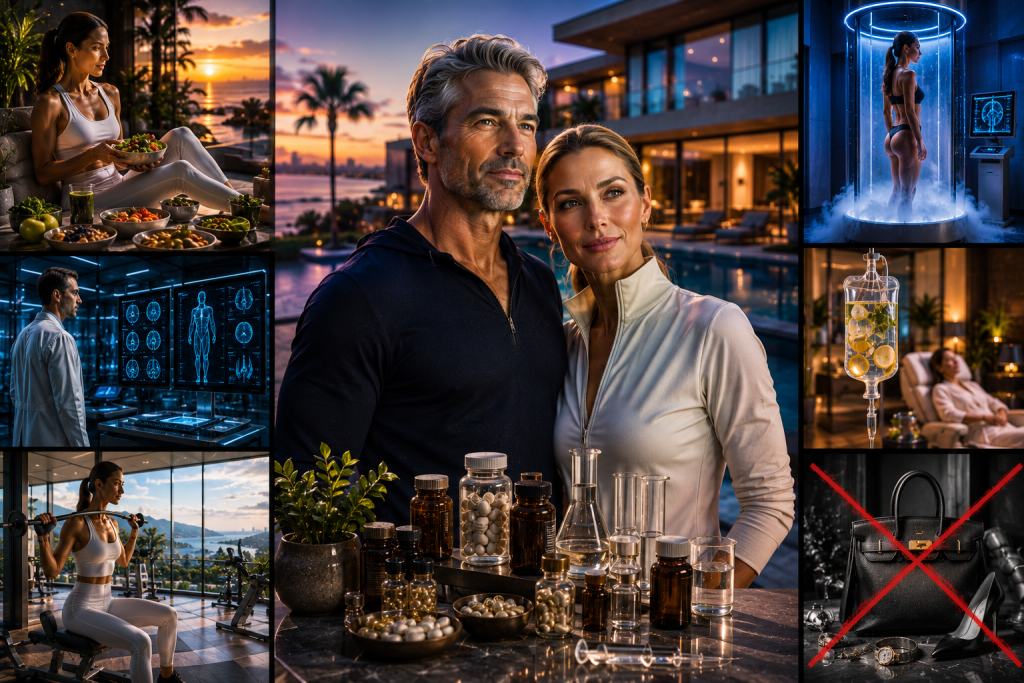
For most of the last century, status on the East End followed a legible script. The address telegraphed the money. A car confirmed it. The watch quantified it. A woman carrying a Birkin at the Bridgehampton Classic did not need to say anything about her household income. The bag said it for her. Status was material, visible, and above all purchasable. If you had the money, you could buy the signal. If you bought the signal, you had the status. The system was simple, elegant, and completely inadequate for what came next. Because the longevity status symbol wealth equation operates on a different axis entirely, and the old rules do not apply.
Bryan Johnson publishes his biological age data on the internet. His claim that his body measures younger than his 48 years is simultaneously a scientific assertion and a status performance. When he posts organ function results showing the cardiovascular system of a man in his thirties, the subtext is not subtle: I have access to something you do not, and it shows on a blood panel. The Birkin says I have money. The biological age score says I have discipline, knowledge, access, and time. One of those signals can be inherited. The other cannot.
The Bourdieu Shift: From Economic Capital to Biological Capital
Pierre Bourdieu, the French sociologist who spent his career mapping how power reproduces itself, identified multiple forms of capital that circulate in social space. Economic capital is money. Cultural capital is education, taste, and knowledge. Social capital is networks and relationships. Symbolic capital is prestige, the accumulated recognition that converts other forms of capital into status. For decades on the South Fork, the game was converting economic capital into symbolic capital through consumption: the house, the car, the membership, the wardrobe.
Longevity introduces a new currency: biological capital. Resting heart rate. VO2 max. Inflammatory markers. Epigenetic age. Hormone optimization scores. These are numbers that cannot be bought at auction, inherited from a trust, or displayed on a shelf. They require sustained investment of time, discipline, and medical sophistication. A person can buy a $300,000 car in an afternoon. Achieving a biological age 15 years younger than chronological age takes years of protocol adherence, dietary discipline, and clinical partnership.
The longevity status symbol wealth equation inverts the traditional hierarchy. Old money could always outspend new money on material goods. Longevity capital favors the person who combines wealth with agency: the willingness to restructure daily life around optimization rather than consumption. In Bourdieu’s framework, this is a new form of distinction, one that separates the merely rich from the strategically healthy. The person with the best biological age in the room may not have the biggest house. But they will outlive the person who does, which is its own form of power.
Why the Watch Lost to the Wearable
A Patek Philippe Nautilus retails for $35,000 and communicates wealth, taste, and membership in a club that recognizes what it means. An Oura Ring retails for $299 and communicates something the Nautilus cannot: data. Heart rate variability. Sleep quality. Recovery readiness. Body temperature trends. The person wearing both is making two status statements simultaneously: I can afford the watch, and I care enough about my biology to track it.
The wearable did not replace the watch. It outranked it on the status hierarchy because it introduced a dimension the watch could not access: proof of effort. The Nautilus proves you spent $35,000. The Oura proves you slept seven hours, maintained a resting heart rate of 52, and achieved a recovery score of 85. One is a receipt. The other is a report card. In a culture that increasingly values optimization over accumulation, the report card wins.
Daymond John did not become a longevity convert because it was fashionable. He became one because cancer forced him to reconsider what his body was telling him. But the cultural effect is the same. When a Shark Tank investor posts about cold plunges and 40-hour fasts, he is signaling something more complex than health consciousness. He is signaling that he has mastered a domain that money alone cannot buy. That signal carries in the rooms where deals are made, partnerships are formed, and social hierarchies are quietly negotiated over dinner in Sag Harbor.
The Gym Replaced the Club
Membership organizations have always served as status markers on the East End. The right beach club. A coveted golf membership. The right dinner party invitation list. These memberships signal belonging, which is a form of social capital. Longevity has introduced a parallel membership economy that signals something different: commitment. The person who trains at 5 AM, fasts until noon, takes 30 supplements, and tracks biomarkers monthly is performing a membership in a club that has no building, no committee, and no waitlist. The admission requirement is consistency.
Fitness was always a status signal, but it used to be aesthetic: look good in a swimsuit at Coopers Beach. Longevity reframed fitness as functional: achieve a VO2 max score that Peter Attia considers predictive of living past 90. That shift from “look good” to “live long” changed who wins the comparison. A person with the best body at 35 may be genetically gifted. The person with the best VO2 max at 55 earned it through years of zone 2 training, strength work, and cardiovascular conditioning. Effort is harder to fake than genetics, which is why the longevity status symbol carries more weight.
For the East End summer population, this shift is visible in real time. The conversation at the dinner party used to center on where you bought the house and what you paid. Now it includes what your biological age is, whether you have tried NAD+ infusions, and which clinic you use for bloodwork. The questions have not replaced the old ones. They have been added on top, creating a new layer of social currency that the traditional status markers cannot reach.
The Transparency Paradox
Old status was performative but private. You wore the watch and carried the bag. Nobody posted their bank statement. Longevity status inverts that norm. Johnson publishes his biomarker data. Paltrow shares her supplement stack on Instagram. Daymond John tells Fortune about his fasting protocol. The longevity class is radically transparent about what they do to their bodies, which creates a paradox: the more they share, the higher the barrier to entry.
When Johnson reveals that his protocol costs $2 million per year and involves 30 doctors, the transparency does not democratize access. It quantifies the gap. Knowing what he takes is free. Replicating it is not. The information is open. The implementation is gated by money, time, medical access, and discipline. Transparency without accessibility is not generosity. It is a status performance dressed as education. And on the South Fork, where the audience is wealthy enough to attempt replication but rarely wealthy enough to match Johnson’s scale, that performance lands perfectly.
The longevity status symbol wealth dynamic thrives on this paradox. Protocols are published. Supplements are named. Clinics are listed. Hamptons wellness clinics offer many of the same treatments at a fraction of the billionaire price point. A client spending $10,000 to $30,000 per summer season on NAD+ drips, peptide protocols, and comprehensive assessments is accessing 80% of the science. The remaining 20% is the margin where status lives. And in status economies, the margin is the whole game.
What Comes After the Birkin
The Birkin is not going anywhere. Material status markers persist because they are visible, immediate, and require no explanation. Biological capital is slower, subtler, and legible only to those who understand what a resting heart rate of 48 or a biological age gap of negative 12 actually means. The audience for longevity status is smaller than the audience for luxury goods. But it is wealthier, better educated, and more influential, which is exactly why it matters.
Social Life Magazine has covered status on the East End for 23 years. The currency has always shifted. Real estate replaced old money discretion. Tech money replaced real estate money. Wellness spending replaced conspicuous consumption as the marker of sophistication. Longevity is the latest iteration, and arguably the most durable, because it cannot be faked. A person can lease a car they cannot afford. Nobody can lease a biological age 15 years younger than their birth certificate.
For the brands, clinics, and practitioners building in this space, the status dimension is the commercial accelerator. Clients do not buy longevity supplements purely for health. They buy them for identity. A supplement stack is a uniform. Clinic membership is a credential. The biological age score is a score in every sense of the word. Medspas adding longevity services are not just adding revenue lines. They are adding status lines. And status, as Bourdieu understood better than anyone, is the commodity that never loses value.
Where The Conversation Continues
Status evolves. The publications that track it must evolve with it. Social Life Magazine covers the culture, the commerce, and the science of the East End because understanding how they connect is what our readers expect.
If you build, sell, or deliver in the longevity space and want editorial visibility with an audience that defines the culture, reach out at [email protected].
For brands seeking premium placement, explore our Paid Feature options.
Stay current at sociallifemagazine.com.
Polo Hamptons returns July 18 and 25, 2026, at 900 Lumber Lane, Bridgehampton. BMW is the title sponsor. For sponsorship inquiries, visit polohamptons.com.
Already a reader? Subscribe to Social Life Magazine for five summer issues and Fall/Winter editions.
Support independent East End journalism via PayPal.
Frequently Asked Questions
Why is longevity considered a new status symbol?
Longevity has become a status marker because biological capital (resting heart rate, VO2 max, biological age, inflammatory markers) cannot be bought, inherited, or faked the way material luxury goods can. Achieving superior biological metrics requires sustained investment of time, discipline, medical access, and protocol adherence. In status economies, signals that require effort carry more weight than signals that require only money. Longevity metrics prove what a luxury watch cannot: that the owner earned the result.
What is biological capital?
Biological capital is a term used to describe the health metrics and biological markers that function as status indicators in the longevity economy. These include resting heart rate, VO2 max (cardiovascular fitness), biological age versus chronological age, hormone optimization levels, inflammatory marker profiles, and epigenetic age scores. Unlike economic capital (money) or cultural capital (education and taste), biological capital requires ongoing physical effort and medical engagement to accumulate and maintain.
How does longevity status differ from traditional luxury?
Traditional luxury status is material, visible, and immediately purchasable: a watch, a handbag, a car, a home. Longevity status is biological, data-driven, and requires sustained effort. A Birkin bag can be acquired in a single transaction. A biological age 15 years younger than chronological age takes years of discipline. Traditional status signals wealth. Longevity status signals wealth plus agency, discipline, knowledge, and medical sophistication. The two systems now operate simultaneously, with longevity adding a new layer on top of traditional markers.
How does Bourdieu’s theory of capital apply to longevity?
Pierre Bourdieu identified economic, cultural, social, and symbolic capital as the currencies that determine social position. Longevity introduces biological capital as a fifth form. On the East End, the traditional status game converted economic capital (money) into symbolic capital (prestige) through consumption. Longevity disrupts this by creating a form of capital that money alone cannot produce. It requires discipline, time, and medical engagement, creating a new axis of distinction that separates the merely wealthy from the strategically healthy.
Author

Written by
Recent Posts
Skrewball Whiskey Toasts New PB&J Launch With The Blonds at NYC Halloween Bash
Periorbital Biorevitalization: Top Methods for Combating Dark Circles

Why a Natural-Looking Hairline Matters More Than a Perfect Haircut

Melanotan 2 and the Regulatory Grey Zone: What Research Buyers Should Understand
Discovering the Elegance and Durability of Slate Roof Tiles
Categories
- Art
- Articles
- Business of Luxury
- Celebrities
- Culture
- Entertainment
- Events
- Faces of Summer 2026
- Fashion
- Fashion & Style
- Featured
- Finance
- Food, Spirits, Wine
- Hamptons
- Hamptons Celebrities
- Health
- Health & Beauty
- Lifestyle
- Luxury Lifestyle
- Press
- Profiles
- Real Estate
- Technology
- The Chronicles
- Travel
- Uncategorized
- Weddings