
The Institution That Makes East Hampton Different
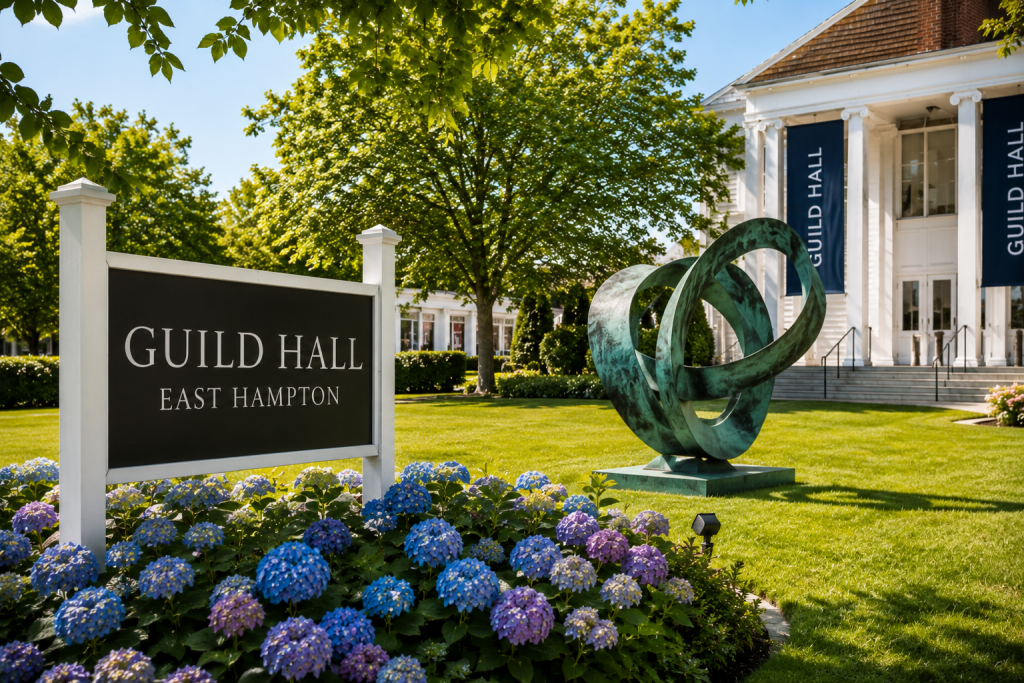
Guild Hall East Hampton is the reason the village can claim something none of its neighbors can: a multidisciplinary cultural institution that has operated continuously since 1931. Sag Harbor has Bay Street Theater. Southampton has the Parrish Art Museum in nearby Water Mill. Neither combines a performing arts theater, a visual art museum with three galleries, and an education center under one roof. Indeed, Guild Hall does all three, and it does them at a level that earned a $29 million renovation completed in 2024, restoring the building to architect Aymar Embury II’s original 1931 vision.
A literary agent from the Upper West Side (the kind who represents three novelists on the National Book Award longlist and rents a cottage on Huntting Lane every June because the address puts her two blocks from Guild Hall) walks through the restored entrance arcade on a Saturday afternoon. The aluminum doors that marred the entryway for decades have been removed. Columns have returned to the lobby, recreating the procession Embury originally intended. She is here for a reading. She will also stop in the gallery. Certainly, she considers Guild Hall her satellite office, a place where cultural capital compounds faster than it does in any Manhattan venue during the summer months.
August 19, 1931: The Opening That Changed the Village
Mrs. Lorenzo E. Woodhouse funded the building. Aymar Embury II designed it in the Georgian style: white painted brick, low-slung, facing East Hampton’s Main Street from a site that had been the homestead of Samuel Miller, a farmer. The location sat between the First Presbyterian Church and Mulford Farm, which meant Guild Hall was literally built between the village’s spiritual and agricultural foundations. Naturally, one thousand people crammed into the theater and gallery on opening night. The local paper declared that East Hampton had never known a celebration like it.
Notably, the funding came from the community itself. John “Black Jack” Bouvier (father of future First Lady Jacqueline Kennedy Onassis) was among those who raised money in five-dollar and ten-dollar contributions. The institution’s mission, as stated in its founding legal documents, was “to encourage a finer type of citizenship through the arts.” That language sounds quaint now, but in 1931 it was radical: a community gathering place that combined visual art, performing arts, and civic education in a village of fewer than a thousand year-round residents. Guild Hall was not built for the summer crowd. It was built for the village, and the summer crowd was invited to participate.
The Theater: From Tennessee Williams to Billy Porter
The theater (now the Hilarie and Mitchell Morgan Theater, originally the John Drew Theater, named after the actor who was uncle to Lionel, Ethel, and John Barrymore) is a 400-seat jewel-box proscenium stage. Notably, its ceiling is decorated in a circus-tent motif, complete with an iconic balloon chandelier that has become one of Guild Hall’s most recognizable features. During its early decades, the theater functioned as a summer testing ground for productions headed to Broadway. Tennessee Williams and Eugene O’Neill credited Guild Hall with helping establish their reputations. Edward Albee maintained a lifelong relationship with the space. Also, Terrence McNally was an active Academy member.
In the visual arts, Guild Hall served as an early showcase for then-unknown artists including Willem de Kooning and Jackson Pollock, both of whom lived in nearby Springs. The institution presented their work alongside local high school students, a practice that deliberately collapsed the distinction between world-class and community-based art. Consequently, this mixing principle became Guild Hall’s signature: a place where a summer resident who collects at Art Basel might sit next to a year-round resident who teaches painting at the Springs School. The theater now presents over 100 performances annually, spanning dance, opera, concerts, film, theatrical readings, comedy, and lectures. Billy Porter reopened the renovated theater in 2024.
She finds her seat in the third row. The circus-tent ceiling arches above her.
The balloon chandelier is original. Everything else has been restored.
The woman next to her is a sculptor whose work hangs in the Whitney.
They will not discuss credentials. They will discuss the performance.
Afterward, in the lobby, they will exchange numbers.
Six weeks later, the sculptor will attend the agent’s book party in the city.
Guild Hall does not network. It creates adjacency.
Adjacency does the rest.
The $29 Million Renovation: Adding by Subtraction
Peter Pennoyer Architects led the comprehensive renovation, working with Hollander Design Landscape Architects on the grounds and Apeiro Design on the theater systems. The philosophy, as Pennoyer described it, was to “take what was really special about the building when Embury designed it and restore it beautifully.” In practice, this meant removing decades of accumulated modifications: aluminum doors from the 1950s, non-original moldings and wall coverings, a partition that covered original skylights in the galleries. Pennoyer’s approach was addition by subtraction, restoring flow and light rather than imposing new design.
The theater received new seating (broader, more comfortable, with greater depth between rows), a restored scalloped proscenium frame that had been part of Embury’s original design but was later concealed, and upgraded sound, lighting, and projection systems. The center aisle was eliminated to improve sightlines. However, the circus-tent ceiling and balloon chandelier were preserved. The Woodhouse, Moran, and Spiga galleries were upgraded to AAM (American Alliance of Museums) standards with new climate control, vapor barriers, and high-performance lighting. Essentially, the building now functions as a museum capable of hosting loan exhibitions that require institutional-grade environmental controls. The grounds were reimagined as a park-like environment with stone-dust seating areas, cafe tables, and a new walkway that connects Guild Hall to the public life of Main Street.
The Permanent Collection and the Gallery Program
Guild Hall holds a permanent collection of 2,400 works of art, anchored by pieces from artists with East End connections. The collection functions as a visual history of East Hampton’s cultural life, documenting the community’s evolution from an artist colony in the 1870s through the Abstract Expressionist era and into the contemporary market. Similarly, exhibitions rotate across three galleries, and the programming explicitly engages local communities including the Shinnecock Nation. For a collector from Chelsea (the Manhattan kind, the type who summers in Springs because the address carries curatorial credibility), Guild Hall’s collection represents something money cannot easily replicate: institutional memory rooted in a specific place.
The current executive director, Andrea Grover (previously Curator of Special Projects at the Parrish Art Museum), has pushed Guild Hall toward greater community engagement, younger audiences, and year-round programming. Approximately 60,000 visitors pass through annually. Over 200 programs run each year. In contrast to the Parrish, which operates as a focused visual art museum in a Herzog and de Meuron building designed for contemplation, Guild Hall operates as a town hall for the arts, a space where the boundaries between disciplines dissolve. Ultimately, that dissolution is the institution’s greatest strength. No other venue on the East End offers the same range under one roof.
Guild Hall vs. the East End Cultural Landscape
Bay Street Theater in Sag Harbor fills a vital role as the East End’s premier performance venue, but it is a theater, not a multidisciplinary institution. The Parrish Art Museum is a museum, not a community center. Bridgehampton’s gallery scene is commercial, not institutional. Amagansett has no comparable cultural anchor at all (a deliberate absence that defines its character). Guild Hall is the only East End institution that combines all three functions: museum, theater, and education center. Also, it is the only one that has done so continuously since 1931.
This uniqueness carries economic weight. Indeed, properties near Guild Hall command a walkability premium in the East Hampton real estate market. The 1770 House sits directly across Main Street. Newtown Lane’s luxury shopping corridor is a two-minute walk. For a buyer who values cultural proximity (the literary agent, the gallery owner, the documentary producer), Guild Hall’s location functions as an amenity that the Maidstone Club cannot provide and that Main Beach does not attempt. Certainly, the Maidstone offers exclusivity. Main Beach offers spectacle. Guild Hall offers something rarer: the feeling of being part of a community that takes its own cultural life seriously.
Where the Conversation Continues
Social Life Magazine is distributed at Guild Hall and throughout the cultural venues of the East End, five summer issues per season, 25,000 copies each. Pick up a copy in the lobby after a performance. Find one at the restaurants where the post-show conversations continue.
If your brand serves the cultural audience of the East End (fine art, luxury publishing, private education, philanthropy, bespoke travel, design), a paid feature in Social Life Magazine positions you in front of the 60,000 people who visit Guild Hall each year. Submit a paid feature here.
Polo Hamptons 2026 returns to 900 Lumber Lane in Bridgehampton on July 18 and 25. BMW North America is the title sponsor. Christie Brinkley is the host. Sponsorship at polohamptons.com.
Subscribe to Social Life Magazine for year-round coverage of the arts, institutions, and cultural life of the East End.
Guild Hall opened in 1931 with a thousand people in the room. Ninety-five years later, the room is better than it has ever been. The crowd is still the same mix of world-class and local. That mix is the institution. The institution is the point.
Author

Written by
Recent Posts

Sculpting Chic

Inside the Year-Round Hot Yoga Spot Quietly Becoming the Hamptons’ Real Club

How to Choose Useful Tech Gifts for Employees and Clients in 2026
The Garage Question: Which Car Goes South for the Season?
VandS Clinic Review Treatment: How Seoul Injectable and Laser Options Compare for US Patients
Categories
- Art
- Articles
- Business of Luxury
- Celebrities
- Culture
- Entertainment
- Events
- Faces of Summer 2026
- Fashion
- Fashion & Style
- Featured
- Finance
- Food, Spirits, Wine
- Hamptons
- Hamptons Celebrities
- Health
- Health & Beauty
- Lifestyle
- Luxury Lifestyle
- Press
- Profiles
- Real Estate
- Technology
- The Chronicles
- Travel
- Uncategorized
- Weddings