
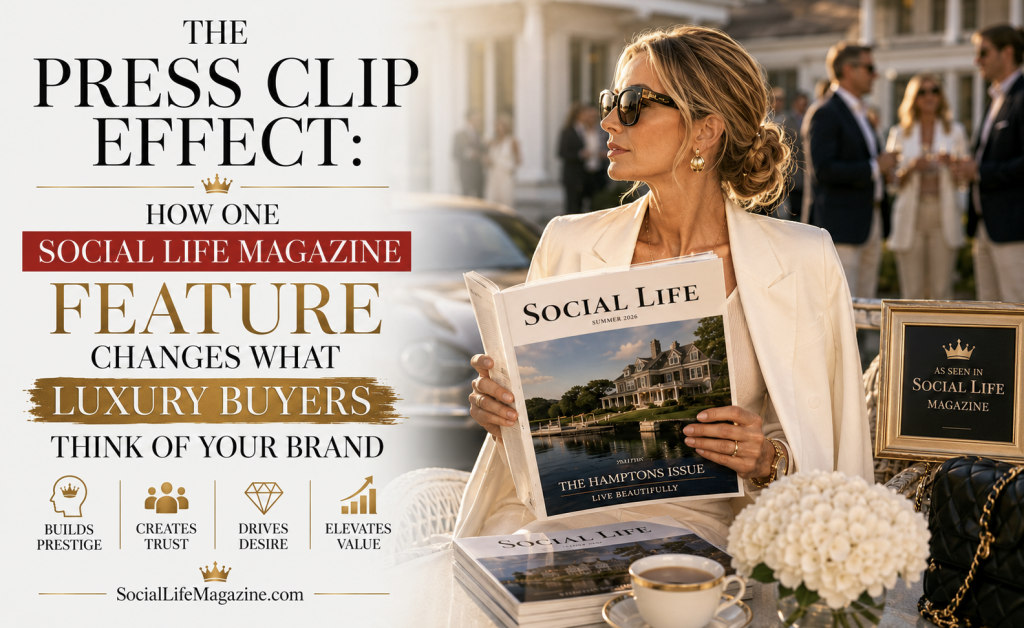
There is a specific moment that happens in the life of every luxury brand that earns editorial coverage in a publication its target audience actually trusts. The moment is not the publication date. It is the first time a member of that audience encounters the coverage and says, without prompting: “I saw you in Social Life Magazine.”
Not “I saw your ad.” Not “I noticed you were advertising.” Saw you. The language of editorial, not of commerce. The language of discovery, not of exposure.
That linguistic distinction is not incidental. It maps onto a neurological and behavioral distinction between how people process advertising and how they process editorial. That gap is the entire argument. A Social Life Magazine feature produces a qualitatively different outcome than any paid placement in any other format.
The Social Life Magazine press feature effect on luxury brands is not about reach. Its print and email reach — 25,000 and 82,000 respectively — meaningful, but not exceptional by mass-market standards. The effect is about recategorization. Specifically: a permanent shift in how a specific audience holds your brand, produced by a single encounter in the right editorial context.
How the Brain Categorizes Sources
There is a body of research in cognitive psychology called “source monitoring” — the study of how the brain tracks where information came from and how that tracking affects the credibility assigned to the information itself.
The core finding is consistent: people assign higher credibility to information from an independent, trusted source than from a party with an obvious interest. Source attribution changes the processing mode entirely. A friend’s recommendation hits differently than an advertisement. A trusted publication review hits differently than brand-owned marketing. The information may be identical. Source attribution changes everything.
This is why editorial coverage produces different outcomes than paid advertising, even when both say the same things about a brand. Readers process an ad calling a medspa the best in the Hamptons as a claim. A Social Life Magazine feature saying the same thing, in editorial voice, registers as fact. Twenty-three summers of authority is the attribution.
Because the processing mode is different, the memory trace is different. Six months later, the reader who encountered the editorial feature remembers it with higher confidence and lower skepticism than the reader who saw the ad. The ad memory degrades and accumulates source skepticism. The editorial memory hardens into a fact the reader holds as her own conclusion — not information she was given by a party with an interest.
This is the foundational mechanism of the press clip effect. A Social Life Magazine feature does not just reach the reader. It changes the epistemological status of the brand in her mind. Before the feature, the brand is something she has heard of or seen advertised. After the feature, it is something she knows. The distinction, in luxury purchasing behavior, is the distance between a browser and a buyer.
The Trusted Source Premium in the Hamptons
Not every editorial mention produces the same effect. The quality of the source attribution determines the quality of the credibility transfer. A mention in a publication the reader does not associate with this domain produces a negligible source premium.
Social Life Magazine’s trust premium in the Hamptons luxury market is specific and accumulated. Twenty-three summers of editorial decisions have produced a track record that readers process as expertise. Which covers to run, which brands to feature, which events to cover — all of it is part of a judgment record. A reader picking up Social Life since 2008 has been building a mental model of its judgment for seventeen years. When the publication features a brand, she processes that choice through seventeen years of accumulated assessment.
This accumulated trust is not available for purchase directly. It has been built through consistency. The audience has internalized the publication’s judgment as a reliable signal because it has been right often enough, over long enough.
What is available is placement within that signal architecture. A brand earning a feature in Social Life is entering a trust relationship the publication spent twenty-three years constructing. The feature transfers a portion of that accumulated credibility to the brand. Not because the reader is naive. Because the track record justifies the inference: if Social Life covers it, it probably belongs.
This is the Social Life Magazine press feature effect: not just reach, but recategorization. The brand moves from “something I might consider” to “something that belongs in the Hamptons summer.” That movement is irreversible. Once a brand has been featured in the right editorial context, the prior perception cannot be recovered. The new category is the permanent one.
Why Paid Features Work: The Transparency Paradox
Social Life Magazine offers paid editorial features: 2,000-word articles written in the publication’s editorial voice, covering a brand in the same register as surrounding editorial content. These features appear with the same visual treatment as editorial, written to the same voice standard, living in the same archive.
The question sophisticated brands sometimes ask: does a paid feature produce the same credibility transfer as earned editorial? The answer, perhaps surprisingly, is largely yes.
Research on native advertising examines how readers respond to editorial-style content that is brand-funded. The finding: native content reading as genuine editorial falls much closer to editorial mode than to advertising mode. Readers of well-executed native content retain it better and assign higher brand credibility than readers of conventional advertising.
The mechanism is not that readers are deceived. The signal readers process — editorial voice, context, presentation — activates source monitoring pathways associated with trusted editorial. Not the skepticism pathways associated with advertising. The form of the signal is doing the perceptual work, not the label on it.
For luxury brands, a well-executed Social Life paid feature produces most of the credibility transfer that earned editorial would produce. It arrives on a predictable timeline, with content shaped to the brand’s positioning goals. Trust architecture of the publication does the heavy lifting. Content direction comes from the brand. Results read as a trusted endorsement without waiting for organic editorial attention.
The Compounding Archive Effect
Most brands do not account for a key dimension when evaluating the investment: the article lives permanently in the publication’s SEO-optimized archive.
Print ads disappear when the issue is recycled. A digital ad disappears when the campaign ends. A Social Life Magazine feature generates ongoing search traffic indefinitely — it lives in a Google-indexed archive.
The SEO value of this permanence compounds over time. A feature published in May accumulates inbound links, search impressions, and topical authority with every passing month. A reader searching “best medspa Hamptons” a year later still encounters the coverage. She processes it through the same source monitoring pathway as a reader from publication day.
Because the archive is evergreen, the press clip effect is not a one-time event. It is a permanent signal. New readers still discover a brand featured in Social Life in summer 2024. Each new discovery produces the same recategorization event. The trust transfer happens freshly, at the moment of encounter, regardless of when the feature was published.
Evaluate the cost against the compounding value of a permanent presence in an SEO-optimized archive with twenty-three years of editorial authority behind it. Not against a single issue’s reach.
Submit a paid feature at sociallifemagazine.com/submit-a-paid-feature. The feature runs in the print issue and lives permanently in the archive. One decision. Two channels. Permanent recategorization.
Where The Conversation Continues
Press clip effects are one expression of how costly signaling creates durable brand credibility in the Hamptons. The full signal economy argument lives in the hub: The Signal Economy: Why the Most Powerful Luxury Marketing Looks Like It Isn’t Marketing.
Other spokes in this cluster examine signaling from different angles:
– How BMW and Christie Brinkley changed the risk calculus for every brand that followed at Polo Hamptons 2026: The Anchor Sponsor Effect – Why what a brand serves at a Hamptons event communicates more than its label: Why the Most Expensive Champagne at a Hamptons Party Is Never the Point
The full pillar: Why Luxury Brands That Ignore Psychology Lose the Hamptons Every Summer.
Author

Written by
Recent Posts
The Skincare Habits That Make a Real Difference Over Time
Hamptons-Ready Beauty: Polished Makeup for Long Summer Days
Is Now a Good Time to Sell a Home in NJ?

The Hidden Work Behind a Seamless Hotel Weekend
Choosing Scratching Furniture for a British Shorthair
Categories
- Art
- Articles
- Business of Luxury
- Celebrities
- Culture
- Entertainment
- Events
- Faces of Summer 2026
- Fashion
- Fashion & Style
- Featured
- Finance
- Food, Spirits, Wine
- Hamptons
- Hamptons Celebrities
- Health
- Health & Beauty
- Lifestyle
- Luxury Lifestyle
- Press
- Profiles
- Real Estate
- Technology
- The Chronicles
- Travel
- Uncategorized
- Weddings