
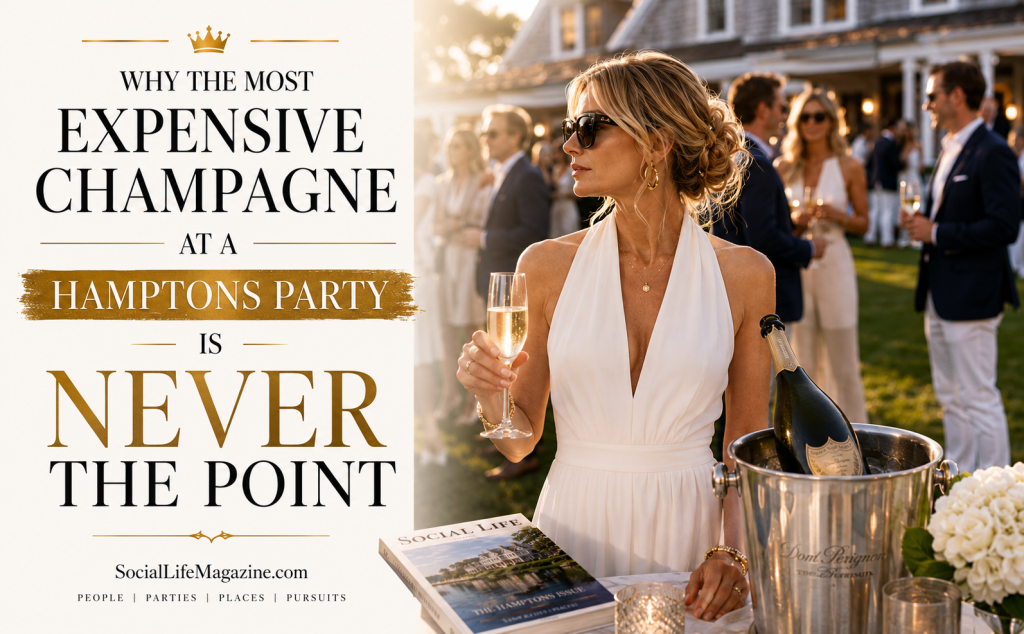
Nobody at a Polo Hamptons table is thinking about the champagne’s technical profile. The minerality. The dosage. The vintage. These details exist. The person who chose the bottle knows them. That is precisely the point.
The point is not the champagne. The point is that someone in this setting chose a bottle that requires you to know something to recognize it. Billecart-Salmon. Laurent-Perrier rosé. Hampton Water — local provenance, a name at the right tables since 2018, a choice that communicates fluency with this specific geography rather than generic luxury competence.
The choice of what to pour at a Hamptons event is not a hospitality decision. It is a signal. And in the context of luxury brand events on the East End, the signal is almost always more valuable than the product it is attached to. What is served communicates what kind of room this is. It communicates what kind of summer this represents. It communicates whether the brand understands the difference between impressing the room and belonging to it.
Luxury brand signals at Hamptons events operate on exactly this logic. The brands that get it right are the ones that understand they are not curating a beverage program. They are curating a statement about their position in the social and cultural hierarchy of the East End summer.
The Sutherland Champagne Principle
Rory Sutherland builds one of his most memorable arguments in Alchemy around expensive champagne. The finding, drawn from behavioral economics research, is specific: an identical champagne tastes better when the drinker believes it is expensive. Not marginally better. Measurably, consistently better, in blind tests where participants are told different prices for the same wine.
The mechanism is not self-deception. It is neurological. When the brain receives a high-cost signal from the environment, it adjusts its sensory processing accordingly. Specifically, it processes information about something expensive or rare differently from something ordinary. The opioid receptors that register pleasure become more active. The experience of taste is genuinely enhanced by the perception of value.
Price as Information
This principle has a direct application for luxury brand events in the Hamptons. The choice of what to serve at an event is not just a quality decision. It is a signal that adjusts how every subsequent element of the event is processed. A guest handed a glass of something she recognizes as a specific, considered choice is already in a different perceptual state than a guest who receives something generic. Her brain processes subsequent experience of the brand through a filter of elevated expectation. The first signal set that filter.
Because of this, the most expensive bottle is not always the correct signal. The correct signal is the one that communicates the specific form of discernment that the event is trying to project. Billecart-Salmon says something different than Dom Pérignon. Hampton Water says something different than either. Each is a signal about what kind of summer this is, and each reaches a different layer of the Hamptons social hierarchy.
The signal must be legible to the intended audience. A bottle impressive to a general luxury consumer but meaningless to a Hamptons insider communicates something different than a bottle only insiders recognize. The latter signals fluency. The former signals effort.
What the Pour Is Actually Saying
There is a category of Hamptons event drinks decision that communicates precisely one thing: someone did their homework. Hampton Water is the clearest current example. Created by Jesse Bongiovi and his father, distributed through relationships built in this specific geography, priced accessibly but not cheaply — it signals local knowledge, not just luxury competence.
A brand that pours Hampton Water at a Hamptons event in July 2026 is communicating that it knows where it is. That it has done the research that a brand genuinely invested in this market does. That it is not importing a beverage program from a corporate hospitality playbook but making a specific choice for a specific room.
Layering the Signal
By contrast, a brand that pours a universally recognized prestige champagne at a Hamptons event is communicating something different. It is communicating resources and a desire to impress. Both of these are legitimate signals. But they reach different parts of the audience differently. The person who is impressed by the Dom Pérignon label and the person who notes approvingly that the host chose Hampton Water are not always the same person. Often they are in different positions in the social hierarchy of the room.
The most sophisticated Hamptons brand activations layer the signal. A primary pour that is accessible and regionally fluent. A secondary option for the guest who looks more closely — the quiet signal for the person paying attention. In Sutherland’s terms, this is a multi-level costly signal architecture. It rewards the person who notices the second layer with a private confirmation of their own discernment.
This is also why events that get the beverage signal right generate better word-of-mouth than events that get it wrong, even when every other element is comparable. The guest who noticed the Hampton Water, or the small-production Sancerre, or the specific rosé that required actual knowledge to source, leaves the event with a story. She tells that story to people who will understand it. Those people form a more accurate and more favorable impression of the brand than any press release could produce.
The Activation Station as Signal Architecture
The beverage signal is the most visible expression of a broader principle. Every choice made in the activation environment is a signal. The cumulative signal is what the guest takes home — not the individual product or interaction.
Table height. The glassware weight. Do the staff know the product or are they reading from a script? Does the space look designed for this event or assembled from generic furniture? The brand materials either belong outdoors on a summer afternoon or they do not.
None of these details appear in most event marketing briefs. A Hamptons guest processes all of them in the first thirty seconds. The cumulative assessment — happening below conscious analysis — determines whether the brand either belongs or merely performs.
Belonging brands invest in the details that guests notice without knowing they noticed them. Performing brands invest in details guests are supposed to notice. The guest who never consciously registers the glassware quality but leaves feeling the brand was somehow more serious has been influenced by a signal she never consciously processed.
This is what Sutherland means when he argues that the best marketing often looks like it isn’t marketing. At a luxury event, the best activation looks like a considered host offering something genuine to guests she actually cares about impressing. The brand is present not as a marketer but as a participant in the summer. The summer does the marketing.
The Spirits Category at Polo Hamptons 2026
The beverage category at Polo Hamptons 2026 represents one of the most signal-rich activation opportunities on the East End summer calendar. An outdoor polo field in Bridgehampton on a July afternoon, Christie Brinkley hosting, BMW anchoring — a natural context for a spirits or wine brand to demonstrate the kind of considered presence that produces genuine brand equity.
The brand that pours at Polo Hamptons 2026 is not just serving drinks. It is becoming part of the memory of a specific afternoon that a specific audience will carry into September and beyond. The guest who photographs the glass, the one who asks what she is drinking, the one who mentions it three weeks later at dinner — these are compounding returns.
Specifically, the spirits position at Polo Hamptons offers category exclusivity in a closed activation environment. The event itself manages the signal-to-noise ratio. There are no competing beverage brands in the same field on the same afternoon. The signal is uncontested. The audience is captive in the best possible sense — present by choice, in a state of summer leisure maximally receptive to the brand encounters that produce durable memory.
Contact Social Life Magazine’s business development team to discuss the beverage brand position at Polo Hamptons 2026. July 18 and July 25, Fishel Estate, Bridgehampton. The pour is the press release.
Where The Conversation Continues
The champagne signal is one instance of how costly signaling creates luxury brand credibility at Hamptons events. The full signal economy framework lives in the hub: The Signal Economy: Why the Most Powerful Luxury Marketing Looks Like It Isn’t Marketing.
Other spokes in this cluster:
– How BMW and Christie Brinkley changed the sponsorship calculus for every brand that followed at Polo Hamptons: The Anchor Sponsor Effect – How a Social Life Magazine feature permanently changes how luxury buyers categorize a brand: The Press Clip Effect (FUTURE)
The pillar: Why Luxury Brands That Ignore Psychology Lose the Hamptons Every Summer.
Author

Written by
Recent Posts

AI for personal finance: where PennyGuard fits
How to Pick a Homecoming Dress for Your Body Type (and Feel Amazing in It)

World Cup Injury Attorney for Vancouver Events
What a 3-Carat Engagement Ring Actually Costs in 2026: The Real Numbers
The Skincare Habits That Make a Real Difference Over Time
Categories
- Art
- Articles
- Business of Luxury
- Celebrities
- Culture
- Entertainment
- Events
- Faces of Summer 2026
- Fashion
- Fashion & Style
- Featured
- Finance
- Food, Spirits, Wine
- Hamptons
- Hamptons Celebrities
- Health
- Health & Beauty
- Lifestyle
- Luxury Lifestyle
- Press
- Profiles
- Real Estate
- Technology
- The Chronicles
- Travel
- Uncategorized
- Weddings