
In the summer of 1981, Ralph Lauren opened a store on Job’s Lane in Southampton. He did not run a campaign to announce it. No agency was hired to generate awareness. He opened a store in the exact geography where the people he wanted to dress were already spending their summers, and he let the location do the talking.
The store is still there. Ralph Lauren has been part of the Hamptons summer for forty-five years. Not because of advertising. Because of placement. Because the decision to put the brand in that specific building, on that specific street, in that specific geography, was a costly signal — a genuine commitment of resources that communicated something no ad ever could: we are serious enough about this market to actually be in it.
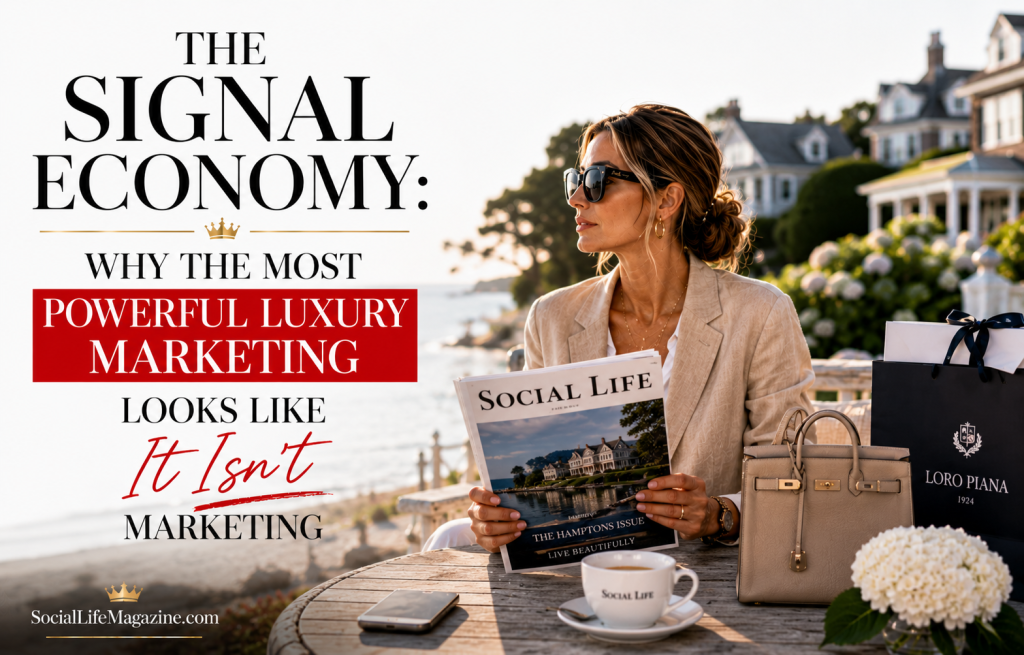
This is the signal economy. It is the system by which luxury brands communicate credibility, not through claims, but through commitments. And it is the reason why the most powerful luxury marketing in the Hamptons — the kind that produces durable brand equity, loyal customers, and the kind of cultural authority that compounds over seasons — consistently looks, to anyone applying conventional marketing logic, like it is not marketing at all.
Luxury brand signaling in the Hamptons is not a soft concept. It is a precisely mechanical one, grounded in behavioral economics, evolutionary biology, and thirty years of advertising research. Understanding it is the difference between a summer that builds something and a summer that disappears into the scroll.
What Makes a Signal Credible
Amotz Zahavi, an Israeli biologist, published a theory in 1975 that upended evolutionary biology. He argued that many animal displays were evolutionarily stable precisely because they were costly. The peacock’s tail, the gazelle’s stotting leap, the nightingale’s song — all costly. A peacock’s tail slows the bird down and attracts predators. It requires enormous metabolic resources. But because it is genuinely costly, it is genuinely informative. A peacock with a magnificent tail is demonstrating, through the signal itself, that it has the genetic resources to afford the handicap.
Zahavi called this the handicap principle. Sutherland translates it directly into marketing: signals that persuade most powerfully are the ones that cost the most to fake. A cheap signal — one that any brand with a modest budget could produce — carries no information about the brand’s actual quality or commitment. An expensive signal — one that requires real resources, real relationships, real reputational skin in the game — is inherently credible because its cost is proof of its authenticity.
In the Hamptons luxury market, specifically, costly signals take specific forms. A title sponsorship of a prestigious event. Multi-year print presence in the dominant regional publication. A physical activation at a venue that requires relationships, not just money, to access. A celebrity host whose name carries social capital earned over decades of genuine Hamptons presence.
Each of these is credible precisely because it is hard to fake. And each one, as a result, does perception work that no served ad can replicate.
BMW, Christie Brinkley, and the Mechanics of an Anchor Signal
The 2026 Polo Hamptons season opens on July 18 at the Fishel Estate in Bridgehampton. BMW is the title sponsor. Christie Brinkley is hosting.
These two facts are not a press release. They are a signal architecture.
BMW’s title sponsorship communicates four things simultaneously, none of which appear in any marketing copy. First, that the event has been vetted by a global luxury brand with standards for partner quality. Second, that the automotive category is closed, which increases the perceived exclusivity of the remaining sponsorship positions. Third, that the activation is at a scale and quality level that justifies investment from a brand with BMW’s reach options. Fourth, that other premium brands considering a presence at Polo Hamptons are looking at an event that has already passed the BMW credibility test.
Christie Brinkley’s hosting role operates on a different register entirely. Her name carries forty years of accumulated social and symbolic capital in the Hamptons specifically. She is not a celebrity who visits the Hamptons. She is a person whose identity is, in meaningful part, constituted by her relationship with this geography. When she attaches her name to an event, she is not lending a brand. She is vouching for a community membership claim.
Together, BMW and Christie Brinkley function as anchor signals — high-credibility commitments that recalibrate the perceived quality of every subsequent brand association. A brand that sponsors Polo Hamptons 2026 is not just buying event presence. It is appearing alongside signals that have already established the event’s position in the Hamptons cultural hierarchy. Anchor signals do the heavy perception lifting. Subsequent brands benefit from the environment those signals created.
Two sponsorship positions remain. The anchor signal loses value with each position filled. This is not a sales tactic. It is signal economics.
The Difference Between Reach and a Signal
Most luxury brands in the Hamptons are buying reach — optimizing for the number of people who see their name, frequency of encounter, and cost efficiency of each impression. These are reasonable things to measure in a mass market. In a luxury market, they measure the wrong thing.
Reach tells you how many people encountered your brand. A signal tells you something about how those people categorized your brand when they encountered it. And in luxury, categorization is everything.
A brand that reaches a million Hamptons consumers through digital channels has produced a million encounters where the brand’s status category is determined by the scroll context — random, uncontrolled, frequently low-status. A brand that produces three hundred encounters at Polo Hamptons, next to BMW and Christie Brinkley and a field in Bridgehampton that has become one of the defining images of the East End summer, has produced three hundred encounters in which the brand’s status category is set by the highest available signal in the Hamptons luxury market.
Why Signals Outperform Ads
Three hundred is less than a million. But in signal economics, the quality of the categorization event is the variable that determines long-term brand equity. A single high-signal encounter, in the right environment, with the right audience, produces a brand memory that influences purchasing behavior for months and sometimes years. A million low-signal impressions produce statistical reach and very little else.
Sutherland makes this argument in Alchemy through the example of expensive champagne. The reason an expensive bottle of champagne at a celebration produces more pleasure than a cheap bottle — even when the taster cannot distinguish them blind — is not fraud or delusion. It is signal processing. The brain, receiving a high-cost signal from the environment, adjusts its processing of the experience accordingly. Because of that adjustment, the same chemical compounds taste better.
At Polo Hamptons, the same mechanism is at work. A brand in that field, on that day, is tasted differently by the people who encounter it there than the identical brand encountered in a programmatic placement. The field is the expensive champagne. Signal does the work.
How Signals Compound: The Three-Summer Argument
A single summer of signal investment produces brand awareness. Two summers of consistent signal presence produce brand familiarity. Three summers produce something qualitatively different: brand belonging.
Brand belonging is the condition in which a brand has been encountered so consistently, in such high-quality signal environments, that it no longer reads as a marketing presence in the Hamptons summer. It reads as part of the summer itself. It is categorized by the consumer not as “brand I have seen in the Hamptons” but as “brand that is of the Hamptons.”
This is the highest available status in any geographically-specific luxury market. And it is produced not by reach, not by spend, and not by creative excellence. It is produced by signal consistency over time.
Social Life Magazine has been producing this condition for brands for twenty-three summers. The brands that have maintained a consistent presence in its pages — that appear summer after summer in the same editorial environment, at the same distribution points, in the same hands that hold the same publication — have accumulated a form of brand equity that no single-summer campaign can replicate. Their signals have compounded.
Because compounding requires time, the brands that start building signal equity now are the ones that will hold the highest-value positions in the Hamptons cultural market three summers from now. The brands that wait until their presence feels urgent are the ones paying premium prices for positions that the early committers already own.
Reading the Signal Landscape Before You Spend
Before any luxury brand commits a dollar to the Hamptons summer, the signal landscape analysis should precede the media plan. The questions are specific.
What signals is the category leader in your space currently making in this market? What environments are they appearing in, and what does that choice communicate about where they believe the credible signal positions are? Which events, publications, and physical spaces in the Hamptons have consistently attracted signal-serious brands across multiple seasons? And crucially: are there signal positions currently unoccupied in your category that would allow your brand to establish the anchor position before a better-resourced competitor does?
Social Life Magazine, for example, has category exclusivity built into its sponsor and advertiser relationships. Once a brand in a given category establishes a consistent presence, it accumulates something that subsequent entrants cannot simply purchase: first-mover signal equity in that category’s Hamptons positioning.
Specifically, several luxury categories still have open anchor positions in the SLM editorial and event ecosystem. The brands that move now are not just buying one summer’s presence. They are establishing the signal that will make every subsequent year’s signal stronger.
The conversation starts at sociallifemagazine.com/submit-a-paid-feature. For Polo Hamptons event sponsorships, contact Social Life Magazine’s business development team directly. Two positions remain. The signal economics do not improve with delay.
Where The Conversation Continues
The signal economy is the second of six principles that determine which luxury brands win the Hamptons and which ones run the same campaign year after year without building equity. The full framework lives in the pillar: Why Luxury Brands That Ignore Psychology Lose the Hamptons Every Summer.
For how perception environments determine brand categorization, see the hub: The Perception Economy: What Hamptons Luxury Brands Are Really Selling.
The three spokes in this cluster go deeper on specific signal mechanics:
– How Christie Brinkley and BMW changed the sponsorship calculus for Polo Hamptons 2026: The Anchor Sponsor Effect (FUTURE) – Why what a brand serves at a Hamptons event communicates more than its label: Why the Most Expensive Champagne at a Hamptons Party Is Never the Point (FUTURE) – How a Social Life Magazine feature changes the way luxury buyers categorize your brand: The Press Clip Effect (FUTURE)
Author

Written by
Recent Posts

World Cup Injury Attorney for Vancouver Events
What a 3-Carat Engagement Ring Actually Costs in 2026: The Real Numbers
The Skincare Habits That Make a Real Difference Over Time
Hamptons-Ready Beauty: Polished Makeup for Long Summer Days
Is Now a Good Time to Sell a Home in NJ?
Categories
- Art
- Articles
- Business of Luxury
- Celebrities
- Culture
- Entertainment
- Events
- Faces of Summer 2026
- Fashion
- Fashion & Style
- Featured
- Finance
- Food, Spirits, Wine
- Hamptons
- Hamptons Celebrities
- Health
- Health & Beauty
- Lifestyle
- Luxury Lifestyle
- Press
- Profiles
- Real Estate
- Technology
- The Chronicles
- Travel
- Uncategorized
- Weddings