
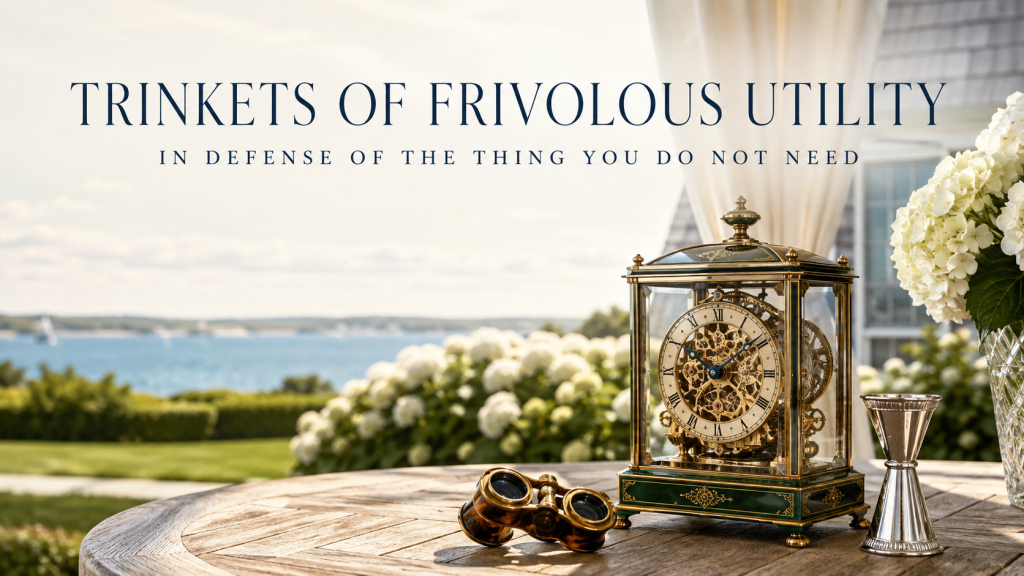
A man on a Sag Harbor dock is showing you his watch. It cost more than the car you drove here in. Also, it keeps worse time than the phone in your pocket. Adam Smith had a name for objects like that one, and the name sounds like an insult: trinkets of frivolous utility. He wrote it in 1759, in a book about morality rather than markets.
Then he did the thing nobody expects. Smith defended the trinket. Not ironically, and not with a wink at readers who already feel superior to the watch.
His argument, stripped of eighteenth-century syntax, is blunt. The useless beautiful object is the engine of the modern world. Because people want things they do not need, they build, invent, plant, ship, and stay up late. Cities exist because somebody wanted a better buckle.
Out here that argument has an address. It has several: the outdoor kitchen nobody cooks in, the boat that leaves the slip four times a summer, the Meadow Lane hedge trimmed to a tolerance no guest will ever measure. Each of them is frivolous by the strict test. Each of them also pays somebody on Friday.
So take this as a defense written by someone who likes the objects. The wider framework behind it sits in the larger argument about wealth, status, and the deception that builds cities. What follows is the narrow case: the watch, the bag, the boat, the teak.
The Watch That Loses Two Minutes a Day
Smith’s own example is a watch, which is lucky, because the example has not aged a day. In Part IV of The Theory of Moral Sentiments he describes a man whose watch falls behind two minutes daily. Since that offends him, he sells it for two guineas and buys another at fifty. The new one will not lose a minute in a fortnight.
Then comes the knife. Smith observes that the fussy owner is not, in fact, more punctual than anybody else. He is not more anxious to know the hour. What he wants is not accuracy at all, but the perfection of the machine that produces it.
Read that again with a Patek on a leather strap at a Bridgehampton lunch. Nobody at that table needs the hour to within a minute per fortnight. Still, the man wearing the movement knows what the movement does, and that private knowledge is most of the pleasure.
Smith is not mocking him. He is describing a genuine human pleasure with unusual precision: we love the fitness of means to ends. A beautifully made thing that works gives us something the cheap thing cannot, even though both tell the same time.
The Insult and the Thank-You Note
Here is where the chapter turns. Having spent pages showing that the baubles do not deliver the happiness they promise, Smith refuses to tell you to stop wanting them.
Instead he calls the whole business a deception, then calls the deception useful. It is well that nature imposes on us in this manner, he writes. That imposition rouses and keeps in continual motion the industry of mankind.
What did the deception build? By Smith’s own accounting: cultivated ground, houses, cities, commonwealths, and all the sciences and arts that ennoble and embellish human life. Not a modest claim. He is saying that civilization runs on wanting the wrong things.
Notice what he declines to do. Smith never argues that the trinket is secretly practical. Rather, he concedes the point his critics would make, immediately and completely, and then argues the trinket matters anyway. That move is rarer than it sounds, especially in writing about money.
Because he gives away the easy ground, the hard ground holds. Luxury does not need a productivity excuse. It needs an honest account of what it does, which is to call enormous amounts of skill, effort, and payroll into existence.
What the Barons Traded for Diamond Buckles
The Wealth of Nations tells the same story at the scale of centuries. In Book III, Smith explains how feudal power actually ended in Europe. Not by revolution, and not by argument.
Great proprietors once fed a thousand retainers, because a surplus of grain could not buy anything else. Then the merchants arrived with objects. Buckles, mirrors, fine cloth, and what Smith calls trinkets and baubles, fitter to be the playthings of children than the serious pursuits of men.
So the barons made a trade. Rather than keep a household of men who owed them personal loyalty, they spent the surplus on things. Their retainers went off to work for wages, and the power went with them.
Smith’s verdict on that swap is withering and also grateful. A revolution of the greatest importance to public happiness, he writes, was brought about by two sets of people who had not the least intention of serving the public. Vanity did the work no reformer could.
Given that history, the modern luxury purchase carries a strange dignity. The buckle was never only a buckle. It was the mechanism by which power left the castle and entered the market.
The Outdoor Kitchen Nobody Cooks In
Now walk the argument down Further Lane. The outdoor kitchen is the purest local specimen: a Wolf grill, a ceramic smoker, a wood-fired oven that has produced eleven pizzas since 2019, and a run of honed counter under a teak pergola.
Almost nobody cooks there. Caterers do, twice a summer, while the family eats at the island indoors like everyone else. By the strict utility test the whole installation is absurd.
Yet look at the invoice. The mason drove in from Riverhead. Teak came through a dealer who has been importing it for thirty years and can tell you which plantation. Someone engineered the drainage, someone else specified the hood, and a fabricator in Calverton templated the stone on a Tuesday in March.
The oven is not really the product. The product is four hundred hours of skilled work, sold to a household that wanted a particular feeling in July. Smith would have recognized the transaction instantly, and he would not have sneered at it.
Consider too what the thing says. An outdoor kitchen announces that the house entertains, which is a claim about a life rather than about food. That claim reads at forty feet, in daylight, before anybody speaks.
The Boat Leaves the Slip Four Times
Boats make the case harder, which is exactly why they make it better. A forty-five-foot center console at Montauk costs real money to buy and more to keep. An honest owner will admit it goes out a handful of times a year.
Ask him about it, though, and watch what happens. He will describe the hull, the way it takes chop off Gin Beach, and the second set of engines he specified because the first set was wrong. His pleasure is technical before it is social.
That is Smith’s watch collector again, wearing sun-bleached fishing gear. Love of the machine is real, and it does not reduce to showing off, even though showing off is in there too.
Meanwhile the boat carries a payroll. Dockage in Sag Harbor, a mechanic who takes calls on Sunday, the kid who washes her down at six, the canvas shop that rebuilt the T-top, and an electronics installer whose winter depends on people like this.
Four trips a summer, and eleven months of somebody’s employment. Similarly, the trinket does its quiet work, not through the owner’s virtue but through the wake he leaves in a local economy.
The Bag Is a Complete Sentence
Objects out here do work that language cannot do fast enough. A bag on the back of a chair at a Wainscott lunch communicates a decade of decisions in under a second, and everybody at the table reads it without admitting they did.
Smith explained the mechanism before anyone had a handbag to explain. We want the object, he argued, because we want the regard attached to it. Wealth is desired chiefly because it draws upon us the attention and approval of others.
That same logic prices a bottle of pale pink wine at fifty dollars on a Bridgehampton terrace. Such a purchase runs on an identical signal, taken apart at length in the anatomy of a bottle whose value is almost entirely social.
The bag differs from the watch in one respect. Its audience is external by design, whereas a movement is a private pleasure inside a public case. Both are trinkets, still, and both are honest once you stop pretending otherwise.
Notably, the brands that do best out here understand this already. They sell the signal without insulting the buyer’s intelligence, since the buyer knows precisely what she is buying and why.
What the Trinket Actually Funds
Two pages after the watch, Smith produces the line everyone attributes to the economics book. The proud and unfeeling landlord, he writes, surveys his fields and imagines consuming the whole harvest himself. His stomach, though, has limits his eyes do not.
So he divides it anyway. Luxury on that scale requires cooks, grooms, builders, and gardeners, and the produce reaches them as wages. They are led by an invisible hand, Smith writes. The result is nearly the distribution an equal division of the earth would have made.
That is the first invisible hand in Smith’s writing, and it appears in the moral book, describing a household. Not a market. Generally the phrase gets quoted by people who have the wrong century in mind.
Apply it locally, without romance. One large house in Water Mill supports a landscape crew, a pool company, a caretaker, an alarm contract, a fuel delivery, and an insurance broker. None of that requires the owner to be generous. It requires only that he want a lawn.
Because the mechanism is impersonal, it is also dependable. Smith’s point was never that rich people are secretly saints. His point is that vanity, unlike charity, does not take the summer off.
The Limit: When the Bauble Wins
Now the honest part, because a defense that concedes nothing persuades nobody. Smith’s view of the trinket has a cost written into it, and he never hides the bill.
The famous parable in that same chapter follows a poor man’s son who wants everything the rich man has. He sacrifices ease, courts people he does not like, works his whole life, and arrives. Then, in old age, he finds the baubles deliver nothing they promised.
Anyone who has watched a founder land after a sale knows that ending by heart. Smith’s 1759 sketch of the arrival, plus the wellness industry that grew up to treat it, runs in the parable that predicted founder burnout.
So the defense has a boundary. Buy the watch because the movement delights you, or because the object marks something that actually happened. Buying it to feel finally sufficient is a different transaction, and that one has never cleared.
Smith’s word for the difference is not moral, exactly. It is closer to accurate. He wants you to see the deception plainly, enjoy the object anyway, and stop asking the object to do a job it was never built for.
How to Buy Like Someone Who Enjoys It
There is a practical version of all this, and out here it separates two buyers who spend identical amounts.
The first buys whatever the room has already approved. His timing is late by definition, since approval is a lagging indicator. He pays a premium for consensus and receives one season of relevance.
Buyer two purchases what he likes, learns the category, and can talk about it for twenty minutes without checking your face. Given enough time, the room follows him. Taste, of course, is a form of capital too, and it compounds quietly.
What separates them is whether the internal judge is doing his job, which is the subject of the argument about the observer seated at every dinner. Smith built that figure to answer this exact question: are you pleased, or are you being seen being pleased?
Both buyers keep the mason and the dealer employed, so the economy does not care. Still, only one of them enjoys the thing in February, alone, with nobody watching.
Where The Conversation Continues
Smith’s argument has an obvious corollary for anyone who makes beautiful, unnecessary things. The object does not sell here on specification. It sells because it appears inside a life the reader recognizes, held by people whose approval he already wants.
That is the work Social Life Magazine does for a category brand. Twenty-five thousand print copies move each summer through the houses, clubs, and shops between Southampton and Montauk, while 82,000 email subscribers open the issue before Friday traffic starts. Meanwhile the teak, the tender, the movement, and the coupe appear where they actually live.
Polo Hamptons in Bridgehampton is the same argument in three dimensions. A lawn, a line of parked cars that is itself an exhibition, and several hundred people practicing the exact behavior described above.
Summer positions stay limited by design, because a page carrying everybody carries nothing. The July issue closes early, as it always does. Someone in your category will be in it, and the reader will file that fact without noticing he did.
Write to the publisher before the calendar hardens.
Author

Written by
Recent Posts

Is Business Class Worth It on a Short-Haul Flight?
Failure to Disclose Finances in Divorce
Columbus Car Accident Attorney: Protecting Your Rights After a Georgia Crash
Does Workers’ Comp Cover Lost Wages? A Guide for Oregon Workers
Understanding Social Security Disability Benefits in Oklahoma
Categories
- Art
- Articles
- Business of Luxury
- Celebrities
- Culture
- Entertainment
- Events
- Faces of Summer 2026
- Fashion
- Fashion & Style
- Featured
- Finance
- Food, Spirits, Wine
- Hamptons
- Hamptons Celebrities
- Health
- Health & Beauty
- Lifestyle
- Luxury Lifestyle
- Press
- Profiles
- Real Estate
- Technology
- The Chronicles
- Travel
- Uncategorized
- Weddings