
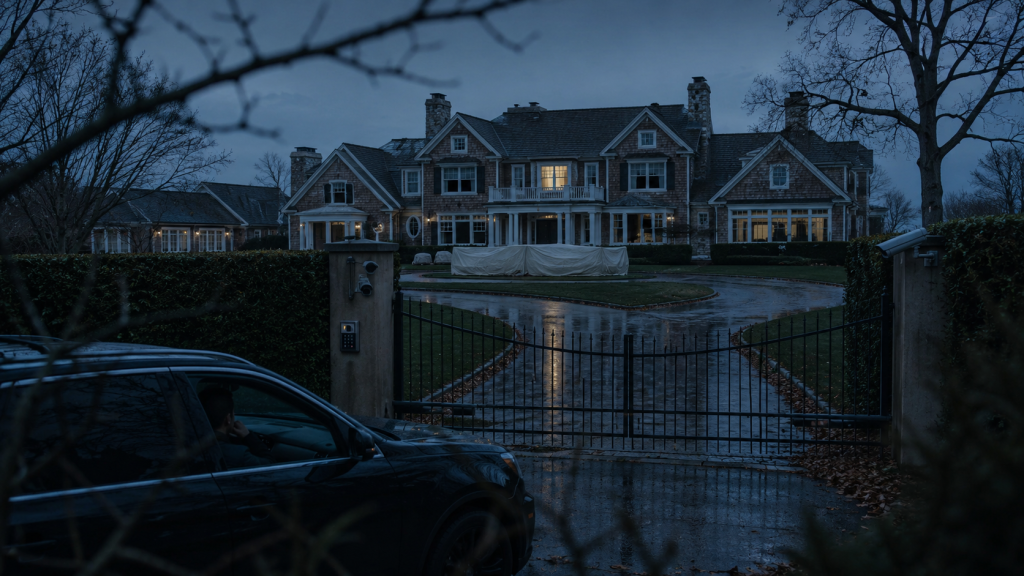
Hamptons home security is not a camera problem. It is an information problem, and Apple just made a two-season television series about that exact distinction.
In Your Friends and Neighbors, Jon Hamm plays a fired hedge fund manager who robs the houses around him. He never picks a lock in any dramatic way. He never disables a system in a montage. Instead he knows who is in Aspen, who is at the club until nine, and which drawer holds the watches.
That is the whole heist. Knowledge, not force.
Out here the same knowledge is essentially public. Our houses sit empty from October through May, our departures are announced at dinner, and the calendar of this place is printed in a magazine. Possibly this one.
East End loss patterns rarely make the papers, and that silence is deliberate. Nobody wants a listing history that mentions a break-in, so quiet claims and quieter settlements are the norm. As a result, most owners badly underestimate how common this is on their own road.
The Show’s Real Villain Is a Calendar
Coop is not a talented criminal. He is an informed one, which turns out to be far more useful.
He knows the neighborhood rhythm because he lives inside it. School pickup, the standing tee time, the Thursday flight, the two weeks in August when three houses on the same road go dark at once. None of that requires surveillance. It only requires attendance.
Consider how much of your own schedule is broadcast without a second thought. The closing weekend post. An airport photo. The benefit seating chart that runs online with your name on it. Notably, the more social you are, the more legible your absence becomes.
So the first honest step in protecting an East End house has nothing to do with hardware. It is a quiet audit of who knows when you are gone, and how they learned it.
Nobody Breaks In. They Are Let In.
The romantic version of theft involves a window and a crowbar. Reality is duller and considerably more embarrassing.
Doors get left open for the cleaners. Codes get texted to a landscaper who forwards them to a subcontractor. A gate clicker lives in a car that goes to the shop. The alarm gets disarmed in May and never gets armed again until the last car pulls out in September.
Because a summer house runs on convenience, and convenience is the opposite of security. Every workaround that makes the season smooth also makes the off-season easier for someone else.
Notice that the show never once shows a sophisticated entry. Coop walks in. That is not lazy writing. That is research.
The Staff Question, Handled Honestly
The most competent person in the series is Elena, a housekeeper who works across several houses and knows every family’s routine. She is also the only character who has ever been genuinely poor, and the show is smart enough to make her the sympathetic one.
Let us be careful here, since this is where most conversations about Hamptons security go badly wrong. Household staff are overwhelmingly not the risk. The people who have worked in a house for nine years are the reason the house still stands.
The actual exposure sits in churn and in layers. Peak season brings a rotating cast of vendors, day labor, delivery, event crews, valets and subcontractors nobody vetted because they arrived as somebody else’s crew. Information leaks through the seams, not through the core.
So the fix is structural rather than personal. Fewer people holding permanent codes. Temporary credentials that expire. One named person who owns access, and a written list of who currently has what.
Cameras Are Not Security. They Are Evidence.
Almost every East End house now carries cameras, and almost every East End owner believes that settles the matter.
A camera does not stop anything. It records. Afterward you get excellent footage of a person you do not recognize carrying your grandmother’s jewelry to a car with no plate. Insurance will appreciate the file.
Deterrence and detection are different products, so buy both deliberately. Monitored alarm with cellular backup, since cutting the internet is the first move. Interior motion in the rooms that matter rather than only at the doors. A safe that is bolted, rated, and not in the primary closet.
Above all, get a human response plan. A siren in an empty neighborhood in February is a sound nobody hears. Knowing which caretaker drives over, and how fast, is worth more than another four cameras.
What Actually Walks Out the Door
The show gets the shopping list right, which is the detail that ought to make East End owners uncomfortable.
Watches first, always. They are small, valuable, and sitting in a drawer rather than a safe. A single box can hold more value than a car in the garage, and it fits in a jacket pocket.
Jewelry second, then cash, then loose art that comes off a wall in under a minute. Wine goes when the thief has time and a vehicle. Bikes and boat electronics go constantly and nobody bothers to report them.
Meanwhile the genuinely valuable things often stay put. Large canvases are difficult. Furniture is difficult. Anything that requires a truck requires a plan, and most losses out here are opportunistic rather than planned.
We priced the full watch closet from the series in the $360,000 watch drawer, including what a fence realistically pays.
The Insurance Conversation Almost Everyone Has Once, Badly
Standard homeowner policies cap jewelry, watches and collectibles at a number designed to insult you. Many owners discover that cap for the first time on the worst day of the year.
Schedule the items. A rider covers named pieces at agreed value, usually including mysterious disappearance, which the base policy will not touch. Appraisals should be current, since a 2016 valuation on a Patek is now a piece of comedy.
Photograph everything, including papers, boxes and serial numbers. Store that record somewhere other than the house it describes. A cloud folder your broker can reach beats a filing cabinet in the room that got emptied.
Finally, ask about vacancy language. Some carriers treat a house empty for sixty days differently than a house in use, and a seasonal property owner should know exactly where that line sits before signing.
The Closing Weekend Checklist
Print this and hand it to whoever locks the place in October.
- Rotate every code and clicker. Not later. That weekend.
- Move watches, jewelry and small art off site or into a bolted, rated safe.
- Confirm the alarm is armed, monitored, and running on cellular backup.
- Set interior motion for the primary bedroom, the office and the wine room.
- Put lighting and a few blinds on random timers rather than a fixed pattern.
- Name one caretaker as the response contact and give the monitoring company that name.
- Send your broker an updated schedule of items and current appraisals.
- Ask the neighbor who stays year round to text you if anything looks wrong.
That last line is free and works better than most paid solutions. Because the one thing Westmont Village has that the Hamptons does not is neighbors who are actually home.
The Things You Forgot You Own
Ask any East End owner to list what is in the house right now and watch the confidence drain out of the room.
Wine is the classic blind spot. A cellar built over fifteen years often has no current inventory, no valuation, and no schedule on the policy. Cases move, bottles get pulled for dinners, and the record lives in one person’s memory. Insurers treat an unlisted cellar exactly as generously as that sounds.
Art is the second. Pieces bought at benefit auctions and never appraised sit on walls at whatever the buyer paid in a good mood eleven years ago. Values move in both directions, so the number in the file is almost never the number today.
Then there is the miscellaneous category that quietly adds up. Bikes, boat electronics, golf clubs, cameras, the good rugs, the outdoor furniture that cost more than the car. None of it is glamorous, yet all of it walks.
Build the inventory once, properly, with photographs and serial numbers. After that, updating it takes twenty minutes each October. Nobody enjoys this task, but everybody who has filed a claim wishes they had done it.
What It Costs to Do This Properly
Owners usually ask for a number, so here is an honest frame rather than a quote.
At the entry level, expect a monitored alarm with cellular backup, a handful of interior sensors, and a rated safe bolted into the structure. This is a low four figure conversation up front and a modest monthly fee after that. For most seasonal houses it removes the majority of realistic exposure.
The middle tier adds managed access. Temporary codes that expire, a documented credential list, real camera coverage on approaches rather than only on doors, and a named local response contact who is paid to actually drive over. Costs rise, though not as much as owners fear.
At the top, you are buying integration. Art and wine on dedicated environmental monitoring, off-site storage for the pieces that never needed to be here in winter, an estate manager who owns the whole system, and a broker who reviews the schedule annually.
Notably, the biggest single improvement in that entire list is free. Rotate the codes every October, and stop telling the table when you are leaving.
What the Show Gets Wrong
In fairness, the series takes liberties.
Fencing high-end watches is far harder than Coop makes it look. Serial numbers travel, dealers check, and collectors on the internet are relentless about spotting a stolen reference in a listing. Real recovery rates for serialized pieces are better than the show suggests, which is precisely why the smart money out here has drifted toward assets that carry no serial number at all.
That argument sits in the painting he steals, which remains the single smartest theft in the series.
Coop also enjoys implausible luck with timing. Real seasonal theft tends to be discovered weeks later, often by a caretaker in January, long after any useful trail has gone cold. That delay is the actual nightmare, since a claim filed in February about a loss that happened in November is a difficult conversation with any carrier.
The other liberty is emotional. Real losses do not feel like a caper. They feel like a violation of a place you thought was yours alone, and that feeling lasts considerably longer than the claim does.
Why This Series Landed Out East
Westmont Village is a fiction shot across Westchester, yet East End readers took it personally, and correctly so.
Production chose those streets deliberately, as covered in the location breakdown. Both places run on the same arrangement. Enormous private value, held loosely, protected mostly by the assumption that everyone around you has as much as you do. Once that assumption cracks, the whole social contract of a wealthy neighborhood starts looking thin.
The show’s actual thesis is that the danger was never outside the gate. It was at the table. We unpacked that reading across the full cluster in the Westmont Village files.
Where The Conversation Continues
Social Life Magazine reaches the houses this article describes. Not the people who service them from a distance, but the owners themselves, in 25,000 East End homes each summer and across an 82,000 name list all year.
On July 24 and July 31, 2027, the same readers gather on a lawn in Bridgehampton for Polo Hamptons, and every one of them owns a house that will be empty by October.
Security integrators, private client brokers, estate managers and art logistics firms all sell into a moment of anxiety that nobody else in this market is willing to name out loud. We just named it.
One partner per category, because exclusivity is the product. Reach the editorial desk before the 2027 season fills, since the empty house season starts in about six weeks and the conversation is easier to have now than in February.
Author

Written by
Recent Posts

AI for personal finance: where PennyGuard fits

How to Pick a Homecoming Dress for Your Body Type (and Feel Amazing in It)

World Cup Injury Attorney for Vancouver Events
What a 3-Carat Engagement Ring Actually Costs in 2026: The Real Numbers
The Skincare Habits That Make a Real Difference Over Time
Categories
- Art
- Articles
- Business of Luxury
- Celebrities
- Culture
- Entertainment
- Events
- Faces of Summer 2026
- Fashion
- Fashion & Style
- Featured
- Finance
- Food, Spirits, Wine
- Hamptons
- Hamptons Celebrities
- Health
- Health & Beauty
- Lifestyle
- Luxury Lifestyle
- Press
- Profiles
- Real Estate
- Technology
- The Chronicles
- Travel
- Uncategorized
- Weddings