
The Shift Nobody Saw Coming—Until It Already Happened
There is a moment, somewhere around 2022, when the economics of building a business changed permanently. It did not make the front page when it happened. It arrived quietly—a new tool here, a capability there—and then suddenly the math of what one person could accomplish alone was completely different from what it had been twelve months before.
Artificial intelligence did not just automate tasks. It compressed time. It eliminated bottlenecks. It removed the primary reason most one-person businesses had a ceiling: there were simply not enough hours in the day to do everything that building something real requires. AI changed that equation at a fundamental level, and the entrepreneurs who recognized what was actually happening—not just a new software trend, but a structural shift in what a single human being could build—are now operating businesses that would have required teams of five to fifteen people a decade ago.
I built my first business in 1999, a salon on Manhattan’s Upper East Side, funded with a $79,000 loan from my father and opened with nothing more than skill, determination, and a Rolodex. I went on to open a second location on 57th Street—eleven days before September 11th, 2001. I covered costs during the downturn by trading stocks. I eventually built the Bombshell Brush brand on Amazon. I wrote three books. I have been running one-person and small-team businesses for twenty-five years, across industries, through recessions and pandemics, in New York and Rio de Janeiro.
What I have watched happen over the past two years is different from anything I have seen before. AI is not a productivity tool. It is a structural advantage—the kind that separates the people who understand what is actually happening from the people who are still waiting to see how things play out.
The Old Bottleneck: Time, Talent, and Payroll
The traditional ceiling of the one-person business was always the same: you ran out of you. You ran out of time to write the content, design the materials, handle the customer service, analyze the data, respond to the emails, research the market, draft the contracts, and still do the actual work that generates revenue. The solution was always to hire—to add people, add payroll, add complexity, add the management overhead that turns a lean operation into something that requires its own bureaucracy to function.
For most of entrepreneurial history, this was simply accepted as the price of growth. You either stayed small and kept your margins, or you grew and added costs that eroded them. There was no third option.
AI is the third option.
A single person with the right AI infrastructure can now produce content at the volume of a marketing team, analyze customer data at the scale of an analytics department, handle routine communications at the bandwidth of a customer service function, and research competitors, markets, and opportunities at a pace that would have required a dedicated research staff five years ago. The ceiling has not just risen—it has effectively disappeared for the right kind of business.
What AI Actually Does for the One-Person Operator
The conversation about AI in business tends to get absorbed by enterprise use cases: large companies deploying AI to optimize supply chains, reduce headcount, or automate customer service at scale. That conversation misses the more profound story, which is what AI does at the individual level.
It eliminates the specialist tax. Every one-person business has historically required either hiring specialists—copywriters, graphic designers, analysts, developers—or doing inferior work in those areas. AI does not replace expertise, but it dramatically raises the floor. A business owner who understands their market can now produce first-draft marketing copy, design frameworks, data summaries, and technical documentation that would previously have required specialists to create from scratch. The cost of competence across disciplines has collapsed.
It compounds time. The most valuable thing AI gives the solo operator is not the ability to do more things—it is the ability to do more things simultaneously without the cognitive overhead of context-switching. Research happening while you write. Analysis happening while you focus on strategy. First drafts being generated while you refine the work from yesterday. The single human brain is no longer the throughput bottleneck it once was.
It creates systems that run without constant attention. The businesses that benefit most from AI are the ones that have figured out how to build automated workflows—processes that intake a trigger, run through a series of AI-assisted steps, and produce an output without requiring human intervention at every stage. Email sequences that qualify leads. Content pipelines that move from idea to draft to formatted post with minimal manual handling. Customer service responses that handle the eighty percent of common questions automatically. These are not theoretical capabilities. They are operational realities for solo operators who have taken the time to build them.
The Business Models That Win in the AI Economy
Not every one-person business benefits equally from AI. The models that generate disproportionate returns in the current environment share specific characteristics: they are built on leverage, they generate recurring or passive income, and they are not dependent on trading time for money at a fixed hourly rate.
Content and intellectual property businesses have been among the largest beneficiaries. Books, courses, newsletters, communities—products that are created once and sold repeatedly—have always had excellent economics for the creator. AI has dramatically reduced the cost and time of creation while expanding the ability to repurpose, translate, adapt, and distribute that content across multiple formats and markets. A book becomes a course becomes a newsletter series becomes a podcast outline becomes a social media content calendar, all from the same core intellectual property, at a pace that would have been impossible to maintain without AI assistance.
Service businesses with defined deliverables benefit from AI’s ability to compress production time without compressing the perceived value of the output. A consultant who delivers a market analysis, a strategist who produces a communication plan, a designer who creates a brand identity—all of these service providers can now produce at two to four times the speed of their pre-AI equivalents without sacrificing quality. That speed either becomes higher margin on the same revenue, or it becomes the ability to serve more clients simultaneously, or both.
E-commerce and product businesses benefit from AI’s ability to generate listing copy, analyze sales data, respond to customer reviews and questions, and optimize advertising copy at a scale that a one-person operator could not previously maintain. Running a product brand on Amazon or direct-to-consumer is fundamentally different today than it was three years ago for operators who have integrated AI into their workflow.
The Compounding Advantage: Why Early Movers Build Durable Leads
There is a compounding dynamic in AI adoption that mirrors the compounding dynamics of financial investment, and it operates on roughly the same principle: the earlier you build the systems, the more advantage accrues over time.
An operator who spent 2023 figuring out AI workflows, building automations, and integrating these tools into their actual business processes did not just save time in 2023. They built institutional knowledge—a library of prompts, processes, and integrations—that made them more effective in 2024, and more again in 2025. The operator who waited until 2025 to seriously engage with these tools is not just behind by two years. They are behind by two years of compounding operational advantage.
This dynamic is particularly acute in content-driven businesses, where the early operators have built audiences, developed voice consistency across AI-assisted content, and created distribution infrastructure that took time to establish. The tools are available to everyone. The systems built with those tools are not.
For the one-person operator, this has a specific implication: the window for establishing AI-driven competitive advantage in your specific niche or market is not indefinitely open. The businesses and individuals who build these systems and develop this competency now will enjoy structural advantages over those who delay that are genuinely difficult to overcome.
The Human Irreducibles: What AI Cannot Build for You
The most important thing to understand about AI as a business tool is also the least intuitive: it does not reduce the value of what is distinctly human. It amplifies it.
AI can generate copy, but it cannot generate the insight that makes copy resonate. AI can produce analysis, but it cannot produce the judgment that knows which analysis matters. AI can draft communications, but it cannot build the relationships that make those communications trusted rather than filtered. AI can create content at volume, but it cannot create the perspective—the accumulated experience, the genuine point of view, the distinctive voice—that makes that content worth consuming.
The one-person businesses that will build the most durable advantages in the AI economy are not the ones that use AI to simulate having something to say. They are the ones that use AI to say what they genuinely have to say at greater scale, with greater consistency, and with greater efficiency than was previously possible.
This is actually one of the most clarifying things about the AI moment for anyone building a one-person business: it makes authenticity more valuable, not less. The world is about to be flooded with AI-generated content created by people and businesses that have nothing original to contribute. In that environment, genuine expertise, genuine experience, and a genuine point of view become the scarcest and most valuable assets available.
The Architecture of the AI-Powered One-Person Empire
Building a business that leverages AI effectively is not simply a matter of subscribing to tools. It requires thinking through the architecture of your operation—understanding where AI creates leverage, where human judgment is irreplaceable, and how to build systems that connect the two effectively.
The framework I have found most useful:
Identify your highest-value hours. Every one-person operation has a set of activities that are genuinely irreplaceable—the work that only you can do, that creates the distinctive value your business delivers. These hours need to be protected and expanded. Everything else is a candidate for AI assistance.
Map your bottlenecks. Where does work pile up? Where do you consistently fall behind? Where does the quality of your output suffer because you are rushed or stretched thin? These are your highest-priority candidates for AI integration.
Build systems, not one-time solutions. The difference between someone who uses AI occasionally and someone who has built an AI-powered business is systems. Documented processes that use AI in defined ways, at defined points, with defined quality checkpoints. These systems compound in value because they improve with iteration and become institutional knowledge that travels with the business.
Invest in your own perspective. Because AI commoditizes the production of generic content and analysis, the premium on original thinking, genuine expertise, and distinctive voice is rising. The most valuable thing you can invest in right now is the thing that makes your business irreplaceable: the depth of your own knowledge, the originality of your perspective, and the authenticity of your communication.
The One-Person Business Has Never Had a Better Moment
I have been building businesses alone—or nearly alone—for twenty-five years. I have competed against larger organizations with bigger teams, bigger budgets, and more infrastructure. What I know, from experience, is that the advantages of the one-person operation—speed, flexibility, low overhead, direct client relationships, decision-making without committees—have always been real. The disadvantage has always been bandwidth.
AI removes the bandwidth constraint. Not entirely, not magically, not without investment in learning and building. But meaningfully. Structurally. In ways that change the math of what one person can build, sustain, and scale.
We are living through a period that will look, in retrospect, like one of the great entrepreneurial opportunities in modern history. The barriers to building a real, revenue-generating, asset-creating business as an individual have never been lower. The tools available to the solo operator have never been more powerful. The ability to compete with established organizations, to serve markets that were previously too resource-intensive to reach, to create intellectual property that generates income across languages and geographies—all of this is available now, to anyone willing to learn how to use it.
The question is not whether AI changes the game for the one-person entrepreneur. It already has. The question is whether you are building on the new foundation or waiting for someone to explain it to you.
The One-Person Empire: A Complete Blueprint
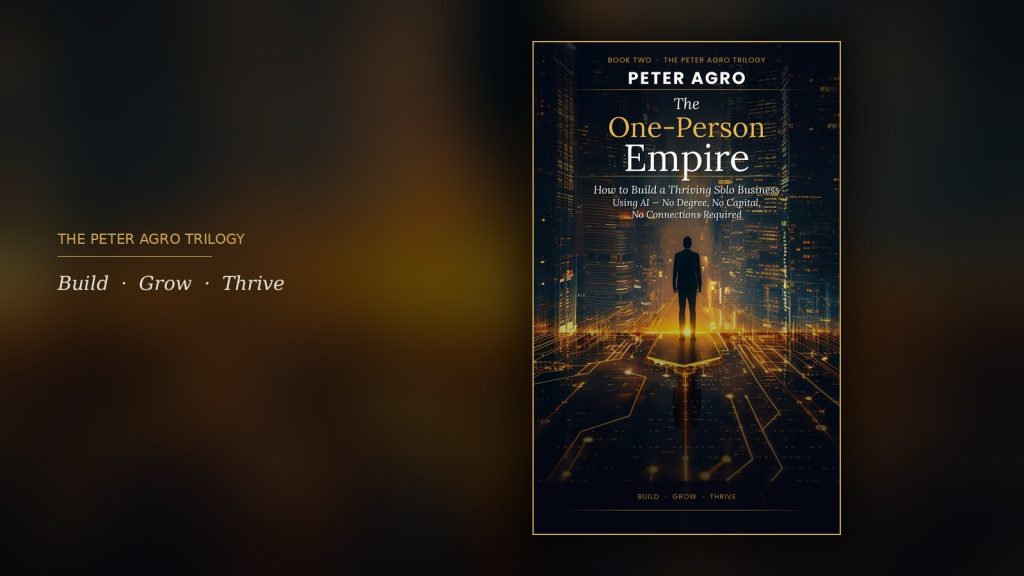
This article covers the mindset and the landscape. The complete blueprint—how to structure a one-person business for maximum leverage, which models work, how to build systems that generate income without constant attention, and how to integrate AI into every layer of the operation—is the subject of my book.
The One-Person Empire by Peter Agro is available now on Amazon.
It is the second book in The Peter Agro Trilogy, written for entrepreneurs, freelancers, and anyone who has ever wanted to build something real without building a company that consumes their life. The blueprint works. The moment for it has never been better.
Peter Agro is an entrepreneur, investor, and author who built the Bombshell Brush brand on Amazon and wrote The Peter Agro Trilogy. He divides his time between New York City, Ft. Lauderdale, and Rio de Janeiro.
Author

Written by
Recent Posts
The New York Women’s Foundation’s 2026 Neighborhood Dinner

Marco Maranghello

The Baker House 1650

MvVO ART Show

Casita Maria Center for Arts and Education
Categories
- Art
- Articles
- Business of Luxury
- Celebrities
- Culture
- Entertainment
- Events
- Faces of Summer 2026
- Fashion
- Fashion & Style
- Featured
- Finance
- Food, Spirits, Wine
- Hamptons
- Hamptons Celebrities
- Health
- Health & Beauty
- Lifestyle
- Luxury Lifestyle
- Press
- Profiles
- Real Estate
- Technology
- The Chronicles
- Travel
- Uncategorized
- Weddings