
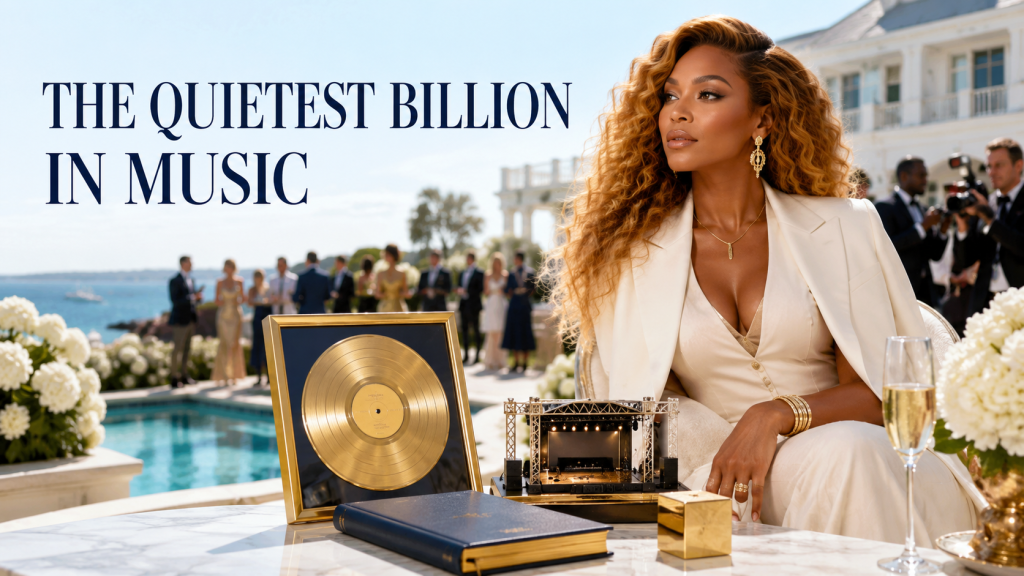
Beyoncé closed the Cowboy Carter tour at Allegiant Stadium in Las Vegas on July 26, 2025. The last night delivered a Destiny’s Child reunion and a final gross of $407.6 million. The Beyoncé net worth figure Forbes prints in 2026 is $1 billion, round and unbothered. Yet the method matters more than the number. She is the only member of pop’s billionaire class who earned her seat mostly by performing.
No beauty conglomerate wrote her into a cap table. Neither shapewear nor a lip kit did the compounding. Instead, the fortune came from three decades of ticket sales, masters she never lost, and property chosen like an endowment. In a class full of new-economy money, hers moves like the old kind.
What Forbes Counts When It Counts Beyoncé
Forbes moved Beyoncé into the billionaire column in 2024, once the Renaissance receipts settled. The 2026 celebrity billionaires list holds her at $1 billion, while Taylor Swift’s climb to $2 billion and Kim Kardashian’s $1.9 billion sit above her. Rihanna, per the same Forbes accounting, sits at roughly the same billion.
The composition is what separates her from the rest of the richest female musicians of 2026. Forbes credits the bulk of the Beyoncé net worth total to three decades of performing, first with Destiny’s Child, then solo. The rest sits in real estate, an art collection reported near $70 million, and full ownership of her recorded catalog.
Read that composition again, because it is rare. Swift’s number rides a catalog she had to buy back. By contrast, Rihanna’s and Selena Gomez’s numbers ride beauty equity. Beyoncé’s rides labor.
She also crossed the line later than her peers, and slower. Rihanna made the list in 2021 on Fenty paper, yet Beyoncé needed until her forties, after the biggest tour of her life, to clear ten figures. Slow money reads as a flaw only to people who have never kept any.
From Houston Rehearsals to the First Nine Figures
The base layer predates the billionaire era by decades. Destiny’s Child sold a reported 60 million records, one of the best-selling girl groups in history. Then Dangerously in Love arrived in 2003 and set the solo flywheel spinning. All eight of her solo studio albums since have debuted at No. 1 on the Billboard 200, a record no other artist holds.
Two early decisions show the instinct. In 2015, she reportedly took about $6 million in Uber stock instead of cash for a private performance, equity that appreciated many times over before the IPO. Later, Netflix reportedly paid $60 million in 2019 for a three-project deal that began with Homecoming, her Coachella concert film. Cash is a fee. Stock and rights are estates.
Coachella 2018 itself deserves a line in the ledger. That two-weekend headline slot, the first ever by a Black woman, became free global marketing for a touring business that has not played to an empty seat since. Fame converted to demand, and demand converted to pricing power.
Two Tours, Three Years, Almost a Billion in Grosses
Between May 2023 and July 2025, Beyoncé played 88 stadium shows across two tours. Together they grossed $986.6 million, a few good nights short of a billion dollars in tickets. No performer in the music industry net worth rankings built a ten-figure fortune this way except her, and arguably Swift. No line item in the Beyoncé net worth file is bigger.
Renaissance: $579 Million Across 56 Nights
The 2023 Renaissance World Tour grossed $579 million over 56 shows, per Billboard Boxscore. At the time, only Swift’s Eras run had ever done more in a single year. Because Parkwood, her own company, produced the tour, a fat share of that gross stayed home. Promoters take points; owners take margin.
The Renaissance year also showed the ancillary stack. Silver dress codes moved retail in every host city, and Stockholm’s hotel surge got blamed by one economist for a Swedish inflation blip. In other words, the ticket was only the entry fee.
Cowboy Carter: $407.6 Million in 32 Shows
The 2025 Cowboy Carter tour was shorter and meaner. Just 32 stadium dates in nine cities moved roughly 1.6 million tickets and grossed $407.6 million, per Billboard. That works out to about $12.7 million per night, the strongest per-show average of her career. It closed as the highest-grossing country tour ever and the biggest solo tour of 2025.
Ticket pricing did quiet work as well. Per-show averages ran well above the Renaissance run because scarcity was the design: nine cities, no secondary markets, fly-in demand. Fewer nights at higher yield is a resort strategy, and she executed it in stadiums.
The album underneath it did its part too. Cowboy Carter won Album of the Year at the February 2025 Grammys, the prize that had dodged her for two decades. Her career total now stands at 35 Grammys, more than any human being who has ever held one.
The Distribution End-Run: AMC and Netflix
The touring machine now has a screen division, and she runs it like a distributor. In December 2023, Renaissance: A Film by Beyoncé skipped the studios and went straight to AMC, grossing a reported $44 million worldwide. Parkwood kept creative control and, reportedly, the dominant share of the split.
Netflix got the next act. Her Christmas 2024 halftime show, streamed live from Houston during the NFL’s first holiday broadcast, aired as Beyoncé Bowl and drew tens of millions of viewers. Each deal follows the same pattern: she supplies the event, keeps the ownership, and lets the platform pay for reach.
The Ivy Park Lesson: Rent Versus a Deed
Every fortune has a tuition bill, and hers was Ivy Park. The Adidas partnership launched in 2019 as a 50-50 profit split on an athleisure line. By 2022, annual sales had reportedly fallen to about $40 million, far under the roughly $250 million Adidas had projected. The two sides parted in March 2023, and she kept the brand name on the way out.
The lesson was structural, not creative. A profit split on someone else’s balance sheet is rent. Equity in your own company is a deed. Rihanna’s beauty-equity fortune comes from co-owning Fenty with LVMH, while Selena Gomez’s Rare Beauty billion comes from founding the company outright. Beyoncé had built the one major deal in her portfolio the other way, and it stalled.
Her response was quiet and total. Cécred, the haircare line she launched in February 2024, is her own company, majority-owned. SirDavis, her whisky with Moët Hennessy, launched that August as a true joint venture. The 2026 Levi’s campaigns are marketing income, not merchandise risk. Ivy Park, by most reporting, has been retired in favor of a reported Balmain collaboration. She pays rent to no one now.
The Catalog She Never Had to Buy Back
Here is the asset that never trends: Beyoncé owns her masters. Parkwood Entertainment has controlled her recordings for years, so every stream of Crazy in Love pays the landlord, and the landlord is her. Swift needed a reported $360 million in May 2025 to buy back what Beyoncé simply never surrendered.
A catalog like hers behaves like a bond that also headlines stadiums. Streaming pays coupon-steady income, while each new album marks the back pages up. Anyone comparing ownership structures across the industry can start with our celebrity net worth guide, but the short version is that owned masters are the difference between earning from music and being owned by it.
Songwriting deepens the moat. Because she holds writing credits across nearly the whole catalog, publishing income arrives in a second stream beside the master royalties. Two claims on every song, held for life plus seventy years, is math that outlasts any single tour. Inside the Beyoncé net worth stack, the catalog is the piece with no expiration date.
Concrete in Malibu, a Pond in East Hampton
In May 2023, the Carters paid $200 million for a Tadao Ando-designed concrete house above Paradise Cove in Malibu. It was the most expensive home sale in California history, and it reportedly closed in cash. Ando has completed only a handful of private homes in the United States, so the purchase reads less like housing and more like acquiring a museum piece with a driveway.
The rest of the portfolio behaves the same way. There is the $88 million Bel Air compound from 2017, a Garden District church in New Orleans, and the $26 million spread on Georgica Pond in East Hampton. Robb Report pegs the couple’s holdings around $313 million. Add a reported $70 million art collection heavy on Basquiat, and the household starts to resemble an acquisitions committee.
The Ando house also solves a problem specific to her tier of fame. A concrete oceanfront compound is privacy you can pour. While lesser fortunes buy visibility, gates in Malibu and hedges on Georgica Pond buy its absence, and absence is the scarcer good.
Notice what is missing: flippers’ churn. Nothing gets listed, staged, or exited. Old money buys things it intends to die owning, and the Beyoncé net worth ledger is full of exactly those things.
The Carter Family Balance Sheet
Forbes puts Jay-Z at $2.8 billion in 2026, which makes the household worth roughly $3.8 billion combined. His side of the ledger is classic deal money: Roc Nation, the Armand de Brignac champagne sale to LVMH, and the D’Ussé settlement with Bacardi. Her side is classic earned money, converted into hard assets before it could evaporate.
Forbes counts them separately, and the distinction is not academic. Her billion requires no marriage to explain it. Within the household, the structure looks like a family office: separate operating businesses, jointly held trophy assets such as the Malibu house, and two children of the deal watching from the Super Bowl box.
The next generation is already on payroll, in fact. Blue Ivy, now 14, danced on both the Renaissance and Cowboy Carter tours and won her first Grammy at nine. Succession planning usually means trusts and trustees. In this house, it also means stage time.
For the reader keeping score against neighbors, that is the model worth copying. Two balance sheets beat one. Shared trophies, separate engines.
What Could Move Beyoncé’s Net Worth in 2026
The 2026 setup is unusually loaded. Act III, the expected close of the trilogy that began with Renaissance, has the rumor economy pricing in a rock era ever since her Levi’s motorcycle spot aired. A third act implies a third tour, and her last two grossed $986.6 million combined. Even a conservative rerun pushes career touring past $1.5 billion.
The consumer lines are compounding too. Cécred moved from direct-to-consumer into roughly 1,400 Ulta doors in April 2025, trading margin for shelf presence. SirDavis picked up early medals in a whisky market starved for new luxury stories. None of it needs to work spectacularly. Because the base is performance income, everything else is upside.
Old Money Behavior in a New Money Class
Set the four pop billionaires side by side and the styles separate fast. Swift’s fortune arrived at supernova velocity, while Rihanna’s and Gomez’s arrived through cap tables. Beyoncé’s arrived the way fortunes did before the internet: decades of work, margins protected, proceeds moved into land, concrete, canvas, and copyrights.
That is why hers is the quietest billion in the 2026 celebrity net worth rankings. There is no product launch to track, no funding round to leak. The money compounds offstage, then surfaces once a decade as a concrete house or a country album. Every Beyoncé net worth estimate is really a report on discipline.
Even the risk profile is conservative. Tours sell out before they price, houses close in cash, and the remaining partnerships sit on her paper rather than a sponsor’s. What remains is a fortune with almost no downside surprise left in it, which may be the most old-money trait of all.
New money performs wealth. Old money performs continuity. She figured out how to do the second while selling tickets to the first.
Where The Conversation Continues
The people who think hardest about this kind of compounding tend to summer in the same few zip codes. Social Life Magazine has spent two decades in those rooms, from the print issue on Southampton coffee tables to the sidelines at Polo Hamptons in Bridgehampton, where the conversation is always some version of who owns what. Our full pop girl billionaires breakdown maps the whole class, Beyoncé included, and the July issue carries the stories that never make the internet. The season is short. The tables are shorter. If this is your conversation, you already know where it happens.
Author

Written by
Recent Posts

AI for personal finance: where PennyGuard fits

How to Pick a Homecoming Dress for Your Body Type (and Feel Amazing in It)

World Cup Injury Attorney for Vancouver Events
What a 3-Carat Engagement Ring Actually Costs in 2026: The Real Numbers
The Skincare Habits That Make a Real Difference Over Time
Categories
- Art
- Articles
- Business of Luxury
- Celebrities
- Culture
- Entertainment
- Events
- Faces of Summer 2026
- Fashion
- Fashion & Style
- Featured
- Finance
- Food, Spirits, Wine
- Hamptons
- Hamptons Celebrities
- Health
- Health & Beauty
- Lifestyle
- Luxury Lifestyle
- Press
- Profiles
- Real Estate
- Technology
- The Chronicles
- Travel
- Uncategorized
- Weddings