
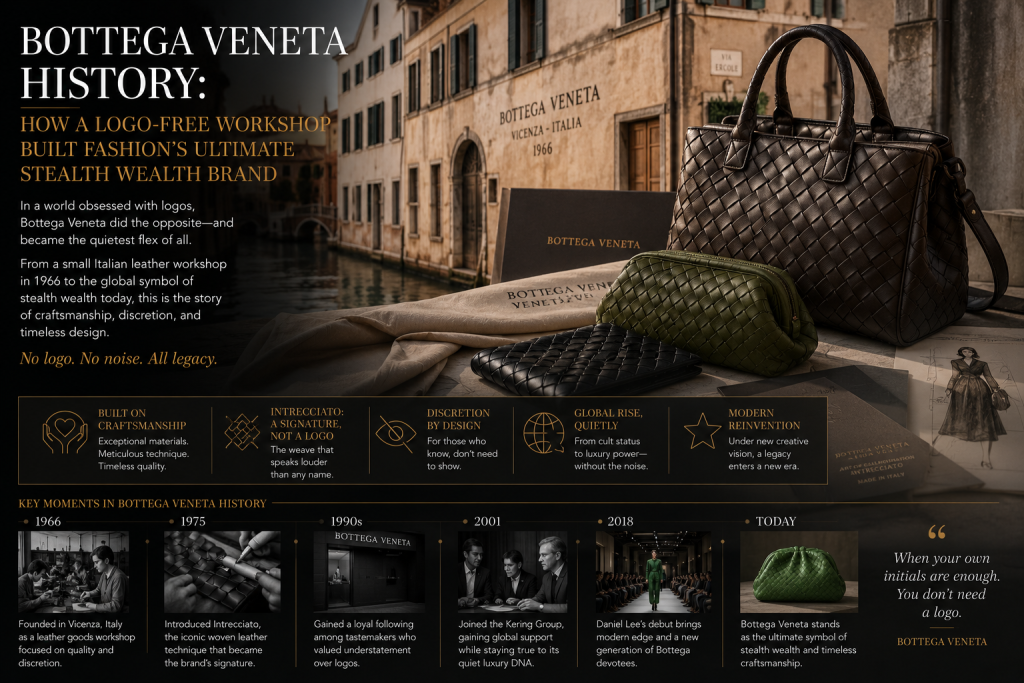
Bottega Veneta spent decades as the fashion industry’s best-kept secret, a brand that wealthy Italians carried precisely because nobody else recognized it. Bottega Veneta history is the story of a leather goods house that turned anonymity into a luxury strategy, nearly went bankrupt doing it, and then got resurrected twice: first by Kering’s corporate money and Tomas Maier’s quiet vision, then by Daniel Lee’s viral reinvention that made stealth wealth the most photographed thing on the internet.
Michele Taddei and Renzo Zengiaro founded the company in Vicenza in 1966, in the Veneto region of northeastern Italy where leather artisanship had been a generational trade for centuries. The name translates loosely to “Venetian workshop,” a description so literal it functioned as a manifesto. This was a workshop, not a fashion house. The product was the point. Everything else, logos, celebrity endorsements, runway spectacle, was decoration that the founders considered beneath the quality of the work.
Intrecciato: The Weave That Built an Empire
Bottega’s signature technique, the intrecciato weave, emerged from a practical constraint. The workshop’s leather was so thin and supple that it couldn’t hold a structured shape on its own. Artisans developed a method of weaving strips of leather together to create a self-supporting surface that was simultaneously soft and structural. The resulting texture was unmistakable to anyone who touched it and invisible to anyone who merely glanced at it from across a room.
That invisibility was the point. The brand’s famous tagline, “When your own initials are enough,” articulated a philosophy that positioned Bottega as the anti-logo brand decades before “quiet luxury” became a marketing category. Among the Italian fashion houses, Bottega occupied a singular position: it was the brand you chose when you no longer needed anyone to know what brand you were carrying. Economic capital so deep it didn’t require symbolic reinforcement. The intrecciato weave functioned as a signature that only the initiated could read, a password spoken in leather rather than printed in gold hardware.
Through the 1970s and 1980s, Bottega built a devoted clientele among European aristocrats, American old money, and Japanese connoisseurs who appreciated the craftsmanship without needing the validation of recognition. Andy Warhol carried a Bottega briefcase. Lauren Hutton was photographed with the intrecciato clutch. Each sighting was accidental rather than staged, which only reinforced the brand’s positioning as something discovered rather than marketed. At its peak in the 1980s, the Vicenza workshop employed over 200 artisans producing bags, luggage, and small leather goods that retailed for prices that even then seemed designed to exclude casual buyers.
The Near-Death Experience
By the late 1990s, Bottega was dying. Revenue had declined for years as the luxury market shifted toward logo-driven conspicuous consumption that made Bottega’s discretion look like irrelevance. While Gucci under Tom Ford was printing double-G logos on everything from thongs to dog collars, Bottega was still whispering in an industry that had started shouting. The intrecciato weave was still beautiful. Nobody was buying it. The company changed hands multiple times, each new owner extracting licensing fees and cutting production quality until the product no longer justified the price. A brand built on the premise that quality speaks for itself discovered that quality needs an audience willing to listen.
Gucci Group (now Kering) acquired Bottega Veneta in 2001 for approximately $156 million, a fraction of what the brand’s intellectual property and artisan infrastructure would be worth a decade later. Tom Ford and Domenico De Sole, then running Gucci Group, recognized that Bottega’s problem was not its aesthetic but its execution. The brand needed a creative director who understood that anonymity was an asset, not a liability, and who could rebuild the product without adding the logo-heavy elements that would have destroyed the brand’s entire reason for existing.
The Tomas Maier Renaissance
They hired Tomas Maier, a German designer who had worked at Hermes and understood luxury as a question of materials and construction rather than marketing and celebrity. Maier’s tenure from 2001 to 2018 was a masterclass in brand resurrection through product excellence. He rebuilt the leather goods line from the inside out, reinvesting in the Vicenza workshops, hiring artisans trained in the traditional intrecciato technique, and introducing new colorways and forms that modernized the aesthetic without corrupting it. His “Knot” clutch became a red carpet staple carried by women who understood that its $2,500 price tag bought artisan labor, not brand recognition.
Maier also expanded Bottega into ready-to-wear, furniture, jewelry, and fragrances, each extension maintaining the same philosophical commitment: no visible logos, no celebrity endorsements, no trend-chasing. The brand’s furniture collection, designed in collaboration with Italian artisans, placed Bottega in living rooms and dining rooms alongside the closets where its bags already lived. Revenue grew from $35 million in 2001 to over $1.2 billion by 2016.
Maier accomplished this without a single celebrity ambassador, without a logo visible on any product, and without the kind of social media strategy that every other luxury brand was pursuing aggressively. His refusal to play the attention game became, paradoxically, the most attention-getting strategy in luxury fashion. In the broader fashion industry, Maier proved that product quality could function as a marketing strategy if the product was genuinely exceptional.
Daniel Lee and the Viral Quiet Revolution
When Daniel Lee replaced Maier in 2018, industry observers expected continuity. They got a revolution. Lee, a 32-year-old British designer who had spent a decade at Celine under Phoebe Philo, kept Bottega’s commitment to craftsmanship and its refusal to use visible logos, but he added a visual boldness that Maier’s more restrained sensibility had never attempted. The Pouch clutch (a pillow-shaped bag that looked like someone had gathered a cloud of leather in their hand), the padded Cassette bag, and the chain-link accessories became the most photographed items in fashion within months of their launch. He introduced Bottega Green, a saturated parakeet hue that became instantly recognizable on social media despite appearing on a brand that technically had no social media presence.
Lee also made the radical decision to delete all of Bottega Veneta’s social media accounts in January 2021. The brand had no Instagram, no Twitter, no Facebook. In an industry that measured relevance by follower counts, Bottega simply disappeared from the platforms. The effect was exactly what Lee intended: the brand became more talked about in its absence than most competitors managed with daily posting. Fan-run accounts like @newbottega filled the vacuum, generating organic engagement that the brand’s own marketing team could never have manufactured. Revenue hit $1.8 billion by 2022.
Lee departed in November 2021, replaced by Matthieu Blazy, whose debut collection in February 2022 earned unanimous critical praise. Blazy’s approach synthesizes Maier’s product obsession with Lee’s visual confidence, adding a conceptual depth that positions Bottega as fashion’s most intellectually ambitious leather goods house. Under his direction, Bottega Veneta history has entered its most creatively fertile period since the brand’s founding.
What Bottega Veneta History Reveals About Anti-Marketing
Bottega’s arc demonstrates something that most luxury executives refuse to believe: you can build a billion-dollar brand without logos, without celebrity ambassadors, and without social media. The catches are severe. You need product quality so exceptional that it generates word-of-mouth organically. You need a parent company (Kering) patient enough to fund years of slow growth before the strategy pays off. And you need creative directors brilliant enough to make restraint look exciting, which is the hardest design brief in fashion.
Among the Italian houses, Bottega occupies the position that Armani once held: the brand for people who don’t need to prove anything. The difference is that Armani’s restraint is recognizable (the silhouette is the signature), while Bottega’s is genuinely invisible until you touch the leather. For Gucci the logo is the product. For Bottega, the craft is the product. That distinction drives every business decision the company makes.
On the Hamptons social circuit, Bottega Veneta history lives in the bags carried by women who stopped caring about recognition years ago. A Bottega Jodie at a private dinner in Sagaponack communicates taste so secure it requires no external validation. In a social ecosystem calibrated to notice everything, choosing a brand designed not to be noticed is the most noticed move you can make.
Where The Conversation Continues
Connect With Social Life
Social Life Magazine has covered the intersection of luxury fashion, power, and the Hamptons for over two decades. Our five summer issues, distributed from Memorial Day through Labor Day across the East End, reach 25,000 readers who define the season’s cultural conversation. From Westhampton to Montauk, this is the publication that brands trust when the audience matters more than the impression count.
We deliver an additional 15,000 copies to Upper East Side doorman buildings during fall and winter, extending the Hamptons conversation into Manhattan’s most exclusive residential addresses. Our 82,000 email subscribers receive curated editorial that blends fashion authority with Hamptons insider access.
Polo Hamptons, our signature sporting and lifestyle event in Bridgehampton, brings together the brands and personalities that shape luxury culture. Christie Brinkley hosts. Getty and McMullan photograph. The corporate cabana and sponsor activations create direct engagement with an audience that treats attendance as a social credential.
The Social Life Guest House in Sag Harbor offers select brands the opportunity to integrate into our editorial through experiential activations. It is a restored residence designed for content creation, product placement, and the kind of organic media coverage that feels editorial because it is.
Whether you are a luxury brand seeking Hamptons credibility, a wellness company building prestige positioning, or a financial services firm targeting high-net-worth audiences, Social Life Magazine offers a platform that combines print authority, digital reach, and experiential access in one integrated partnership.
Contact Cass Almendral, Head of Business Development, at [email protected] to discuss editorial features, event sponsorships, and brand activations for the 2026 season.
For Polo Hamptons corporate cabana inquiries, reach Justin Mitchell at [email protected].
Author

Written by
Recent Posts

Planning an Arizona Road Trip? Practical Details to Handle Before You Leave

Short Homecoming Dresses That Feel Polished, Not Overdone
Men’s Health After 40: Important Changes to Pay Attention To
What You Need to Know About Spray Tanning

Simple Ways to Upgrade Your Summer Drink Routine
Categories
- Art
- Articles
- Business of Luxury
- Celebrities
- Culture
- Entertainment
- Events
- Faces of Summer 2026
- Fashion
- Fashion & Style
- Featured
- Finance
- Food, Spirits, Wine
- Hamptons
- Hamptons Celebrities
- Health
- Health & Beauty
- Lifestyle
- Luxury Lifestyle
- Press
- Profiles
- Real Estate
- Technology
- The Chronicles
- Travel
- Uncategorized
- Weddings