
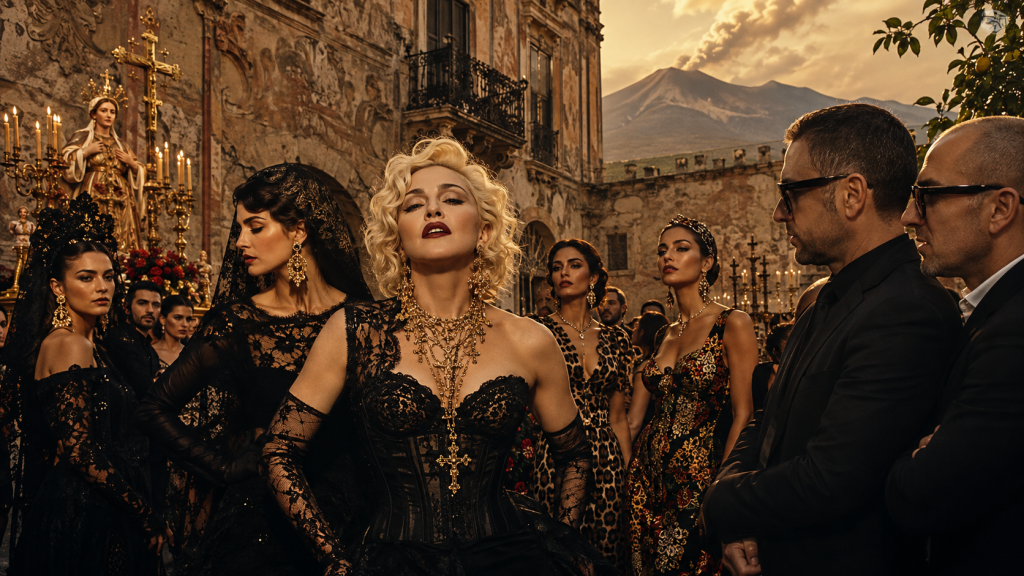
Domenico Dolce and Stefano Gabbana built a $5.6 billion fashion empire by treating Sicily not as a geographic origin but as a creative ideology. Dolce and Gabbana history is the story of two designers who turned Southern Italian identity, its Catholic iconography, its maternal worship, its sexual theatricality, into a luxury brand that operates as a cultural manifesto dressed in lace, leopard print, and 24-karat gold.
Dolce was born in Polizzi Generosa, a hilltop village in the Madonie mountains of Sicily, in 1958. His father was a tailor. His mother sewed garments in their home. Fabric was the family business before it became his personal obsession. Gabbana, born in Milan in 1962 to a printing company employee, brought the metropolitan perspective that Dolce’s Sicilian roots lacked. They met in 1980 while working at the same Milanese fashion atelier, began a romantic relationship, and decided to channel that partnership into a shared creative vision.
The Sicilian Debut
Their first collection in 1985 was shown during Milan Fashion Week on a shoestring budget. Models wore their own jewelry. There was no backstage. The clothes, however, communicated something that Italian fashion had not previously articulated: Southern Italy as a source of creative power rather than economic backwardness. While Milan’s established houses drew from French couture traditions and Northern Italian industrial culture, Dolce and Gabbana drew from their grandmother’s wardrobes, village festivals, and the black-and-white Italian cinema of Visconti and Rossellini.
The corset became their first signature piece. Not the constrictive Victorian garment but a celebratory one, designed to emphasize rather than suppress the female form. Paired with devotional crosses, lace mantillas, and the baroque ornamentation of Sicilian churches, the corset anchored an aesthetic that positioned femininity as power rather than vulnerability. When Madonna wore a jeweled D&G corset on her 1993 “Girlie Show” world tour, the brand crossed from Italian fashion house to pop culture institution overnight.
The Madonna Partnership and Celebrity Machine
Madonna was not simply a client. She was a co-conspirator. Dolce and Gabbana designed costumes for five of her world tours between 1993 and 2012, creating a creative partnership that generated more press coverage per garment than any designer-celebrity relationship in fashion history. Each tour wardrobe functioned as a $30 million advertising campaign that someone else paid for: Madonna paid for the costumes, the world’s media covered them for free, and Dolce and Gabbana collected the brand equity.
Their celebrity clientele expanded methodically. Monica Bellucci became the brand’s living embodiment, her Sicilian beauty and unapologetic sensuality a walking advertisement for the D&G worldview. Beyonce, Jennifer Lopez, Scarlett Johansson, and Victoria Beckham each wore D&G at career-defining moments. The designers understood instinctively what Versace had pioneered: celebrity dressing was not a service but a strategy, and the return on investment scaled with the star’s visibility.
By the mid-1990s, Dolce and Gabbana were operating two separate labels. The main collection, Dolce & Gabbana, occupied the luxury tier with ready-to-wear priced alongside Gucci and Prada. The secondary line, D&G, targeted a younger audience at lower price points with denim, graphic tees, and the casual menswear that would later influence every fast-fashion brand on the planet. Annual revenue climbed past $1 billion before 2000. They shuttered the D&G line in 2012 to concentrate all creative and commercial energy on the main label, a consolidation move that increased average selling prices and pushed total revenue past $1.6 billion by the mid-2010s. They achieved this growth without outside investors, without a parent conglomerate, and without a single share of equity sold to anyone outside the partnership.
Controversies, Cancellations, and Survival
Dolce and Gabbana have courted controversy with a consistency that suggests strategy rather than accident. Comments about IVF children in 2015 triggered a boycott led by Elton John. A 2018 advertising campaign featuring a Chinese model struggling to eat Italian food with chopsticks generated a firestorm that effectively shut down the brand’s operations in China for over a year. Revenue dropped an estimated $500 million in the Chinese market alone.
Every controversy followed the same pattern: provocation, outrage, apology (usually insufficient), and then a creative collection so strong that the fashion industry quietly forgave what the public had not forgotten. Their Spring 2019 couture show in Sicily, arriving just months after the China debacle, featured hand-painted ceramics, citrus motifs, and cathedral-inspired embroidery that reminded critics why the brand mattered regardless of its founders’ public statements. That collection alone generated over $200 million in orders.
Their ability to survive cancellations that would have destroyed lesser brands stems from a structural advantage: they own the company outright. No board can fire them. No shareholders can demand a public relations strategy. When the internet decides they are finished, they simply keep making clothes until the internet finds someone else to be angry at. The brand’s estimated valuation of $5.6 billion reflects the market’s assessment that the product and the client base are more durable than any single controversy.
That independence also allows them to operate without the creative director carousel that defines conglomerate-owned brands. Dolce designs. Gabbana styles and directs the campaigns. The aesthetic has remained remarkably consistent for four decades: Sicilian baroque, animal prints, Catholic iconography, celebration of the maternal body, menswear that borrows from the wardrobe of the Southern Italian man (fitted suits, undershirts as outerwear, gold chains worn without irony). The consistency is itself a form of luxury. Customers know exactly what they are buying. In an industry addicted to reinvention, that reliability generates a loyalty that trend-driven brands cannot replicate.
The Alta Moda Bet
In 2012, Dolce and Gabbana launched Alta Moda (haute couture for women) and Alta Sartoria (haute couture for men), invitation-only collections shown in spectacular locations: Capri, Venice, Palermo, Lake Como, Agrigento’s Valley of the Temples. Each show functions as a multi-day event where the world’s wealthiest clients fly in, attend elaborate dinners, and commission custom pieces priced from $50,000 to over $1 million. Alta Moda generates an estimated $500 million in annual revenue from fewer than 1,000 clients globally.
The Alta Moda strategy represents Dolce and Gabbana history’s most sophisticated business move. While the broader luxury market battles for middle-class aspirational buyers through handbags and entry-level accessories, D&G went in the opposite direction: deeper into exclusivity, higher in price point, smaller in client base. They bet that the ultra-wealthy would pay extraordinary premiums for extraordinary experiences, and the bet paid off. Alta Moda clients include members of royal families, billionaire wives, and American socialites who treat the shows as the fashion equivalent of Davos.
What Dolce and Gabbana History Reveals About Independent Luxury
Among the Italian fashion empires, Dolce and Gabbana’s independence is their defining feature. While Fendi belongs to LVMH, Valentino to Kering, and Versace to Capri Holdings, D&G answer to nobody. That independence allows creative risks that corporate governance would never approve (the China controversy alone would have triggered a board-level crisis at any public company) but also enables the kind of long-term strategic bets (Alta Moda) that quarterly earnings pressure makes impossible.
The succession question looms. Both designers are in their sixties. They have no children, no designated successors, and no corporate structure designed for transition. The Dolce and Gabbana history endgame likely involves an acquisition by one of the luxury conglomerates, but the founders have consistently resisted offers that would dilute their creative control. When they eventually exit, the brand faces the same challenge that every founder-led house confronts: can the aesthetic survive without the people who created it?
For the Hamptons social calendar, D&G occupies a specific and unapologetic position. Wearing Dolce and Gabbana to a benefit gala on Gin Lane signals that you are not interested in blending into the quiet luxury consensus. The leopard print, the gold hardware, the baroque embroidery, all communicate a willingness to be looked at and a confidence that what they see will be worth the attention. In a summer circuit increasingly dominated by muted tones and understated bags, D&G is the brand for people who believe fashion should be an event, not a murmur.
Where The Conversation Continues
Connect With Social Life
Social Life Magazine has covered the intersection of luxury fashion, power, and the Hamptons for over two decades. Our five summer issues, distributed from Memorial Day through Labor Day across the East End, reach 25,000 readers who define the season’s cultural conversation. From Westhampton to Montauk, this is the publication that brands trust when the audience matters more than the impression count.
We deliver an additional 15,000 copies to Upper East Side doorman buildings during fall and winter, extending the Hamptons conversation into Manhattan’s most exclusive residential addresses. Our 82,000 email subscribers receive curated editorial that blends fashion authority with Hamptons insider access.
Polo Hamptons, our signature sporting and lifestyle event in Bridgehampton, brings together the brands and personalities that shape luxury culture. Christie Brinkley hosts. Getty and McMullan photograph. The corporate cabana and sponsor activations create direct engagement with an audience that treats attendance as a social credential.
The Social Life Guest House in Sag Harbor offers select brands the opportunity to integrate into our editorial through experiential activations. It is a restored residence designed for content creation, product placement, and the kind of organic media coverage that feels editorial because it is.
Whether you are a luxury brand seeking Hamptons credibility, a wellness company building prestige positioning, or a financial services firm targeting high-net-worth audiences, Social Life Magazine offers a platform that combines print authority, digital reach, and experiential access in one integrated partnership.
Contact Cass Almendral, Head of Business Development, at [email protected] to discuss editorial features, event sponsorships, and brand activations for the 2026 season.
For Polo Hamptons corporate cabana inquiries, reach Justin Mitchell at [email protected].
Author

Written by
Recent Posts
Planning an Arizona Road Trip? Practical Details to Handle Before You Leave
Short Homecoming Dresses That Feel Polished, Not Overdone
Men’s Health After 40: Important Changes to Pay Attention To
What You Need to Know About Spray Tanning
Simple Ways to Upgrade Your Summer Drink Routine
Categories
- Art
- Articles
- Business of Luxury
- Celebrities
- Culture
- Entertainment
- Events
- Faces of Summer 2026
- Fashion
- Fashion & Style
- Featured
- Finance
- Food, Spirits, Wine
- Hamptons
- Hamptons Celebrities
- Health
- Health & Beauty
- Lifestyle
- Luxury Lifestyle
- Press
- Profiles
- Real Estate
- Technology
- The Chronicles
- Travel
- Uncategorized
- Weddings