
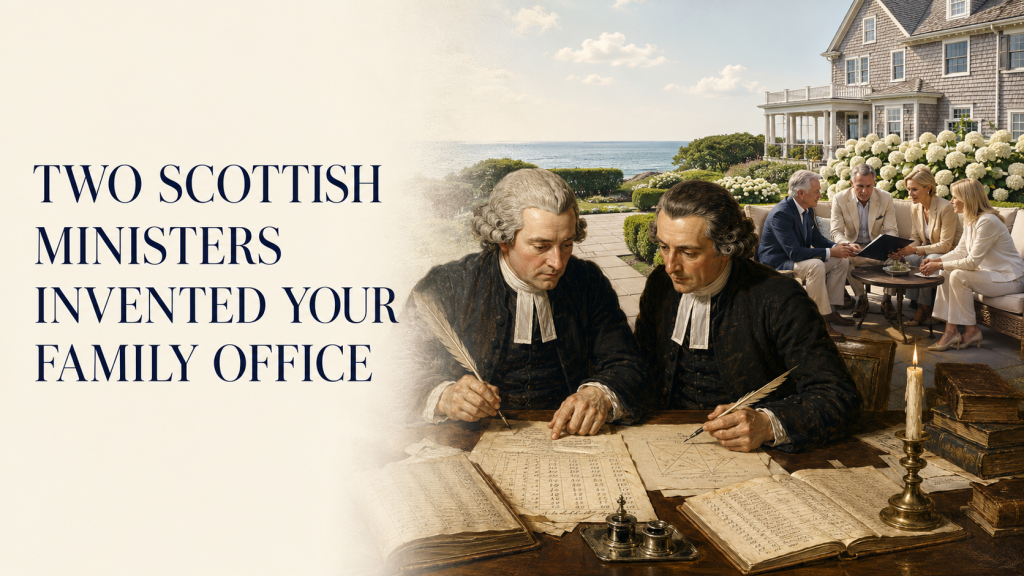
Edinburgh, 1744. Two ministers of the Church of Scotland, Robert Wallace and Alexander Webster, are worrying about a problem with no glamour in it whatsoever. Ministers die. So their widows and children fall into poverty, publicly, in the middle of the congregation. Charity handles it badly and unpredictably, which everyone can see, and the seeing is the problem.
What the two of them built to fix it became, through a long chain nobody planned, the modern family office, the structure that now manages the largest fortunes out here from behind the calmest doors. The chain runs from a widows’ fund to your neighbor’s dynasty, and it is worth walking, because every link explains something about how the quietest money on the East End actually thinks.
The Problem of the Widows
Wallace and Webster’s insight was not compassion. After all, the church had compassion. Their insight was that death, unpredictable for any one minister, is astonishingly predictable for all ministers together. Count the clergy and consult the mortality tables. You can then state with indecent accuracy how many widows next year will produce.
So they built the machine. So every minister pays an annual premium. The premiums get invested, and the returns compound. Payouts to widows are calculated against projected deaths, not hoped against them. An Edinburgh professor who understood compounding better than anyone alive checked the mathematics. Notably, their projections of the fund’s future value proved accurate to within a few pounds, which remains one of the quiet miracles of financial history.
The professor deserves his name. Specifically, Colin Maclaurin held Edinburgh’s chair of mathematics and checked the ministers’ tables as a favor, which means one of the great mathematicians of the age spent evenings pricing clergy mortality. In fact the collaboration set a precedent the industry never abandoned. Behind every calm structure, then and now, still sits someone very good at math whom the beneficiaries never meet.
Notice what they had actually invented, because it was bigger than a pension. They had demonstrated that the future is calculable and that risk pooled becomes risk tamed. A properly built structure, they proved, keeps promises longer than any person can. The fund they built ran, solvent, for two and a half centuries. Both men were dust before it hit its stride. That was the design.
What a Family Office Actually Is
Strip any modern family office to the frame and the same three moves appear. Pool the risk, so no single death, divorce, or bad heir can sink the name. Project the future, in decades, with math instead of hope. Then build the structure to outlast every individual it serves, on purpose, from the first document.
Everything else, the investment committee, the bill pay, the plane schedule, the cousin management, is furniture. The family office is not a wealthy family’s accounting department. It is an insurance scheme against the family itself, written by the one generation that understood the risk clearly. Usually that generation had just watched another family fail to.
Notice also what the definition excludes. A smart accountant is not a family office. A trusted broker is not one either. The test is whether the structure would keep functioning, unchanged, through the founder’s funeral. Most wealth arrangements out here fail that test, and the failing gets discovered at the worst possible attendance.
The modern threshold question, how much money justifies one, misses the ministers’ point. The structure is not a reward for size. It is a response to complexity, and complexity arrives with the second generation, the second marriage, or the second country, whichever comes first. Families below the famous thresholds run lean versions and call them nothing. The instinct is identical.
In fact the honest definition is temporal. Ordinary wealth management asks what the money should do this year. A family office asks what the money should do after everyone in the room is dead. It asks at every meeting, politely, under other agenda items.
From the Fund to the Dynasty
The chain from Edinburgh runs through two centuries of borrowed logic. Insurance mathematics escaped the church within a generation, pricing lives and ships and buildings, teaching private fortunes that uncertainty was negotiable. The trust absorbed the same idea: assets held by a structure, governed by documents, indifferent to the mood of any living beneficiary.
American law added its own hinge in the spendthrift trust, a structure that protects a beneficiary’s inheritance from the beneficiary’s own creditors, which is to say from the beneficiary. Courts blessed it, dynasties institutionalized it, and the polite fiction that heirs own their money has been maintained at scale ever since.
Then in 1882 the Rockefellers assembled the piece everyone now copies, a dedicated office for one family’s affairs, and the modern form was complete. The innovation was not the wealth. Fortunes that size had existed before. The innovation was the admission, unusual among founders, that the fortune needed protecting from its own future owners. The protection, they decided, should be staffed.
That last link is recent and everywhere. Offices that served one family began taking a second, then a tenth, and an industry assembled itself around the model, conferences and all. Purists grumble that a multifamily office is a contradiction in terms. The ministers would not. Theirs served every manse in Scotland, and pooling was the entire point.
Every family office since is a variation on those two documents, the widows’ fund and the Rockefeller charter. One taught that the future is calculable. The other taught that the family is a risk category. Put together, they are the entire operating philosophy of quiet money.
The Office at the Benefit
Out here the structure is visible mostly as an absence, and the absence is exquisite. The family that has one does not take your first meeting. A pleasant person with an unplaceable title takes it, asks intelligent questions, and commits to nothing. Three weeks later a decision arrives that no individual appears to have made. You have just met the machine. It was built precisely so you would never meet the family.
The rhythm gives it away faster than the org chart. Family office money moves on the calendar of institutions: quarterly reviews, annual allocations, decisions ratified in rooms that meet twice a year. Urgency does not translate. A deadline presented to a family office is a curiosity, examined kindly, like a seashell.
For anyone selling into this coastline, the practical rule follows from the structure. You are never persuading the person in front of you. You are equipping that person to persuade a committee you will not attend, so the best pitch is a document that survives being forwarded. Charm dies in the forwarding. Clarity does not. The offices, for their part, keep quiet files on who understands this, and the files get consulted.
Also, learn the titles. Director of family affairs, principal, chief of staff: each maps to a different distance from the money, and the mapping is consistent across the industry. Ask any good development officer out here. They keep the org charts the way birders keep lists.
The staff, meanwhile, are their own species, and worth knowing. Discreet, permanently employed, and personally modest, they hold more practical power over this coastline’s money than most of its owners. The good ones wear it the way the ministers would have. As a duty, with excellent manners, forever.
The Actuarial Family
Live inside a structure like that for a generation and it rewires the family temperament, which is the deepest inheritance of all. Actuarial families think in probabilities and decades. They do not ask whether the marriage will last. They ask what the documents say if it does not. The question gets asked before the engagement party, and nobody considers it rude.
The same temperament explains their strange calm around losses. A bad year is a data point inside a hundred-year projection, priced in by people who were hired to price it. Panic, in an actuarial family, is a governance failure, and governance failures are what the structure exists to prevent.
Watch an actuarial family hire, and the temperament shows plainest. References go back decades. Probation lasts years. Yet once inside, people stay for whole careers, because the structure extends its time horizon to its staff, and loyalty, like everything else in the building, compounds.
Equally, the temperament is contagious in rooms. One actuarial family on a benefit committee changes how the whole committee budgets, because probability talk, once introduced, embarrasses optimism out of the minutes. Institutions out here that feel unusually well run usually trace to one such family, two structures back.
Of course the temperament has its costs, and the structure’s beneficiaries pay them. It is difficult to feel like the protagonist of your own life when your life is a line item in a projection. The projection was accurate before you were born. The literature on unhappy heirs is really literature about this, although almost none of it says so.
What the Ministers Would Recognize
Walk Wallace and Webster through a Further Lane family office today and very little would confuse them. The premiums are called capital contributions now. Mortality tables have become estate projections. The compounding is the same compounding, still checked by the best mathematician money can retain.
Only the direction of protection has reversed, and they would notice it immediately. Their fund protected families from the deaths of the men who provided. The modern office protects fortunes from the lives of the heirs who inherit. Same machine, same math, pointed the other way, and neither version has ever once been wrong to worry.
The ministers would approve, on balance. Then they would ask, because they were ministers before they were actuaries, what all this protected money is for. The room would go briefly, interestingly quiet. That question is not in the documents. It remains the one calculation no office has ever been asked to run.
Where The Conversation Continues
If your own structure has an answer to the ministers’ question, you are ahead of most of the coastline. If it does not, that is a different kind of meeting, and worth having before the next quarterly.
Social Life Magazine has covered the families and the structures for over two decades. For editorial inquiries, reach the editorial desk.
For brands and individuals ready to be part of the story, explore a feature in Social Life.
The people in these pages get the invitations first. Sign up for Event Invites and Specials and read the season before it happens.
The structures and their families assemble in person every July. Polo Hamptons, Bridgehampton.
Print still carries a weight the feed cannot. Subscribe to the print edition and hold the season in your hands.
Independent coverage of this world stays independent because readers keep it that way. Support Social Life’s editorial desk.
Author

Written by
Recent Posts
Sectional Sofa vs. Regular Sofa: Which One is Best for You?

Sober and Injured: How to Manage Pain Treatment After a Massachusetts Slip and Fall
Flexible Liquidity Options Are Reshaping How Modern Professionals Handle Unexpected Expenses
5 Best At-Home Teeth Whitening Kits for a Brighter Smile in 2026

From Spa Retreats to Aesthetic Care, the Luxury Travel Itinerary Is Changing
Categories
- Art
- Articles
- Business of Luxury
- Celebrities
- Culture
- Entertainment
- Events
- Faces of Summer 2026
- Fashion
- Fashion & Style
- Featured
- Finance
- Food, Spirits, Wine
- Hamptons
- Hamptons Celebrities
- Health
- Health & Beauty
- Lifestyle
- Luxury Lifestyle
- Press
- Profiles
- Real Estate
- Technology
- The Chronicles
- Travel
- Uncategorized
- Weddings