
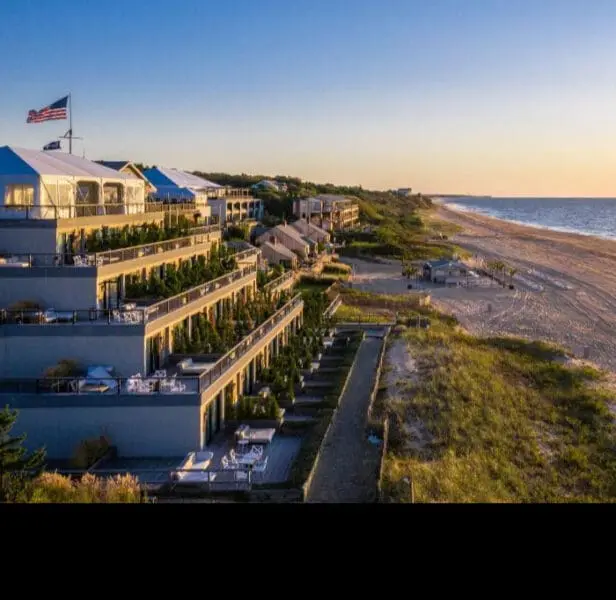
Gurney’s Montauk turns 100 this summer, a milestone that puts its founding before the stock market crash, before the Second World War, and before Andy Warhol discovered the End. Founded in 1926 by Maude Gurney as a 20-room inn on land purchased from Carl Fisher’s Montauk Beach Development Corporation, the resort has survived every cycle of Hamptons reinvention while remaining the one constant at Montauk: the only year-round property, the only oceanfront resort, and the only place where you can get a seawater spa treatment at 10 a.m. and a Dolce & Gabbana beach cabana at noon without changing buildings.
Men’s Journal named it the best beach hotel in America for 2026. Indeed, the honor is deserved, although “beach hotel” undersells the operation considerably. Gurney’s Montauk Resort & Seawater Spa is a 158-room oceanfront campus, a dining complex, a spa destination, a beach club, a cultural programming venue, and (this is the part nobody says aloud) the single most effective status-sorting mechanism east of the BQE. More on that in a moment.
One Hundred Years: The Arc from Inn to Icon
It is 1926. Maude Gurney, a Christian Scientist who opposes alcohol consumption, builds a modest 20-room inn on Old Montauk Highway. Her guests are fishermen, birdwatchers, and the occasional New Yorker who has driven far enough east to feel like he is no longer in New York. The rooms are simple. The ocean is the amenity. Maude runs the inn for thirty years, during which the Hamptons social season operates entirely in Southampton and Sag Harbor, forty-five and thirty minutes west respectively, and nobody with a summer social calendar considers Montauk a destination. Nobody will for another fifty years.
In 1956, Nick Monte, a businessman from Brooklyn, purchased the inn from Maude Gurney for $200,000. Monte immediately began doing what Maude, as a Christian Scientist, had not. First came the liquor. Then came the expanded dining room (the Skipper’s Dining Room, a name that telegraphed nautical aspiration without quite achieving it). After that came the additional rooms. Monte understood something prescient about the Montauk market. The people who came to the End did not want Southampton’s formality or Sag Harbor’s literary posturing. Instead, they wanted the ocean, a drink, and permission to be slightly less composed than they were in the city. Gurney’s under Monte became the place that granted that permission.
The Spa That Changed Everything
In 1979, Monte opened the seawater spa. With that decision, the resort’s identity shifted permanently. The spa drew heated Atlantic seawater directly into an indoor pool, a practice with European precedent but virtually no American equivalent at the time. Essentially, it created a thalassotherapy facility decades before “wellness” became a $4.4 trillion global industry. Initially, the spa was not luxurious by contemporary standards. It was functional, slightly clinical, and deeply weird in the way that all genuinely novel ideas are weird before they become mainstream.
By the 1980s, the seawater spa had become Gurney’s defining feature. Women from the Upper East Side (a specific demographic: married, philanthropic, Jazzercise-adjacent, with a particular commitment to the idea that saltwater reverses cellular aging) drove two and a half hours each way for a spa day. The resort became a co-op in 1982, with units offered under a timeshare arrangement. To be sure, this was not a glamorous era for Gurney’s. Yet it was an essential one. The spa established the resort as something more than a hotel. It became a health destination, a category that barely existed in 1979 and now generates billions.
The Filopoulos Renovation
In 2013, investor George Filopoulos purchased the property and began a renovation that would transform Gurney’s from a faded co-op into a modern luxury resort. Rooms were gutted and rebuilt. The lobby was redesigned. Every restaurant program was overhauled. By 2015, the property had rebranded as Gurney’s Montauk Resort & Seawater Spa, a name that announced its intention to compete with coastal resorts worldwide rather than merely with the other hotels in Montauk (of which, to be fair, there were not many operating at this level).
The Seawater Spa itself received a $20 million renovation, designed by Alonso Designs, the firm behind Manhattan’s Aire Ancient Baths. As a result, the facility now combines the original thalassotherapy concept with contemporary wellness programming. At its center, the indoor seawater pool remains the centerpiece. Around it, treatment rooms offer everything from deep-tissue massage to cryotherapy to IV vitamin drips. In the context of a century-old fishing village, these services require a certain suspension of historical irony. The spa is open to both resort guests and day visitors. Still, the pricing structure (treatments start around $200) functions as its own form of qualification.
The Campus: What Gurney’s Actually Is in 2026
She is forty-four and runs a media buying agency in Tribeca. Her husband is a dermatologist with a practice on Park Avenue and a clinical interest in marine collagen that he will not discuss at dinner parties because it makes him sound like a supplement influencer. They book a Junior Suite at Gurney’s for the first weekend of July. The rate is $1,200 per night. She considers this reasonable. He considers it an investment in his professional credibility, because three of his referral partners will be at the Beach Club on Saturday and he needs to be seen in a context that is not clinical. Neither of them articulates this calculus aloud. Gurney’s operates on the unspoken.
The resort occupies a campus on Old Montauk Highway with 158 rooms, suites, and cottages, every one of which overlooks the Atlantic. Floor-to-ceiling windows face east. The 2,000-foot private beach is the longest in the Hamptons under single management. This is not a detail. It is the detail. In a region where oceanfront access is gated, metered, and socially adjudicated, two thousand feet of private sand is not merely an amenity. It is a statement. Of course, day-pass holders who pay for Beach Club access share the same beach, creating its own micro-hierarchy among people lying on identical sand.
The Dining Program
For the centennial, Gurney’s unveiled a remodeled lobby designed to flow directly into Gigi’s MTK, the resort’s flagship restaurant. Gigi’s launched in summer 2025 and serves New American coastal cuisine with indoor and outdoor oceanside seating. The menu emphasizes seasonal, locally sourced ingredients: Montauk fluke, North Fork produce, small-batch olive oil. In practice, Gigi’s serves a crowd that ranges from the anniversary couple who reserved three months in advance to the Beach Club guest who wanders in wearing a coverup. Both are accommodated, of course. The dress code is “resort casual,” which at Gurney’s means something slightly more assembled than at the Surf Lodge and significantly less formal than anything in Southampton’s private clubs.
Beyond Gigi’s, the resort operates Firepit, a seasonal outdoor lounge with ocean views and specialty cocktails. At Firepit, drinks run $28, and nobody flinches. The Dune Cafe handles breakfast and lunch. Meanwhile, the Beach Club offers daytime food and drink across 2,000 feet of sand. Umbrellas, lounge sofas, and daybeds are available for rental at prices that communicate exclusivity without stating it. Together, these venues cover every meal from sunrise espresso to midnight Negroni without requiring a guest to leave the property or put on actual shoes.
The Dolce & Gabbana Beach Club
For the second consecutive summer, Dolce & Gabbana returns to Gurney’s with a branded beach club experience. The collaboration dresses the Beach Club in the fashion house’s signature Italian maximalism: patterned cushions, ceramic-tiled tables, DG-branded towels and cabanas. This is not subtle. Nor is it trying to be. The D&G Beach Club transforms a section of Gurney’s oceanfront into a fashion editorial set that also serves lunch. For the resort, it is a brand alignment play. Specifically, it positions Gurney’s alongside European coastal luxury (Cap Eden-Roc, Hotel du Cap) rather than the understated New England register that defines most Hamptons hospitality. For D&G, it is a customer acquisition channel disguised as a beach day. Both parties understand the arrangement. Neither discusses it in those terms.
Star Island: The Second Campus
Gurney’s also operates the Montauk Yacht Club on Star Island, a separate property on Lake Montauk that Carl Fisher built in 1927 as part of his “Miami Beach of the North” vision. The Yacht Club campus offers marina access, a pool, and rooms that look out at the harbor Fisher dynamited into existence. For 2026, the campus debuted Alba Spiaggia, a new Italian restaurant by Chef Adam Leonti (from Manhattan’s Cucina Alba), serving crudos, wood-fired pizza, and house-made pastas on the waterfront. Showfish, the existing seafood restaurant, continues to operate alongside it.
The two campuses serve different constituencies, and the difference is instructive. Gurney’s on Old Montauk Highway draws the couple who wants the ocean, the spa, and the Beach Club. Star Island draws the boater, the fisherman, and the family who wants marina access and a calmer waterfront. Although both audiences spend at comparable levels. But their status signals are entirely different. At Gurney’s, the signal is the Beach Club cabana. At Star Island, the signal is the boat. Notably, these are parallel currencies in a village that officially recognizes neither.
The Centennial and What It Means
Without a doubt, one hundred years is a long time for any business. It is an exceptionally long time for a hospitality business at the eastern tip of Long Island. Hurricanes, nor’easters, real estate cycles, and cultural shifts have destroyed dozens of properties over the same period. Carl Fisher’s boardwalk is gone. His polo field is gone. His seven-story office tower survives only as a landmark, not a functioning business. Meanwhile, Gurney’s persists. Since then, it has changed owners, changed names, changed aesthetics, and added a Dolce & Gabbana Beach Club, but the fundamental proposition has remained constant since Maude Gurney built the first room: here is the ocean, here is a bed, and here is permission to stop.
In a way, Gurney’s is the anti-Ditch Plains. Ditch Plains earns its authenticity through salt and sand and a $4 burrito. By contrast, Gurney’s earns its authenticity through duration. One hundred years of continuous operation is a form of credibility that no renovation can fabricate. Equally, both are real. Both are Montauk. The surfer at Ditch Plains and the guest at Gurney’s exist in the same village, use the same ocean, and share the same sunset. The difference is the thread count. And at Gurney’s, the thread count has been getting higher for a century.
Where the Conversation Continues
Social Life Magazine has covered the East End for 23 years, which is roughly a quarter of the time Gurney’s has been open. We are the publication that the Hamptons actually reads, and if your brand, practice, or property belongs in this conversation, there is a seat at the table.
For brands and tastemakers: explore our paid features program. This is how you become part of the record.
Polo Hamptons 2026 returns July 18 and 25 at 900 Lumber Lane in Bridgehampton, forty minutes west of Gurney’s, with BMW North America as title sponsor and Christie Brinkley as host. Details at polohamptons.com.
Subscribe: sociallifemagazine.com/subscription.
Gurney’s has been here for a hundred years. The ocean has been here longer. Both will outlast your reservation.
Author

Written by
Recent Posts
How to Measure Whether a Hair Loss Treatment Is Working
Is Online Psychiatry Covered by Insurance? What to Know Before Booking
Four Habits of Quietly Successful Entrepreneurs

The Most Common Preventable Health Concerns Doctors See Today
What Affects a Rideshare Injury Settlement?
Categories
- Art
- Articles
- Business of Luxury
- Celebrities
- Culture
- Entertainment
- Events
- Faces of Summer 2026
- Fashion
- Fashion & Style
- Featured
- Finance
- Food, Spirits, Wine
- Hamptons
- Hamptons Celebrities
- Health
- Health & Beauty
- Lifestyle
- Luxury Lifestyle
- Press
- Profiles
- Real Estate
- Technology
- The Chronicles
- Travel
- Uncategorized
- Weddings