
Every Memorial Day, somebody pays $250,000 for a rental south of the highway and discovers the money bought the house but not the summer. The invitations never arrive. Meanwhile, the neighbors with the smaller house and the older Defender seem to be everywhere that matters. Welcome to the Hamptons social hierarchy, the least documented and most ruthlessly enforced status system in American life.
This piece is the map. Not the property map, which anyone can buy, but the social one, which nobody sells. Specifically: how the Hamptons social hierarchy manufactures, verifies, and revokes status between Southampton and Montauk. Because the machine has rules. In fact, it has more rules than the club that just waitlisted your application.
How the Hamptons Social Hierarchy Actually Ranks You
Four tiers, roughly. At the top sits legacy money: families whose names live on hospital wings and whose Gin Lane houses have never been listed. Below them, established money that converted decades ago, the private equity founders of the 1990s who now chair the benefits. Then comes new money in active conversion: founders and fund managers buying their way toward committee seats. At the bottom, and largest, sits the aspirant class: renters, sharehouse veterans, and everyone whose July depends on other people’s guest lists.
The tiers aren’t secret because they’re hidden. They’re secret because nobody at the top benefits from explaining them. Old money holds symbolic capital, the kind you can’t wire. New money holds the other kind, and the exchange rate between the two is the entire drama of the East End. A $40 million Sagaponack build buys square footage. It does not buy the nod from the woman who has summered on First Neck Lane since Reagan.
What this system actually measures is time. Time in the ground, time on boards, time at tables. Money accelerates almost everything in American life, but out here it mostly buys a better seat while you wait. That’s the machine’s first cruelty, and also its genius. Scarcity is the product. The waiting is the point.
Geography Is Destiny
Start with the map, because the map is the first sorting mechanism. South of Montauk Highway outranks north of it, everywhere, always. Within the south, the lanes rank each other: Gin Lane and First Neck for the old guard, Further Lane for the quietly enormous, Meadow Lane for people who want the ocean and the audience at once.
The villages sort by tribe as much as by price. Southampton holds the legacy families and the clubs that still matter. Bridgehampton and Sagaponack belong to finance; the hedge fund corridor runs through the potato fields like a private index. East Hampton takes the celebrities and the people who collect them. Sag Harbor, by contrast, shelters the creative class and the new-media money that finds golf embarrassing. Montauk remains the pressure valve, where everyone pretends rank doesn’t apply and then applies it at the door of the Surf Lodge anyway.
None of this is about commute times. An address out here announces which game you’re playing and how long you’ve been playing it. Renting on the wrong lane doesn’t just cost prestige; it announces that you didn’t know. And in the Hamptons social hierarchy, not knowing is the one sin that compounds.
The Sharehouse Substrate
Below the deeded tiers runs the economy that feeds them: the Hamptons sharehouse. Twelve professionals, one Sag Harbor colonial, a spreadsheet of half-shares and quarter-shares, and a house meeting that resembles a hostile board fight over paper towels. Everyone laughs at the sharehouse. Yet nearly every self-made name in the Hamptons social hierarchy passed through one, back when a half-share cost what a benefit ticket costs now.
Inside the house, rank replicates in miniature. The leaseholder controls the master bedroom and, more importantly, the Saturday invite list. Full-shares outrank half-shares, and the guy who Venmos late outranks nobody. Even so, the real product isn’t the bed. It’s proximity: the sharehouse puts a first-year analyst three barstools from a managing partner, which Manhattan never does.
Graduation is the whole design. First you rent a bedroom, then a house, then you buy north of the highway and pretend you always meant to. The sharehouse teaches the machine’s actual curriculum: who to know, where to be seen, and how to leave a room thirty seconds before it peaks. Tuition runs $4,000 to $12,000 a season. Cheaper than business school, and the network is better dressed.
The Invitation Economy
Summer out here runs on a currency the banks don’t clear: the guest list. Benefit season is the exchange floor. The Parrish Art Museum Midsummer Party, the Southampton Hospital gala, the Watermill Center benefit: these are not parties, exactly. They are audited social balance sheets with a band.
The math is public if you know where to look. Tickets start around $1,500. Tables run from $15,000 to $50,000 and up, depending on proximity to the people the room came to see. But the real product isn’t the seat. It’s the committee listing, the chair title, the name in nine-point type on the invitation. That line of print converts cash into standing in the Hamptons social hierarchy at the best rate anywhere.
As a result, the smartest new money doesn’t buy the biggest table. It buys the earliest involvement: junior committee at thirty-five, benefit chair by forty-five, board seat when a legacy member ages out. The invitation economy rewards sequence over size. Show up loud in year one and the room remembers the volume. Show up correctly for five years and the room forgets you were ever new. Forgetting, out here, is the entire prize.
The Table Is the Territory
Restaurants out here are not food businesses. They are seating charts with kitchens. Le Bilboquet in Sag Harbor is the loudest example: the room decides who you are before the Cajun chicken arrives. Sant Ambroeus in Southampton performs the same sorting at espresso prices. Nick & Toni’s in East Hampton has run the quietest velvet rope in America since 1988, and Duryea’s in Montauk will sell anyone a $97 lobster Cobb while making perfectly clear which deck they belong on.
The sovereign of this territory is the maître d’, the one figure in the Hamptons social hierarchy whose power is absolute and whose salary doesn’t show it. He knows who called twice. He knows whose card declined in 2019. Above all, he knows the difference between a regular and a person who merely eats there often, which is the entire distinction.
A table matters because it’s visible. Anyone can claim a house nobody sees. By contrast, the 8 p.m. four-top by the window is a public filing. That’s why the summer’s realest status battles happen at the reservation podium, and why the people who win them never seem to have made one.
New Money’s Conversion Problem
Here is the problem every founder discovers after the wire clears: economic capital doesn’t convert at par. The fortune that took ten years to build wants recognition in one summer, and the machine simply refuses. Conversion runs on a three-summer minimum. Season one, you’re invisible. By season two, you’re familiar. Season three, if the first two went correctly, you’re invited.
The corridor’s richest residents learned this the expensive way. The hedge fund billionaires who colonized Further Lane and Meadow Lane spent fortunes on houses before learning the houses weren’t the application. Philanthropy is the application. A hospital wing works faster than a helicopter, and a decade of quiet board service outranks both.
What new money misreads, specifically, is what the old guard is protecting. It isn’t wealth; they respect wealth. It’s the right to decide what wealth means. That right is the last asset that can’t be bought directly, which is precisely why everything out here is priced around it. The medspa founder, the fund manager, and the streaming executive are all running the same conversion trade at different speeds. Those who succeed treat the Hamptons social hierarchy like a market with a lockup period. Those who fail treat it like a store.
The Impostor Test
Every status system attracts counterfeiters, and the great ones get magazine features written about them. Anna Sorokin ran her fake-heiress act on Manhattan, where the rooms are large and the memory is short. Clark Rockefeller ran his for a decade on a borrowed surname alone. Both cons worked because big-city society verifies lazily; the name on the reservation is the audit.
The East End is harder terrain, though not for the reason people assume. Verification out here isn’t done with documents. It’s done with time and cross-reference. Everyone summered somewhere, knew someone, sat on something. Accordingly, the fact-checking happens casually, over rosé, in the form of “Oh, you must know the Andersons.” A fabricated pedigree survives one dinner. It rarely survives a season.
And yet the machine wants to be fooled a little. A confident newcomer with the right wardrobe and one plausible sponsor gets months of runway, because everyone gains from a crowded, glamorous room. The impostor is the Hamptons social hierarchy’s stress test and its guilty pleasure. When the con finally surfaces, nobody admits to having been charmed. Check the party photos from that summer, though. Everybody was. The full roster of East End con artists deserves, and has, its own dossier.
What the Machine Produces
All of this sorting has a purpose, and the purpose is deal flow. Status out here isn’t decorative. The right July converts into board seats, fund allocations, brand partnerships, and the occasional marriage. Social capital is the only asset class on the East End that pays dividends in every other one.
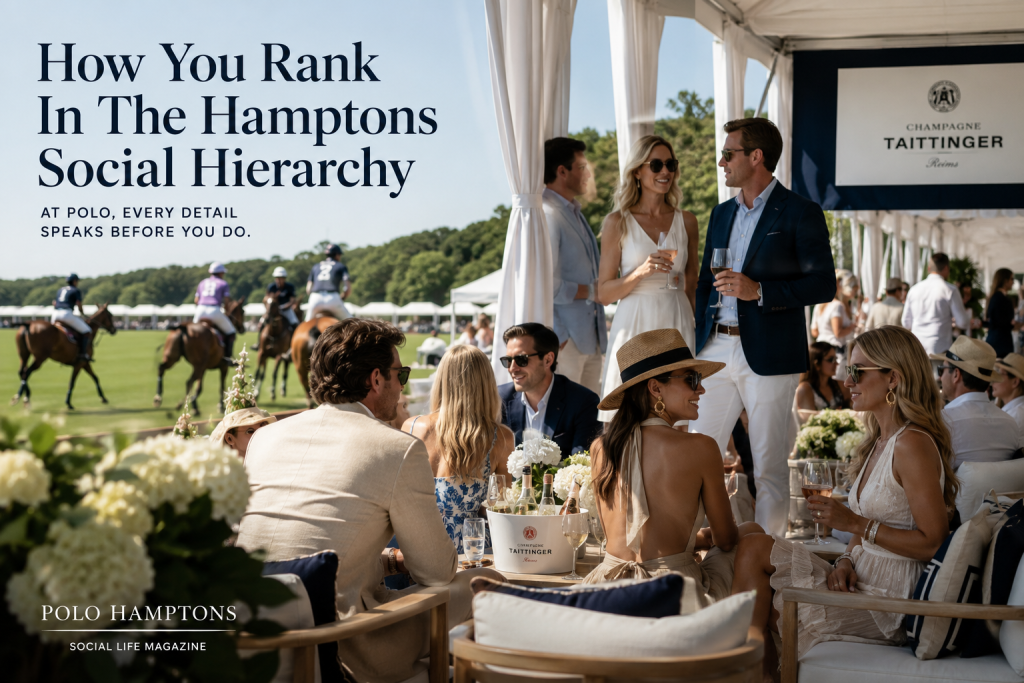
Which explains why the machine needs physical venues, rooms where the hierarchy becomes visible and negotiable. For one Saturday at a time, the polo field in Bridgehampton is the clearest of them. Polo Hamptons runs July 18 and 25 this summer at the Fishel Estate, with BMW holding the title and Christie Brinkley holding the room. The guest census reads like the hierarchy itself: average household income north of $315,000, average net worth of $3.62 million, and a bar where the person beside you either runs a fund or married one.
Brands understand this arithmetic faster than people do. A logo in that tent isn’t advertising; it’s a claim of membership, photographed by Getty and syndicated as proof. The machine’s final product, in other words, is the room itself. Everything else, the lanes and the galas and the tables, is qualification rounds.
Where The Conversation Continues
Two young fish swim past an older fish, who nods and says, “Morning, boys. How’s the water?” A while later, one turns to the other and asks, “What the hell is water?” Out here, the water is the status machine. Most people swim in it for decades without seeing it. Now you’ve seen it.
If your brand or your story belongs inside this coverage, the front door is open. Social Life Magazine builds editorial features around the people and companies shaping the East End. Start the conversation here.
For founders and brands ready to move now, our Submit a Paid Feature program publishes your story with full editorial treatment. Prices are published. No awkward phone call required.
Equally important: the sharpest read on who matters Out East lands in 82,000 inboxes. Join the list and get the next piece before the party does.
And if you’d rather be in the room than read about it, Polo Hamptons convenes the exact crowd this article describes. Sponsorship and VIP details are one click away.
The print edition ships to 25,000 Hamptons households each summer and 15,000 Upper East Side doorman buildings after Labor Day. It sits on the coffee tables where the Hamptons social hierarchy actually convenes. Subscribe here.
Finally, if this piece earned its keep, the most direct way to keep independent luxury journalism alive is a contribution here. Any amount. No obligation.
Author

Written by
Recent Posts

Victoria Justice Kicks Off Halloween Early with Love Zombie Bash in Hollywood

Planning an Arizona Road Trip? Practical Details to Handle Before You Leave

Short Homecoming Dresses That Feel Polished, Not Overdone
Men’s Health After 40: Important Changes to Pay Attention To
What You Need to Know About Spray Tanning
Categories
- Art
- Articles
- Business of Luxury
- Celebrities
- Culture
- Entertainment
- Events
- Faces of Summer 2026
- Fashion
- Fashion & Style
- Featured
- Finance
- Food, Spirits, Wine
- Hamptons
- Hamptons Celebrities
- Health
- Health & Beauty
- Lifestyle
- Luxury Lifestyle
- Press
- Profiles
- Real Estate
- Technology
- The Chronicles
- Travel
- Uncategorized
- Weddings