
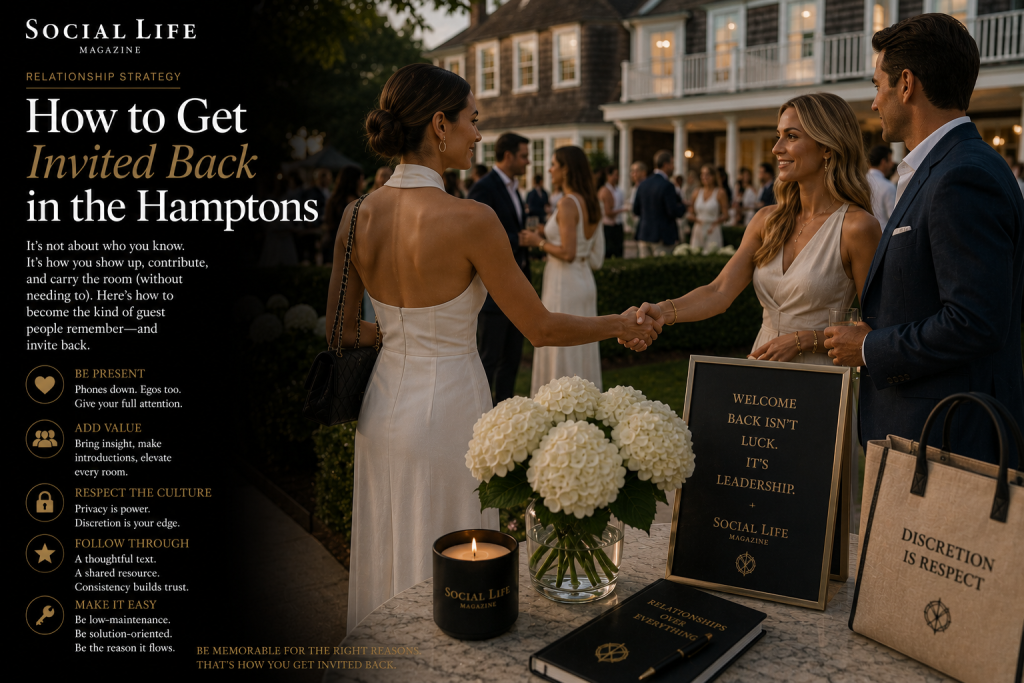
You got the invitation. You went, you had a lovely night, you said your thank-yous and drove home pleased with yourself. Then nothing. No second dinner, no follow-up, no easy slide into the next thing, and you never quite knew why. That silence is the whole subject here, because how to get invited back is a different skill from how to get invited the first time, and almost nobody tells you the two are not the same.
The first invitation is easy to misread. It feels like arrival. But it is not. It is a tryout, and the verdict comes later, in whether the second one ever lands.
So this page is about the second invitation, since the second is the one that means something. The first can be curiosity or a favor or a numbers game. The second means they actually liked having you there.
Here is the good news. This is the most learnable skill in the whole manual, and it is not about wealth or wit. It is about a handful of small moves that almost no one makes on purpose.
So here is how the second invitation gets earned.
Master this one skill and the rest of the manual gets easier. Almost every other code bends toward the same idea, which is give more than you take.
The First Invitation Is Luck. The Second Is a Verdict.
Separate the two in your head and everything gets clearer. The first invitation can happen for a dozen reasons that have nothing to do with you. A mutual friend, an empty seat, a host being generous.
The second invitation has only one reason. They want you back. So the second is the only one that actually measures how the night went, since it is the host voting with the one currency that counts.
This is why chasing first invitations is the wrong game. Anyone can angle their way into a room once. The art is being the person the room asks to return, and that is earned at the table, not before it.
The whole logic of who makes the list lives in the guest list is the product. Getting asked back is how you move from a one-time name to a fixture on it.
Aim there from the start. Do not play to get in once. Play to become the name the room cannot imagine leaving off.
Add to the Room, Do Not Take From It
Here is the single idea under all the others. The guests who get asked back are the ones who add to the room. They make the night better by being in it.
So ask yourself what you brought to the table, and not the bottle. Did you draw out the quiet person, carry a lull, make someone laugh, leave the room warmer than you found it. That is the contribution the host actually remembers.
The taker does the opposite. He pulls focus, steers every topic back to himself, treats the table as an audience. Because the room feels drained rather than lifted, the taker rarely hears from the host again.
So the move is to give. Attention, warmth, ease, a good story that is not about you. Because giving is rare at this level, the giver becomes the guest everyone wants back.
Picture the host driving home happy. If your being there is part of why, you will hear from them again.
Make the Host Look Good
Every host is quietly performing for the rest of the table. The party is their production, and the guests are the cast. So the fastest way to get asked back is to make the host look like a genius for inviting you.
That means being easy to seat next to anyone. It means getting along, lifting the energy, never creating a scene the host has to manage. Because you made their night smoother, they connect your presence with the evening going well.
The host’s whole night rides on a few key seats. Be one they can put anywhere and trust completely.
So think of yourself as helping them host. You are not just attending. You are part of whether the night works, and the guest who makes the night work is the guest who gets the next call.
Praise the night, not yourself. A guest who makes the evening feel like the host’s own triumph gets adopted fast.
Be the Easiest Person There
Hosts remember difficulty. The guest with the long list of needs, the one who is late, the one who lingers an hour past everyone else. None of it is dramatic, and all of it gets quietly filed.
Easy is underrated and rare. Most guests want to seem impressive. The host just wants one less thing to manage.
So be the easy one. Arrive on time, go with the plan, need nothing, and read the moment the night is winding down. Because easy guests cost the host nothing, easy guests are the first ones asked again.
This is where the new arrival often slips. The instinct is to make an impression, so the volume goes up. But the impression that earns the second invitation is the opposite, which is the sense that you were no trouble at all.
Read the room’s clock. Leaving while the night still feels good is its own kind of gift, and hosts remember the graceful exit.
Never Work the Room
Here is the fastest way to never be asked back. Treat the dinner as a networking event. Collect contacts, pitch your thing, scan the room over someone’s shoulder for a better conversation.
The room feels all of it instantly. The moment a guest turns transactional, the warmth drops, since nobody wants to be a rung on someone’s ladder. Because the working-the-room energy reads as taking, it is the surest way to get crossed off.
So leave the agenda at the door. Be there for the night itself, not for what the night can get you. The paradox is that the connections come anyway, since people help the person who was not trying to use them.
That is the trick hiding in plain sight. Stop hunting the connection and you become the person worth connecting to.
This is the exact thing most arrivals get backward, and it costs them. The full list of those mistakes lives in what new money always gets wrong.
Drop the pitch entirely for one summer. Watch how much more comes to you once you stop reaching for it.
The Note, the Timing, the Reciprocity
The follow-through is half the verdict. The next morning, you write the note, since a specific handwritten line lands harder than the most expensive gift. It tells the host the evening landed.
Then comes the timing. You do not reciprocate the very next week, which reads as a transaction. You let it breathe, then return the gesture in your own way, on your own terms, when it feels natural.
So the reciprocity is real but unhurried. You have them to your place eventually, or you connect them to something they would love, or you simply show up gracious the next time. Because the exchange feels like friendship and not bookkeeping, the relationship deepens instead of squaring up.
Keep a light touch on all of it. Friendship moves slower than a deal, and the room can tell which one you think you are in.
Why the Second Invitation Matters So Much
Step back and look at what the second invitation opens. It is not just one more dinner. It is the door from stranger to regular, and the regular gets everything the stranger does not.
So one good night, handled right, compounds. The host mentions you warmly to other hosts. The second invitation becomes a third, and a fourth, and an introduction to the table next door. Because standing builds on standing, one earned dinner can open a whole season.
This is the quiet engine of belonging out here. It does not run on big gestures. It runs on being the person the room keeps choosing to have back, one invitation at a time.
Big gestures fade by morning. Being easy to have around does not, since it is the one thing a host can count on the next time.
This is the same sorting that governs the whole region. The full map of it lives in luxury status codes, and the second invitation is its most honest signal.
Count the regulars at any good table. Every one of them earned a second invitation once, and then simply never stopped.
How This Reframes Every Dinner
Here is the shift that changes your whole summer. Stop walking into dinners asking what you can get. Start walking in asking what you can give to the night.
So every dinner becomes the same simple assignment. Leave the room better than you found it. Make the host glad you came. Be the easiest, warmest, least transactional person at the table.
Carry that lens and the pressure lifts. You stop auditioning and start contributing, which is the version the room actually rewards.
This is not an act, and it is not a strategy you can fake. It is a posture you adopt and then forget, until it becomes the way you simply are at a table. Because the room can feel the difference, the genuine version is the only one that works.
The next page takes this further into the host turn. When you are ready to give the dinners instead of attend them, read the host move that changes everything. It all starts at the hub, the new money manual.
Reading the 2026 Season
The summer is a string of first invitations, and most of them go nowhere. The season belongs to the people who turn that first dinner into a standing seat.
So treat every early invitation as the start of something, not the prize itself. The arrivals who own August are the ones who earned the second invitation in June. By midsummer the regulars are set, and the regulars get the rest of the calendar.
The widest first table of the summer is the field at Polo Hamptons on July 18 and 25 in Bridgehampton. It is where a lot of first introductions happen, so it is the best place to start a thread you can carry all season.
Master the second invitation now and the summer opens up. Miss it, and you spend another season collecting first dinners that quietly lead nowhere.
The math is kind here. One dinner done right can carry you to a dozen, so the first good night is worth all the care you can give it.
Where the Conversation Continues
A fish does not notice the water, and most guests never notice that the first invitation was only a tryout. The ones who get asked back noticed, and adjusted. Reading the difference is the whole game, and it is the one we play for a living.
The best way to learn the place is to read it all year, so start with a subscription. The rooms are easier to read once someone hands you the map and keeps it current.
For the earliest read on the season and the rooms that matter, get on the insider list. So far it is the closest thing to a key we hand out.
For a wide open first table, there is Polo Hamptons on July 18 and 25 in Bridgehampton. It is the field where a lot of seasons quietly begin.
If you want a quieter way in, start with the contact page. We know the rooms, and we know how the right introductions get made.
If your brand wants to be part of the story the room reads, look at a paid feature. Because it is editorial, it earns a trust that buying alone never could.
And if this saved you a season of one-time dinners, you can support the work. Of course the room still decides. We just make the second invitation easier to earn.
Author

Written by
Recent Posts
The Skincare Habits That Make a Real Difference Over Time
Hamptons-Ready Beauty: Polished Makeup for Long Summer Days
Is Now a Good Time to Sell a Home in NJ?
The Hidden Work Behind a Seamless Hotel Weekend
Choosing Scratching Furniture for a British Shorthair
Categories
- Art
- Articles
- Business of Luxury
- Celebrities
- Culture
- Entertainment
- Events
- Faces of Summer 2026
- Fashion
- Fashion & Style
- Featured
- Finance
- Food, Spirits, Wine
- Hamptons
- Hamptons Celebrities
- Health
- Health & Beauty
- Lifestyle
- Luxury Lifestyle
- Press
- Profiles
- Real Estate
- Technology
- The Chronicles
- Travel
- Uncategorized
- Weddings