
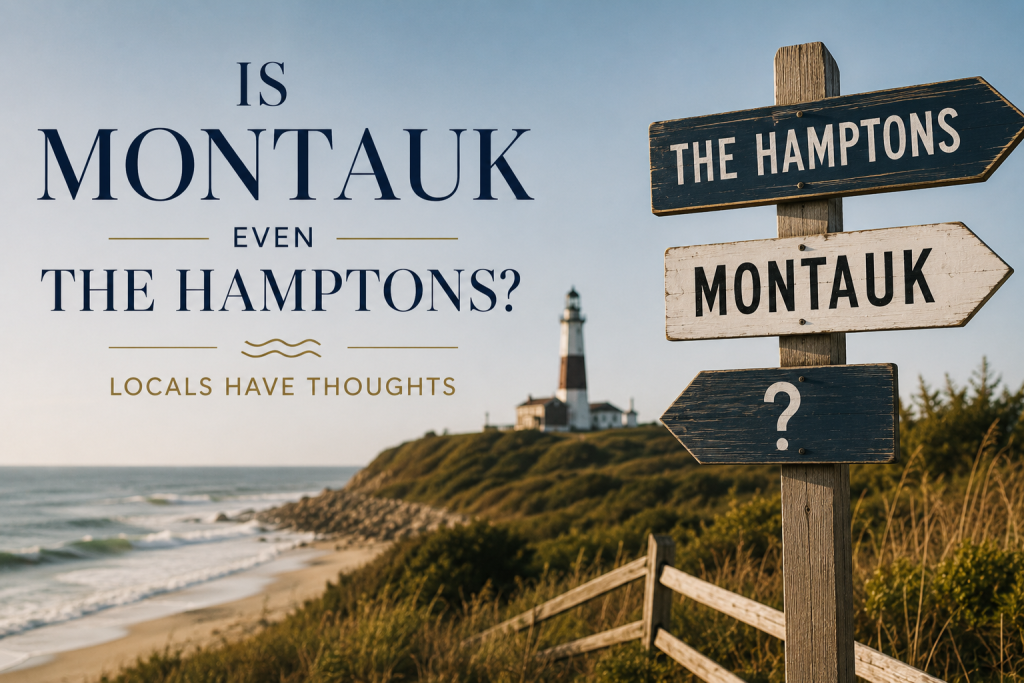
Ask whether Montauk is really the Hamptons and you will start a fight. The bumper stickers out at the end say “Montauk: it’s not the Hamptons.” Locals repeat the line like a creed. Yet the question itself reveals more than the answer ever could.
Montauk sits at the far eastern tip of the same island, past East Hampton and past Amagansett. Geographically, it falls within the Town of East Hampton. So on paper the answer looks simple.
The reality is messier and more interesting. Because Montauk spent decades as a working fishing town, it carries an identity the manicured villages never had. This guide sits inside our map of the village rankings and our larger read on the social order. Here is what the Montauk question actually reveals.
The Geography Says Yes
Start with the map, since it is the least arguable part. Montauk lies within the Town of East Hampton, one of the two towns that make up the Hamptons proper. By every official boundary, Montauk is the Hamptons.
The zip code agrees. Tax rolls and broker listings use the Hamptons label whenever it helps the price. So the paperwork settles the geographic question without much drama.
Yet maps and paperwork miss the point locals are making. They are not arguing about boundaries. Instead, they are arguing about identity, which no survey line can capture.
This is where the interesting part begins. The Montauk question is really a status question wearing a geography costume. So the denial is doing work that the map cannot.
The History Says No
Montauk’s history runs against the Hamptons grain. While Southampton and East Hampton built genteel summer colonies, Montauk worked. It was a fishing port, a fleet town, a place of labor rather than leisure.
That working past still shapes the culture. The commercial docks remain active, and the fishing families remain proud. Because the town earned its keep on the water, it never adopted the manicured airs of its neighbors.
For a long time the price gap reinforced the difference. Montauk stayed cheaper and rougher while the western villages polished themselves. So the town developed a chip on its shoulder, and arguably a point of pride.
This history is the root of the denial. When a local says Montauk is not the Hamptons, the claim is partly about that working heritage. It is a way of saying the town earned its place rather than inherited it.
The End of the World Feeling
Part of Montauk’s identity comes from pure geography. The town sits at the very end of the island, where the land simply stops. That dead-end position gives Montauk a frontier feeling the other villages lack.
The lighthouse at the tip makes the point physically. Beyond it there is only ocean, which lends the whole town a remote, edge-of-everything mood. Because you cannot pass through Montauk to reach anywhere else, arriving feels like a decision.
This geography shapes the culture in real ways. People who choose the end of the island tend to want separation from the polished scene to the west. So the location itself attracts the type who likes feeling apart.
The distance is also a filter. The extra hour of driving keeps the casual crowd thinner than in the closer villages. In effect, geography does some of the gatekeeping that hedges do elsewhere.
The Surfers Found It
The first wave of change came on surfboards. Montauk’s breaks drew a surf crowd that loved the rough, end-of-the-world feel. They came for the waves, not the galas.
That crowd gave Montauk a new identity without erasing the old one. The fishing town gained a bohemian, salt-crusted cool. Because the surfers valued authenticity, they reinforced the idea that Montauk was different and better for it.
For a while this balance held nicely. The fishermen and the surfers shared the town without much friction. Prices stayed reachable, and the vibe stayed genuine.
Still, cool is a magnet for money. The very authenticity that made Montauk special started attracting people who wanted to buy a piece of it. So the next wave was inevitable.
Then the Brands Arrived
Money followed the cool, as it always does. Boutique hotels replaced motels, and the room rates climbed fast. The bottle-service crowd discovered Montauk, and the brands were not far behind.
Suddenly the rough fishing town had a twenty-eight-dollar cocktail problem. A summer weekend brought traffic, velvet ropes, and pop-up shops from labels chasing the surf aesthetic. Because the cool was now for sale, the authenticity started to thin.
The longtime locals watched with mixed feelings. The money was real and the attention was flattering. Yet the very thing that made Montauk Montauk was being packaged and priced.
This is the tension that defines the town today. We trace the whole arc in detail in our Montauk dossier. The short version is that success is slowly eroding the difference Montauk insists upon.
The Two Montauks Today
Modern Montauk runs as two towns sharing one name. The first remembers the fleet, wakes early, and still smells of diesel and bait. The second arrives Friday night and pays resort prices for the privilege.
These two Montauks coexist uneasily. The working town resents the velvet ropes, while the weekend town barely notices the docks. Because both groups claim the real Montauk, the argument over authenticity never ends.
The split shows up everywhere. One bar serves the fishermen, while a renovated hotel next door serves the influencers. So the town offers two different experiences depending on which door you choose.
This duality is exactly why the identity question stays alive. Montauk cannot fully be the old town or the new one. Instead, it performs both at once, which keeps the debate permanently unsettled.
Why the Denial Is the Tell
Here is the part the bumper stickers miss. The loud insistence that Montauk is not the Hamptons is itself a status move. A place truly secure in its rank would feel no need to deny anything.
Bourdieu would read the denial instantly. By rejecting the Hamptons label, Montauk claims a different and supposedly purer cultural capital. The town positions itself as too authentic to be ranked, which is, of course, its own kind of ranking.
This move is more sophisticated than it looks. Claiming to stand outside the status game is a classic way to score within it. We explore the same trick in our look at the Sag Harbor complex, which plays a similar card.
So the denial reveals the anxiety underneath. If the comparison did not sting, nobody would bother repeating the line. The insistence is the evidence that the ranking still matters.
What the Locals Really Mean
When a local insists Montauk is not the Hamptons, listen closely. The claim is rarely about maps. It is about values, and about a refusal to be lumped in with the glossier towns.
The statement carries pride in the working past. It also carries a quiet critique of the western villages and their manicured wealth. Because the speaker wants to read as authentic, the denial becomes a badge.
Yet the claim also protects something fragile. Longtime residents watch the town change and reach for the line as a kind of defense. So the denial is part identity and part grief for what is slipping away.
Understanding this makes the bumper sticker legible. It is not really a geographic argument. Instead, it is a flag planted by people who fear their town is becoming what it claims not to be.
The Price of Cool
Authenticity, once discovered, rarely stays affordable. Montauk’s prices have climbed toward the levels of its fancier neighbors. The gap that once defined the town is closing fast.
Money keeps chasing the very roughness it erases. Each new buyer who comes for the authentic Montauk makes it a little less authentic. Because demand feeds on the town’s character, that character slowly gets consumed.
The highway line matters here too, just as it does everywhere out here. We map that divide in our guide to the highway line. Even at the rugged end of the island, the address still sorts you.
Still, Montauk clings to its difference. The wetsuits, the docks, and the bumper stickers all insist the town is its own thing. Whether that holds as prices rise is the open question.
So, Is It the Hamptons?
Time for the verdict. Geographically and officially, Montauk is absolutely the Hamptons. Culturally and emotionally, it is fighting hard to be something else.
The truest answer is that Montauk is both. It is a Hamptons town that refuses the Hamptons identity, which makes it the most interesting case on the island. The contradiction is the whole point.
For a visitor, this means Montauk offers a different flavor of the same region. You get the ocean and the prestige, plus a rougher, cooler self-image. So the town delivers the Hamptons while pretending not to.
The denial, in the end, is part of the brand. Montauk sells the fantasy of being the exception. That fantasy is valuable precisely because so many people want to believe it.
Where Montauk Lands in the Ranking
So where does Montauk actually sit in the local order? The answer depends entirely on which scale you use. By the old-money measure, Montauk ranks below the genteel western villages.
By the cool measure, Montauk often ranks above them. The surf crowd and the younger set would take Montauk over a stuffy gala town any day. Because the town competes on a different axis, it can lose and win at once.
This dual ranking is what keeps Montauk interesting. It refuses to play the same game as Southampton, then quietly wins a game of its own. We place it against the full field in our village hierarchy guide.
For the newcomer, the lesson is freeing. You do not have to rank Montauk on anyone else’s scale. The right question is which scale matters to you, and whether Montauk tops it.
What It Means for Brands
For a brand, Montauk is a specific and tricky audience. The crowd skews younger, looser, and more surf-adjacent than the western villages. A label that reads as stiff or formal will fall flat here.
The winning move is to respect the authenticity story. Brands that lean into the rugged, end-of-the-island vibe land better than those that import Southampton polish. Because the town prizes cool over grandeur, the message has to match.
Get it right and Montauk rewards you with genuine buzz. Get it wrong and you become another outsider cashing in. So the choice to activate here demands a different playbook than the rest of the region.
This is the read we give the brands we partner with. After more than twenty years covering every town out here, we know which labels fit Montauk and which do not. The right match turns a sponsorship into a welcome.
Should You Buy in Montauk?
For a buyer, Montauk offers a real trade. You get ocean, prestige, and a cooler self-image, but you pay rising prices for a town in flux. The question is whether the surf-town identity suits you.
The end-of-the-island buyer values separation over polish. If that describes you, Montauk rewards the choice with a vibe no western village can match. So the fit matters more than the rank.
Still, watch the trajectory before you commit. The town is gentrifying fast, and the rough charm thins a little each season. The smart buyer reads where Montauk is heading, not just where it stands today.
Where The Conversation Continues
Montauk is the Hamptons town that swears it is not, and that contradiction is exactly what makes it valuable. The denial is a status play, the cool is real, and the prices keep proving the point. The question is which Montauk you are here for.
If you are a brand chasing the surf-cool crowd, or a buyer weighing the end of the island, the read matters as much as the budget. We have covered Montauk from the fleet days to the bottle-service era. Pick the wrong angle and the town files you as a tourist.
The season is short, and the good rooms fill early. Tell us what you are building, and we will show you how Montauk says yes. The ones who ask now are the ones welcomed later.
Author

Written by
Recent Posts
How to Measure Whether a Hair Loss Treatment Is Working
Is Online Psychiatry Covered by Insurance? What to Know Before Booking
Four Habits of Quietly Successful Entrepreneurs

The Most Common Preventable Health Concerns Doctors See Today
What Affects a Rideshare Injury Settlement?
Categories
- Art
- Articles
- Business of Luxury
- Celebrities
- Culture
- Entertainment
- Events
- Faces of Summer 2026
- Fashion
- Fashion & Style
- Featured
- Finance
- Food, Spirits, Wine
- Hamptons
- Hamptons Celebrities
- Health
- Health & Beauty
- Lifestyle
- Luxury Lifestyle
- Press
- Profiles
- Real Estate
- Technology
- The Chronicles
- Travel
- Uncategorized
- Weddings