
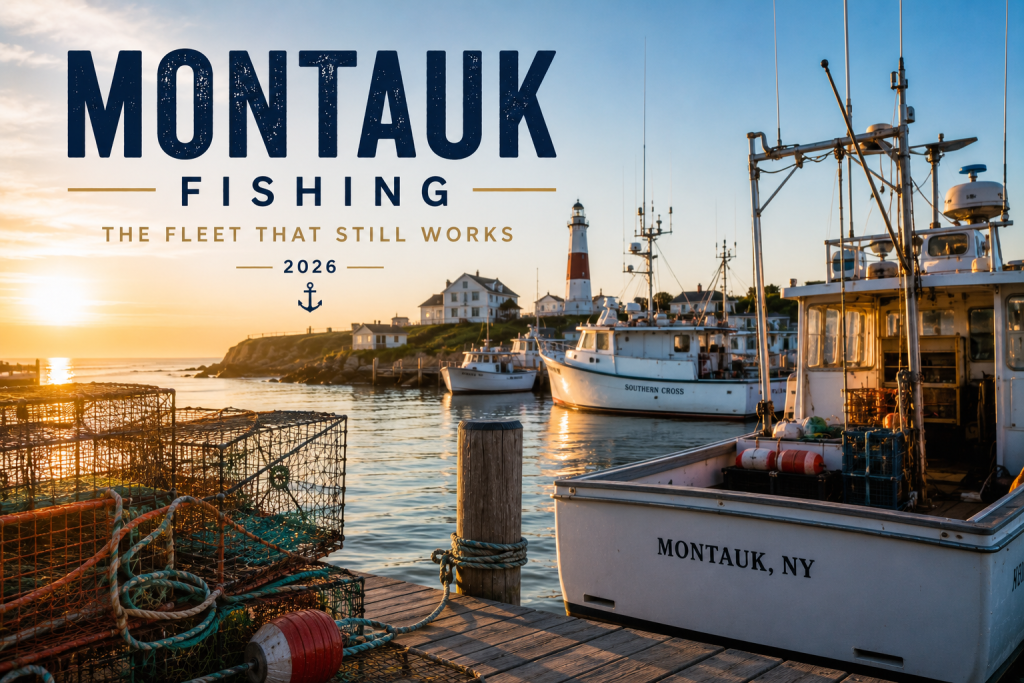
Montauk fishing is not a lifestyle brand. Instead, it is an economic engine. While the rest of the Hamptons runs on real estate commissions, restaurant reservations, and the conversion of social capital into advertising revenue, Montauk runs on fish. The harbor houses New York State’s largest commercial and recreational fishing fleet. The port holds more saltwater fishing records than any other in the world. Charter boats depart before dawn every morning, year-round, in conditions that would make a Tribeca media buyer reconsider his relationship with the ocean. And at Gosman’s Dock, the catch that a commercial trawler brought in at 4 a.m. is the same catch that a tourist in flip-flops orders as chowder at noon. This is not a metaphor. It is a supply chain.
The Harbor That Dynamite Built
Every Montauk fishing story begins with the harbor, and every harbor story begins with Carl Fisher and a box of dynamite. In 1927, Fisher, the Indiana promoter who was trying to build “the Miami Beach of the North,” blasted an inlet through the northern shoreline to connect a freshwater lake to Block Island Sound. The lake had been called Lake Wyandanch, after the Montaukett chief. It was the largest freshwater body on Long Island. After the blast, it became Lake Montauk. Specifically, this 900-acre artificial embayment now functions as the harbor, marina, and operational base for the fleet.
Of course, Fisher’s intention was yachts, not trawlers. He built the Montauk Yacht Club on Star Island, at the center of the newly created harbor, and imagined a parade of wealthy sportsmen motoring in from Newport and Greenwich. Instead, he went bankrupt. But the harbor he created survived his ambition and became something more useful: a working port. Before long, commercial fishermen recognized that Montauk’s position at the tip of Long Island put them closer to the offshore fishing grounds than any other port between New Jersey and Cape Cod. As a result, the fleet grew. It has not stopped growing since.
Viking Fleet: 90 Years on the Water
It is 5:15 a.m. on a Saturday in June. He is thirty-eight and runs quantitative strategies at a fund in the Financial District. Total comp last year was $1.4 million. His Patagonia fleece costs $180 and is the most expensive item on the boat except for the man wearing it. He stands on the deck of a Viking Fleet party boat alongside twenty-three strangers, none of whom know or care what he does for a living. The mate hands him a rod. The rod does not know what he does for a living either. For the next eight hours, his job title is “angler,” and his performance will be measured exclusively in pounds of fluke.
Viking Fleet has operated since 1936, when Carl Forsberg started the business in Freeport, Long Island. His son Paul moved the operation to Montauk in 1951. Paul’s reason was simple. “At the Point,” he told his skeptical wife, “the fish were a lot closer.” He was correct. Montauk’s position at the tip of Long Island means shorter runs to the offshore grounds. Basically, more time fishing. Less time motoring. That geographic advantage has sustained the fleet for nine decades.
The Year-Round Operation
Today, Viking Fleet runs three party boats, a high-speed interstate ferry (seasonal service to Block Island and New London, Connecticut), a luxury private charter vessel, and the Viking Fivestar, its newest addition. The operation is year-round, which distinguishes it from almost every other business in Montauk. While the Surf Lodge closes after Labor Day and the Beach Club at Gurney’s shutters for winter, Viking Fleet keeps running. December cod trips depart in darkness and return in darkness. January brings blackfish and ling. Spring opens with porgies and sea bass. By Memorial Day, the summer schedule launches: half-day family trips, full-day fluke runs, twilight striped bass sessions, and multi-day offshore expeditions for tuna, tilefish, and wreckfish.
The Party Boat Economy
A half-day trip on a Viking party boat costs roughly $80 to $100 per person. Rod, reel, tackle, and bait are included. The mate cleans and fillets your catch at the end. For a family of four from the Upper East Side (household income $800,000, private school tuition consuming 40% of it, accustomed to $400 dinners at Carbone), an $80 fishing trip represents an anomaly: an activity in the Hamptons that costs less than a single entree at their usual restaurant. Their children will catch porgies. The father will catch nothing. His wife will photograph the children with their porgies. Yet everyone will agree it was the best part of the weekend, and nobody will fully understand why.
Ultimately, the party boat model works because of volume. Twenty-five passengers at $85 each is $2,125 per trip. Two trips per day, seven days per week in peak season, and the boat generates roughly $30,000 per week in fares alone, before tackle sales and tips. This is not glamorous revenue. It is reliable revenue, the kind that allows a fishing operation to survive recessions, pandemics, and the slow-motion gentrification that has transformed every other business model in Montauk.
The Charter Fleet: From Stripers to Tuna
Beyond the party boats, Montauk operates one of the deepest charter fleets on the East Coast. Dozens of private charter boats run out of the harbor, each captained by someone who has spent enough years reading swells, tides, and fish-finder screens to qualify as a marine scientist with a better tan. Half-day inshore charters typically run $600 to $900. Targets include striped bass, fluke, black sea bass, and bluefish around Montauk Point. Full-day offshore trips run $1,500 to $2,500. Bluefin tuna, yellowfin, mahi, and sharks wait in the canyons sixty to eighty miles out.
Montauk is known as the “Surfcasting Capital” of the world, a title that refers to fishing from shore rather than from a boat. The lighthouse rips (the turbulent water where currents collide at Montauk Point) are among the most productive surfcasting spots on the East Coast. During the fall run, when striped bass migrate south along the coast, the rocks below the lighthouse become standing room only. As a result, anglers arrive at 3 a.m. to claim spots. Even so, they cast into the dark. The fish, when they arrive, arrive in numbers that justify the alarm clock.
The Seasonal Calendar
Montauk fishing operates on a seasonal calendar that most visitors never see. Spring (April through May): porgies and sea bass open the season, followed by the first striped bass runs. Summer (June through August): fluke, sea bass, and bluefish dominate inshore. Offshore, shark season peaks and tuna begin showing in the canyons. Fall (September through November): the legendary fall run. Striped bass stack up along Montauk Point. False albacore and bonito appear. Above all, the serious anglers arrive. Winter (December through March): cod, blackfish, and ling for the year-round diehards who fish in conditions that would constitute a workplace safety violation in most industries.
This calendar means that Montauk produces fish twelve months a year. By contrast, most Hamptons businesses produce revenue for roughly sixteen weeks. The seasonal imbalance explains why the fishing fleet occupies a unique position in the village’s economy: it is the only industry that operates at full capacity when everything else is closed. The charter captains who fish through January are the same people who serve the hedge fund managers in July. But in January, nobody is performing anything. The ocean in winter does not accommodate performance.
The Tournaments: Where Competition Meets the Deep
The boat leaves at 4 a.m. Six men and one woman, all of them holding coffee in thermoses that cost more than the coffee. A blue marlin is the target, although any billfish will do. The entry fee is $2,500. Meanwhile, the calcutta (the side pot) adds another $5,000 per boat. By noon, somebody on a competing boat will have hooked something large enough to change the leaderboard. By 6 p.m., the dock will be crowded with spectators who did not fish but want to see the weigh-in. The fish does not care about the spectators. Neither does the angler who caught it. The tournament exists in the space between those two indifferences.
Montauk hosts a tournament calendar that draws competitive anglers from across the Northeast. Marquee events include the Montauk Mercury Grand Slam, which targets fluke, bluefish, striped bass, and sea bass across three divisions. The Annual Star Island Shark Tournament operates out of the Montauk Yacht Club. Separately, the Montauk Marine Basin Shark Tournament runs separately but concurrently, creating a competition within a competition. Fall brings the striped bass tournaments, timed to the migration.
Tournament culture in Montauk predates the resort culture by decades. The fishing community was holding weigh-ins at the dock before Andy Warhol bought Eothen, before the Surf Lodge existed, and before anyone used the word “wellness” east of the BQE. In a village where cultural credibility often traces to arrival date, the fishing tournament circuit has the deepest roots. If you want to understand Montauk’s hierarchy (and every village has one, regardless of what it claims), start at the dock at 4 a.m. The people loading bait are the ones who were here first.
Gosman’s Dock: Where the Fleet Meets the Tourist
Gosman’s Dock at 484 West Lake Drive has operated at the intersection of commercial fishing and tourism for more than 80 years. The property is a working dock, a fish market, a restaurant complex, and a gift shop. For the Murray Hill first-timer who arrived by LIRR and Googled “things to do in Montauk,” Gosman’s is the default destination. For the commercial fisherman who docked at 5 a.m., Gosman’s is where his catch enters the retail supply chain. Both of these people are standing on the same dock, looking at the same water, and neither fully understands the other’s relationship to it.
New for 2026, the Gosman’s property debuted the Lobster House & Clam Bar, inspired by the former Inlet Cafe. Chef Tony Cruz, with 15 years of Gosman’s experience, teams with Chef Eddie G to serve lobster tacos, pan-seared tuna, and mussels in white cream sauce. Open seven days a week. Also returning is the Topside Bar. Together with Westlake Fish House on the commercial dock side, these venues compose a dining circuit built entirely on proximity to the catch. The fish on your plate was swimming this morning. Notably, that is not a marketing claim. It is a logistical fact.
The Coexistence: Fleet and Yacht Club
The most instructive thing about Montauk’s harbor is what it contains simultaneously. On one side: commercial trawlers, diesel fumes, bait barrels, and men who have been awake since 3 a.m. doing physical labor that pays modestly and demands constant vigilance. On the other side: the Montauk Yacht Club on Star Island, with its marina, pool, waterfront rooms, and the new Alba Spiaggia restaurant serving crudos and wood-fired pizza to guests in linen.
In Sag Harbor, the marina is curated. Sailboats and vintage wooden craft predominate, and the aesthetic communicates literary aspiration. In Southampton, the marinas serve the estate crowd, and the boats are large enough to have names that function as brand statements. Montauk’s harbor does not curate. For instance, a $3 million sportfishing yacht sits twenty slips from a commercial dragger worth a tenth of that. Remarkably, neither vessel acknowledges the other. Neither needs to. The harbor Fisher built by dynamiting a lake does not enforce a dress code. And the fish do not distinguish between vessels.
Why Montauk Fishing Matters Beyond the Fish
Without a doubt, Montauk fishing is the village’s oldest continuous economic activity, older than the hospitality industry, older than the real estate market, older than the cultural programming that now generates most of the media coverage. The Montaukett fished these waters before Europeans arrived. Commercial operations have run continuously since at least the early twentieth century. Viking Fleet has been here since 1951. When everything else about Montauk changes (and everything else does change, seasonally and permanently), the fleet remains.
In effect, this permanence gives the fishing community a specific form of authority in Montauk’s internal politics. When zoning disputes arise (and they arise often, given the tension between year-round residents and seasonal development), the fishermen speak with the credibility of people who use the harbor every day, not just the weekends between Memorial Day and Labor Day. Boats are in the water in January. Livelihoods depend on the health of the fishery, the condition of the harbor infrastructure, and the regulatory environment that governs catch limits. Their stake is not seasonal. It is permanent. And in a village where permanence is the rarest form of capital, that stake carries weight that no real estate transaction can replicate.
Consider the contrast. The Surf Lodge‘s Chicken Tender Tower trends on social media. At Ditch Plains, the $17 million oceanfront record makes headlines. Over at Gurney’s, the Dolce & Gabbana Beach Club photographs well. But at the dock, before sunrise, the catch comes in. It has come in every morning for a century. The fish do not care about your cap table, your concert lineup, your cabana, or your beach club collaboration. The fish have never cared. That is the deepest truth about Montauk. The fleet proves it every morning.
Where the Conversation Continues
Social Life Magazine has covered the East End for 23 years. If you are a marine brand, charter operation, or hospitality company that connects to the water, you should be in this magazine.
For brands and tastemakers: explore our paid features program.
Polo Hamptons 2026 returns July 18 and 25 at 900 Lumber Lane in Bridgehampton, with BMW North America as title sponsor and Christie Brinkley as host. Details at polohamptons.com.
Subscribe: sociallifemagazine.com/subscription.
The fleet leaves before dawn. The fish do not wait. Neither should you.
Author

Written by
Recent Posts

AI for personal finance: where PennyGuard fits

How to Pick a Homecoming Dress for Your Body Type (and Feel Amazing in It)

World Cup Injury Attorney for Vancouver Events
What a 3-Carat Engagement Ring Actually Costs in 2026: The Real Numbers
The Skincare Habits That Make a Real Difference Over Time
Categories
- Art
- Articles
- Business of Luxury
- Celebrities
- Culture
- Entertainment
- Events
- Faces of Summer 2026
- Fashion
- Fashion & Style
- Featured
- Finance
- Food, Spirits, Wine
- Hamptons
- Hamptons Celebrities
- Health
- Health & Beauty
- Lifestyle
- Luxury Lifestyle
- Press
- Profiles
- Real Estate
- Technology
- The Chronicles
- Travel
- Uncategorized
- Weddings