
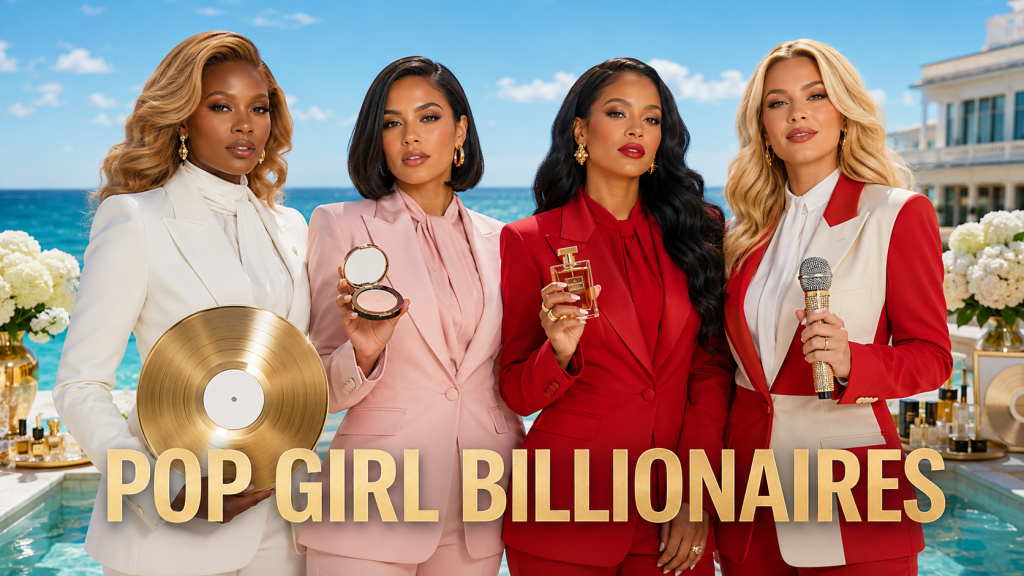
On December 23, 2025, Forbes finally said the word: Beyoncé, billionaire. She was the last of the four to cross, and the slowest, and the announcement read less like news than a coronation everyone had already RSVP’d to. The pop girl billionaires are now a confirmed class. Taylor Swift sits at $2 billion, Rihanna near $1.4 billion, Selena Gomez around $1.3 billion, and Beyoncé holds the newest membership card. Four women, one playbook, zero accidents.
Here is the part the fan forums keep missing. The fortune is not in the music, because recorded music barely pays anymore. Streaming settles in fractions of a cent, while radio pays mostly in exposure. Instead, the money lives in what the music lets you sell: foundation shades, liquid blush, lingerie, whisky, hair oil, and above all equity. Touring is marketing. Equity is the product.
Social Life readers will recognize the structure, since half of you built fortunes the same way. Fame became distribution. Distribution became a cap table. So read the four names above less as singers than as founders with a customer acquisition cost of zero.
The Old Model: Why Pop Stars Died Famous, Not Rich
For fifty years, the standard record deal was a payday loan with a stage. Labels advanced money, then recouped it from the artist’s own royalties, at rates the artist did not set. The label kept the masters, meaning the recordings themselves, the asset that pays forever. Artists kept the fame and the tax bill.
The casualty list is long and instructive. TLC filed for bankruptcy in 1995 in the middle of the CrazySexyCool run, while the album sold millions. Toni Braxton went bankrupt twice, despite moving more than 40 million records. Even Michael Jackson’s real fortune came from publishing, notably his $47.5 million purchase of the Beatles catalog in 1985, not from Thriller royalties.
Under that model, a pop star could gross hundreds of millions and bank a rounding error. The wealth pooled at the label, because the label owned the asset while the artist owned the schedule. Our music industry net worth rankings for 2026 still show the fingerprints of that arrangement on a whole generation of catalog-poor legends.
The industry’s late-stage answer was the 360 deal, which let labels take a cut of touring and merchandise too. In other words, the response to artists finding new income was to tax the new income. Madonna and Whitney Houston got famous under versions of this math, and their fortunes, while large, never approached ten figures.
Nobody fixed the record deal, in fact. The pop girl billionaires simply stopped needing it, then built companies where the deal could not follow them.
The New Model: Touring Is the Ad, Equity Is the Exit
The pop girl billionaire playbook has four moves, and none of them involves a better royalty rate. First, convert years of parasocial trust into a brand that feels like a text from a friend. Second, pick a category with software-grade margins, such as prestige beauty. Third, keep the equity: half of it, most of it, ideally all of it. Fourth, let the tour and the album function as a global ad campaign the company never pays for.
Run the numbers and the logic turns rude. An arena tour grosses in the hundreds of millions, but a beauty company at exit trades on a multiple of revenue. One is income, taxed and spent. The other is an asset, compounding quietly while the owner sleeps in on a Tuesday.
Beauty is the preferred vehicle for a reason, specifically margin. A $23 blush costs a few dollars to make, and the rest is trust. Pop stardom manufactures trust at industrial scale, so the arbitrage was sitting there for decades, waiting for someone to run it properly.
This is why the richest female musicians of 2026 are not ranked by chart weeks. They are ranked by ownership percentage, and the ranking barely moves when an album underperforms, because the company does not care.
The Celebrity Beauty Graveyard
The playbook looks easy, yet the failure rate says otherwise. Dozens of celebrity beauty lines have quietly folded since 2020, because fame alone does not convert. Recognition gets a product picked up. Only trust gets it repurchased, and trust is the scarce input here.
Notice what the four winners share: each spent a decade or more in a confessional relationship with her audience before selling it anything. Diary-entry lyrics, makeup tutorials filmed bare-faced, public health disclosures. The customer was not buying blush from a stranger. She was backing a friend’s company, and repeat purchase rates behave accordingly.
Taylor Swift: The $2 Billion Standard
Forbes now pegs Taylor Swift at $2.0 billion, the largest fortune any female musician has ever held, and the number that reordered the whole list. When Social Life last audited the Taylor Swift fortune, the figure was $1.6 billion, and that piece already felt breathless. Then she went shopping.
Her version of the playbook has a twist worth studying. While the others bought into beauty, Swift’s equity play was the music itself, treated not as a royalty stream but as a private company she intended to control outright.
Consider how unusual that is. Catalogs were the thing artists sold in distress and financiers bought at auction, such as the wave of nine-figure catalog sales between 2020 and 2023. Swift ran the trade in reverse, and the reversal is what separates her from every seller on that list.
The $360 Million Masters Buyback
In May 2025, Swift bought back the master recordings of her first six albums from Shamrock Capital, for a reported $360 million. The purchase ended a six-year war that started when Scooter Braun acquired them in 2019. Her weapon was the re-recording project, four Taylor’s Version albums released from 2021 onward. Those versions gutted the resale value of the originals she did not yet own.
The result reads like a private equity case study. Forbes credits the buyback, together with the catalog’s restored value, for pushing her to $2 billion by early 2026. She devalued an asset she wanted, then bought it at the discount she created. Bridgehampton fund managers call that talking your book. She calls it Speak Now.
What the Eras Tour Was Actually Selling
The Eras Tour grossed a reported $2 billion plus across 149 shows, the biggest concert run ever staged. Yet the gross is the least interesting number. By proving demand at four-figure resale prices, the tour re-priced her entire catalog, and the catalog is the equity here. Swift’s company is Taylor Swift.
Watch what she did with the concert film, because it is the same instinct. Rather than sell the rights to a studio, she cut a direct distribution deal with AMC Theatres. The Eras Tour movie grossed a reported $261 million worldwide, and no studio took a cut on the way through.
The Flywheel After the Buyback
Since then, the machine has kept compounding. The Life of a Showgirl arrived in October 2025 and broke first-week records on masters she now owns outright. Her August 2025 engagement to Travis Kelce merged the NFL audience into hers, free of charge. Every headline is unpaid media for a catalog she controls.
Among the pop girl billionaires, Swift is the only one whose company and whose art are the same object. That concentration cuts both ways, of course. But it also explains why her number is the biggest: she owns 100 percent of the thing the world cannot stop discussing. In the full breakdown of Taylor Swift’s $2 billion, the asset column starts with her own name.
Rihanna: The Billionaire Who Does Not Need an Album
Rihanna has not released an album since Anti, in January 2016. In the decade since, she has become worth a reported $1.4 billion. She also welcomed a third child in 2025 and expanded into haircare with Fenty Hair. The lesson is uncomfortable for purists: the most efficient fortune among the pop girl billionaires required no new pop at all.
Her decade of silence was not retirement. Rather, it was a founder reallocating her time toward the asset that actually compounds, which stopped being the discography around 2017. Fans keep asking when she will return to music, but the sharper question is why she ever would, given what her calendar earns elsewhere.
Fenty Beauty’s Fifty Percent Solution
Fenty Beauty launched in September 2017 as a joint venture with LVMH, with Rihanna reportedly keeping roughly half the company. The debut did a reported $100 million in its first weeks, powered by 40 foundation shades when competitors stocked a fraction of that. Inclusion was the marketing. Margin was the business.
Savage X Fenty followed in 2018 and reached a reported $3 billion valuation by 2022. Both companies monetize the same underlying asset, a fanbase that treats her taste as an instruction. Music built that asset before 2016. Since then it has needed only maintenance, such as the 2023 Super Bowl halftime show, performed pregnant, watched by 121 million people.
The Fenty House Lesson
Not everything converted. Fenty, the LVMH luxury fashion house that made her the first Black woman to lead an LVMH maison, was paused in 2021 after two years. The takeaway is precise: her trust moves $36 foundation at volume, but $800 runway pieces answer to a different god. Even the best founders learn where the brand ends.
For the complete Rihanna net worth deep dive, start with the LVMH term sheet, not the discography. Her catalog still earns, of course, but the earning is a rounding error against the equity. R9, the mythical ninth album, remains unreleased because it is, financially speaking, optional. No release date has ever cost less to miss.
Beyoncé: The Slowest, Most Deliberate Billion
Forbes declared Beyoncé a billionaire in December 2025, years after fans insisted she already was one. The delay was not underperformance. It was the price of her particular strategy, which is owning everything and licensing almost nothing.
Where Rihanna took LVMH’s capital and Swift bought back her past, Beyoncé built in-house. Parkwood Entertainment produces her tours, films, and albums, so the margins stay home. Of course, so do the costs, which is why her billion arrived last and cleanest.
There is a status logic underneath the accounting. Selling equity means answering to whoever bought it, and she has spent twenty years constructing a career with no one to answer to. The billion was delayed by the same trait that made it inevitable.
Cowboy Carter and the Ownership Tax
The 2025 Cowboy Carter stadium tour grossed a reported $400 million across 32 shows, a record for a country tour. Because Parkwood owns the production, more of each dollar reached her than any standard promoter split would allow. That run pushed her over the line Forbes had spent years refusing to draw.
The precedent was already set in 2023, when the Renaissance World Tour grossed a reported $579 million. She then released the Renaissance concert film through AMC directly, the same studio-skipping route Swift took, in the same season. Two pop girl billionaires independently deciding Hollywood was an unnecessary middleman should have been the industry’s five-alarm moment.
The House Bets: Cécred, SirDavis, and the Ivy Park Lesson
Her equity bets skew personal. Cécred, the haircare company launched in 2024 with her mother Tina Knowles, channels the Houston salon where she grew up sweeping floors. SirDavis, her American whisky with Moët Hennessy, arrived the same year. By contrast, Ivy Park, the Adidas partnership that ended in 2023 with reported losses, taught the expensive lesson: rented distribution is someone else’s asset.
The Beyoncé net worth file is a study in refusing exactly that. Slower, yes. But nothing in her column belongs to anybody else, and that makes her balance sheet the purest of the four.
Selena Gomez: The $1.3 Billion Case for Intimacy
Selena Gomez is the strangest of the pop girl billionaires, because her music was never the biggest anything. No stadium tours, no $2 billion grosses, no country-album land grabs. Yet Forbes placed her on its richest self-made women list at roughly $1.3 billion, built almost entirely on Rare Beauty.
Her scale asset was never the charts. It was the 400 million Instagram followers who watched her discuss lupus, a kidney transplant, and a bipolar diagnosis in the first person. Vulnerability became trust. Trust became conversion rates the conglomerates would trade an heiress for.
Rare Beauty and the Intimacy Margin
Rare Beauty launched at Sephora in September 2020, priced mid-prestige and pitched in mental health language. The Soft Pinch liquid blush became a TikTok staple, reportedly selling one every few seconds at its peak. Annual revenue has been reported above $350 million, and Gomez kept the controlling stake, which is the entire story.
Acquisition rumors have floated valuations near $2 billion, though she has so far declined to sell. In September 2025 she married the producer Benny Blanco in Santa Barbara, and the wedding content outperformed most album launches. Not one stadium was required.
The Portfolio Behind the Blush
Beyond the blush, the holdings rhyme with the thesis. Wondermind, the mental health media company she co-founded with her mother Mandy Teefey, reached a reported $100 million valuation. Only Murders in the Building keeps her on premium television every year, alongside Steve Martin and Martin Short, as recurring proof of relevance that costs her nothing to maintain.
Notably, Rare Beauty routes 1 percent of all sales into its Rare Impact Fund for youth mental health. Cynics call that marketing. Fine, but it is marketing that deepens the exact trust the margins depend on, which is the whole trick performed in miniature.
The full Selena Gomez net worth story is the cleanest proof of the thesis. Minimal touring, maximum equity, billionaire anyway. She is what the model looks like with the music turned almost all the way down.
The Bench: Who Joins the Pop Girl Billionaires Next
Every wealth class needs a bench, and this one has a yardstick, a cautionary tale, and a growth stock. Together they mark the edges of the map: one adjacent fortune, one exit taken early, one IPO still ahead. Reading the near-misses teaches more than reading the winners, because the misses show which moves were actually load-bearing.
The Kim Kardashian Yardstick
Kim Kardashian ran this exact playbook first, just without the music. SKIMS converted attention into shapewear equity, reached a reported $4 billion valuation in 2023, and made Forbes call her a billionaire back in 2021. But the 2026 list delivered the symbolic handover, with Swift moving ahead of her.
The Swift versus Kardashian net worth matchup settles a real question about inputs. Singing was never required, yet a catalog compounds in a way a persona cannot. Attention has to be re-earned every news cycle. A song earns while its owner sleeps.
Katy Perry’s $225 Million Cautionary Tale
In September 2023, Katy Perry sold her catalog rights to Litmus Music for a reported $225 million. Nobody should cry over that check. Still, it is the anti-playbook: she sold the compounding asset for cash, near what may prove the bottom of the catalog market. Swift spent $360 million buying the same kind of asset back. One of them was buying what the other was selling, and the 2026 list shows which side won.
Perry remains rich, near $400 million by most estimates, with a Lifetimes world tour and a seat on that April 2025 Blue Origin flight to show for it. Rich, though, is now the consolation bracket in this cohort. The sale converted tomorrow’s compounding into yesterday’s liquidity, and this class keeps score in tomorrows.
Sabrina Carpenter, the Growth Stock
Sabrina Carpenter is where the class scouts its next member. Espresso owned the summer of 2024, Short n’ Sweet took the Grammy for Best Pop Vocal Album, and Man’s Best Friend arrived in August 2025. Her reported net worth sits in the tens of millions, which is roughly where Rihanna sat before Fenty.
Right now she is in the trust-accumulation phase, the unglamorous decade the winners all served first. So watch for the equity vehicle, probably beauty or spirits, because the playbook is now public. The first analyst to model her as a pre-revenue consumer brand will look silly for about three years, then prescient.
Also circling: Lady Gaga, whose Mayhem arena run and Haus Labs stake keep Lady Gaga’s net worth trajectory pointed at the ten-figure line. The template no longer needs inventing. It only needs signing.
The Equity Playbook, Distilled
Strip away the discographies and the pop girl billionaires resolve into one balance-sheet doctrine. Own the asset, rent out nothing but attention. Swift owns the catalog, Rihanna owns half of Fenty, Beyoncé owns the production company, and Gomez owns the brand. Each tour, album, and engagement announcement is a marketing expense the market pays them to incur.
The psychology matters as much as the structure. These four watched a generation of predecessors gross fortunes and keep fractions, so they priced their fame like founders price a Series A: control first, checks second. Every one of them turned down easier money at least once. Swift could have licensed instead of buying, and Gomez could have sold Rare twice over.
For the reader auditing her own position, the uncomfortable question is the same one these women answered. What percentage of the thing your reputation sells do you actually own? Because the difference between famous-rich and billionaire-rich is not talent, reach, or timing. It is the cap table, every single time.
Where The Conversation Continues
The pop girl billionaires read like a Social Life cluster because they are one. Our full ranking of music’s wealthiest women goes deeper on every figure here, and the individual files land all summer. In print, the conversation happens where these fortunes actually vacation. The July issue moves from Southampton dinner tables to the VIP tent at Polo Hamptons in Bridgehampton, where a Fenty-sized idea gets pitched over rosé most weekends. People who read about equity like this tend to be holding some. Join them on the Hamptons calendar this season, or hear about it secondhand in September.
Author

Written by
Recent Posts

Planning an Arizona Road Trip? Practical Details to Handle Before You Leave
Short Homecoming Dresses That Feel Polished, Not Overdone
Men’s Health After 40: Important Changes to Pay Attention To
What You Need to Know About Spray Tanning

Simple Ways to Upgrade Your Summer Drink Routine
Categories
- Art
- Articles
- Business of Luxury
- Celebrities
- Culture
- Entertainment
- Events
- Faces of Summer 2026
- Fashion
- Fashion & Style
- Featured
- Finance
- Food, Spirits, Wine
- Hamptons
- Hamptons Celebrities
- Health
- Health & Beauty
- Lifestyle
- Luxury Lifestyle
- Press
- Profiles
- Real Estate
- Technology
- The Chronicles
- Travel
- Uncategorized
- Weddings