
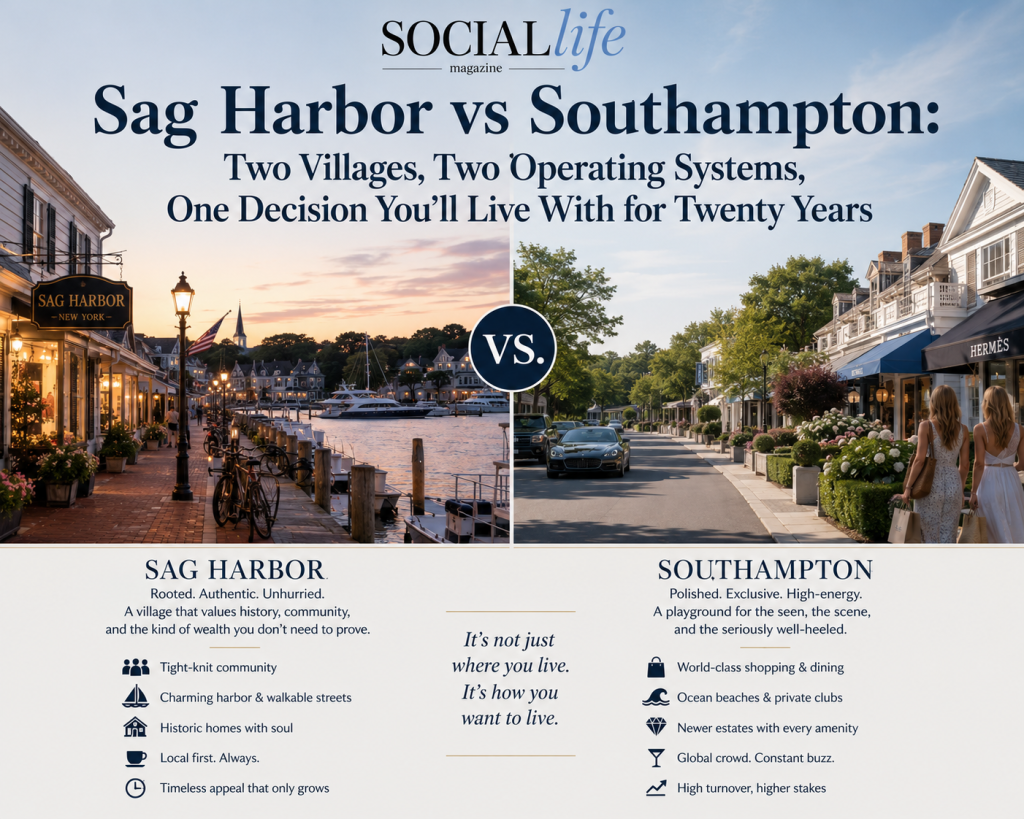
The Founding Question
Southampton was settled in 1640. However, it is New York’s first permanent English settlement, which means it has been performing seniority for 386 years. In addition, the founding mythology is colonial and agricultural: English settlers, Shinnecock land, farming, the slow accumulation of social order on a landscape that required order to be habitable. As a result, southampton’s identity is about establishment. For instance, about having been here first.
Sag Harbor appears in European records in 1707 on the site of Wegwagonock, a Montaukett village. Meanwhile, its founding mythology is maritime and commercial: deep-water harbor, whaling ships, global trade, risk. Similarly, by the 1840s, Sag Harbor was the sixth-largest whaling port in America and had dispatched 750 voyages. In contrast, sag Harbor’s identity is about enterprise. Consequently, about having gone further.
This foundational difference persists in the social physics of each village 300 years later. Furthermore, southampton asks: how long has your family been here? In particular, sag Harbor asks: what did you build? By contrast, the first question rewards inheritance. After all, the second rewards ambition. In fact, both are legitimate forms of social currency. Ultimately, one is available to you by birthright. Essentially, the other is available to you by effort.
The Geography as Psychology
Southampton: The Ocean
Southampton faces the Atlantic. Accordingly, cooper’s Beach, recognized globally as one of the finest beaches in the world, anchors a stretch of coastline that includes the legendary estate streets: Gin Lane, Meadow Lane, Coopers Neck Lane, First Neck Lane. Moreover, these are among the most expensive residential roads in America. Nevertheless, the properties behind the hedgerows on these streets face the ocean. . Specifically, this means their owners wake to the sound of surf and the awareness that there is nothing between their bedroom window and Portugal except 3,000 miles of water. . The specific form of existential awe that unlimited horizons produce in people wealthy enough to afford frontage on them.
The ocean is a dominance metaphor. On the other hand, it is large, powerful, and indifferent to human ambition. However, living on the ocean in Southampton communicates a willingness to position yourself against a force that dwarfs you. . This is either courage or vanity depending on your interpretive framework. In addition, .Which the real estate market does not distinguish between because both produce the same outcome: a willingness to pay $40 million for a house on a street named after a spirit.
Sag Harbor: The Harbor
Sag Harbor faces the bay. As a result, the water is protected, calmer, oriented toward sunset rather than surf. For instance, the marina is the village’s social center. Boats move slowly. Meanwhile, the harbor was designed for commerce, not contemplation, which means its beauty is incidental to its utility. . Similarly, this is the specific quality that makes it more beautiful than a landscape designed to be beautiful.
The harbor is an interiority metaphor. In contrast, it is contained, reflective, and human-scaled. Consequently, living near the harbor in Sag Harbor communicates a preference for shelter over exposure, for the protected cove over the open coast. Furthermore, the whaling captains who built Main Street chose the harbor because it was deep enough for their ships and protected enough to survive a storm. In particular, the founders and executives who buy in Sag Harbor today choose it for the same reasons. . Although they describe the storms differently.
The Money Comparison
Southampton Village’s median home price reached approximately $4.34 million in 2025, representing a nearly 30% increase from the previous year. By contrast, properties south of the highway, in the estate sections, routinely exceed $10 million. After all, sales above $20 million are common. In fact, gin Lane and Meadow Lane are not streets. Ultimately, they are asset classes.
Sag Harbor’s median listing sits around $2.8 million as of early 2026, with luxury homes ranging from $3 million to $12 million. The village set records in Q2 2025 for sales volume, transaction count, and median prices. Values have risen dramatically as younger buyers and creative professionals discover the village.
At $5 million, your buying power differs structurally. In Southampton, $5 million buys a solid village house north of the highway or a modest property in a secondary location. You are below the estate tier. In Sag Harbor, $5 million buys a renovated captain’s house in the historic district, a waterfront in Noyack with a dock. . Alternatively, a premium unit at The Watchcase. You are in the upper tier of the market.
The psychological implication: in Southampton, $5 million positions you as an entrant. In Sag Harbor, $5 million positions you as an owner. The number is the same. The social altitude is different. For the person making this decision, the question is not which village costs more (Southampton, by a significant margin at the top) but which village’s status architecture makes your specific budget feel like arrival rather than aspiration.
The Social Operating Systems
Southampton’s Operating System: Hierarchy
Southampton’s social structure is vertical. It has layers. The estate section is the apex. South of the highway is above north of the highway. Oceanfront is above non-oceanfront. Private club membership sorts further. The Meadow Club, the Bathing Corporation, the Southampton Bath and Tennis Club: these institutions function as additional filters within an already filtered population, producing a social hierarchy so finely graded that the difference between two families on the same street can be measured in generations of membership.
This system rewards patience, lineage, and the specific form of social competence that involves knowing when to speak, what to reference, and which invitation to accept. It is a system designed by and for people who believe that social order is not an imposition but a comfort, that knowing your position in a hierarchy is preferable to navigating an environment without one. .That tradition, even when its origins are arbitrary, becomes meaningful through repetition.
If you thrive in environments with clear rules, established norms. .The understanding that certain doors open with credentials and close without them, Southampton’s operating system will feel familiar and, eventually, welcoming.
Sag Harbor’s Operating System: Conversation
Sag Harbor’s social structure is horizontal. It has textures rather than layers. The whaling captain and the novelist and the plumber at Murf’s. . The founder at Jack’s Stir Brew occupy the same village without a formal hierarchy determining their relative social position. What determines status in Sag Harbor is not what you own or who your family is but what you contribute to the conversation. . There, “conversation” means the ongoing cultural life of the village: the play you saw at Bay Street, the film at the cinema, the book you’re reading at Canio’s, the observation you make at dinner that reveals you’ve been paying attention.
This system rewards curiosity, cultural engagement, and the specific form of social intelligence that involves being interesting rather than being important. It is a system that produces discomfort in people who are accustomed to having their position recognized automatically. . This is because Sag Harbor does not recognize position automatically. The result recognizes presence. It recognizes participation. It recognizes the person who shows up at the Whaling Museum and at Murf’s and at Le Bilboquet and who understands that all three are Sag Harbor. . That the village’s range is its genius.
The Saturday Night Test
Two couples. Same income, same industry, same ages. One rents in Southampton for the summer. The other rents in Sag Harbor.
The Southampton Saturday: Morning at Cooper’s Beach, where the sand is white and the parking requires a permit that requires a village address that requires a rental contract. . This means the beach functions as a gated community with tides. Afternoon at the club, where the tennis is competitive and the post-match drinks are a continuation of the competition by other means. Dinner at a restaurant on Jobs Lane where the table spacing communicates the establishment’s price point and the menu is excellent in the way that expensive restaurants in established markets are excellent: technically perfect, emotionally predictable. The couple drives home through estate streets lined with hedgerows tall enough to conceal the architecture behind them. . This is the point: in Southampton, wealth signals through concealment. The hedgerow is the message.
The Sag Harbor Saturday: Morning at the farmers market. . This functions as a weekly census of the village’s current residents conducted through the medium of heirloom tomatoes. Afternoon split between the marina and a walk through the village. . There, Main Street produces accidental encounters with people who turn out to be more interesting than planned encounters at most networking events. Dinner at Dopo La Spiaggia, where Chef Maurizio greets you at the door because this is your third visit and he remembers. After dinner, a walk past the cinema (the neon sign glowing red and blue, the Truffaut Terrace visible on the third floor), to Murf’s for one drink at a bar where nobody asks what you do, or to Le Bilboquet for the horseshoe bar and the DJ and the rosé and the specific form of social electricity that the quietest village on the East End produces at its one loud venue. The couple walks home through streets narrow enough that the walking feels like participation rather than transit.
Neither Saturday Is Superior. Both Satur
Neither Saturday is superior. Both Saturdays are complete. But they produce different versions of the people who live them. .Over the course of three summers, five summers, ten summers, those versions compound into identities that the villages have been producing for centuries.
The Culture Comparison
Southampton’s cultural institutions include the Southampton Arts Center, the Parrish Art Museum (technically in Water Mill but gravitationally in Southampton’s orbit), the Southampton Historical Museum. .A retail environment on Jobs Lane that includes major luxury brands alongside local boutiques. The cultural infrastructure is real, serious, and well-funded.
Sag Harbor’s cultural institutions include Bay Street Theater (35 years, world premieres, 299 seats on a thrust stage where the actors’ sweat is visible), the Sag Harbor Cinema (rebuilt from fire with $20 million in community donations, Dolby Atmos, 35mm projection, Martin Scorsese’s Festival of Preservation), the Whaling Museum (the village’s origin story in Greek Revival architecture), Canio’s Books (a surviving independent bookstore in an age of algorithmic recommendation). .A literary history that includes James Fenimore Cooper, John Steinbeck, Betty Friedan, Spalding Gray, Lanford Wilson, E.L. Doctorow, and the office above a barbershop where Thomas Harris wrote The Silence of the Lambs.
Southampton’s culture is institutional. It is supported by the same wealth that supports the estate section and the private clubs. .It operates with the professionalism and polish that institutional funding provides.
Sag Harbor’s culture is organic. It grew from the village rather than being built on top of it. Bay Street Theater began because a Welsh actress looked at a former discotheque on the wharf and said it would make a nice theater. The cinema survived because the village decided to save it with donations ranging from 35 cents to a million dollars. The bookstore survives because enough people in this village believe that encountering a book you didn’t know you needed is worth the inconvenience of a physical store.
The Year-Round Question
This is the variable that separates decision from visit.
Southampton contracts in winter. The estate section goes dark. Inside, shops on Jobs Lane reduce hours or close. The restaurants thin. The village, which in summer operates at maximum social intensity, becomes quieter in a way that can feel either peaceful or abandoned depending on whether you chose Southampton for its community or for its scene.
Sag Harbor operates year-round. The restaurants stay open. The Bell and Anchor serves dinner on a Tuesday night in February. Bay Street Theater programs through December. The cinema screens films in the off-season. Jack’s makes coffee in January. Canio’s sells books in March. Murf’s is open Thursday through Sunday regardless of the calendar. The village has a year-round population that sustains these institutions not because the population is large (it is small, approximately 2,000) but because it is committed.
If you are buying a summer house, this distinction matters less. If you are buying a life, it matters more than the price per square foot.
The Verdict That Isn’t a Verdict
This spoke is part of a Sag Harbor cluster, which means its center of gravity is transparent. But the comparison is offered in good faith, and the good faith version is this:
Choose Southampton if your social energy is oriented outward: toward the ocean, toward established institutions, toward a hierarchy that has been refined over centuries and that provides the specific comfort of knowing exactly where you stand. The weekend involves the beach, the club, the estate section. The understanding that your participation in this system is itself a form of status. Choose Southampton if you want your village to announce your arrival to the world.
Choose Sag Harbor if your social energy is oriented inward: toward the harbor, toward conversation, toward a cultural ecosystem that rewards curiosity over credentials and participation over position. The weekend involves a bookstore, a theater, a cinema that the village spent $20 million to save, a dive bar from 1792, a French bistro where a DJ plays at midnight. A marina that teaches ambitious people that the water doesn’t care about their cap table. Choose Sag Harbor if you want your village to change you rather than confirm you.
Both villages are excellent. For instance, both villages are expensive. Both villages will, over time, shape you into the person they need you to be.
Choose the person you want to become.
Where the Conversation Continues
Social Life Magazine covers both villages. Five summer issues, 25,000 copies each, distributed from Westhampton to Montauk. The magazine reaches the Southampton estate section and the Sag Harbor marina, the Cooper’s Beach parking lot and the Jack’s Stir Brew counter, the Jobs Lane boutique and the Murf’s back patio. Coverage this comprehensive requires twenty-three years of presence and the understanding that the East End is not one market but nine villages, each with its own social physics, each deserving the specificity that most publications substitute with the word “Hamptons.”
If your brand serves the East End, it serves both villages, both operating systems, both versions of wealth. A paid feature in Social Life Magazine places your brand inside the publication that the Southampton estate owner reads on the beach and the Sag Harbor founder reads at the coffee shop. Same magazine. Same credibility. Different tables. Explore paid features here.
Polo Hamptons 2026 runs July 18 and 25 at 900 Lumber Lane, Bridgehampton. . This sits geographically between Southampton and Sag Harbor and socially at the intersection of both villages’ crowds. BMW North America is the title sponsor. Cabanas, VIP tables, and sponsorship packages available. polohamptons.com
Subscribe. Join here.
Southampton has the ocean. Sag Harbor has the harbor. Both have the magazine. Choose your water.
Author

Written by
Recent Posts

Powerful Strategies to Stay Ahead in a Fast-Moving Real Estate Market
How Latino Players Have Helped Shape Modern Basketball Culture
10 Best Designer iPhone 18 Pro Cases to Choose From

AI for personal finance: where PennyGuard fits

How to Pick a Homecoming Dress for Your Body Type (and Feel Amazing in It)
Categories
- Art
- Articles
- Business of Luxury
- Celebrities
- Culture
- Entertainment
- Events
- Faces of Summer 2026
- Fashion
- Fashion & Style
- Featured
- Finance
- Food, Spirits, Wine
- Hamptons
- Hamptons Celebrities
- Health
- Health & Beauty
- Lifestyle
- Luxury Lifestyle
- Press
- Profiles
- Real Estate
- Technology
- The Chronicles
- Travel
- Uncategorized
- Weddings