
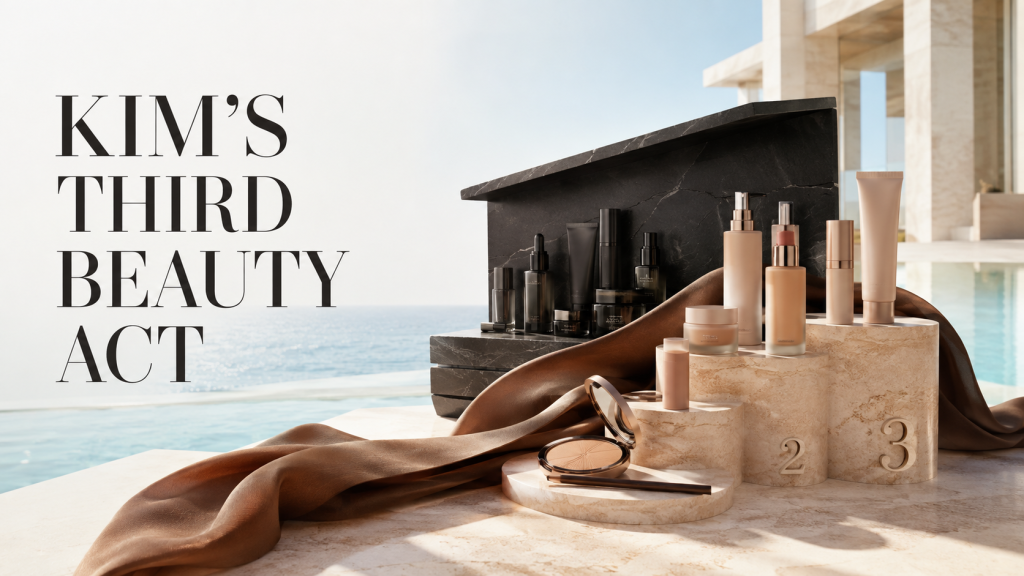
Kim Kardashian has launched more beauty brands than anyone else in this cluster, and she just killed the second one on purpose. SKKN by Kim wound down in mid-2025, although it was barely three years old. In its place comes Skims Beauty, folded inside her multi-billion-dollar apparel machine instead of standing alone. The shutdown is the strategy, which makes this the strangest success story in the file.
Her full balance sheet, together with the apparel math, lives in Kim’s net worth file. This piece follows one thread, namely the beauty money, through three brands, one buyback, and the most interesting consolidation in celebrity commerce.
Three Brands, One Founder
The sequence matters, so here is the ledger. Initially, KKW Beauty launched in 2017 and sold contour kits at reality-TV speed. After that came SKKN in 2022, a nine-step prestige skincare system. Finally, Skims Beauty arrives as chapter three, confirmed in October 2025.
Each brand answered a different market. Contour was the Instagram era, clinical skincare was the self-care era, while the new line bets on the body era her shapewear already owns. Say what you want about the family, but they read rooms professionally.
The Coty Loop
Coty keeps appearing in this cluster like a recurring character. The conglomerate paid $200 million for 20 percent of KKW Beauty in 2020, a $1 billion valuation at the very top of the market. Previously, the same company took the Kylie writedown and licensed Gaga’s first fragrance.
Eventually came the reversal. In March 2025, Skims bought Coty’s stake back, returning full control just before the wind-down, as the trade coverage detailed. Indeed, buying back your own name at a discount is the decade’s signature move.
Ariana did it through a bankruptcy, whereas Kim did it through a negotiation. Either way, the pattern holds: the celebrities are reclaiming the equity the 2020 deals gave away.
Why SKKN Didn’t Work
Above all, the product had a timing problem. A nine-step routine priced in the hundreds launched directly into the minimalism turn, the wave that made Rhode’s three-product discipline and The Outset’s quiet essentials the winning formats. The market wanted less, yet SKKN sold more.
The name did not help either. Vowel-less branding reads as luxury in furniture and as friction in skincare. Customers asked for the Kim products, not the SKKN products, which told the company where the equity actually lived.
The Consolidation Play
Here is where it gets smart. Beauty did not die, it moved inside Skims, the company that carries most of her fortune and just ran the NikeSkims playbook with the biggest athletic brand on earth. Every product line now compounds one brand’s value instead of fragmenting three.
Watch the sequencing against a future public offering. A shapewear company is a nice IPO. A body-first platform spanning apparel, athletic wear, and beauty is a category story bankers can sell. The beauty line is an exhibit in that deck.
Also, the move fits the celebrity brand extension ladder we mapped. The top rung was never more brands. It was one brand big enough to hold everything.
The Valuation Arithmetic
Run the numbers across the decade. KKW Beauty was worth $1 billion on paper in 2020, although the paper aged badly. Skims raised at $4 billion in 2023, then stacked the Nike partnership on top.
Her fortune now tracks the apparel company, since her stake there dwarfs everything else on the ledger. So beauty’s job changed. It stopped needing to be a fortune and started needing to feed one.
That reframe explains the patience. A standalone SKKN had to win its category to matter, whereas a Skims beauty line only has to deepen a relationship the company already owns. Lower bar, bigger machine.
What Skims Beauty Will Be
Kim previewed the philosophy in an October 2025 interview: bring back what works. Read that as the greatest hits of KKW and SKKN, re-priced and re-platformed for the Skims customer. Expect body-first categories, the ones shapewear already primes.
The distribution advantage is unfair this time. Skims ships to a customer file built over six years, so the beauty line launches with the acquisition costs of a restock email. None of her previous brands started with that. Equally, the retail partners come pre-sold, because the apparel sell-through already proved the customer shows up.
The Body Era Bet
The cultural timing is deliberate too. Body attention is the defining beauty story of the decade, a shift our body transformation economics piece tracks in detail. Skin got its era. The body is getting one now.
Shapewear taught her company what faces never could, namely how women actually feel about their bodies at checkout. Beauty products built on that data start with an honesty advantage. Expect the line to speak body first and face second.
Also expect a scent eventually. The 2026 bottle rush proves the category is running hot, and a Skims fragrance would launch into the strongest customer file in celebrity commerce.
The Shutdown as Strategy
File this next to the failures carefully, because it is not one. The shakeout autopsy covers brands that died owing money to their own hype. SKKN closed by choice, with the founder holding the equity and the timeline.
Owned shutdowns are a privilege of control. She could fold the brand because she had bought back the stake, and she could relaunch inside Skims because she never sold the name’s future. The licensing class gets neither option.
That is the quiet lesson for every founder watching. Ownership is not just about keeping the upside. It is about controlling the endings. By contrast, the graveyard class learned about theirs from a press release.
The Third Act Risk
Fairness requires the bear case. Beauty lines inside apparel companies have a mixed record, because teams built to sell bras rarely sell serums well. Category focus was the one advantage SKKN had that Skims Beauty will not.
There is also the fatigue question. Three launches in nine years asks a lot of customer trust, although the Skims name arrives cleaner than the Kim initials did. The relaunch has to feel like a continuation, not another reset.
Still, the downside is capped in a way the failures never managed. If the line stalls, it folds back into a thriving parent instead of a liquidation thread. That safety net is what consolidation actually buys.
The Kardashian Ledger
The family now demonstrates every play in this cluster. Kylie sold at the top and took the recount. Kim bought back, consolidated, and re-platformed. Between them, the sisters have run the full syllabus of celebrity beauty finance.
The bigger frame sits in celebrity wealth versus dynasty wealth. Individual brands rise and fold, but the family’s combined position keeps compounding across categories. Beauty is one drawer in a much larger cabinet.
Of course, the sister acts keep evolving. Kendall holds tequila, Kylie holds the remains of her empire, and the family office logic strengthens every cycle. Watch consolidation spread through the portfolio, because the playbook clearly works.
Where The Conversation Continues
The scoreboard lives in the 2026 net worth rankings and the beauty empire board. When Skims Beauty ships, this cluster gets its next chapter, and the freshness clock resets again.
Beauty sponsors should note what Kim just modeled. Consolidation beats fragmentation, and presence beats reach. The July issue works the same way.
Author

Written by
Recent Posts

AI for personal finance: where PennyGuard fits
How to Pick a Homecoming Dress for Your Body Type (and Feel Amazing in It)

World Cup Injury Attorney for Vancouver Events
What a 3-Carat Engagement Ring Actually Costs in 2026: The Real Numbers
The Skincare Habits That Make a Real Difference Over Time
Categories
- Art
- Articles
- Business of Luxury
- Celebrities
- Culture
- Entertainment
- Events
- Faces of Summer 2026
- Fashion
- Fashion & Style
- Featured
- Finance
- Food, Spirits, Wine
- Hamptons
- Hamptons Celebrities
- Health
- Health & Beauty
- Lifestyle
- Luxury Lifestyle
- Press
- Profiles
- Real Estate
- Technology
- The Chronicles
- Travel
- Uncategorized
- Weddings