
By the time the last guests have gone home, the holiday table will have acquired a second life. Someone will leave a box there. Someone else will be looking for a pencil. If there’s a child in the house who likes to make things, those two objects may soon be part of a village, a marble run, or a long debate about whether a cardboard door needs to open both ways. A gift can give that afternoon somewhere to go.
When shopping for STEM gifts for kids, think about what the child will be able to take out again the following weekend. An elaborate demo can be fun once. A little box of parts, with room in it for something the child made, can sit on the same shelf all winter. The trick is to choose an activity that has a good second day.
A Building Gift That Can Stay on the Table
A cardboard town with an address
Save a low box with a clean, flat bottom, then add some pieces of stiff cardboard, colored tape and a thick pencil. The low box is the town limits. Put the first building near one corner and give it a number. When a child adds a second, leave the street wide enough for the toy car that’s supposed to drive up it. A folded piece of paper makes a perfectly useful map.
After the first session, see whether the car can turn at the end of the street. That’s often where the most interesting work starts. One child will move the houses. Another will announce the car has been going the wrong way all along. Take a picture from above before things move so there’s a record of how the town looked that morning.
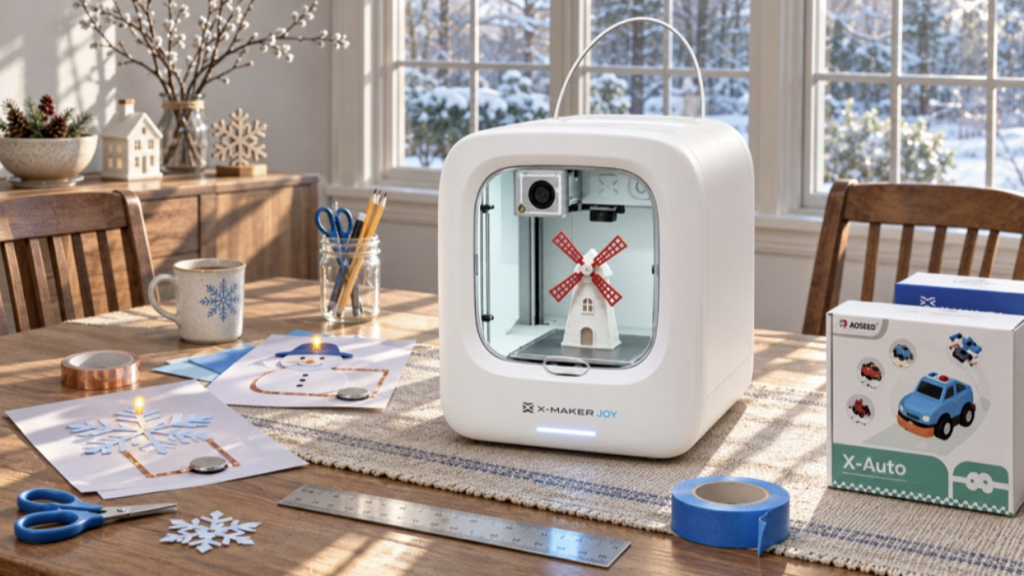
A family that already sketches or prints parts might make a little set of numbered doors or a connector for a wall. An enclosed printer such as the X-MAKER JOY from AOSEED is one way to make those pieces. Try a single door in cardboard first to see where it catches. An adult can supervise any printing, follow the maker’s ventilation guidance and take out the part after it cools.
Make enough room to come back
A spot on a shelf matters more than another bag of craft supplies. Slide the whole town onto a tray if the dining table needs to be cleared. Put loose doors and unfinished decorations in an envelope inside the box. A child will have an easier time finishing the bakery if they can find the piece they cut for its roof.
A Science Gift for the Person Who Notices Everything
A notebook that leaves the house
Give a child a notebook small enough to fit in a winter coat. Add a pencil and the date of a walk you can take together. A nearby pavement or row of trees is plenty. Where does the damp patch in front of one house go as the sun moves? Why are all the leaves over by that one fence? Give the child enough time to choose what’s worth drawing. If the picture looks like a heap of sticks to you, ask them what they put in it. They might have a whole theory about where the wind comes from.
On the second walk, take the same notebook. Let the child choose a page to look at before you leave. A hand lens is worth adding when there’s something small they want to see. Remind them to keep it out of direct sunlight and away from their eyes when looking anywhere near the sun. The more useful extra may be a bit of packing tape to make a tab marking one drawing they want to come back to.
A window with a number on it
For a child who’s already checking what clothes they need before going out, an outdoor thermometer gives them something to compare with the forecast. An adult should fit it where the instructions recommend. Put a scrap of paper near the window and try taking a reading at the same time for a few mornings. Draw one cloud or a sun alongside the number. If the chill outside catches the child by surprise on a windy morning, ask them what else belongs on the page. That’s probably the day the paper becomes a weather diary.
A Gift That Gets Taken Apart and Used Again
A gear board for someone who asks how things turn
The gear board can begin with two cogs. Ask someone to turn the blue one slowly while you watch the other. They’ll turn in opposite directions. Now imagine there’s another cog between them. Let the child draw an arrow on a piece of paper showing the direction they think the outer one will go before the wheels touch. The prediction is more fun when somebody else in the room has drawn the arrow the other way.
Later, put the same board beside a book that shows the inside of a familiar machine. A picture of a clock or a hand drill gives the wheels a job. Leave the book open to the drawing rather than setting an assignment. One good question about what happens inside a closed case can bring everyone right back to the board.
Paper, a ruler and a place to launch
A paper-airplane gift can be nothing more than a folder of paper with two models marked for folding. Set aside a line on the floor from which both planes will fly. If a wing keeps dipping, try bending the back edge a little. Let the same person fly both planes from the same spot a few times. Masking tape on the floor makes a landing marker that can move as the flights get longer.
For the next session, turn it into a delivery game. Draw a short runway and see which fold lands closest. It may be a different plane from the one that flew farthest. Saving both models is handy, especially if the child wants to work out how one plane became good at a job nobody had in mind the day it was folded.
Give the First Afternoon Along With the Gift
The most useful thing to tuck in the box may be a card with a time written on it. A Saturday afternoon to build a few houses or find out which way a gear turns can take the pressure off Christmas morning. There’s room to look for the tape, change plans and leave something unfinished. By then the gift is doing what you bought it for. There’s a project within reach, and somebody in the house wants to see what happens next.
Author

Written by
Recent Posts
The Digital Nomad’s Money Map: Taxes, Banking and Budgets Across Borders
STEM Gifts That Keep Kids Busy Long After Christmas Morning

THE DOME at 53 Makes Its MoMA Debut, Led by Ahmass Fakahany and Richie Romero
Nancy Davis Is Turning Personal Tragedy Into a Mission to Save Lives

When ChatGPT Picks the Bottle
Categories
- Art
- Articles
- Business of Luxury
- Celebrities
- Culture
- Entertainment
- Events
- Faces of Summer 2026
- Fashion
- Fashion & Style
- Featured
- Finance
- Food, Spirits, Wine
- Hamptons
- Hamptons Celebrities
- Health
- Health & Beauty
- Lifestyle
- Luxury Lifestyle
- Press
- Profiles
- Real Estate
- Technology
- The Chronicles
- Travel
- Uncategorized
- Weddings