
The Decision That Created a Billion-Dollar Franchise
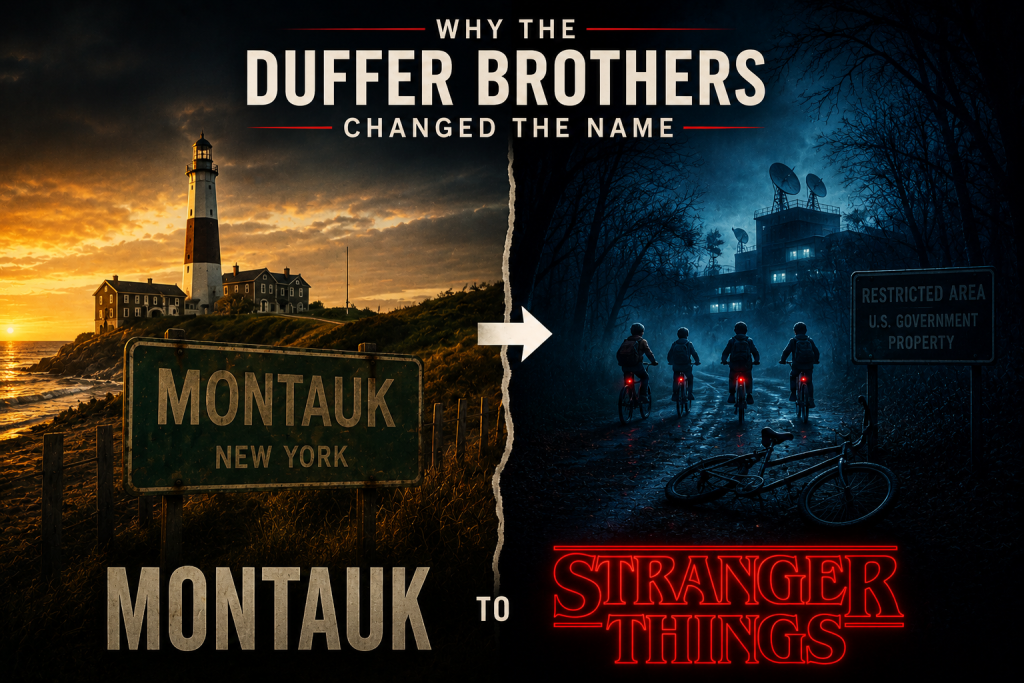
The show was called Montauk. Then it wasn’t. And the distance between those two states, between a Long Island conspiracy thriller and a Midwestern nostalgia machine, between a found-footage experiment and a streaming juggernaut, is the distance between a show that might have been a cult favorite and a show that became the second most-watched English-language series in Netflix history. In fact, the name change is where Stranger Things became Stranger Things. Everything that happened before was research. Everything that happened after was execution.
But the name change from Montauk wasn’t a single decision. It was a cascade of decisions, each driven by different pressures (aesthetic, legal, financial, geographic), that together transformed a project rooted in East End conspiracy mythology into something that looked and felt entirely different while remaining, at its structural core, the same show. Specifically, the Duffer Brothers changed the setting, the title, the time period, and the visual language. They did not change the story. And understanding why they changed what they changed, and why they kept what they kept, tells you something essential about how the most successful creative adaptation in recent television history actually worked.
What “Montauk” Meant
In fact, when Matt and Ross Duffer titled their project Montauk, the word was doing specific narrative work. It signaled coastal isolation, Cold War paranoia, government secrecy, and the particular kind of conspiracy mythology that had been accumulating at Camp Hero since Preston Nichols published his book in 1992. In effect, the title told prospective buyers (the Duffers were pitching to networks) exactly what kind of show they were getting: a paranormal thriller set at the site of America’s most elaborate conspiracy theory.
David Harbour, who would eventually play Chief Hopper, said in a 2025 interview that he thought the original title was “so strong.” He elaborated that “Montauk has this end-of-the-world feeling. Indiana feels safe. That’s what makes the horror work.” Still, Harbour’s observation captures something important about what was lost in the transition. Montauk as a title carried geographic dread. It told you that the story happened at the edge of something, at a place where the land runs out and the ocean begins and the government once ran a radar station that still, allegedly, turns on its own. Stranger Things carries no geographic information at all. It is a tone, not a place. Which is precisely why it worked for a broader audience.
The Aesthetic Shift
The first and most consequential reason for the name change from Montauk was visual. The Duffers wanted to make a show that looked and felt like early Spielberg: E.T., Close Encounters of the Third Kind, Poltergeist. They wanted suburban neighborhoods, kids on bikes, walkie-talkies, arcades, middle-school hallways illuminated by fluorescent lighting that makes everyone look slightly anxious. They wanted the particular quality of American ordinariness that Spielberg captured in the early 1980s, where the horror is effective precisely because it erupts from a landscape that feels completely safe.
Montauk’s landscape is the opposite of safe. It is dramatic, coastal, wind-battered, and naturally atmospheric. Its bluffs rise 75 feet above the Atlantic. Fog rolls in without warning. And the radar tower at Camp Hero looks like something from a science fiction film. Of course, if the Duffers had shot in Montauk, they wouldn’t have needed to manufacture dread. The landscape provides it for free. But that abundance of natural atmosphere would have pushed the show toward gothic horror rather than suburban thriller, toward something closer to The Fog or The Wicker Man than E.T.
As a result, the move to fictional Hawkins, Indiana, stripped the landscape of its inherent drama and replaced it with manufactured normalcy. And the horror works precisely because Hawkins is boring. Streets are flat. Houses are modest. The biggest event of the year is the town fair. When the Demogorgon appears, the contrast between the monster and its setting is what creates the impact. In Montauk, a monster emerging from the fog near a decommissioned military base would have felt almost expected. In Hawkins, it feels like a violation of reality. That violation is the show’s engine. And it required leaving Montauk behind.
The Kessler Lawsuit
The second factor in the name change from Montauk was legal. In 2018, filmmaker Charlie Kessler filed a plagiarism lawsuit against the Duffer Brothers. Kessler had directed a short film called The Montauk Project and claimed he had discussed his concept with the brothers at a party hosted by a mutual acquaintance in 2014. According to Kessler, the Duffers subsequently developed a similar project using ideas he had shared.
Ultimately, the lawsuit was dismissed in 2019 after a brief trial in which the Duffers’ attorneys presented evidence that the brothers had been developing their concept independently before the alleged 2014 meeting. Still, the legal exposure associated with the Montauk name during the show’s early development years added practical urgency to a creative decision that was already underway. After all, keeping the title Montauk would have invited ongoing association with Kessler’s work. Changing it created a clean break.
Of course, it is worth noting that the Kessler lawsuit, whatever its merits, illuminated something interesting about the Montauk mythology’s cultural status. Indeed, multiple creators had independently identified the Montauk Project conspiracy as source material for a horror project. Kessler made a short film about it. The Duffers developed a series about it. Other filmmakers produced documentaries about it. The conspiracy had reached a level of cultural saturation where its adaptation was, in some sense, inevitable. Indeed, the question was not whether someone would turn the Montauk Project into entertainment but who would get there first and how they would do it.
The Production Economics
The third factor was financial, and it was decisive in a way that aesthetic and legal considerations alone might not have been. Of course, filming on Long Island is expensive. Permits, locations, housing for cast and crew, and the general cost of operating in the New York metropolitan area add up quickly. Georgia, by contrast, also offered one of the most generous film tax incentive programs in the country. The state provided a 20% base tax credit on qualified production expenditures. An additional 10% uplift applied for including the Georgia logo in credits.
Specifically, the suburbs north of Atlanta, where Stranger Things ultimately filmed, provided the small-town Indiana look the Duffers wanted at a fraction of the cost of a Long Island production. Jackson, Georgia, doubled for Hawkins. Emory University’s Briarcliff Campus stood in for Hawkins Lab. The forests around Atlanta provided the woods where the boys search for Will Byers. None of these locations looked like Montauk. All of them looked like Indiana. And the savings allowed the production to invest in visual effects, creature design, and the Winona Ryder salary that a Long Island shoot might not have been able to accommodate.
The Time Period Shift
The original Montauk pilot was set in October 1980. By contrast, the produced show is set in November 1983. That three-year shift served multiple purposes. It placed the show in the aftermath of E.T. (1982), which defined the visual and emotional template the Duffers were working from. It aligned with Red Dawn (1984), whose Cold War paranoia influenced the show’s atmosphere. And it moved the timeline deeper into the Reagan era, when American anxiety about government overreach and nuclear annihilation was at its peak.
Interestingly, the time shift also, perhaps inadvertently, strengthened the show’s connection to real government programs. The Stargate Project, the CIA’s psychic research program, was fully operational in 1983. MKUltra had ended a decade earlier, but its exposure through congressional hearings was still recent news. By setting the show in 1983 rather than 1980, the Duffers placed Eleven’s abilities in a historical context where the government’s interest in psychic warfare was documented fact, not speculative fiction. As a result, the three years made the show more plausible, not less.
What the Name Change Preserved
Everything. The name change from Montauk to Stranger Things altered the show’s surface while preserving its core. Camp Hero became Hawkins Lab. The Montauk Boys became Eleven. The portal Duncan Cameron allegedly opened became the gate to the Upside Down. MKUltra stayed MKUltra (the show references it by name). The cover-up stayed a cover-up. The government stayed the villain.
The Return
And in the series finale, the name came back. Hopper told Joyce he wanted to move to Montauk. Ross Duffer called it “a wink to the fans.” But it was more than that. It was an admission that the show never really left. Settings changed. Titles changed. Geography changed. The story didn’t. The story was always Montauk. It started at a radar tower on the South Fork and ended with a character choosing to go back there. Everything in between was the scenic route. And the scenic route, it turned out, was worth approximately one billion dollars in franchise value. Which is, if nothing else, a testament to the enduring power of a conspiracy theory that started at a fishing village at the end of Long Island and refused to stay there.
The Word Itself
There is, finally, something worth saying about the word “Montauk” itself and what it means as a piece of language rather than a geographic reference. “Montauk” is a word that carries weight in the mouth. It has the percussive quality of a place name that sounds like it was chosen by someone with a sense of drama: two syllables, hard consonants, the “auk” ending that rhymes with nothing and therefore sits in the ear without easy comparison. “Hawkins” is soft, almost domestic, the kind of name you’d give a cat or a street in a planned community. “Stranger Things” is a phrase, not a name. Phrases work differently in marketing contexts. They describe while names invoke. The Duffers gained marketability in the transition.
Whether they lost something harder to measure is a question that David Harbour answered when he said the original title was “so strong.”
What the Duffer Brothers ultimately accomplished with the name change from Montauk is a feat of creative engineering that deserves more analysis than it typically receives. First, they identified the structural elements of the Montauk Project conspiracy that were narratively essential and separated them from the elements that were geographically specific.
The Engineering of Adaptation
Then they transported the essential elements to a setting that served their aesthetic goals while leaving the geographic specifics behind. It is the kind of adaptation that appears simple in retrospect. But it required a precise understanding of which parts were load-bearing and which were decorative. They kept every load-bearing wall. They repainted everything else. And the series finale, in which Hopper chooses to move to Montauk, is the quiet admission that the original walls were always visible beneath the paint.
Where the Conversation Continues
The name change from Montauk to Stranger Things is the creative decision that turned a conspiracy thriller into a cultural phenomenon. Social Life Magazine has covered the East End for 23 years. The stories at the intersection of history, conspiracy, and culture land here before they land anywhere else.
If you have a story, a brand, or a project that belongs in these pages, reach out at sociallifemagazine.com/contact.
For brands looking for premium editorial placement, our paid feature submission portal is open at sociallifemagazine.com/submit-a-paid-feature/.
Stay in the loop with our weekly email blast covering events, openings, and who’s doing what Out East. Sign up at enflyer.sociallifemagazine.com.
Polo Hamptons 2026 returns to Bridgehampton on July 18 and July 25 with BMW as title sponsor. For event details and sponsorship opportunities, visit polohamptons.com.
Never miss a feature, a profile, or a party recap. Subscribe to Social Life Magazine at sociallifemagazine.com/subscription.
If the work we do matters to you, you can support independent East End journalism directly via PayPal.
Author

Written by
Recent Posts
Sectional Sofa vs. Regular Sofa: Which One is Best for You?

Sober and Injured: How to Manage Pain Treatment After a Massachusetts Slip and Fall
Flexible Liquidity Options Are Reshaping How Modern Professionals Handle Unexpected Expenses
5 Best At-Home Teeth Whitening Kits for a Brighter Smile in 2026

From Spa Retreats to Aesthetic Care, the Luxury Travel Itinerary Is Changing
Categories
- Art
- Articles
- Business of Luxury
- Celebrities
- Culture
- Entertainment
- Events
- Faces of Summer 2026
- Fashion
- Fashion & Style
- Featured
- Finance
- Food, Spirits, Wine
- Hamptons
- Hamptons Celebrities
- Health
- Health & Beauty
- Lifestyle
- Luxury Lifestyle
- Press
- Profiles
- Real Estate
- Technology
- The Chronicles
- Travel
- Uncategorized
- Weddings