
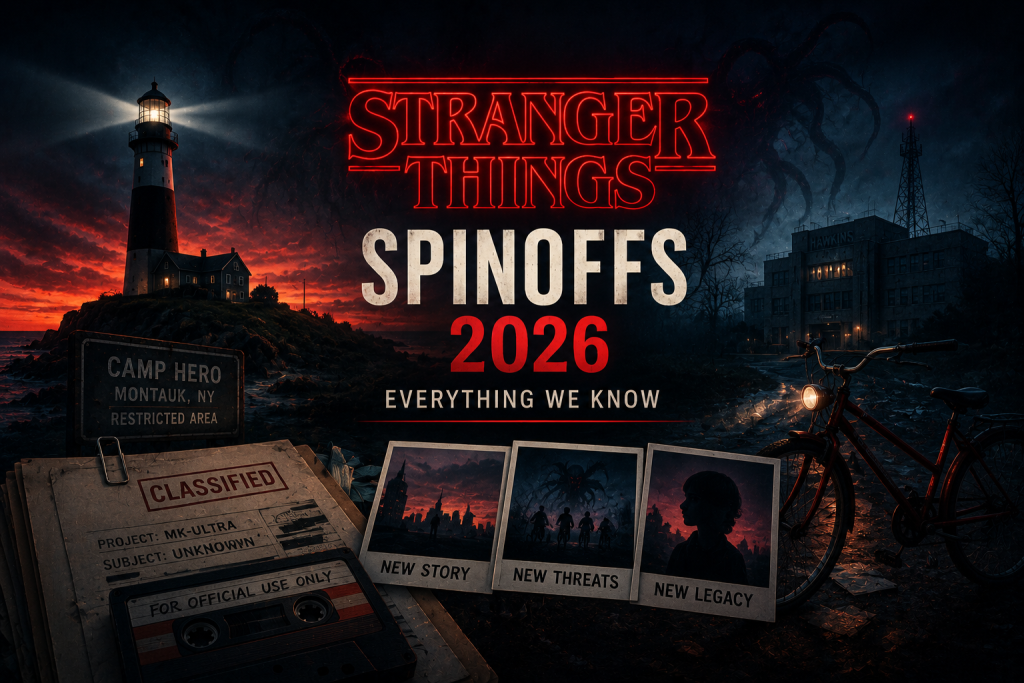
The Franchise That Refuses to End
On New Year’s Eve 2025, the Stranger Things series finale aired to what Netflix described, with characteristic understatement, as “record-breaking viewership.” The show was over. Eleven had saved Hawkins one last time. Hopper had told Joyce he wanted to move to Montauk. Credits rolled. And then the franchise immediately continued. In the way that billion-dollar intellectual properties operate in the streaming era, it behaved as if nothing had ended at all.
Indeed, as of May 2026, the Stranger Things spinoffs landscape looks like this: one animated series already on the air and renewed for a second season, one live-action spinoff in active development with details still under wraps, a stage play running in London’s West End, and a merchandise operation that generates revenue figures Netflix declines to disclose but that industry analysts estimate in the hundreds of millions annually. After all, the show ended. The universe didn’t. And every new entry in that universe sends millions of people back to the mythology that started it all, back to Camp Hero and the Montauk Project and the self-published book from 1992 that made all of this possible.
Here is everything we know about where the franchise goes next. This page will be updated with every new announcement.
Stranger Things: Tales From ’85
The first official spinoff premiered on Netflix on April 23, 2026. Stranger Things: Tales From ’85 is an animated series set in the winter of 1985, between the second and third seasons of the main show. It follows the core group of characters (Eleven, Mike, Dustin, Lucas, Will, and Max) as they confront new monsters and what Netflix describes as “a chilling paranormal mystery” in Hawkins.
The series was developed by showrunner Eric Robles. His previous credits include Glitch Techs and Fanboy and Chum Chum. The Duffer Brothers serve as executive producers. They are joined by Shawn Levy, Dan Cohen of 21 Laps, and Hilary Leavitt of Upside Down Pictures. Animation is handled by Flying Bark Productions, the Australian studio behind Marvel’s What If…? and Rise of the Teenage Mutant Ninja Turtles.
The voice cast is entirely new, with younger actors replacing the live-action performers. Brooklyn Davey Norstedt voices Eleven, with Jolie Hoang-Rappaport as Max, Luca Diaz as Mike, Elisha “EJ” Williams as Lucas, Braxton Quinney as Dustin, Ben Plessala as Will, Brett Gipson as Hopper, and Jeremy Jordan as Steve. The series also introduces a new character, Nikki Baxter (voiced by Odessa A’zion), described as “a tinker” with pinkish hair. Supporting cast includes Janeane Garofalo, Lou Diamond Phillips, and Robert Englund, who horror fans will recognize as the original Freddy Krueger.
The Saturday Morning Aesthetic
The Duffers have been explicit about the show’s visual and tonal ambitions. Ross Duffer said in the announcement featurette: “With animation, there’s really no limits.” Matt Duffer added: “The idea was kind of to evoke a feeling of an ’80s cartoon.” Robles described the series as feeling “like a lost season” of the main show, translated into the visual language of Saturday morning cartoons that the show’s target demographic grew up watching.
Still, this is worth examining because it represents a deliberate creative strategy. By setting Tales From ’85 between existing seasons, Netflix avoids the constraints of continuing a finished story. The characters are younger, the stakes are lower, and the tone is lighter. In other words, the spinoff expands the audience downward rather than forward. It targets younger viewers who may not have watched the live-action series. It is a breadth play, not a depth play. And it appears to be working. In fact, Netflix renewed the series for a second season, arriving in fall 2026, before the first season had completed its initial viewing cycle.
The Live-Action Spinoff
The Duffer Brothers have confirmed that a live-action spinoff is in development, but details remain sparse to the point of deliberate provocation. What we know: the spinoff will feature “a different mythology” from the original series. In addition, it will not be set in Hawkins. It will not follow the characters from the main show. And, according to the Duffers, there is an Easter egg hidden in the Season 5 finale that points to the spinoff’s concept.
Fans have spent months dissecting the finale for the alleged Easter egg. Of course, the leading theory, which the Duffers have neither confirmed nor denied, involves the brief appearance of a classified government document visible on a desk in one of the epilogue scenes. The document appears to reference a facility that is not Hawkins Lab. If this is indeed the clue, the live-action spinoff may explore another node in the network of government facilities that the Montauk Project conspiracy describes.
Specifically, this is where the spinoff becomes relevant to the Montauk Dossier. The original show adapted the Montauk mythology through the lens of a single location (Hawkins/Camp Hero). Specifically, a spinoff with “a different mythology” could draw from any number of related conspiracy threads: Plum Island’s biological experiments, the Stargate Project’s psychic research program, Operation Paperclip’s Nazi scientist recruitment, or Tesla’s Wardenclyffe Tower experiments. Each of these threads was present in the original show’s DNA. Any one of them could sustain a full series. All of them trace back to the East End.
Stranger Things: The First Shadow
Running at the Phoenix Theatre in London’s West End, Stranger Things: The First Shadow is a stage play set in Hawkins in 1959, decades before the events of the television series. The play explores the origins of Henry Creel, who becomes the show’s ultimate villain Vecna. It is directed by Stephen Daldry, whose credits include Billy Elliot, The Reader, and The Crown.
The stage production also represents Netflix’s first significant foray into live theater and, more broadly, the franchise’s expansion into formats that don’t require a screen. Whether the play’s narrative will inform the live-action spinoff’s direction is unclear. But its existence confirms that Netflix and the Duffers view the Stranger Things universe as a multi-platform property capable of generating revenue across streaming, animation, theater, merchandise, and live experiences.
What Every Spinoff Means for Montauk
Here is the detail that matters most for the Montauk Dossier. Every new Stranger Things release, regardless of format or setting, drives millions of people back to the franchise’s origin story. And the origin story is the Montauk Project.
The Traffic Engine
After all, Tales From ’85 premiered on April 23, 2026. Season 2 arrives in fall 2026. The live-action spinoff is presumably targeting 2027 or 2028. The stage play continues its run. Of course, each release generates search traffic. Stranger Things searches approximately 20 million times per month according to SEMrush data. Still, a meaningful fraction of that traffic flows to queries about the show’s real-life inspiration: “stranger things montauk,” “mkultra stranger things,” “hawkins lab real,” “camp hero tunnels.”
The Compounding Effect
In other words, the franchise isn’t dying. It is metamorphosing. And every metamorphosis regenerates interest in the source material. The book that Preston Nichols self-published in 1992 is now the seed of a content network (and the word “network” is unavoidable here, despite its corporate connotations, because the interconnection between products is genuinely organic) that spans streaming, animation, theater, merchandise, tourism, and search. Camp Hero State Park sees increased foot traffic after every major franchise release. The radar tower gets photographed. People re-discuss the Montauk Monster. And the conspiracy gets retold.
For brands operating on the East End, the Stranger Things franchise is not a pop culture curiosity. It is a permanent traffic generator. And its output schedule, with at least one major release per year for the foreseeable future, means the traffic will compound rather than decay. As a result, the question for Montauk-adjacent businesses is not whether to engage with the franchise’s cultural footprint. It is whether they can afford not to.
There is a particular irony in the fact that the Stranger Things franchise is expanding at the exact moment its source material is becoming more relevant, not less. In May 2026, MKUltra files were physically seized from the DNI’s office by the CIA. Then in April 2026, Tales From ’85 brought millions of viewers back to Hawkins. In the series finale five months earlier, Hopper chose Montauk. Each event feeds the others. Each sends traffic to the origin story. And the origin story sits at the end of Long Island, at a state park with sealed buildings and a radar tower that still turns on its own, waiting for the next wave of visitors who watched the show and want to see where it all began.
The Tributaries
The Stranger Things spinoffs are not sequels. They are tributaries. Each one flows from a different angle toward the same source. And the source, whether Netflix acknowledges it or not, is a self-published book from 1992 about secret experiments at a military base in Montauk. Preston Nichols never got a writing credit. But every spinoff, every animated episode, every stage performance, and every piece of merchandise carries his fingerprints. The franchise that refuses to end is also the franchise that refuses to leave Montauk, no matter how many times it changes the setting to Indiana.
Where the Conversation Continues
The Stranger Things spinoffs are expanding a universe that started at Camp Hero in Montauk. Social Life Magazine has covered the East End for 23 years. This page will be updated with every new franchise announcement. The stories that matter Out East land here first.
If you have a story, a brand, or a project that belongs in these pages, reach out at sociallifemagazine.com/contact.
For brands looking for premium editorial placement, our paid feature submission portal is open at sociallifemagazine.com/submit-a-paid-feature/.
Stay in the loop with our weekly email blast covering events, openings, and who’s doing what Out East. Sign up at enflyer.sociallifemagazine.com.
Polo Hamptons 2026 returns to Bridgehampton on July 18 and July 25 with BMW as title sponsor. For event details and sponsorship opportunities, visit polohamptons.com.
Never miss a feature, a profile, or a party recap. Subscribe to Social Life Magazine at sociallifemagazine.com/subscription.
If the work we do matters to you, you can support independent East End journalism directly via PayPal.
Author

Written by
Recent Posts
How to Measure Whether a Hair Loss Treatment Is Working
Is Online Psychiatry Covered by Insurance? What to Know Before Booking
Four Habits of Quietly Successful Entrepreneurs

The Most Common Preventable Health Concerns Doctors See Today
What Affects a Rideshare Injury Settlement?
Categories
- Art
- Articles
- Business of Luxury
- Celebrities
- Culture
- Entertainment
- Events
- Faces of Summer 2026
- Fashion
- Fashion & Style
- Featured
- Finance
- Food, Spirits, Wine
- Hamptons
- Hamptons Celebrities
- Health
- Health & Beauty
- Lifestyle
- Luxury Lifestyle
- Press
- Profiles
- Real Estate
- Technology
- The Chronicles
- Travel
- Uncategorized
- Weddings