
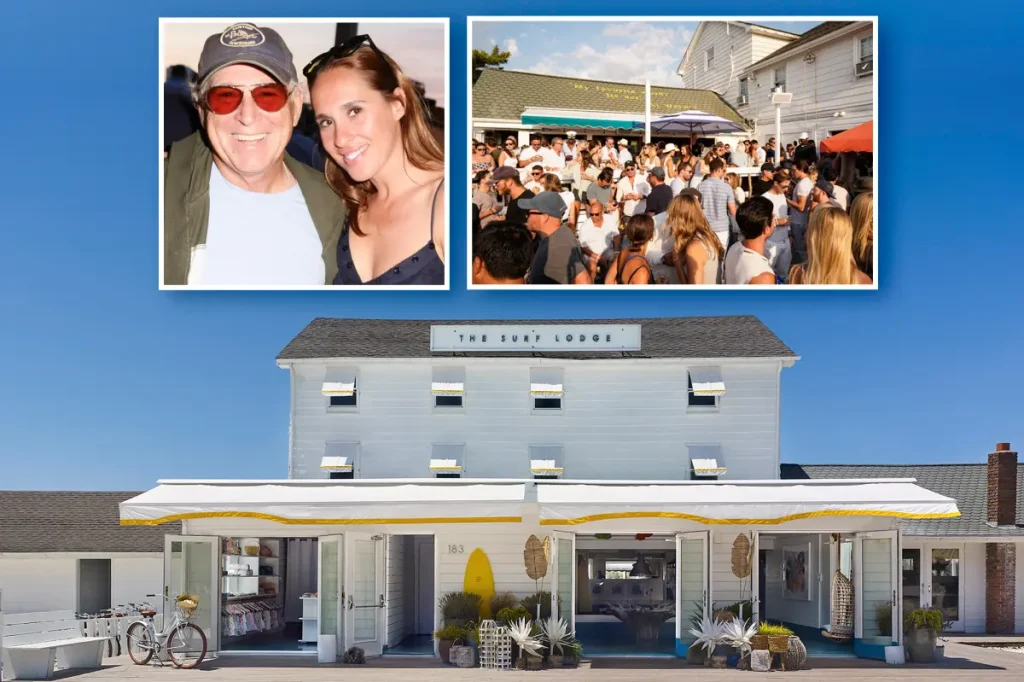
The Surf Lodge Montauk is a 20-room boutique hotel on Edgemere Street that overlooks Fort Pond, hosts a summer concert series featuring acts like Snoop Dogg and Willie Nelson, operates a branded beach club redesigned annually by international fashion houses, and has been called “the East End’s ultimate cool-kid mecca” by Condé Nast Traveler. It is also, fundamentally, a shack. Jayma Cardoso, its founder, calls it that herself. “People get so mad,” she told one interviewer. But the word is precise. The Montauk venue that reshaped Hamptons nightlife, redefined the relationship between hospitality and cultural programming, and generated more fashion-magazine coverage per square foot than any property east of Manhattan began its life as a 1967 motor inn called the Lakeside Inn. Understanding how it became what it is now requires understanding Jayma Cardoso, and understanding Jayma Cardoso requires starting in Newark.
Newark to Nolita: The Education of a Cultural Architect
She is seventeen years old. Her father has just died. She arrives in Newark, New Jersey, with her mother and a determination that will later be described as “fierce” by profile writers who have never been seventeen and broke in Newark. She enrolls at Fordham University to study biology. To pay tuition, she takes a job checking coats at a SoHo restaurant. She will not stay at the coat check long. But she will remember every detail of how a room operates when the person running it is invisible.
Cardoso moved through the front of house with systematic precision. She understood that hospitality is, at its core, applied anthropology. After the coat check came hostessing. After hostessing came bartending. Then cocktail waitressing at Lotus in the Meatpacking District, a venue that in the early 2000s functioned as a graduate seminar in New York nightlife economics (cover charges, bottle service ratios, the precise relationship between celebrity sightings and door revenue). At Lotus, she met Jamie Mulholland, a South African bartender. Together, they opened CAIN in Chelsea.
The Club Years: CAIN, GoldBar, Lavo
CAIN was a safari-themed nightclub that became a celebrity magnet. The concept was absurd (a jungle in Chelsea, essentially), but the execution worked because Cardoso understood a principle that would later define the Surf Lodge: the venue is not the point. People inside the venue are the point. A venue’s job is to create conditions where those people feel simultaneously exclusive and unguarded. GoldBar in Nolita followed. Then came Lavo with the Tao Group, an Italian restaurant and nightclub on the Upper East Side that Cardoso later described as her “Cornell School of Hotel Administration.”
Each venue taught a specific lesson. CAIN taught her that theme generates attention. GoldBar taught her that intimacy generates loyalty. Lavo taught her that scale generates revenue. But what she actually wanted, throughout all of it, was a hotel. “I always wanted to do a hotel,” she told interviewers, “as it afforded me the opportunity to create a much richer experience.” Clubs close at 4 a.m. Hotels never close. And the experience she wanted to create required more than one night.
The Purchase: A Motel, a Pond, and $400,000
In 2008, during the middle of the global financial crisis (a detail that every profile of Cardoso mentions, because the timing was either brave or insane, and the line between those two things in real estate is always thinner than people admit), Cardoso and two business partners bought the Lakeside Inn, a roadside motel on Edgemere Street in Montauk. It overlooked Fort Pond, a freshwater body near downtown. The bones were good. But the rooms were not. She spent $400,000 on renovations and renamed it the Surf Lodge.
Cardoso saw something in Montauk that her investors did not. Where they saw a fishing village at the end of a long drive, she saw Brazil. Specifically, she saw the energy of her home country’s coastal culture: informal, communal, music-driven, organized around sunset rather than reservation time. “I always go to Montauk,” she told the people who thought she was crazy. The opening weekend booking confirmed her instinct. Stephen and Julian Marley performed during a freezing rainstorm to a crowd that was small, cold, and (this is the part that mattered) completely committed.
The Concert Series: How Music Became the Product
He is twenty-nine, an associate at a Midtown media agency making $95,000 plus a bonus that depends on billings he cannot control. At 7:15 p.m. on a Saturday in July, he stands on the Surf Lodge deck, holding a drink that cost $24 and watching a DJ whose name he does not recognize. Around him, 300 people simultaneously watch the DJ, the sunset, and each other. He will post a photo of the sunset. The DJ will not be in it. The drink will.
From the beginning, Cardoso understood that music was not entertainment at the Surf Lodge. It was the product itself. The small deck overlooking Fort Pond became a stage. The setting sun provided production value that no lighting rig could match. Initially, she booked surf staples like Donavon Frankenreiter. Before long, managers started calling because their clients wanted to play “that place in Montauk.” This is the inflection point in every venue’s life: the moment when artists pursue the stage rather than the other way around.
The Willie Nelson Pursuit
The legend-making booking was Willie Nelson, and the story behind it reveals Cardoso’s operational patience. She pursued Nelson for four years. During that period, she booked his son, then seemingly everyone else on his label, establishing a relationship with his management by demonstrating reliability and audience quality. Eventually, his manager relented. Nelson played the Surf Lodge. The photographs from that night became permanent cultural currency.
Since then, the concert series has featured John Legend, Jimmy Buffett, Wyclef Jean, Rufus Du Sol, Halsey (as an emerging act opening for Tove Lo), Diplo, Jon Bon Jovi, Zoë Kravitz with LOLAWOLF, and, for the 2026 season, headliners including Snoop Dogg, Teddy Swims, and the Martinez Brothers. Of course, what makes the series distinctive is not the names. Other Hamptons venues book famous musicians. What makes the Surf Lodge concert series different is the format: intimate, sunset-timed, outdoors, on a deck overlooking a pond. There is no VIP section and no meaningful separation between artist and audience. As a result, a Grammy winner performing here looks less like a concert and more like a friend playing guitar at a very good party.
The Five Pillars and the Business Model
Cardoso describes the Surf Lodge’s operating philosophy around five pillars: art, music, culinary, wellness, and community. This sounds like a brand deck, and in a sense it is. But the pillars also describe a genuine structural innovation. Each pillar generates its own programming, its own partnerships, and its own revenue stream. Music brings the concert series. Art brings gallery exhibitions and artist residencies (through a partnership with Ned’s Club). Culinary brings the restaurant and the brand collaborations. Wellness brings the spa programming. Community brings the local engagement that keeps the town from shutting the place down.
That last pillar is not decorative. In its early years, the Surf Lodge racked up more than 900 zoning and noise violations. The venue was nearly forced to close. In 2012, Cardoso orchestrated a sale to a company run by tech investor Michael Walrath. She remained a partner. The ownership restructuring was, in part, a strategic response to the regulatory pressure. It also provided capital for the 2017 renovation, when Architectural Digest documented the addition of a large outdoor stage. Subsequently, the violations decreased. The programming matured. And the property that nearly lost its operating permits became the single most consequential cultural venue in the modern Hamptons.
The Fashion Layer: Beach Club as Editorial Set
She is thirty-two and works in fashion PR for a firm that represents three luxury brands she cannot name in conversation without violating her NDA. She arrives at the Surf Lodge Beach Club on a Saturday morning and discovers that this year’s design is by Casablanca, the Paris streetwear label. The lounge chairs, umbrellas, and private cabanas are dressed in ombré hues of deep blue and light teal. She photographs the setup from four angles before sitting down. The photographs will appear on her personal Instagram (42,000 followers, carefully curated, never sponsored) within the hour. She does not think of this as work. It is work.
Each summer, the Surf Lodge redesigns its beach club through a fashion partnership. Recent collaborators include Casablanca (with interiors conceived by Antonio Di Oronzo of Bluarch), Revolve, and Ferragamo (at the St. Barths pop-up). Land Rover Defender provides cars for guests to explore local beaches and trails. For 2026, Popeyes partnered as the exclusive provider of the venue’s signature Chicken Tender Tower, a branded food item that sounds ridiculous and generates significant social media engagement precisely because it sounds ridiculous.
These partnerships are not sponsorships in the traditional sense. They are co-productions. Each brand contributes design, product, or programming in exchange for access to the Surf Lodge audience, a demographic that skews young (25 to 45), affluent (household income $200K and up), and disproportionately influential in fashion, media, and technology. Cardoso has said that these collaborations help create “additional points of interest, which beverage sales and hotel room nights cannot do alone.” In other words, the Surf Lodge is not a hotel that happens to host brands. It is a platform that happens to have rooms.
The Rooms: 20 Suites and the Scarcity Premium
There are only 20 waterfront guest rooms and suites at the Surf Lodge. This is by design. Scarcity generates demand. Demand generates waitlists. Waitlists generate word-of-mouth. Word-of-mouth generates the specific cultural currency that the Surf Lodge trades in, which is not luxury (luxury is available at Gurney’s, a mile east) but rather relevance. The rooms feature plush king beds, en-suite baths, private decks with hammocks, and sunset views over Fort Pond. Rates during peak season exceed $1,000 per night.
Still, nobody books the Surf Lodge for the room. People book it for the proximity to the programming, the way one might book a hotel near a festival for the festival and not the minibar. A private deck becomes a private box overlooking the concert. The hammock becomes a seat at the show. And the sunset, visible from every west-facing room, is the headliner that plays every night regardless of who is on the stage below.
Snow Lodge, St. Barths, and the Expansion
In 2019, Cardoso opened the Snow Lodge at the St. Regis Aspen Resort, applying the Surf Lodge formula to ski season. Dining, art, music, experiences, all adapted from sand to snow. The 2024-25 winter marked its fifth year, featuring collaborations with Revolve, a country music series, and sold-out sets from Diplo, Bob Moses, and Guy Gerber. Cardoso convinced the hotel owner to hand over the Presidential Suite, which she transformed into the Snow Lodge Suite. “Now we can retain a solid group of crazy people like me, who want to work with us,” she told Business Traveller about hiring full-time, year-round employees for the first time in nearly two decades.
St. Barths followed, with a pop-up at Hotel Le Toiny in partnership with Ferragamo. California and a third permanent property are reportedly under consideration. The expansion proves the model is exportable. The formula: identify a location with natural beauty and an existing community, then layer programming over it until the programming becomes inseparable from the place. This is exactly what Warhol did at Eothen, although Warhol did it with a guest list and Cardoso does it with a concert series and a branded chicken tower.
What the Surf Lodge Means for Montauk
Before 2008, Montauk’s nightlife consisted of Shagwong Tavern, the Memory Motel, and whatever was happening at Gurney’s. This was adequate for a fishing village. It was not adequate for a destination. The Surf Lodge filled the gap, but it also created a new category. Specifically, it proved that Montauk could support a venue model that had nothing to do with the private club architecture that governed Southampton and the rest of the East End. There is no membership, no waitlist for entry (only for rooms), and no dress code beyond the implicit one that every venue communicates through its Instagram grid.
Querer É Poder
Cardoso’s Brazilian phrase captures it: “Querer é poder.” To want is to be able. The Surf Lodge is the Hamptons venue where wanting to be there is, theoretically, sufficient. In practice, of course, the economic barriers are real ($24 cocktails, $1,000 room nights, $98 bottles of rosé by the pool). But the social barriers are absent. This is the opposite of Southampton, where the social barriers are the point. At the Surf Lodge, your invitation is your arrival. Everything after that is between you and the sunset.
Whether the Surf Lodge is good for Montauk is a question that divides the village along predictable lines. The year-round residents who remember the Lakeside Inn (quiet, inexpensive, unremarkable) sometimes view the Surf Lodge as the patient zero of Montauk’s transformation into a scene. The seasonal visitors who discovered Montauk because of the Surf Lodge view it as the reason the village matters culturally. Both perspectives are correct. Both miss the deeper point, which is that Montauk has absorbed the Surf Lodge the way it absorbs everything: without resolution, without apology, and without any intention of explaining itself. The fishing fleet still works. The Ditch Witch still closes at 2 p.m. And on the deck overlooking Fort Pond, the sun still sets at exactly the angle that Jayma Cardoso saw from a motor inn in 2008, when she looked at a shack and saw Brazil.
Where the Conversation Continues
Social Life Magazine has covered the East End for 23 years. If your brand belongs on the stage that the Hamptons watches every summer, this is the publication that puts you there.
For brands and tastemakers: explore our paid features program.
Polo Hamptons 2026 returns July 18 and 25 at 900 Lumber Lane in Bridgehampton, with BMW North America as title sponsor and Christie Brinkley as host. Details at polohamptons.com.
Subscribe: sociallifemagazine.com/subscription.
The Surf Lodge opens Memorial Day and closes Labor Day. The sunset does not keep those hours. Arrive early.
Author

Written by
Recent Posts
Sectional Sofa vs. Regular Sofa: Which One is Best for You?

Sober and Injured: How to Manage Pain Treatment After a Massachusetts Slip and Fall
Flexible Liquidity Options Are Reshaping How Modern Professionals Handle Unexpected Expenses
5 Best At-Home Teeth Whitening Kits for a Brighter Smile in 2026
From Spa Retreats to Aesthetic Care, the Luxury Travel Itinerary Is Changing
Categories
- Art
- Articles
- Business of Luxury
- Celebrities
- Culture
- Entertainment
- Events
- Faces of Summer 2026
- Fashion
- Fashion & Style
- Featured
- Finance
- Food, Spirits, Wine
- Hamptons
- Hamptons Celebrities
- Health
- Health & Beauty
- Lifestyle
- Luxury Lifestyle
- Press
- Profiles
- Real Estate
- Technology
- The Chronicles
- Travel
- Uncategorized
- Weddings