
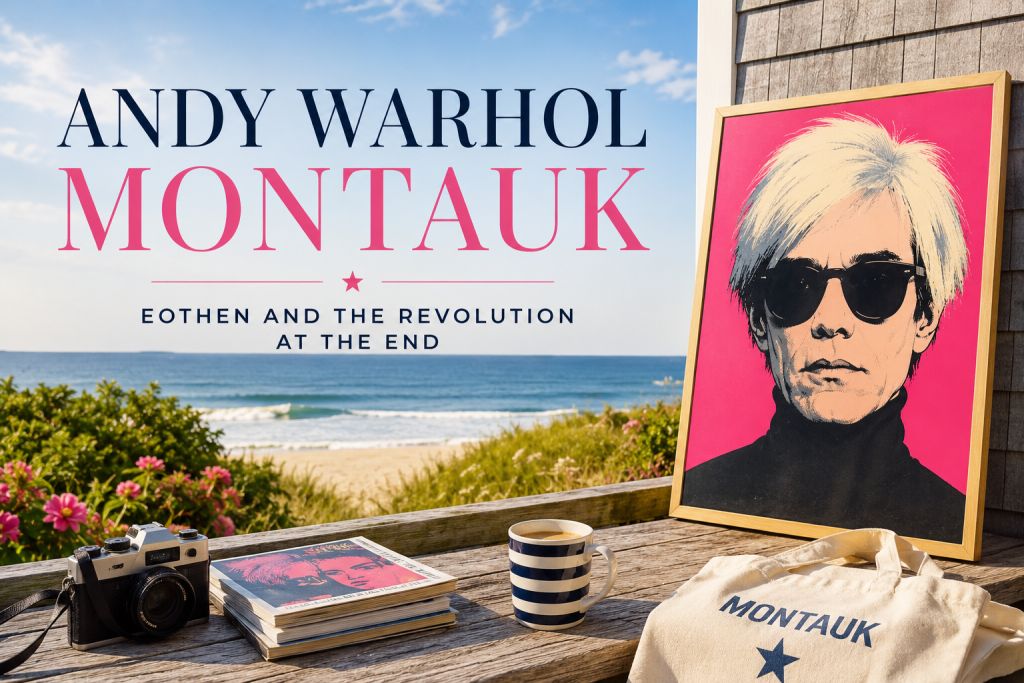
Andy Warhol Montauk is a phrase that sounds like a brand collaboration, and in a way, it was. In 1971, the most famous artist in America bought a compound at the absolute edge of Long Island for $225,000. He named it Eothen, ancient Greek for “at first light.” Over the next sixteen years, he turned it into a private salon where Jackie Kennedy sunbathed, the Rolling Stones rehearsed, and Dick Cavett walked the beach wearing nothing but a cap and shoes. Yet the fish market in town did not adjust its hours. Montauk absorbed Warhol the way it absorbs everything: without performance, without apology, and without particular interest in what he was worth.
This is Spoke #10 of the Montauk Village Dossier, and it covers the cultural mythology that transformed a fishing village into a destination. Because before Warhol, Montauk was simply the end of the road. After Warhol, it became the end of the road where famous people went to disappear.
The Church Estate: Before Warhol
Eothen was not built for art. It was built for fishing and duck hunting. In the early 1930s, the Church family, heirs to the Arm & Hammer baking soda fortune, commissioned architect Rolf W. Bauhan to design a seasonal compound at 16 Cliff Drive. The result was five white clapboard cottages arranged in a loose semicircle on twenty acres of oceanfront bluff. No pretension. No grandeur. Just simple structures at the edge of a cliff, facing east toward open water.
For nearly forty years, the compound served its original purpose. The Churches came in summer, fished, shot ducks, and left. Montauk was still a hamlet of fishermen and lighthouse keepers. The social architecture of the Hamptons existed forty-five minutes west, in Southampton and Sag Harbor, where whaling money and old money had already established the rules. In contrast, Montauk had no rules. It barely had roads. And that was precisely the point.
The Purchase: $225,000 for the Edge of the World
He is forty-two, already the most recognizable artist alive, already the inventor of the Factory and the screen test and the soup can. His silver wig has been photographed more than most faces. He has survived a gunshot wound that nearly killed him three years earlier. Now he is standing on a bluff in Montauk, looking east, and there is nothing between him and Portugal except water. He writes a check. The amount, $225,000, is less than the price of a studio apartment in SoHo in 2026. But in 1971, it buys twenty acres of ocean cliff and five cottages at the literal end of the known world.
Andy Warhol and Paul Morrissey, his manager and film collaborator, purchased the compound together. Morrissey handled logistics. Warhol handled the guest list. Initially, the compound served as a quiet retreat from the Factory’s Manhattan chaos. But quiet and Warhol were never compatible for long. Within a year, Eothen had become what Bob Colacello, longtime editor of Warhol’s Interview magazine, later called “the Factory answer to Hyannisport.”
The Name and What It Meant
Eothen translates from ancient Greek as “at first light” or “from the east.” The name is borrowed from a nineteenth-century travel book by Alexander Kinglake. For Warhol, the meaning was geographic: the compound sat at the easternmost point of Long Island, where dawn arrived before it reached anywhere else in the Hamptons. But the name also carried a quieter resonance. At Eothen, things happened first. Trends that would later define Montauk culture, from celebrity retreats to beach fashion to the art-meets-surf aesthetic, all began here.
The Guest List That Rewrote Montauk
Warhol’s genius was not just artistic. It was social. He understood that proximity creates culture. Specifically, he understood that if you put the right people in the right place at the right time, the place itself transforms. Eothen became a laboratory for this theory.
During the first summer of 1972, Warhol rented the main cottage to Princess Caroline of Monaco and Lee Radziwill, Jackie Kennedy’s sister. Jackie herself visited. Photographer Jonas Mekas captured a young Anthony Radziwill and John F. Kennedy Jr. dancing to a Rolling Stones record inside the cottage. Warhol reportedly joked about installing gold plaques over the beds reading “Jackie Slept Here.” Of course, the joke contained a serious business instinct. Each famous guest elevated the mythology, and the mythology elevated the property, and the property elevated Montauk.
The Full Roll Call
Over sixteen years, the guest list expanded into a who’s-who of 1970s and 1980s cultural power. In addition to Jackie Kennedy and Lee Radziwill, Eothen hosted Mick Jagger, Bianca Jagger, John Lennon, Yoko Ono, Elizabeth Taylor, Liza Minnelli, Halston, Catherine Deneuve, Truman Capote (commuting from nearby Sagaponack), Keith Haring, Julian Schnabel, and photographer Peter Beard. Dick Cavett, the talk-show host, lived next door and was a regular visitor.
Vincent Fremont, who worked for Warhol throughout the 1970s, described the compound as a place where fame dissolved into routine. “Montauk was less populated then,” Fremont recalled. The absence of paparazzi, tabloid photographers, and social media meant that celebrities could exist at Eothen without the performance that Manhattan demanded. Warhol himself was inspired by the light. He created his “Sunset” print series from the view off the Eothen bluffs, capturing the specific orange that the Atlantic produces at dusk on the easternmost point of New York State.
The Rolling Stones at Eothen: Spring 1975
Five men walk into a compound at the end of Long Island. Charlie Watts brings his jazz records. Keith Richards brings a guitar and something stronger. Mick Jagger brings Bianca, who will spend most of her time at a bar in town, opening clams. For five weeks, the Rolling Stones rehearse in Warhol’s living room. Two girls with no hair and black cats on leashes follow them all the way from Manhattan. Mr. Winters, the caretaker, finds them hiding in the bushes.
In the spring of 1975, the Rolling Stones rented Eothen for $5,000 while preparing for their Tour of the Americas and the Black and Blue album sessions. Warhol had a longstanding relationship with the band. He had designed the famous lips logo. He had photographed Jagger’s hips for the Sticky Fingers album cover, complete with a working zipper. When the Stones needed a place to rehearse far from Manhattan’s distractions, Eothen was the obvious choice.
What Happened to the Village
As Warhol later wrote in his diary: “Mick Jagger really put Montauk on the map. All the motels were overflowing with groupies. When Mick went into town everything stopped. Surfers chased him from White’s Drug Store to White’s Liquor Store.” Meanwhile, Bianca Jagger rolled up the sleeves of her Yves Saint Laurent dresses and opened clams at Shagwong Tavern on Main Street. Cavett, their neighbor, once walked the beach entirely nude except for a cap, a scarf, and shoes. Fred Hughes, Warhol’s business manager, discovered him and was reportedly speechless.
At night, the band drifted to the Memory Motel, the only bar in town with a piano and a pool table. The owner was not a fan of the Rolling Stones and was not keen on having them around. Still, they stayed long enough for Jagger to write a song about a woman he met there. “Memory Motel” appeared on the Black and Blue album in 1976. The woman’s identity remains disputed. Carly Simon is the primary suspect, although Jann Wenner of Rolling Stone magazine insisted it was photographer Annie Leibovitz. Jagger offered only this: “The girl in Memory Motel is actually a real, independent American girl.” The Memory Motel still exists and hosts live music on summer weekends.
Peter Beard, the Beach, and the Art That Stayed
Among Eothen’s regular visitors, photographer Peter Beard occupied a unique position. Beard, known for his African wildlife photography and his collage diaries, became a close friend of both Warhol and the Rolling Stones during the 1975 summer. He documented Eothen extensively, producing photographs that remain the primary visual record of the compound during its cultural peak. His images show the Stones on the lawn, Warhol on the bluffs, and the cottages in their original white-clapboard simplicity.
Beard eventually settled in Montauk permanently, living in a camp he built on the grounds of a nearby property. His presence, along with the Warhol legacy, established Montauk as a creative outpost distinct from the social Hamptons. Bridgehampton had its galleries. Sag Harbor had its writers. Montauk, because of Warhol and Beard and the musicians who followed them, had something rawer. The art here was not displayed in white-walled galleries. It was made on cliffs, in salt air, with sand in the camera.
After Warhol: The Estate’s Path Through Money
Warhol died on February 22, 1987, from cardiac arrhythmia following gallbladder surgery. He was fifty-eight. Paul Morrissey inherited the compound and subsequently donated fifteen acres to the Peconic Land Trust, creating the Andy Warhol Preserve, a permanently protected stretch of Montauk moorland. The remaining 5.7 acres, including the cottages, went on the market.
Morrissey listed the compound for $50 million in the early 2000s. It proved a hard sell. The property finally found a buyer in 2007, when J. Crew CEO Mickey Drexler purchased it for $27 million. Drexler hired architect Thierry Despont to renovate the cottages, giving them a polished, catalog-ready aesthetic while preserving the semicircular layout. He also owned an adjoining 24-acre horse pasture called Indian Field. Drexler used the compound sparingly, typically spending August there.
The $50 Million Sale
In June 2015, Drexler listed the entire property, compound plus pasture, for $85 million. By October, billionaire art collector Adam Lindemann was in contract for the 5.7-acre compound alone. The sale closed in December 2015 at $50 million, the most expensive residential transaction in Montauk history. Lindemann, who owns a gallery on Madison Avenue, already had a property nearby on Old Montauk Highway, a home designed by architect David Adjaye. He told the New York Post: “I knew Andy in the early 1980s as a very young man, and I’m a collector of his work. I’m very lucky to have this opportunity.”
The price trajectory tells a clean story. Eothen cost $225,000 in 1971. By 2007, it cost $27 million. In 2015, it cost $50 million. Each transaction reflected not just appreciation but mythology. By contrast, a comparable oceanfront property without the Warhol provenance would likely trade at a fraction of the price. Eothen is not just real estate. It is cultural equity, the Hamptons equivalent of owning the building where the Factory operated on East 47th Street.
What Eothen Means for Montauk Now
She is thirty-nine, a documentary filmmaker based in Tribeca. Every August, she rents a house in Montauk because she needs to “get away from the scene,” she does not realize she is quoting the Warhol playbook; she will eat at Duryea’s on Friday, watch surfers at Ditch Plains on Saturday, and tell friends the village feels “authentic.” She is not wrong. But the authenticity she perceives was manufactured, at least in part, by a man who made his career manufacturing images.
Warhol’s influence on Montauk is both direct and atmospheric. Directly, Eothen established the precedent that the end of Long Island could function as a retreat for the cultural elite. Before 1971, no prominent artist or celebrity had chosen Montauk as a base. After Warhol, the pipeline opened. The Surf Lodge, which Jayma Cardoso opened in 2008 as a motel-turned-cultural-venue, operates on the same principle: if you bring the right people to the end of the road, the road becomes a destination.
Atmospherically, Warhol gave Montauk permission to be simultaneously casual and significant. Southampton requires formality. Sag Harbor requires literary credibility. Bridgehampton requires visibility. Montauk requires nothing, and that permission traces back to a man who wore a silver wig to a fishing village and was accepted anyway. The fish market on the dock did not care that Warhol was famous. Equally important, Warhol did not care that the fish market did not care. That mutual indifference became the template for how Montauk relates to fame.
The Andy Warhol Preserve
The fifteen acres that Morrissey donated to the Peconic Land Trust in the late 1980s now operate as the Andy Warhol Preserve, a publicly accessible stretch of moorland, wildflower meadow, and ocean bluff. The preserve sits adjacent to Eothen and connects to the network of trails and open spaces that define Montauk’s eastern tip. No entrance fee. No programming. Just land, protected permanently from development, carrying the name of a man who spent sixteen summers looking at it from his cottage window.
In a way, the preserve is the most Warhol thing in Montauk. Andy Warhol built his career on reproduction, on multiples, on the idea that an image gains power through repetition. The preserve cannot be reproduced. It exists once, at the edge of the continent, and it will exist in its current form long after the cottages are renovated again and the ownership changes once more. This is perhaps the deepest irony of the Andy Warhol Montauk story. The artist who mass-produced culture left behind the one thing in Montauk that cannot be mass-produced: open land.
Where the Conversation Continues
Social Life Magazine has covered the East End for 23 years, five summer issues and 25,000 copies per run from Memorial Day through Labor Day, Westhampton to Montauk. We understand that the right story, told at the right time, changes how people see a place. If you are reading this, you already know that.
For brands, practitioners, and tastemakers who want to be featured in the publication that the East End actually reads: explore our paid features program. This is how you become part of the record.
Polo Hamptons 2026 returns July 18 and 25 at 900 Lumber Lane in Bridgehampton, forty minutes west of Eothen, with BMW North America as title sponsor and Christie Brinkley as host. Details and sponsorship inquiries at polohamptons.com.
Subscribe to Social Life Magazine: sociallifemagazine.com/subscription.
The sunset at Eothen still arrives before it reaches anywhere else in the Hamptons. Some things Warhol did not have to invent.
Author

Written by
Recent Posts

AI for personal finance: where PennyGuard fits

How to Pick a Homecoming Dress for Your Body Type (and Feel Amazing in It)
World Cup Injury Attorney for Vancouver Events
What a 3-Carat Engagement Ring Actually Costs in 2026: The Real Numbers
The Skincare Habits That Make a Real Difference Over Time
Categories
- Art
- Articles
- Business of Luxury
- Celebrities
- Culture
- Entertainment
- Events
- Faces of Summer 2026
- Fashion
- Fashion & Style
- Featured
- Finance
- Food, Spirits, Wine
- Hamptons
- Hamptons Celebrities
- Health
- Health & Beauty
- Lifestyle
- Luxury Lifestyle
- Press
- Profiles
- Real Estate
- Technology
- The Chronicles
- Travel
- Uncategorized
- Weddings