
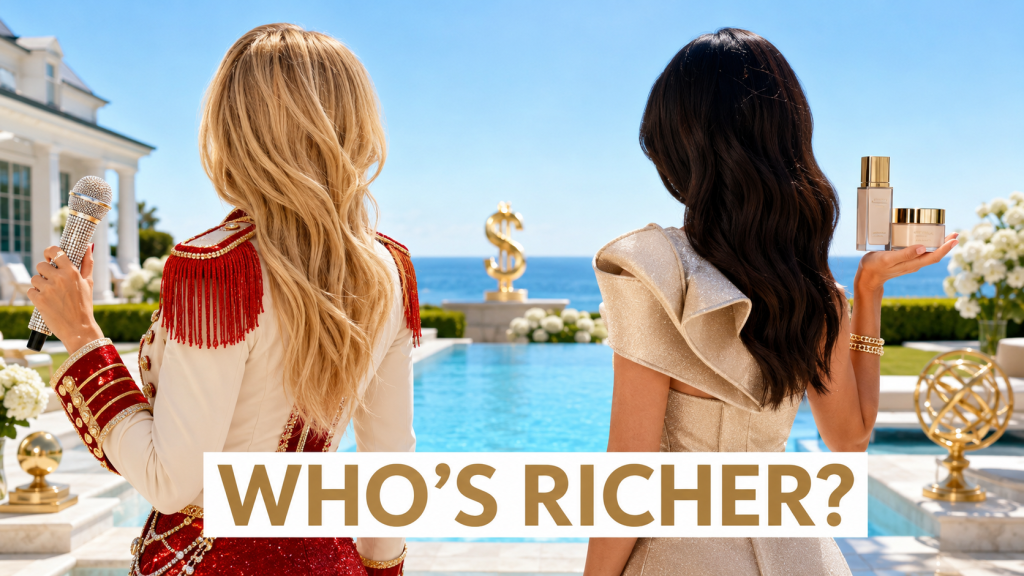
On March 11, 2026, Forbes published its new billionaires list, and a seventeen-year argument quietly closed. Taylor Swift came in at $2 billion. Kim Kardashian came in beneath her, at roughly $1.9 billion. So the Taylor Swift vs Kim Kardashian question, born on an awards-show stage in September 2009, finally has a scoreboard that neither publicist can spin. Not followers, not headlines, not Grammys. A ledger.
For the people who read Social Life Magazine, this is not gossip. It is a case study in the two dominant ways American fame converts to money. One woman sold tickets and songs, in public, one transaction at a time. The other sold equity, in private, one term sheet at a time. Both routes end at ten figures. Yet only one of them holds the higher number right now, and the reasons why are worth taking apart line by line.
The Headline Numbers: Swift at $2 Billion, Kardashian at $1.9 Billion
Start with the official arithmetic. Forbes pegs Swift at $2.0 billion in 2026, the first performer to reach that mark purely on music and touring. Kardashian sits just under her, with most 2026 estimates clustering around $1.9 billion. The gap is roughly $100 million, about five percent, close enough that both camps checked the math twice.
Kardashian’s number is not small money in decline. In fact, her figure grew over the past year, because Skims raised $225 million in November 2025 at a $5 billion valuation, in a round led by Goldman Sachs. Her reported stake of about 35 percent marks out at roughly $1.75 billion on paper. Add the real estate, the Hulu money, the SKKN line, and the private equity firm, and you get her total.
Swift simply grew faster. The Eras Tour closed in December 2024 as history’s first $2 billion tour, per Forbes billionaires accounting. Then she bought back her first six albums’ master recordings in May 2025, a deal reported around $360 million, and released The Life of a Showgirl in October 2025 to the biggest sales week of the modern era. Where she ranks against every other famous fortune is mapped in the 2026 celebrity net worth rankings. Short version: nobody in entertainment moved money that fast.
How Each Fortune Is Built: Catalog and Touring vs Equity and Licensing
The Taylor Swift vs Kim Kardashian comparison only gets interesting when you open the hood. These are not two versions of the same fortune. They are opposite machines that happen to print similar totals. One machine converts feelings into receipts. The other converts visibility into valuation. Understanding the difference is, in fact, the entire sport of reading a billionaires list correctly.
Swift’s Side: Tickets, Catalog, and Owning the Product
Swift’s wealth is a royalty machine she now owns outright. The Eras Tour grossed $2.077 billion across 149 shows, and she famously took no outside tour sponsor. The concert film went around the studios entirely, straight to AMC, and grossed over $260 million. Streaming pays her monthly. Publishing pays her forever, because she wrote or co-wrote everything.
Then came the masters deal. In May 2025 she bought back the original recordings of her first six albums from Shamrock Capital, reported at roughly $360 million. As a result, every stream of every era now flows to her, not to a fund. Our earlier Taylor Swift net worth profile, filed when the figure read $1.6 billion, aged out within a year. The full anatomy of the climb sits in how Taylor Swift reached $2 billion. What matters here is the structure: no partners, no board, no dilution.
Off the stage, the assets look old-fashioned. Forbes has credited her with more than $110 million in real estate, spanning Tribeca, Beverly Hills, Nashville, and the Watch Hill bluff in Rhode Island. Everything sits in her own name, bought with cleared cash. That detail becomes the whole argument two sections down, because liquidity is the real divider in this matchup.
Kardashian’s Side: Equity, Licensing, and the Term Sheet
Kardashian’s fortune, by contrast, is a portfolio of stakes. Skims, co-founded in 2019 with Jens Grede, is the anchor: a $4 billion valuation in 2023 made her a billionaire, and the $5 billion Goldman-led round in November 2025 extended the lead. NikeSKIMS, the activewear line launched with Nike in 2025, bolted a $100 billion distribution partner onto her label. That is the trade in one sentence.
Around the anchor sit the satellites. SKKN by Kim in beauty. SKKY Partners, the private equity firm she co-founded with former Carlyle partner Jay Sammons in 2022. The Hulu contract, the All’s Fair legal drama, and, since December 2025, an actual California bar card, because she passed the attorney’s exam after a six-year apprenticeship. It is the same playbook that built Rihanna’s Fenty fortune: rent your name to operators, keep the equity, let the valuation do the compounding.
The operating numbers support the mark. Skims has reported annual sales north of $1 billion, along with profitability, which is why Goldman priced the round. In addition, the licensing layer pads her downside: Nike carries the NikeSKIMS inventory risk, and Coty paid $200 million for a piece of her beauty business back in 2020. Her genius was never product. It was renting distribution while keeping the cap table.
Liquidity vs Paper Wealth: Cash Receipts Against Private Marks
Here is where the Taylor Swift vs Kim Kardashian ledgers stop being comparable, and where your private wealth advisor would start asking questions. Swift’s $2 billion is unusually liquid for a celebrity fortune. Tour settlements cleared years ago. Royalties arrive as cash, quarter after quarter. Her catalog is a hard asset she could sell tomorrow at auction, although she spent six years proving she never will.
Kardashian’s $1.9 billion is mostly a mark, not a balance. Specifically, about $1.75 billion of it is a minority stake in a private company, priced by the last investor willing to write a check. Private valuations are real until they are not; ask anyone who held consumer-brand paper marked at 2021 prices. Until Skims exits through an IPO or a sale, the wealth exists the way a Hamptons appraisal exists, impressive and unspendable in equal measure.
None of this makes Kardashian’s number fake. Goldman Sachs does not price sentiment, and Skims sells actual product at scale. Still, the distinction matters, and it is the first thing the methodology in our celebrity net worth guide teaches: a dollar of tour revenue and a dollar of private-company mark are cousins, not twins. Swift could wire her fortune. Kardashian, for the most part, would have to negotiate hers.
There is a wealth psychology reading here that lands close to home. Every founder reading this holds some version of the Kardashian position, a paper mark that feels like money and spends like nothing. Swift’s position is the one they envy: already converted, taxes paid, no exit required. So the pop star, oddly, runs the more conservative balance sheet. Nobody at the 2016 snake party would have predicted that sentence.
The 2009 VMA Moment: Celebrity’s Longest Subplot, Settled in Dollars
Every rivalry needs an origin scene, and this one has the most replayed thirty seconds in awards history. September 13, 2009, Radio City Music Hall: Kanye West takes the microphone from a nineteen-year-old Swift mid-speech. Kardashian was not on that stage. But she married West in 2014, and by 2016 the feud had become community property.
The 2016 sequence is now a business-school case in reputational warfare. West released Famous with a lyric claiming credit for Swift’s fame. Swift objected, and then Kardashian posted edited call footage to Snapchat that July, detonating #TaylorSwiftIsOverParty and a global snake-emoji pile-on. Swift disappeared for a year. She returned with Reputation in November 2017, which sold 1.2 million copies in week one, built on the snake imagery her enemies handed her.
The postscript ran long. In 2020 the full phone call leaked, and it largely supported Swift’s account. Kardashian filed for divorce from West in 2021. By 2026 the two women occupy adjacent lines on the same billionaires list, with Swift on top. Seventeen years of subplot, ultimately settled not by an apology but by a ranking. In this economy, that counts as closure.
Both women, notably, made money on the war. Reputation became a stadium tour that grossed $345 million, then a Netflix special. Kardashian’s audience spiked with every news cycle, because attention was always her raw material. Feuds usually read as costs on a career. For these two, the fight worked as free marketing that neither could have bought at any price.
The Fame-to-Money Conversion Rate: Who Monetizes Attention Better
Strip the feud away and you are left with the real question: who converts a unit of fame into a dollar more efficiently? Both women are elite at it, but the exchange rates work differently. Swift monetizes devotion at retail. Millions of people paid face value, then resale markups, then bought four vinyl variants of the same album. The Life of a Showgirl reportedly moved about four million units in its first week because the audience treats purchasing as participation.
Kardashian monetizes reach at wholesale. Her 350 million Instagram followers are not customers so much as proof of distribution, the slide that justifies the valuation. She converted twenty years of being watched into shapewear margins, a Nike partnership, and a Goldman-priced cap table. Pop money is earned in public, one confessional song at a time. Equity money is earned in conference rooms, and the audience only hears about it in a press release.
The family infrastructure matters too. Kris Jenner has taken a reported 10 percent management commission on her children’s deals since the show began, which makes the Kardashian operation a fund with one general partner. Swift’s equivalent is a Merrill Lynch father and a famously small inner circle. Different org charts, same discipline: nothing leaks, nobody freelances.
Notably, the second model is now the template. Selena Gomez’s Rare Beauty windfall runs the Kardashian play, not the Swift one, and so does nearly every name on our list of the richest female musicians of 2026. Swift is the exception that outperformed the template. That is precisely what makes the comparison worth reading.
Taylor Swift vs Kim Kardashian by 2030: Who Wins the Decade
Now the forward-looking part, the section your wealth manager would skim first. Swift’s path to a bigger number is boringly durable. Her catalog compounds whether she works or not, since she now owns every layer of it. Any future tour clears a billion dollars gross, if she chooses to stage one. There is no cap table to dilute her and no consumer cycle to survive.
Kardashian’s path is steeper but has a bigger single payoff. A Skims IPO at, say, $10 billion could vault her past Swift in one filing, especially with NikeSKIMS scaling through 2027. The risk runs the other way too, because shapewear is a consumer category, and consumer marks deflate faster than song catalogs. Her fortune has more variance in both directions, which is exactly how private equity people like it.
The sober call: Swift stays ahead through the decade unless Skims prices a spectacular exit. The broader scoreboard, from Beyoncé’s touring machine to the moguls in our music industry net worth rankings for 2026, says the same thing. Owned catalogs are the new blue chips. Meanwhile, everyone measuring themselves against either woman should notice what they share: neither waited for permission to own the asset.
One wildcard sits outside both spreadsheets: cultural staying power. Swift is 36, engaged to Travis Kelce since August 2025, with a wedding coming that will be the decade’s biggest earned-media event. Kardashian is 45, a licensed lawyer, and edging toward institutional respectability. Attention ages differently than catalogs do. By 2030 the sharper question may not be who is richer, but which fortune still requires its owner to stay famous.
Where The Conversation Continues
The Swift and Kardashian ledgers will get re-marked, but the conversation about what fame is worth happens in rooms, not comment sections. Social Life Magazine hosts those rooms. The print issue circulates through the houses where the term sheets get discussed over rosé, and the summer calendar runs from Memorial Day through Polo Hamptons in Bridgehampton, where at least one guest usually has a Skims-adjacent cap table story they will only tell in person. Our full pop girl billionaires series maps every fortune in this class. Meanwhile, the July issue is being set now. The people in it already know.
Author

Written by
Recent Posts

Planning an Arizona Road Trip? Practical Details to Handle Before You Leave

Short Homecoming Dresses That Feel Polished, Not Overdone
Men’s Health After 40: Important Changes to Pay Attention To
What You Need to Know About Spray Tanning

Simple Ways to Upgrade Your Summer Drink Routine
Categories
- Art
- Articles
- Business of Luxury
- Celebrities
- Culture
- Entertainment
- Events
- Faces of Summer 2026
- Fashion
- Fashion & Style
- Featured
- Finance
- Food, Spirits, Wine
- Hamptons
- Hamptons Celebrities
- Health
- Health & Beauty
- Lifestyle
- Luxury Lifestyle
- Press
- Profiles
- Real Estate
- Technology
- The Chronicles
- Travel
- Uncategorized
- Weddings