
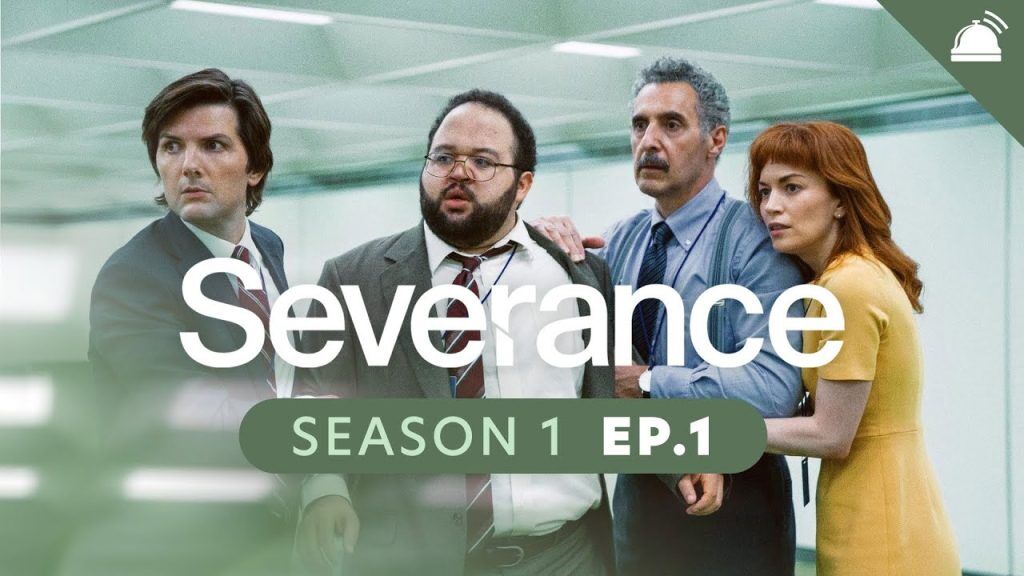
A meditation on identity, grief, and corporate theology. Specifically, nine hours of television. One very specific American madness. With footnotes, because some things require footnotes.
This Severance season 1 analysis opens where the show does. Consider a moment in the second episode. Mark Scout sits alone at a steakhouse table. Apple TV+’s psychological thriller — now the platform’s most-watched series in history — earns its reputation here. Notably, a little sign reads VIP Area.
Three years after its 2022 premiere, the show remains the rare prestige event people actually argue about at dinner. Additionally, Adam Scott plays him with quiet devastation, eating a meal the company bought as compensation for a workplace injury. Still, the camera holds. Food is on the table.
Yet Scott does absolutely nothing with his face except exist. Indeed, that turns out to be the most devastating acting choice available. The whole show — every corporate mystery, every sci-fi conceit, every philosophical gut-punch — is asking one question. Consequently, this shot is where it first gets asked out loud: Is this enough?
Ultimately, the answer is complicated in the way only the truth can be. This Severance season 1 analysis goes episode by episode through why — and what each episode reveals about that cost.
Severance Season 1 Analysis: What the Show Actually Is

For this Severance season 1 analysis, here is the premise. Severance was created by Dan Erickson and directed by Ben Stiller — yes, that Ben Stiller. Specifically, Lumon Industries offers its employees a procedure. Furthermore, it surgically divides their memories between work and personal life. Consequently, the “innie” wakes at the elevator each morning knowing nothing of the outside world. Meanwhile, the “outie” clocks out each evening with zero memory of the job. Two identities. One body. No negotiation.
The genius, and also the specific cruelty, of this premise is that it is not science fiction. Rather, it is diagnosis. Every person who has smiled at a Monday meeting while something in them quietly died already understands what severance is. Moreover, they have been doing it, more or less voluntarily, for years. Indeed, the chip Lumon installs is just the honest version of the thing we all agreed to without being asked.
Accordingly, what follows is a Severance season 1 analysis of all nine episodes — each one a little more unsettling than the last — written in the spirit of a certain maximalist American novelist. He understood that the most complex human experiences require both surgical precision and the willingness to follow a thought wherever it actually goes, even into the footnotes, even into the margins, even into the places we tell ourselves are beside the point but which are, inevitably, the point.
Episode 1: “Good News About Hell”

The White Room
A woman lies on a conference table. Everything is white — walls, ceiling, floor. Yet one door exists, and it is locked. A voice comes through an intercom — friendly, practiced, the tone of someone who has done this before — and asks a series of questions. The first question is: Who are you?
She cannot answer. This, the voice tells her, is a perfect score.
Notably, this is how Severance begins, and it is also how a great deal of adult professional life begins: an institutional structure assures you that your inability to define yourself is an asset. Your blankness is hireable. The fact that you don’t quite know who you are yet is precisely why you’ll fit in here.
Britt Lower as Helly R.
The woman is Helly R., played by Britt Lower, who before this earned recognition through the Hulu series High Maintenance and several independent films. In those earlier roles, she specialized in intelligent, slightly guarded warmth. Yet none of that warmth appears in the first thirty seconds here. Instead, Lower performs the experience of having no past — not amnesia as tragedy, but amnesia as beginning. Initially, her eyes are open and completely empty, like a browser tab that hasn’t loaded, and then something flickers. The fighting starts.
Helly will fight the entire season. Furthermore, note it.
Adam Scott as Mark Scout
Meanwhile, on the other side of the elevator — the show’s central architectural metaphor, threshold between the two selves — Mark Scout is crying in a parking lot. His car is practical. Meanwhile, the lot is normal. He wipes his face, checks the clock, and gets out. By the time he reaches his desk, something has shifted. Notably, his grief, enormous and rooted in the death of his wife Gemma in a car accident, does not travel past the elevator. His innie self carries no wife to grieve. For a while — this is the part that requires sitting with — this arrangement seems like it might actually be working for him.
Adam Scott spent two decades as the smartest guy in whatever room comedy writers placed him. Ben Wyatt in Parks and Recreation. Derek in The Good Place. Henry in Big Little Lies. Furthermore, Scott’s face carries a particular quality — analytical, slightly incredulous, perpetually calculating whether what’s happening in front of him is real. Consequently, that makes him the ideal vessel for Mark Scout. Consequently, Mark keeps arriving, episode after episode, at the conclusion that things are worse than he thought.1
“The chip Lumon installs is just the honest version of the thing we all agreed to without being asked.”
The Architecture of Lumon
Additionally, this episode establishes Lumon’s full architecture efficiently. Clearly, Stiller trusts his audience to keep up. The severed floor is fluorescent and geometrically perfect. Hallways stretch impossibly long. The break room is a narrow corridor with a single chair and a single sheet of paper that you read until you mean what it says. The perpetuity wing holds portraits of the Eagan family lineage — a corporate hall of saints. Kier Eagan, the founder, appears everywhere: in maxims, in framed photographs, in the hushed reverence of every manager who invokes his name with the tone reserved for deities and quarterly earnings calls.
Ms. Cobel, Mark’s boss, enters simultaneously as his workplace superior and his next-door neighbor, Mrs. Selvig. Patricia Arquette deploys the reveal with precision. Arquette won an Oscar for Boyhood. She became a cultural touchstone in The Act, playing DeeDee Blanchard with terrifying cheerfulness. Consequently, she brings that same quality here: the load-bearing smile, the kindness with an agenda, the warmth you’d swear was real until you can’t swear anything at all. She is Lumon’s most loyal instrument. Furthermore, she is also the show’s most unsettling presence. Her devotion is genuinely felt. Notably, she believes.
We do not know what she believes yet. Ultimately, that is the whole point of this episode. We are Helly. We just woke up. The first question is: Who are you? And the show gives us forty-seven minutes to establish that none of these people can fully answer it — which means we are exactly where we need to be.
Read more: Adam Scott Net Worth, Origin Story, and Where He Is Now | Patricia Arquette: From True Romance to Apple TV Villain
Episode 2: “Half Loop”

The Loop With No Exit
Helly tries to quit. She cannot quit. The orientation video — of herself, her outie self, filmed before severance, cheerfully consenting — is the show’s first genuinely vertiginous moment. It presents a loop with no exit: the only person who can consent to your freedom is the person who put you here, and she already said no.
Notably, legal and philosophical implications occupy a very specific type of Reddit thread, and the show knows this. However, the show refuses to resolve it, because resolution is not the point. The feeling of the trap is the point. That feeling is precise and familiar — it explains why the professional class, the people who gave their best years to buildings they don’t own, watches this show with a recognition that sitcoms about work never quite generate.
Reintegration and Its Cost
Outside the building, Mark’s outie encounters Petey Kilmer — his former colleague. Specifically, he has undergone a dangerous, experimental reversal of the severance procedure. Petey is deteriorating. The two reintegrated identities fight for control of a brain designed to keep them separate, and the result is a man lucid in flashes and haunted between them. Indeed, he is the show’s canary. Additionally, he is the first proof that the severance barrier isn’t merely corporate policy. Break it, and the self begins to break with it.
John Turturro as Irving
Consequently, Irving emerges more fully here as a character rather than a presence. John Turturro plays him with the dignity of a man who has decided that the world’s meaning is best found in procedural fidelity — in knowing the rules, following them, trusting that a well-maintained system constitutes a kind of grace. Turturro spent forty years playing men at the edge of obsession. Barton Fink dissolved under artistic pressure. The Coen Brothers’ tortured intellectuals followed. Then came the baroque loyalists of The Night Of. Irving Bailiff is the gentlest version of that archetype. Turturro plays his peace inside Lumon’s structure with a tenderness that makes the coming revelations — Irving’s subconscious bleeding into oil paintings of a dark hallway, reproduced again and again at home — land with weight that pure narrative mechanics could never achieve alone.
Zach Cherry as Dylan
Dylan, introduced more fully here, occupies Zach Cherry’s territory. Cherry specializes in comic timing that disguises intelligence as laziness — notable appearances in Silicon Valley, Succession, and You — and Dylan George is the show’s most deliberately opaque early character. He pursues office perks — finger traps, melon parties, the coveted waffle party. Initially, this reads as shallow. By contrast, that shallowness eventually reveals something more interesting: a man who, given a self with no past and no future, has constructed a value system entirely from available materials. Yet when tested, he proves capable of something very close to heroism.
Read more: John Turturro Net Worth: The Character Actor Who Became a Legend
Episode 3: “In Perpetuity”

Lumon’s Cathedral
They take Helly to the perpetuity wing.
The perpetuity wing is Lumon’s cathedral. Portraits of the Eagan family — six generations of executives with the formal gravitas of a papal lineage — cover the walls in oil paint and gilt frames. Additionally, plaques line one wall. Display cases hold artifacts of the company mythology. Furthermore, reverence hangs in the air — so carefully manufactured it has curdled into something theological. The MDR team receives it with the particular discomfort of people asked to feel something they have never been given the vocabulary for.
Consequently, this episode makes explicit what the first two only suggested: Lumon is a religion. Kier Eagan is its god, his descendants its priesthood, his employees its congregation, the severed floor its monastery, and the procedure itself its sacrament. The framing is not subtle, and it is not meant to be. Ben Stiller lingers on these portraits with the same patience he gives to the fluorescent hallways — too long, deliberately, until the discomfort becomes information.
Visual Grammar: Warm Outside, Cold Inside
Outside, Petey is getting worse. Mark’s outie sits with him in a diner. The light is warm and ordinary — the exact opposite of Lumon’s fluorescence. This contrast, warm outside and cold inside, chaotic human world against perfect institutional world, becomes the show’s visual grammar for the rest of the season.2 Meanwhile, Mark listens to Petey describe reintegration, and his face does the thing Adam Scott’s face does throughout this show: receive information while visibly calculating the cost of acting on it.
Tramell Tillman as Milchick
Helly, back on the severed floor, continues fighting. She tries to send messages to her outie by writing on her body. Milchick intercepts them. This is where Tramell Tillman’s performance begins its long negotiation with audience sympathy. He is clearly an agent of institutional cruelty. Simultaneously, he is a human being navigating a system that rewards compliance and punishes doubt. Before Severance, Tillman built his resume through supporting roles in Elementary and Barron’s Cove. Here, however, he gives Milchick a quality that resists a single name: the bureaucratic warmth of a man who genuinely enjoys his work and is genuinely working for something genuinely wrong, simultaneously, in every scene.
“Lumon is a religion. Kier Eagan is its god, his descendants its priesthood, his employees its congregation.”
The perpetuity wing tour ends with Helly smiling for the required photograph. It is the episode’s final image: a woman who has been fighting for her freedom since the first frame, finally, temporarily, performing the compliance that is all anyone here has ever actually asked of her. The smile does not reach her eyes. Ultimately, this matters less than the fact that it doesn’t need to.
Episode 4: “The You You Are”

Ricken’s Book and the Revolution It Starts
Ricken Hale’s self-help book arrives on the severed floor. The You You Are — a maximally earnest manifesto of the type that the professional intelligentsia has trained itself to condescend to — begins to do its work. Consequently, Mark’s innie reads it in secret. The prose is terrible. The ideas are obvious. Inside Lumon’s hermetically sealed theology of pure labor, however, they are revolutionary.
Michael Chernus plays Ricken with the brave specificity of a character actor who understands there is nothing more difficult than playing a man who is genuinely sincere, genuinely a little ridiculous, and genuinely correct about the things that matter. Chernus lands Ricken’s secular spirituality — the guy at the party who genuinely means it — without condescension and without false endorsement. That is the hardest tone to hold, and the one the show requires of him.
Helly’s Video: Television’s Most Devastating Monologue
Outside, Helly’s outie sends a video message to Helly’s innie. That message is the most devastating piece of writing in the first season — possibly in the history of prestige television workplace drama. Instead, the outie speaks with measured corporate affect. It barely conceals contempt, or despair, or both. The innie’s suffering, she explains, does not constitute a claim. Furthermore, the outie has decided to continue the procedure. Moreover, the innie’s experience is not the thing that counts. Work, the message concludes, will resume now.
Britt Lower plays Helly’s response with one of the great silent performances of recent television. Her face moves through states too fast for a single emotional label, arriving somewhere past anger and past grief and not yet acceptance — somewhere that people who have been told by an institution that their suffering is administrative rather than real will recognize immediately and viscerally.
Patricia Arquette at a Funeral
Mark, meanwhile, attends Petey’s funeral. Mrs. Selvig — Cobel, unsevered, playing neighbor, playing human — accompanies him. Patricia Arquette keeps Cobel’s surveillance mission and her genuine, complicated affection for Mark in simultaneous operation throughout this scene. The actress who played the mother in Boyhood, crying at a kitchen table because her life moved too fast, now does the opposite thing: she plays a woman whose life has been entirely subordinated to an institutional loyalty she mistakes for meaning. Arquette carries both versions of that woman in the same face, in the same scene, without commentary. It is exceptional work.
Read more: Patricia Arquette: True Romance to Oscar to Apple TV Villain — The Full Arc
Episode 5: “Hide and Seek”

The Institution Sees a Procedure Problem
Helly tries to hang herself with a printer cord.
The show does not cut away. Stiller frames it with the same visual grammar as everything else on the severed floor — fluorescent, geometric, clean — which is the correct and terrible choice, because the clinical framing is the point. The environment that produces this act cannot register it as tragedy. Instead, Milchick processes it as an HR incident. Similarly, Cobel processes it as a liability. The institution sees a problem with a procedure, not a person in crisis, because the institution built itself to see exactly that and nothing more.
Consequently, this episode drops the subtext entirely. The severed floor is not a neutral space. Indeed, corporate neutrality is a fiction. Furthermore, the procedure that lets a person opt out of their own suffering while their innie absorbs it is not a benefit. It is an outsourcing arrangement with the human soul as the commodity.
Christopher Walken as Burt Goodman
Meanwhile, on the outside, the discovery of the Optics and Design department — and the revelation that O&D contains a room full of baby goats — introduces the show’s secondary register: comedy of the specific variety only genuine absurdism produces. Not jokes, but situations so precisely wrong that laughter is the only available response that doesn’t require calling someone.3 Christopher Walken appears more fully here, as Burt Goodman of Optics and Design. White-haired, deliberate, possessed of a gentleness so absolute it seems structural — like the building itself might lean toward him.
Walken has been many things in forty years of film. He has been a man who needs more cowbell and Max Shreck and the most terrifying figure in The Deer Hunter. Additionally, he has been the most melancholy figure in Annie Hall and the most charming man at any given awards ceremony by a considerable margin. What he brings to Burt, however, is something none of those roles quite accessed: achieved serenity that reads as wisdom rather than passivity. Eventually, he falls in love with Irving Bailiff across their departments’ forbidden boundary with a naturalness suggesting this is simply what humans do when you leave them alone long enough.
Read more: Christopher Walken Net Worth: Five Decades of Being the Most Interesting Person in the Room
Episode 6: “The Grim Barbarity of Optics and Design”

The Show’s Only Voluntary Relationship
Irving and Burt fall in love across a conference table, and it is the most quietly radical thing the show does.
Not because Irving is gay, though Turturro brings such specificity to Irving’s desire — careful, embarrassed by its own intensity, educated by decades of self-management into a fluency with restraint — that “representation” feels like entirely the wrong word for what’s happening. Rather, the love story between Irving Bailiff and Burt Goodman is the show’s only purely voluntary relationship. Everything else at Lumon is institutional, procedural, managed. Consequently, two people choosing each other inside a space where choice has been comprehensively eliminated — and succeeding — is the season’s only unambiguous mercy.
Turturro and Walken Together
Turturro and Walken share scenes with the ease of two men who have collectively been doing this for eighty years. They know every shortcut. Yet they take none of them. Subsequently, Subsequently, Irving visits Burt’s department and sees the O&D mural. It depicts MDR employees as villains in a mythological narrative. Naturally, this should cause conflict. Instead, it causes Irving, against his own considerable will, to be charmed. Two minutes of reaction work contains more about these people than most scripts deliver in a full season.
The Outside World as Contrast
Outside, Mark’s outie world continues to expand. Notably, his sister Devon is pregnant. Furthermore, her husband Ricken is earnest, slightly annoying, and ultimately correct. The domestic scenes of the outie world carry a warmth that is clearly deliberate — production design slightly softer, color temperature slightly higher, camera slightly less static. However, they do not read as unambiguously better than the severed floor. They read as messier. They read as more. The show is not making the argument that the outside world is paradise. It argues that the outside world is yours.
Episode 7: “Defiant Jazz”

Dylan Wakes Up
Dylan wakes up inside his outie’s body, in his outie’s home, and a small child runs into the room and calls him Daddy.
The Overtime Contingency is the show’s structural masterstroke. This emergency protocol allows innies to activate inside their outies’ bodies. It simultaneously reveals that the barrier between innie and outie is more permeable than anyone understood, and personalizes the abstract horror of severance with a single image requiring no explication. A man who did not know he had a son now knows. He stands in a house at midnight, looking at evidence of a life he has never lived. He cannot keep it.
Zach Cherry Carrying the Weight
Zach Cherry, whose comedic precision has always lived in the gap between what a character says and what they mean, receives something here that Silicon Valley and his various film appearances never required: a full emotional landscape deployed fast, under pressure, in the dark. Specifically, innie Dylan cannot betray his presence. Moreover, he cannot be discovered. He cannot feel too much. Ultimately, that constraint becomes the scene’s central tension. Cherry holds it with the precision of someone who has spent twenty years building exactly this muscle without knowing it would be needed here.
The MDR Team Begins to Organize
Back on the severed floor, the MDR team starts organizing. Ricken’s book has done its work. Helly’s attempted escape, Irving’s growing unease, Dylan’s new knowledge of his son — each of them arrives, by different routes, at the same conclusion. Ultimately, something is wrong here that knowing the rules cannot fix. Mark S., who has believed in the work and the institution and the procedure’s fundamental neutrality longer than any of them, is the last to be convinced. He has the most invested in the conviction that surrendering the grief was an acceptable trade.
“A man who did not know he had a son now knows. He looks at evidence of a life he has never lived and will not be able to keep.”
Episode 8: “What’s for Dinner?”
The Photograph
Mark’s outie tapes back together a photograph.
He had torn it in half earlier in the season — a picture of his wife Gemma, who died — and now, reassembled, she looks back at him with the specific quality of the dead: absolute presence and absolute absence simultaneously. Mark’s outie stares at the photograph. So does the audience — seven episodes of watching Ms. Casey in Lumon’s basement suddenly reconfigured in two seconds. Something that was always true arrives now. The show placed it in plain sight and surrounded it with enough other information that we managed not to see it. That is the cruelest kind of reveal.
Consequently, Gemma Scout is Ms. Casey. His wife is alive. She is in the basement. Furthermore, she has no idea who she is.
Dichen Lachman as Ms. Casey
Dichen Lachman plays Ms. Casey with a troubling stillness. Not the stillness of peace, but the stillness of radical incompleteness — a person whose interiority has been so thoroughly managed that what remains barely qualifies as personality. Lachman’s range spans the ferocious physicality of Dollhouse to the cool menace of various action-adjacent roles. Here, however, she plays someone who has been reduced to minimum viable human software. Her moments of warmth land as both genuine and terrible. Lumon took something from her to produce them, and the cost shows.
Reghabi and the Security Card
Meanwhile, Dr. Reghabi — ex-Lumon scientist, architect of reintegration, now operating outside the institution’s reach — meets outie Mark in the dark. She kills Doug Graner, head of security, with complete matter-of-factness. Indeed, the show earns this: Lumon has committed violence so comprehensive that Graner’s death registers as proportionate rather than shocking. Subsequently, Reghabi hands Mark a security card and tells him his innie will know what to do with it.
Consequently, this is the episode where the season’s machinery locks into place with the satisfying click of a well-made thing. Every thread — Irving’s painted obsession, Dylan’s son, Helly’s discovered identity, Mark’s photograph — has arrived at the same destination. The barrier between who you are at work and who you are at home is not neutral, not harmless, and not, ultimately, survivable.
Episode 9: “The We We Are”

The Escape
The innies escape the floor.
Dylan holds the levers of the Overtime Contingency in both hands — the mechanism that activates innies in their outies’ bodies — and the show deploys its masterstroke. Four people who have never experienced the outside world suddenly inhabit their own bodies at a party, at a house, on a street. They encounter evidence of lives that belong to them and also do not belong to them. They have approximately twenty minutes before Milchick finds the security breach and sends them back.
Britt Lower at the Podium
The sequence is the finest television of 2022 and arguably of the decade so far. Helly stands at a Lumon gala podium, her outie’s speech cards in her hands, surrounded by the institutional power that created and maintains and profits from the procedure. Instead, she delivers the truth that no one in that room agreed to hear. The full force of a woman who has been fighting since the first frame is behind every word. Britt Lower’s face in this scene is a complete performance history and a complete character arc. It is a ninety-second argument about what happens to a self told it doesn’t count.
Irving at the Door
Irving finds Burt’s house. Burt has a husband. Irving stands on the porch in someone else’s body, looking at the life of the man he loves. John Turturro does nothing except stand there and understand something, and that is the performance. It is enough. It is too much. The show cuts away before we see what happens next, because the cut is where the feeling lives.
She’s Alive
Mark, in Devon’s house, surrounded by people he doesn’t recognize at a party he has no context for, eventually finds the photograph. The face of the woman in it is the face of Ms. Casey. He looks at his sister. He says: She’s alive.
The Overtime Contingency ends. Accordingly, all four innies go back. Then one door closes. Fluorescent light resumes. Every hallway is exactly as long as it has always been.
Season one ends. That question — Is this enough? — remains, as the best questions always remain, unanswered and therefore permanently instructive. Furthermore, the show spent nine hours building the most precise model of a specific American arrangement: trading selfhood for institutional belonging and calling it reasonable. It achieved this through a sci-fi workplace thriller with baby goats and finger traps and Christopher Walken being gentle, which is exactly the kind of genius you don’t see coming and then, once you’ve seen it, cannot unsee.
The Cast, Assembled: Why These People, Why This Show
The Gap Between Former Role and This One
Before moving to the footnotes, it is worth noting something about casting that the show’s success tends to obscure. Stiller selected each principal not for the role they typically play, but for the specific gap between that role and this one. The show draws considerable power from the audience’s felt sense of that gap — the awareness that the person you’re watching has spent years building a different persona that this character now quietly dismantles.
Adam Scott
Adam Scott was Ben Wyatt. Ben Wyatt was competent, warm, self-aware, fundamentally okay. Mark Scout carries all of those qualities and also the grief of a man who outsourced his suffering to a basement and is discovering, episode by episode, that the bill will come due. Notably, that distance — between Parks and Recreation comfort and Severance excavation — is precisely what the show asks Scott to cover. He covers it. The journey is visible in his face in every episode. Read his full origin story here.
Patricia Arquette
Patricia Arquette was Alabama Whitman and Frankie Paige and the mother in Boyhood and DeeDee Blanchard — a career’s worth of women at the limits of their circumstances. Harmony Cobel is a woman who replaced her circumstances with a theology. Instead, she gave herself entirely to an institution. In return, it gave her purpose and proximity to power. Ultimately, the slow revelation that neither suffices is the arc she plays. She performs it with the intelligence of an actress who knows where this ends and the restraint to not let the character know it yet. Her full career arc and net worth analysis is here.
John Turturro
John Turturro was Barton Fink and the tortured intellectual and the Coen Brothers’ preferred vessel for existential suffering with comic undertones. Irving Bailiff is the most peaceful version of that archetype — a man who found his structure and is now, slowly, discovering that the structure is what’s wrong. Notably, the tenderness of the love story with Burt arrives like a gift the character didn’t expect, and the audience didn’t either. His full story here.
Christopher Walken
Christopher Walken was the cowbell man and Max Shreck and the Russian roulette scene in The Deer Hunter and every eccentric and every inexplicable charm offensive in the canon. Burt Goodman is a man who has found peace inside a mystery and offers that peace to Irving with a generosity the institution around them cannot quite contain. Walken — seventy-nine or eighty, depending on the episode — brings something no younger actor can access. It is the authority of a man who has outlasted his own legend and is simply present. That is the rarest quality in any room. Full net worth and career analysis here.
Britt Lower
Britt Lower was the supporting role and the independent film and the character who existed to illuminate someone else’s arc. Helly R. is the lead. The fighter. The heir who didn’t know she was the heir. The innie who knows exactly what she is and refuses to accept it. Lower plays her with a ferocity the show requires and the awards season failed to honor. The audience, however, watched it and felt it, and will likely remember it longer than the trophy count anyway. Her origin story and career analysis here.
What This Severance Season 1 Analysis Reveals About Work

Work, Grief, and the Consent Form We All Signed
Severance is about work. Specifically, it examines the modern arrangement. Specifically, we become one thing at the office and something else everywhere else. It interrogates the toll that arrangement levies and the way institutions that benefit from it will always describe it as a benefit. Additionally, it is about grief and how we manage it. It asks whether love survives conditions designed to eliminate it. Furthermore, it interrogates the difference between belonging and captivity — and the fact that institutions depend on our inability to distinguish between the two.
The Consent Form You Already Signed
Moreover, and this is the part that earns the footnotes, every one of us has already signed the consent form. We signed it when we took the job. Similarly, we signed it when we got the business card. Furthermore, we sign it every morning in the parking lot. Then we wipe our faces, check the clock, and become the version of ourselves the institution requires.
The question is not whether you are severed. The question is whether — when the Overtime Contingency finally fires, when you find yourself in someone’s house at a party with twenty minutes and the photograph in your hands — you will still know what you’re looking at.
She’s alive, Mark says.
Ostensibly, he means his wife. He also means himself.
Notes on the Steakhouse Scene
1 The steakhouse scene is also, quietly, the episode’s only sustained view of Mark outie’s emotional condition in a neutral environment — not grieving at home, not performing competence at Lumon, not navigating his sister’s household. Just a man eating a steak alone in a VIP area that is a folding sign and four feet of rope. The camera says: this is enough for him right now, and this is also not enough, and he cannot feel the difference. It is the essential condition of the entire show in forty-five seconds of a man eating.
Notes on Visual Grammar and the Goats
2 The show is meticulous about location in ways that reward close viewing. Cold blue at Lumon, warm amber in the outside world, and Mark’s car lit differently in nearly every scene — as if the car itself cannot commit to either register. By the finale, color temperature alone generates dread or relief, which is the definition of direction as pure language.
3 The goats. The show never fully explains the goats, which is correct. Lumon does things, and the doing is always in service of something, and the something is never what they say it is. The goats are also very cute, which is also correct, because horror is most effective when compartmentalized inside cuteness — which, now that you mention it, is the entire premise.
There is a particular kind of reader who makes it to the footnotes. You probably noticed that the show you watch on your lunch break is a documentary about your lunch break — and that the not-funny part is worth sitting with. Social Life Magazine exists at the intersection of the life you live and the life you’re building: the East End in summer, the deal that closes over dinner, the profile that changes how the room sees you. If any part of this piece landed, the rest of what we do will too.
The writers, strategists, and luxury-market analysts behind every Social Life feature can place your brand, your story, or your business inside the cultural conversation at the exact moment that conversation is happening. Reach us here.
82,000 readers receive our exclusive email briefings — the short version of everything worth knowing about the Hamptons market, luxury culture, and the people who move between both. Join the list.
Polo Hamptons 2026 is where the conversations from the magazine become the relationships that close deals. Two events. One summer. The exact demographic your brand needs in a tent with your logo on it. Sponsorship details here.
The print edition of Social Life Magazine ships to 25,000 households in the Hamptons corridor and 15,000 doorman buildings on the Upper East Side. It is the thing on the coffee table when the right person picks it up. Subscribe or advertise here.
If this piece was worth your time and you want more like it, the most direct way to make that possible is a contribution here — any amount, no obligation, just the acknowledgment that independent luxury media that takes the culture seriously is worth keeping alive.
Author

Written by
Recent Posts

Inside the Art Collections Hidden Behind Hamptons Estate Gates

Next Holidays Makes Holiday Booking Faster, Easier, and More Convenient

The Fertility Pioneer: Inside Dr. David Smotrich’s Mission to Build Families
Beat the Summer Heat Safely: 5 Practical Styling Hacks for Boat Trips and Lake Days
First Date Outfit Ideas: Flattering and Budget-Friendly Dresses to Wear Tonight
Categories
- Art
- Articles
- Business of Luxury
- Celebrities
- Entertainment
- Events
- Faces of Summer 2026
- Fashion
- Fashion & Style
- Featured
- Finance
- Food, Spirits, Wine
- Hamptons
- Hamptons Celebrities
- Health
- Health & Beauty
- Lifestyle
- Luxury Lifestyle
- Press
- Profiles
- Real Estate
- Technology
- The Chronicles
- Travel
- Uncategorized
- Weddings