
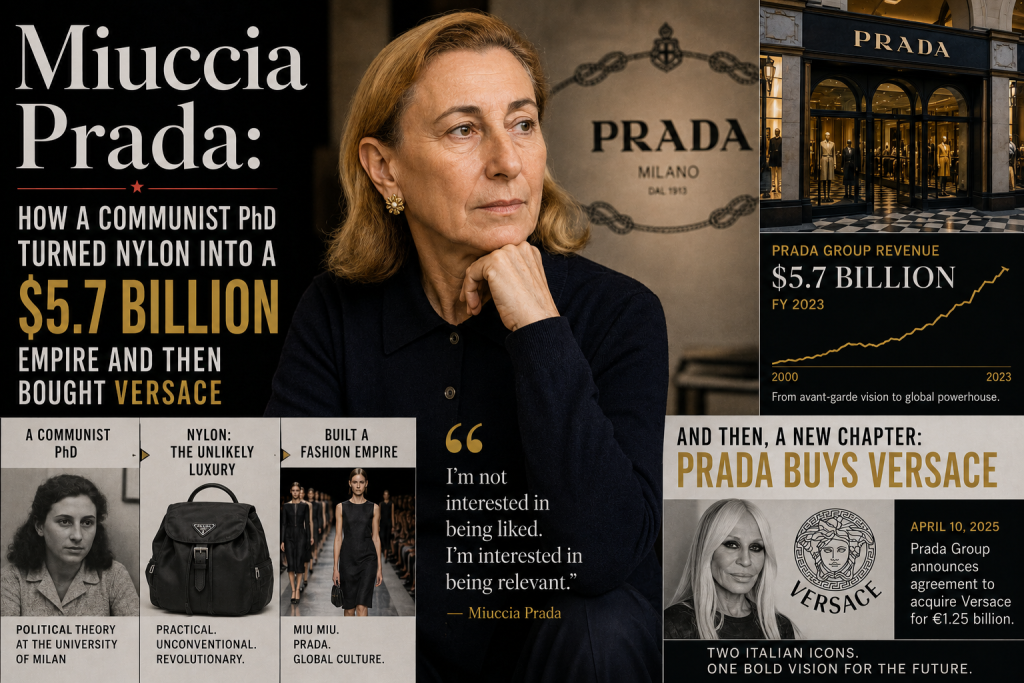
Miuccia Prada holds a PhD in political science, spent five years training as a mime, carried a Communist Party membership card, and inherited a luxury goods company she did not want. She took it anyway and turned it into a $5.7 billion empire that acquired Versace as an afternoon transaction. Miuccia Prada’s fashion career is proof that the most dangerous person in any industry is the one who arrived by accident and stayed out of intellectual curiosity.
Born Maria Bianchi in Milan in 1949, she later took the surname of her maternal grandfather, Mario Prada, who had founded the leather goods house in 1913. Her academic background (political science at the University of Milan, followed by years of Communist Party activism and mime training at the Piccolo Teatro) prepared her for exactly nothing in fashion and exactly everything in understanding how humans use objects to construct identity. When she inherited the family business from her mother in 1978, the company sold steamer trunks and leather accessories to wealthy Milanese women who visited out of habit rather than desire. Revenue was approximately $50 million. The brand had no ready-to-wear, no global distribution, and no ambition beyond serving the same clients it had served since the 1920s.
The Nylon Thesis
In 1984, Miuccia introduced the black nylon backpack that would redefine luxury. The bag was made from Pocono nylon, a military-grade fabric used in parachutes and army tents. It cost almost nothing per yard. Prada charged $450 for it. The fashion industry’s initial reaction ranged from confusion to contempt. Nylon was industrial. It was what soldiers and backpackers used. Luxury meant leather, not polyester derivatives.
That was precisely the point. Miuccia was not selling materials. She was selling intelligence. Carrying a nylon bag at luxury prices was a declaration that you understood something about fashion that most people did not: that the idea behind the object mattered more than the cost of the raw material. The triangular enamel logo, derived from the brand’s 1919 royal warrant from the House of Savoy, became the only identifier. Recognizing it required knowledge. Knowledge was the entry fee. That intellectual gatekeeping became Prada’s permanent competitive moat, and it has never been breached because it cannot be purchased, only earned through cultural literacy.
The nylon bag generated over $100 million in revenue within its first five years and established Prada as a brand whose value proposition was fundamentally different from every other Italian house. Gucci sold desire. Versace sold confidence. Armani sold authority. Prada sold the flattering implication that its customer was smarter than everyone else in the room. That proposition turned out to be worth billions.
Ugly Beautiful and the Anti-Fashion Fashion
Miuccia’s ready-to-wear debut in 1988 confused Milan. The clothes were simple, muted, almost severe. No sequins, no shoulder pads, no sex appeal in any conventional sense. The palette leaned toward greens, browns, and grays that a 1950s suburban housewife might have chosen for curtains. New York understood before Milan did. American editors and buyers recognized that Prada’s minimalism was not absence but precision. Every garment was meticulously cut and finished to a standard that the more visually aggressive Italian houses rarely matched. Simple turned out to be the most expensive thing to get right.
By the mid-1990s, she had developed “ugly chic” as a formal design philosophy: avocado greens, muddy browns, 1950s suburban prints deployed at couture prices. Each collection demanded cultural literacy from its audience. Where Gucci under Tom Ford made recognition effortless (sex plus logo equals sale), Prada made recognition an act of knowledge. Where Versace shouted from the rooftop, Prada whispered in a corner. The whisper was deliberate, and it was very, very expensive.
Her Spring 1996 collection is widely regarded as the inflection point. The clothes referenced 1970s secretarial style, complete with A-line skirts, twin sets, and prints that could have been sourced from a thrift store in Parma. Critics initially dismissed the collection as anti-fashion. Within six months, every major competitor was copying the silhouettes. Miuccia had identified a cultural hunger for what the industry would later call “normcore” two decades before the word existed. Being unfashionable, presented with sufficient confidence and at sufficient price, became the most fashionable thing of all.
Bertelli and the Business Architecture
No account of Miuccia Prada’s fashion career is complete without Patrizio Bertelli. They met in 1977 at a leather goods trade fair in Milan and married in 1989. Where Miuccia was cerebral and instinctively anti-commercial (she has repeatedly said she dislikes the business of fashion), Bertelli was operational and commercially ruthless. Together they formed a partnership where creative and commercial authority were genuinely equal. He brought manufacturing in-house when competitors were outsourcing to Asia. He negotiated global distribution deals that placed Prada in every major city. And he pursued an acquisition strategy that briefly attempted to rival LVMH in scope and ambition.
Between 1999 and 2003, Prada acquired stakes in Jil Sander, Helmut Lang, Church’s shoes, and a significant minority share of Fendi. The strategy was sound in theory: build a multi-brand luxury conglomerate to compete with Bernard Arnault. In execution, it nearly bankrupted the company. The acquisitions were financed with debt at a time when the luxury market was softening after September 11. Prada sold its Fendi stake to LVMH at a loss and divested Helmut Lang and Jil Sander. The failed empire taught Bertelli a lesson that shaped the next two decades: grow organically through Prada and Miu Miu rather than through acquisitions. That discipline held for twenty-two years, until December 2025, when Prada acquired Versace from Capri Holdings for $5.8 billion, signaling that Bertelli’s conglomerate ambitions had waited, not died.
Miu Miu and the Dual-Brand Flywheel
In 1993, Miuccia launched Miu Miu (named after her childhood nickname) as a secondary line targeting younger consumers who found the main Prada collection too cerebral or too expensive. For two decades, Miu Miu operated competently in Prada’s shadow: generating respectable revenue, earning decent reviews, but never breaking through to the cultural conversation in the way that the main line dominated it. Then, beginning in approximately 2022, something shifted.
Miu Miu exploded. Revenue surged 35 percent in 2025 alone, making it the fastest-growing luxury brand on earth by percentage growth. The micro-mini skirt (which debuted in the Spring 2022 collection), low-rise waistbands, deconstructed preppy aesthetics, and visible underwear waistbands captivated Gen-Z consumers who found Prada too austere and Gucci too loud. Miu Miu occupied a space that no competitor had claimed: intellectually credible fashion for the TikTok generation, designed by a 75-year-old Communist who understood that youth rebellion is itself a form of intellectual exercise.
The dual-brand strategy is Miuccia’s most underappreciated achievement. She designs both lines personally. Prada serves the woman who reads Proust and considers fashion a necessary compromise with the physical world. Miu Miu serves the woman who quotes Proust on TikTok and considers fashion a performance of intellectual identity. Combined, Prada Group posted $5.7 billion in revenue for 2025 with operating margins exceeding 27 percent.
The Raf Simons Experiment
In 2020, Miuccia appointed Raf Simons as co-creative director of Prada, creating the first shared creative directorship at a major Italian house. Simons, the Belgian conceptualist whose previous stints at Jil Sander, Dior, and Calvin Klein had established him as fashion’s most intellectual designer, brought a Northern European rigor that complemented Miuccia’s Mediterranean instinct. Their collections were presented as dialogues: two designers with fundamentally different sensibilities negotiating a shared outcome in real time.
The partnership lasted five years. Simons departed in 2025, leaving behind collections that critics ranked among Prada’s finest and a proof of concept that luxury creative direction could function as dialogue rather than monologue. Whether the experiment will be replicated at other houses remains to be seen. What it demonstrated was Miuccia’s fundamental confidence: she did not need a co-director for commercial reasons. She wanted one for intellectual ones. That distinction tells you everything about how she approaches fashion.
What Miuccia Prada Reveals About Intellectual Luxury
Among the designers who built the Italian fashion corridor, Miuccia occupies a singular position. Armani built on restraint. Valentino built on romance. Versace built on spectacle. Miuccia built on ideas, and ideas, it turns out, have the highest margin in luxury because they cost nothing to produce and everything to replicate. No competitor can copy intelligence. They can copy a silhouette, a fabric, a hardware detail. But the sensation that carrying a Prada bag makes you smarter than the woman carrying a Gucci bag is not reproducible through manufacturing. It exists only in the cultural perception that Miuccia spent four decades constructing.
At 77, she still designs every collection personally, still runs a company that just bought Versace for $5.8 billion, and still treats fashion as the least interesting thing about fashion. The Communist who made capitalism look smarter than it has any right to be. The mime who stopped performing for audiences and started performing for revenue. The intellectual who discovered that the highest form of intelligence in a consumer economy is making other people feel intelligent for buying your product.
For the Hamptons social circuit, Miuccia’s influence lives in every woman who carries a nylon bag to a benefit dinner as a deliberate refusal to compete on the same terms as the woman in Chanel. Prada on Newtown Lane in East Hampton attracts a different consumer than the Gucci store next door. Quieter. More deliberate. More certain that what she is carrying requires no explanation to anyone worth explaining it to. That certainty is the product. The bag is just the receipt.
Where The Conversation Continues
Connect With Social Life
Social Life Magazine has covered the intersection of luxury fashion, power, and the Hamptons for over two decades. Our five summer issues, distributed from Memorial Day through Labor Day across the East End, reach 25,000 readers who define the season’s cultural conversation. From Westhampton to Montauk, this is the publication that brands trust when the audience matters more than the impression count.
We deliver an additional 15,000 copies to Upper East Side doorman buildings during fall and winter, extending the Hamptons conversation into Manhattan’s most exclusive residential addresses. Our 82,000 email subscribers receive curated editorial that blends fashion authority with Hamptons insider access.
Polo Hamptons, our signature sporting and lifestyle event in Bridgehampton, brings together the brands and personalities that shape luxury culture. Christie Brinkley hosts. Getty and McMullan photograph. The corporate cabana and sponsor activations create direct engagement with an audience that treats attendance as a social credential.
The Social Life Guest House in Sag Harbor offers select brands the opportunity to integrate into our editorial through experiential activations. It is a restored residence designed for content creation, product placement, and the kind of organic media coverage that feels editorial because it is.
Whether you are a luxury brand seeking Hamptons credibility, a wellness company building prestige positioning, or a financial services firm targeting high-net-worth audiences, Social Life Magazine offers a platform that combines print authority, digital reach, and experiential access in one integrated partnership.
Contact Cass Almendral, Head of Business Development, at cass.almendral@sociallifemagazine.com to discuss editorial features, event sponsorships, and brand activations for the 2026 season.
For Polo Hamptons corporate cabana inquiries, reach Justin Mitchell at admin@polohamptons.com.
Author

Written by
Recent Posts
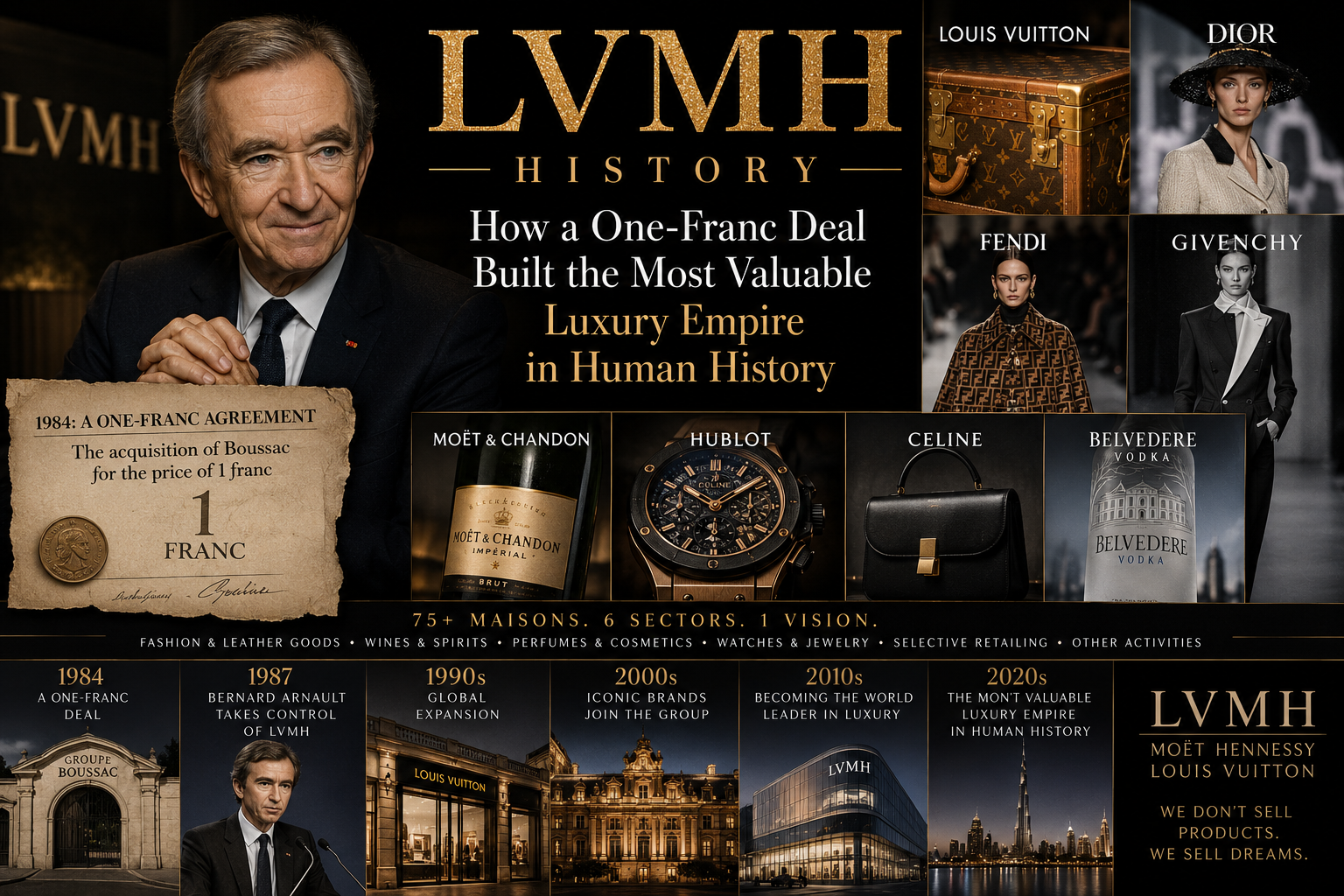
LVMH History: How a One-Franc Deal Built the Most Valuable Luxury Empire in Human History
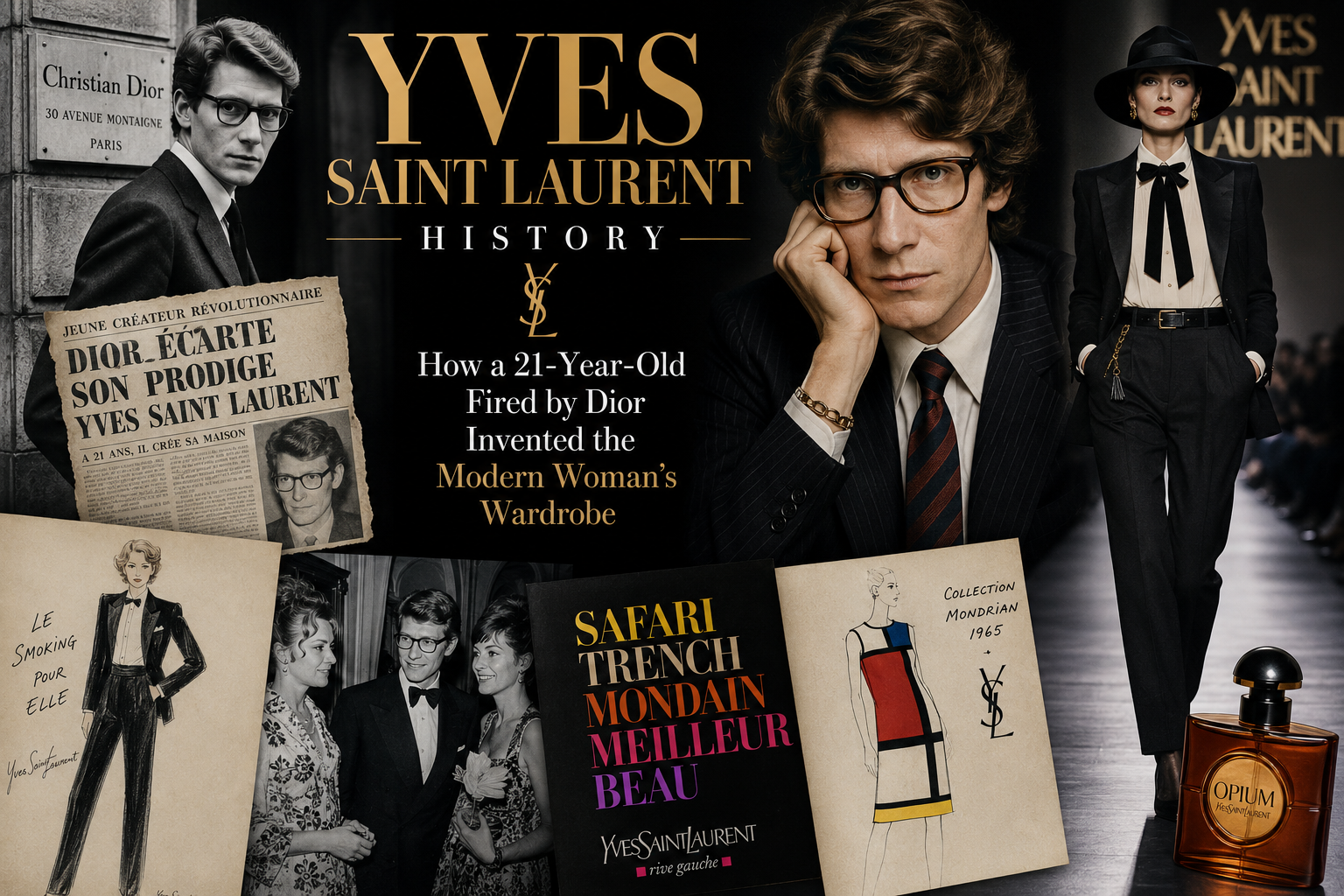
Yves Saint Laurent History: How a 21-Year-Old Fired by Dior Invented the Modern Woman’s Wardrobe
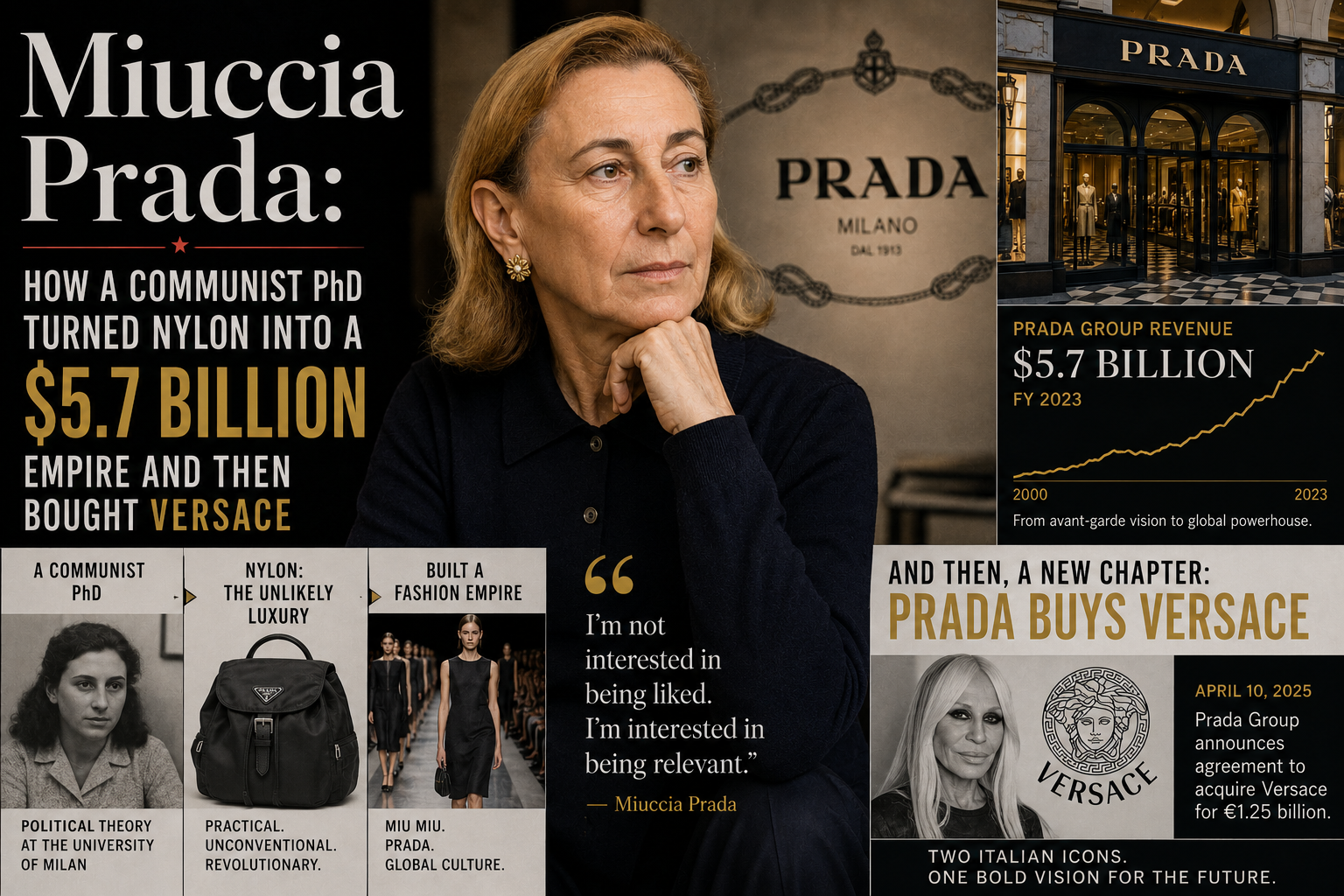
Miuccia Prada: How a Communist PhD Turned Nylon Into a $5.7 Billion Empire and Then Bought Versace
Demna: How a Georgian Refugee Turned Irony Into a Billion-Dollar Brand and Then Took Over Gucci
Virgil Abloh: How Quotation Marks, a Kanye Apprenticeship, and Louis Vuitton Built Fashion’s Most Democratic Legacy
Categories
- Art
- Articles
- Beauty & Skincare
- Celebrities
- Chronicles
- Events
- Fashion
- Fashion & Style
- Featured
- Food & Beverage
- Food, Spirits, Wine
- Hamptons
- Hamptons Celebrities
- Health
- Health & Beauty
- Lifestyle
- Luxury Lifestyle
- Press
- Profiles
- Real Estate
- Technology
- The Chronicles
- Travel
- Uncategorized
- Weddings