
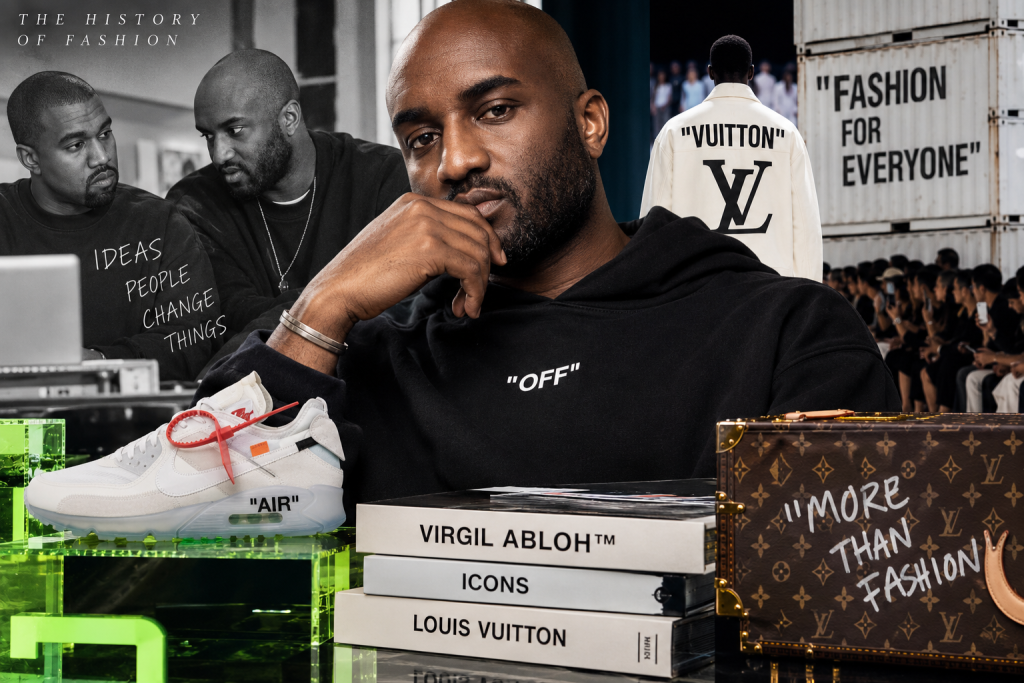
Virgil Abloh put quotation marks on everything and called it a design philosophy. Then he became the most powerful creative director in luxury fashion, ran Louis Vuitton menswear while simultaneously operating his own brand, and died of cardiac angiosarcoma at 41 before anyone could determine whether he was a visionary or a provocateur. Virgil Abloh’s fashion career collapsed the boundaries between streetwear, high fashion, architecture, music, and contemporary art so completely that nobody has figured out how to reassemble them since.
Born in Rockford, Illinois, in 1980 to Ghanaian immigrant parents, Abloh grew up between two worlds. His mother was a seamstress. His father worked in a paint company. Rockford was not Paris or Milan or even New York. It was a mid-sized Midwestern city where fashion arrived late and left early. Abloh studied civil engineering at the University of Wisconsin-Madison and earned a master’s in architecture from the Illinois Institute of Technology, where Mies van der Rohe had once taught. That architectural training, the Bauhaus insistence that form follows function, became the intellectual scaffold for everything he later built in fashion.
The Kanye West Apprenticeship
In 2009, Abloh and Kanye West interned together at Fendi in Rome. Two Black Americans, neither trained in fashion, learning the Italian luxury system from inside one of its most traditional houses. The internship lasted a few months. The relationship lasted a decade and reshaped the entire luxury industry. West hired Abloh as creative director of his agency Donda, where Abloh designed album covers, concert stages, merchandise, and the visual identity of West’s creative output during its most commercially productive era.
Working with West gave Abloh access to a celebrity network, a production infrastructure, and a cultural platform that no emerging designer could have built independently. It also taught him the principle that would define his career: everything is design. An album cover is design. A concert ticket is design. A hoodie is design. The boundaries between these categories are artificial, maintained by industries that profit from keeping them separate. Abloh’s entire creative project was the systematic demolition of those boundaries.
Off-White and the Quotation Mark Revolution
Abloh founded Off-White in 2013 in Milan with a concept borrowed from contemporary art theory. His signature move was literal: he put quotation marks on things. A jacket labeled “JACKET.” A shoelace tagged “SHOELACES.” The gesture was simultaneously ironic and sincere, a nod to Marcel Duchamp’s readymades and a commercial strategy that turned basic garments into collectible objects. Whether this constituted genius design or clever marketing depended entirely on your tolerance for postmodern ambiguity.
Off-White grew from a small Milan-based label to a global brand generating an estimated $250 million in annual revenue by 2019. LVMH acquired a 60% stake in 2021, valuing the brand at over $1 billion. The collaboration with Nike (the “The Ten” collection in 2017, which deconstructed ten iconic sneakers with Off-White’s signature zip-tie tags and exposed stitching) became the most commercially successful designer-sneaker partnership in history. Individual pairs resell for $2,000 to $15,000. The collaboration proved that the streetwear audience would pay luxury prices for luxury ideas applied to everyday objects.
Abloh’s design philosophy, which he called the “3% approach” (change an existing design by 3% and it becomes a new design), infuriated traditional designers who believed in originality as a moral imperative. His response was that originality was a myth. Everything references everything else. The honest designer acknowledges the reference. The dishonest one pretends the idea was new. By making the quotation marks literal, Abloh was being more honest than the houses that borrowed silhouettes from the archive and presented them as fresh invention.
Louis Vuitton: The Most Powerful Appointment
On March 25, 2018, Louis Vuitton announced Abloh as artistic director of menswear. He was the first Black designer to hold the position at any major French fashion house. The appointment was a seismic event not just for fashion but for the broader cultural conversation about who gets to define luxury. For 164 years, French fashion houses had been led exclusively by European designers. Abloh was American, Black, trained as an architect, famous for putting quotation marks on sneakers. His appointment said that luxury’s gatekeepers had either evolved or been overwhelmed.
His debut collection for Louis Vuitton in June 2018, shown at the Palais-Royal gardens in Paris, opened with a rainbow-gradient runway that transitioned from white to every color of the spectrum. Models walked in tailored suits that gradually deconstructed as the show progressed, starting with traditional LV monogram pieces and ending in tie-dyed harnesses and transparent bags. Abloh wept at the finale. Kanye West wept in the front row. The show generated more social media impressions than any men’s fashion show in history.
Under Abloh, Louis Vuitton menswear revenue grew substantially. His collections brought a demographic to the Champs-Elysees store that had never considered entering: young men of color who saw themselves reflected in a luxury house for the first time. Collaborations with Nigo (the Japanese streetwear pioneer), Nike (the Air Force 1 redesign), and artists including Takashi Murakami extended LV’s cultural reach into communities that traditional luxury marketing had ignored or actively excluded. In the broader history of fashion, Abloh’s tenure at Vuitton represented the moment when luxury’s demographic assumptions became indefensible.
The Death That Stopped the Industry
Abloh was diagnosed with cardiac angiosarcoma, a rare and aggressive form of cancer, in 2019. He told almost no one. For two years, he continued designing for both Off-White and Louis Vuitton, traveling between shows, staging exhibitions, and collaborating across disciplines while undergoing treatment. He died on November 28, 2021, at age 41. The announcement, posted simultaneously by LVMH and his family, shocked an industry that had no idea he was ill.
Bernard Arnault’s statement called Abloh “a genius designer and a visionary.” Kanye West posted nothing publicly for days. The silence from West, typically the loudest voice in any cultural conversation, communicated the loss more eloquently than any statement could have. Abloh’s final Louis Vuitton show, a collaboration with the Alvin Ailey American Dance Theater, aired posthumously and was widely described as his masterpiece.
Pharrell Williams succeeded Abloh at Louis Vuitton menswear in February 2023. LVMH maintained Off-White as a separate entity within the group, appointing Ibrahim Kamara as art and image director. Neither successor has matched Abloh’s cultural velocity, which may prove that what he generated was not a replicable strategy but a singular force of personality that cannot be systematized or transferred.
What Virgil Abloh Reveals About Fashion’s Future
Virgil Abloh’s fashion career compressed what most designers spread across forty years into twelve. From the Fendi internship in 2009 to his death in 2021, he founded a billion-dollar brand, took the most prestigious appointment in men’s fashion, collaborated with every major sneaker and streetwear institution, and redefined who luxury fashion was for. The 3% approach, the quotation marks, the refusal to distinguish between a concert stage and a runway show: these were not aesthetic choices. They were arguments about what design meant in a world where everything was already designed.
Among the American fashion designers who shaped the global conversation, Abloh stands apart because he never separated his American identity from his work. Ralph Lauren sold an aspirational version of American aristocracy. Tom Ford sold American sexuality through Italian tailoring. Abloh sold American hybridity: the Midwest and Ghana, architecture and hip-hop, high fashion and sneaker culture, all occupying the same garment without hierarchy or apology.
On the Hamptons social circuit, Abloh’s legacy shows up in the Off-White diagonal stripes on a teenager’s hoodie at Surf Lodge and the Louis Vuitton trainer on a hedge fund manager’s foot at a Sagaponack dinner party. He made it possible for those two garments to exist in the same social space without either person feeling out of place. That achievement, the demolition of fashion’s class ceiling, may outlast every garment he ever made.
Where The Conversation Continues
Connect With Social Life
Social Life Magazine has covered the intersection of luxury fashion, power, and the Hamptons for over two decades. Our five summer issues, distributed from Memorial Day through Labor Day across the East End, reach 25,000 readers who define the season’s cultural conversation. From Westhampton to Montauk, this is the publication that brands trust when the audience matters more than the impression count.
We deliver an additional 15,000 copies to Upper East Side doorman buildings during fall and winter, extending the Hamptons conversation into Manhattan’s most exclusive residential addresses. Our 82,000 email subscribers receive curated editorial that blends fashion authority with Hamptons insider access.
Polo Hamptons, our signature sporting and lifestyle event in Bridgehampton, brings together the brands and personalities that shape luxury culture. Christie Brinkley hosts. Getty and McMullan photograph. The corporate cabana and sponsor activations create direct engagement with an audience that treats attendance as a social credential.
The Social Life Guest House in Sag Harbor offers select brands the opportunity to integrate into our editorial through experiential activations. It is a restored residence designed for content creation, product placement, and the kind of organic media coverage that feels editorial because it is.
Whether you are a luxury brand seeking Hamptons credibility, a wellness company building prestige positioning, or a financial services firm targeting high-net-worth audiences, Social Life Magazine offers a platform that combines print authority, digital reach, and experiential access in one integrated partnership.
Contact Cass Almendral, Head of Business Development, at [email protected] to discuss editorial features, event sponsorships, and brand activations for the 2026 season.
For Polo Hamptons corporate cabana inquiries, reach Justin Mitchell at [email protected].
Author

Written by
Recent Posts
The Skincare Habits That Make a Real Difference Over Time
Hamptons-Ready Beauty: Polished Makeup for Long Summer Days
Is Now a Good Time to Sell a Home in NJ?

The Hidden Work Behind a Seamless Hotel Weekend
Choosing Scratching Furniture for a British Shorthair
Categories
- Art
- Articles
- Business of Luxury
- Celebrities
- Culture
- Entertainment
- Events
- Faces of Summer 2026
- Fashion
- Fashion & Style
- Featured
- Finance
- Food, Spirits, Wine
- Hamptons
- Hamptons Celebrities
- Health
- Health & Beauty
- Lifestyle
- Luxury Lifestyle
- Press
- Profiles
- Real Estate
- Technology
- The Chronicles
- Travel
- Uncategorized
- Weddings