
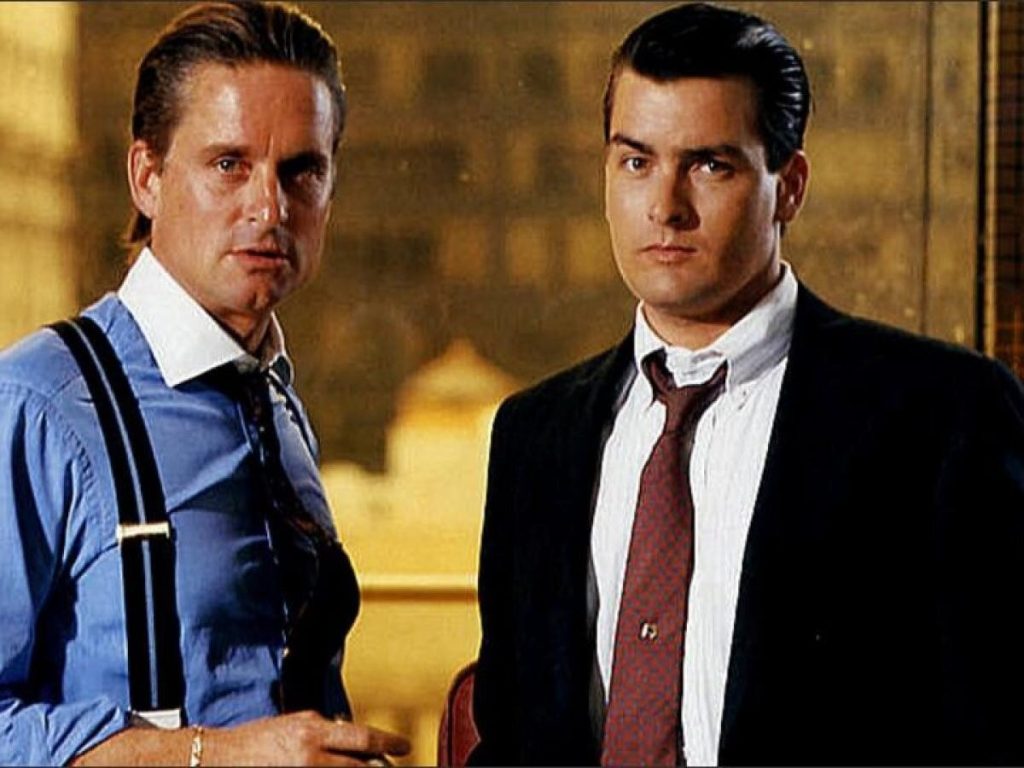
Oliver Stone intended to make a warning. Instead, he made a recruitment video. Wall Street arrived on December 11, 1987 — barely seven weeks after Black Monday erased 22% of the Dow in a single session. The film told the story of a young stockbroker seduced by a corporate raider whose philosophy reduces all human endeavor to one imperative: acquire.
Consequently, the villain was supposed to lose. He did lose. And then a generation of young men watched him lose and decided they wanted to be him anyway. That paradox — the cautionary tale that functions as aspiration — remains the defining legacy of the film that wrote the playbook for every Wall Street movie that followed.
Stanley Weiser, who co-wrote the screenplay with Stone, published an op-ed two decades later titled “Repeat After Me: Greed Is Not Good.” In it, he expressed bewilderment that audiences had so thoroughly misunderstood a film whose core message is simple: Gekko goes to jail. Yet people still approach Charlie Sheen and Michael Douglas to say they became stockbrokers because of this movie. The villain became a lifestyle. The warning became a brand. This is the wall street 1987 true story behind it.
The Origin: A Stockbroker’s Son and a Film Originally Called “Greed”
Stone dedicated the film to his father, Louis Stone, a stockbroker during the Great Depression who died in 1985. The dedication appears in the final frame: “Dedicated to Louis Stone, Stockbroker, 1910-1985.” Notably, Stone did not approach Wall Street as an outsider exposing corruption. He approached it as the son of a man who had lived inside the system honorably, watching it overtaken by a generation that viewed honor as an impediment to profit.
The screenplay originally bore the title Greed. Stone and Weiser spent three weeks visiting Wall Street firms and interviewing the people who ran them. Their consultants included corporate raiders Carl Icahn, Asher Edelman, and T. Boone Pickens. Additionally, they spoke with confessed insider trader David S. Brown, investment bankers John Gutfreund and Alan Greenberg, junk bond architect Michael Milken, and SEC prosecutor Gary Lynch.
Assembling Gekko from Spare Parts
The research produced a screenplay that functioned less as fiction than as collage. Stone and Weiser assembled Gordon Gekko from real men the way Frankenstein assembled a body from real corpses. Gekko’s shareholder speech came from Carl Icahn’s actual takeover rhetoric. Boesky’s commencement address supplied the philosophy. Investor Asher Edelman’s art-filled office provided the visual style, while Stone’s own rapid-fire speech patterns shaped the dialogue. Furthermore, Stone contributed the character’s name. The soul, such as it was, belonged to the decade itself.
The Real Men Inside Gordon Gekko
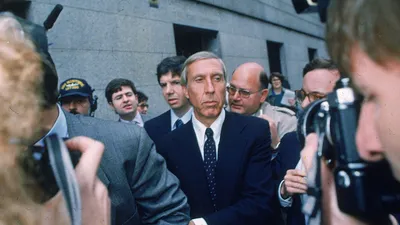
Ivan Boesky built a $200 million fortune as an arbitrageur betting on corporate takeovers in the early 1980s. In May 1986, he stood before UC Berkeley’s Haas School graduates and told them greed was healthy — that they could be greedy and still feel good about themselves. Seven months later, prosecutors charged him with insider trading. Subsequently, he cooperated with authorities, wore a wire, and helped bring down Michael Milken — the “Junk Bond King” at Drexel Burnham Lambert. Ultimately, Boesky paid a $100 million fine and served twenty months. His Berkeley speech became Gekko’s most famous line: “Greed, for lack of a better word, is good.”
Icahn, Milken, and the Aesthetic of Power
Carl Icahn provided the structural argument. Gekko’s shareholder address at Teldar Paper — pointing out that management owns less than three percent of stock and employs too many vice presidents — draws almost directly from Icahn’s actual hostile takeover speeches. Icahn viewed himself as a liberator of shareholder value from complacent executives. The argument held merit. The methods, however, did not always stay legal.
Moreover, Milken added the financial engineering: junk bonds that enabled leveraged buyouts by letting raiders borrow against their targets’ own assets. Asher Edelman contributed the aesthetic — the art collection, the tailored suits, the office that communicated power through beauty rather than intimidation. As producer Edward Pressman summarized: “Originally, there was no one individual who Gekko was modeled on. But Gekko was partly Milken.”
The Casting: Douglas, the Sheens, and the Family That Played a Family
The studio wanted Warren Beatty for Gekko. Stone wanted Richard Gere. Both passed. Michael Douglas consequently got the role and transformed it into something neither Stone nor the studio had anticipated: a villain so magnetic that the film’s moral architecture collapsed under the weight of his charisma.
The Trailer Provocation
Stone tested Douglas early in the shoot by walking into his trailer and asking if he was doing drugs because he “looked like he hadn’t acted before.” The provocation was deliberate, and it worked. Stung, Douglas did more research, worked his lines harder, and channeled what Stone called “repressed anger” into the performance. The “Greed is good” speech was the culmination. Douglas won the Academy Award for Best Actor. AFI later named Gekko the 24th greatest villain in cinema history, and the line ranked 57th among the 100 greatest movie quotes.
Additionally, the casting of the Fox family represented Stone’s most elegant structural decision. Charlie Sheen plays Bud Fox, the young stockbroker torn between two fathers. Martin Sheen, Charlie’s real father, plays Carl Fox — a blue-collar airline mechanic and union leader who represents everything Gekko despises: loyalty, modesty, and the conviction that some things matter more than money. In essence, the central conflict is Platoon transposed to the trading floor. Stone used the same two-fathers structure in that 1986 film, with Berenger and Dafoe battling for Charlie Sheen’s allegiance in Vietnam. In Wall Street, the jungle is Manhattan and the weapon is a telephone.
The Timing: Seven Weeks After the Crash
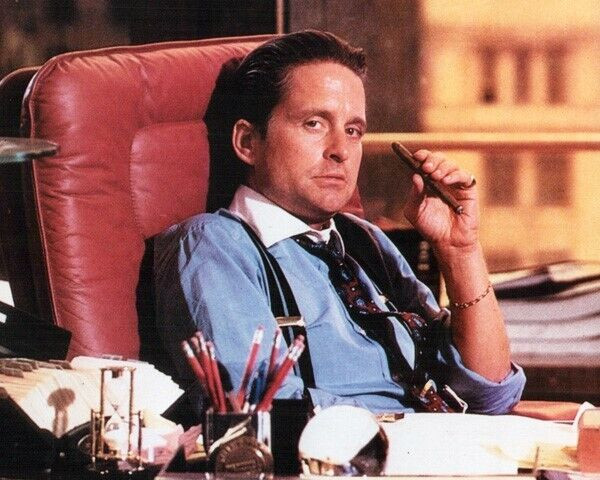
Wall Street arrived on December 11, 1987. Black Monday — the single worst day in stock market history at that point — had occurred on October 19, less than eight weeks earlier. The Dow dropped 508 points, a 22.6% decline, in a single session. Hundreds of billions in wealth vanished. Pension funds took massive hits. Individual investors panicked.
In theory, the crash should have made the film’s message land with devastating force. It did not. Opening to $4.1 million across 730 theaters, the film eventually grossed $43.8 million domestically — a solid return, but not a blockbuster. Audiences in 1987 were still processing the crash in real time. However, the film became significantly more popular through home video and cable television, which is when its cultural impact truly detonated. One week after release, prosecutors sentenced Boesky — the man whose speech inspired Gekko’s most famous line — to three years in federal prison. Nobody planned the timing. Yet the resonance was undeniable.
The Paradox: Why the Warning Became a Recruitment Tool
The most troubling legacy of Wall Street is not what it depicted but how audiences received it. Stone made a film in which prosecutors arrest the villain, the hero cooperates with authorities, and the moral is explicit: greed destroys. Audiences watched the arrest, noted the moral, and then asked where they could get Gekko’s suspenders. As a result, Wall Street firms reported surges in job applications. Business school enrollment increased.
Nevertheless, the phenomenon reveals something about narrative that Stone understood intellectually but could not control practically: audiences identify with charisma, not morality. Gekko is the most alive person in the film. He moves faster, talks faster, thinks faster, and occupies more space in every frame than any other character. Bud Fox is reactive. Carl Fox is passive. Gekko alone acts. In a culture that worships action, the man of action becomes the hero regardless of what the script says.
Boiler Room’s Mirror
The 2000 film Boiler Room made this subtext explicit. In one scene, brokers at J.T. Marlin gather to watch Wall Street and recite Gekko’s dialogue the way sports fans recite play-by-play. They are not misreading the film. Instead, they are reading it correctly — as a portrait of a man who had the courage to take what he wanted while everyone else waited for permission.
The Two Fathers: Stone’s Deepest Structure
The genius of Stone’s screenplay lies not in the financial detail — though the detail is precise — but in the mythological framework underneath it. Bud Fox stands between two fathers. Gordon Gekko offers wealth, status, a penthouse on the Upper East Side, and a girlfriend who functions as a luxury accessory indistinguishable from the artwork on his walls. By contrast, Carl Fox offers a small apartment in Queens, a union card, and the conviction that honest work is its own reward even when the reward is modest.
The Courthouse Steps and the Line That Defines Everything
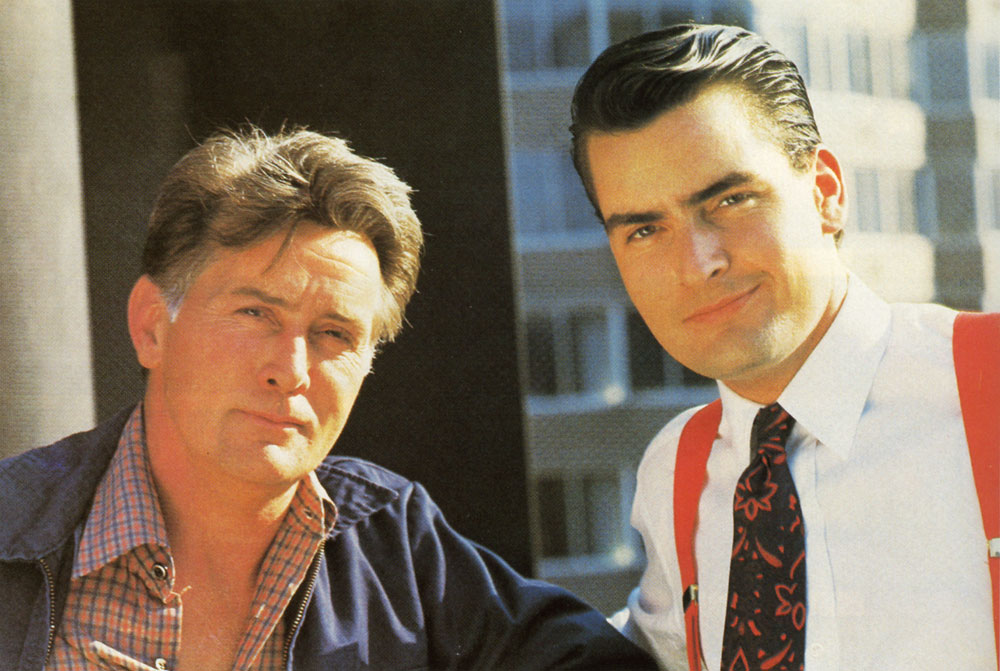
Martin Sheen’s performance as Carl Fox anchors the film’s moral center, and it is deliberately unglamorous. Carl wears a jacket to dinner. A heart attack takes him down mid-scheme. Rather than delivering speeches about capitalism, he simply exists as evidence of a value system that every other character has already abandoned.
The heart attack scene — in which Bud learns his father has collapsed while executing one of Gekko’s schemes — is the moment the film’s structure reveals itself. Bud has tried to serve two fathers. One father’s body has just failed. Meanwhile, the other is on the phone asking about the trade. Notably, the film’s emotional climax is not the arrest. It is the reconciliation on the courthouse steps, where Carl says simply: “A man looks in the abyss, there’s nothing staring back at him. At that moment, man finds his character. And that is what keeps him out of the abyss.”
Douglas, the Oscar, and the Man Who Couldn’t Escape His Character
Michael Douglas won the Academy Award for Best Actor and spent the next two decades being confused with Gekko. At a 2012 United Nations press conference — where Douglas served as a Messenger of Peace promoting nuclear disarmament — a reporter asked whether he bore “some responsibility for the greed merchants who had brought the world to its knees.” Douglas attempted to redirect toward nuclear weapons. Another reporter asked him to compare nuclear Armageddon with “the financial Armageddon on Wall Street.” A third addressed him as Gordon. Douglas replied: “My name is not Gordon. It’s a character I played 20 years ago.”
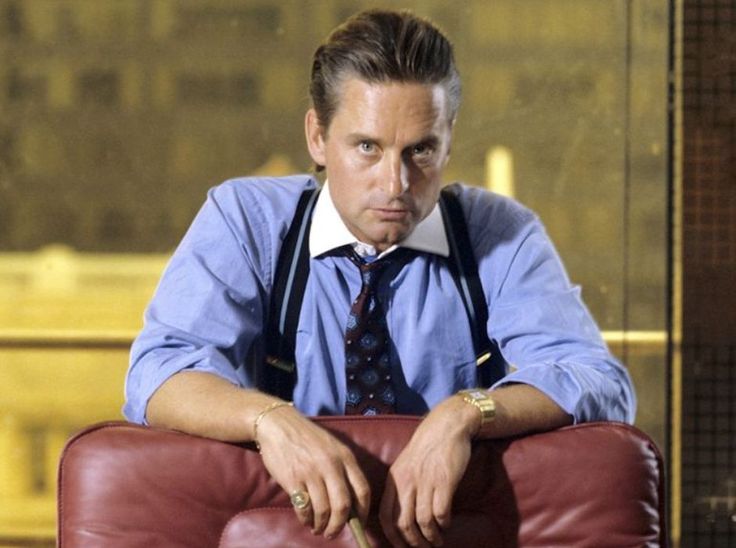
The anecdote captures the film’s impossible legacy. Douglas created a character so vivid that it consumed the actor. Psychiatrists Leistedt and Linkowski, in a 2013 study, cited Gekko as “probably one of the most interesting, manipulative, psychopathic fictional characters to date.” The word “fictional” does significant work there. Stone assembled Gekko from real men who did real things. The fiction was the name. Everything else was documentary.
Why Wall Street Is the Origin of Everything
Every film in the Wall Street cinema canon descends from this one. Boiler Room‘s traders watch it on repeat. Wolf of Wall Street‘s Jordan Belfort quotes it without attribution. Margin Call‘s John Tuld is Gekko with thirty additional years of practice. The Big Short‘s outsiders are the people Gekko would have bet against. Indeed, remove Wall Street from the canon and the rest becomes unintelligible.
The Children of Gordon Gekko
Kevin Rudd, then Prime Minister of Australia, gave a 2008 speech titled “The Children of Gordon Gekko.” He argued that Gekko’s philosophy had been absorbed so deeply into global finance that it had become policy. Rudd’s argument held up. Deregulation throughout the 1990s — the repeal of Glass-Steagall, the exemption of derivatives from oversight — rested on the assumption that markets self-correct and that greed, properly channeled, truly works. That assumption proved catastrophically wrong.
Yet nobody went back and rewatched the film to see how it ended. Stone himself said in 2015 that Wall Street culture is “horribly worse” today than in the 1980s. The villain went to jail. The culture didn’t notice. That is the wall street 1987 true story: a film that told America exactly what was going to happen, and America watched it, applauded, and asked for more.
If you’ve ever seen the warning that everyone else treated as an invitation — then you already understand why Social Life Magazine exists. We cover the world where cautionary tales and success stories are often the same people. Reach out to our editorial team to be featured.
Want to position your brand inside the culture that shapes how America thinks about ambition? Submit a Paid Feature and let our editors build something worth reading.
Join 82,000+ subscribers who get our take on luxury, culture, and the Hamptons scene before anyone else. Subscribe to our email list.
The Turning Point
Experience the intersection of sport, style, and status at Polo Hamptons — Bridgehampton’s premier luxury polo event, now in its seventh year with BMW as title sponsor.
Never miss a print issue. Subscribe to Social Life Magazine and get five summer issues delivered from Memorial Day to Labor Day.
Love what we do? Support Social Life Magazine and help us keep covering the culture that matters.
Author

Written by
Recent Posts
Get Panama Residency in 30 Days — A Simple Look at Mercan’s Easy Program Process
How to Choose a Stay for a Multigenerational Resort Trip
How Family Property Disputes Can Affect Relationships and Long-Term Plans

Choosing a Reformer for the Life You Already Have

Artful Living: Unique Gifts With A Creative Edge
Categories
- Art
- Articles
- Business of Luxury
- Celebrities
- Culture
- Entertainment
- Events
- Faces of Summer 2026
- Fashion
- Fashion & Style
- Featured
- Finance
- Food, Spirits, Wine
- Hamptons
- Hamptons Celebrities
- Health
- Health & Beauty
- Lifestyle
- Luxury Lifestyle
- Press
- Profiles
- Real Estate
- Technology
- The Chronicles
- Travel
- Uncategorized
- Weddings