
The Before: Cambridge, a Janitor’s Son, and the Joint Bank Account
Benjamin Géza Affleck-Boldt was born on August 15, 1972, in Berkeley, California, and raised in Cambridge, Massachusetts, by a school teacher and a man who could not hold a job. His mother, Chris Anne Boldt, taught elementary school. His father, Timothy Byers Affleck, worked intermittently as a social worker, a janitor, a mechanic, an electrician, a bartender, a bookie, and an aspiring stage actor. Timothy was also an alcoholic. The addiction would cost him his marriage, his stability, and eventually his relationship with his sons — and it would be inherited, in different form, by Ben, who has spoken publicly about his own battles with alcohol, anxiety, and the specific cruelty of growing up watching a brilliant man choose a bottle over a family.
When Ben was eight years old, his mother introduced him to a ten-year-old neighbor named Matt Damon. The boys discovered they shared two obsessions: acting and baseball. They took drama classes together. They played Little League together. Ultimately, they opened a joint bank account and pooled their earnings from minor acting gigs — a Burger King commercial for Ben, local theater for Matt — to buy train and plane tickets to auditions in New York.
Nevertheless, the bank account is the foundational image of both careers: two kids from Cambridge who understood, before either of them could drive, that the only way out was together. Every dollar earned went into the same account. Every ticket purchased came from the same fund. The partnership was not a strategy. It was a survival mechanism. It has now lasted forty-five years and produced two Academy Awards, a Best Picture winner, and a production company that is restructuring how Hollywood compensates creative talent.
The Pivot Moment: $325,000, an Oscar at Twenty-Five, and the Script Nobody Else Would Write
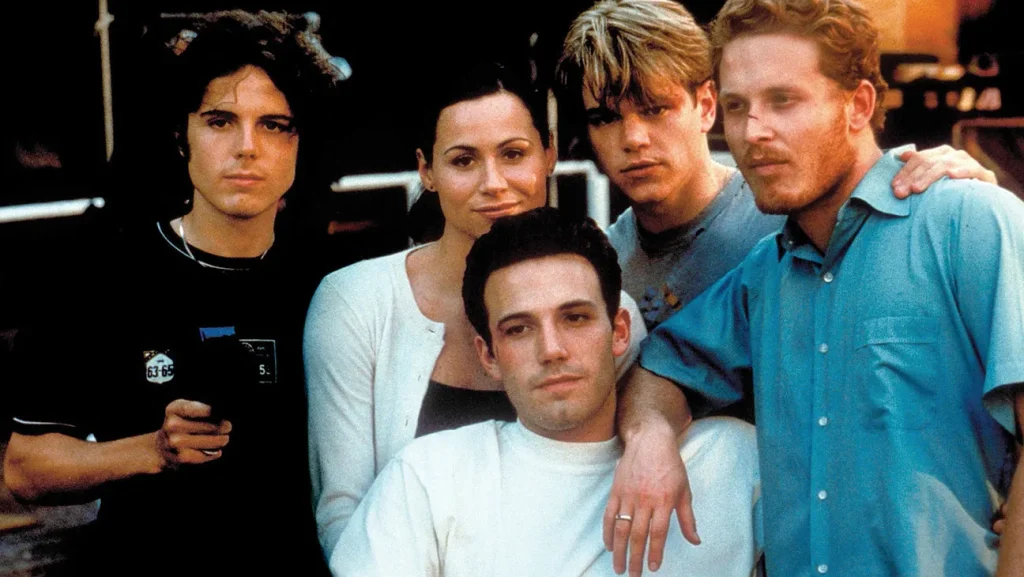
Good Will Hunting began as a writing exercise that Ben and Matt developed while Damon was at Harvard and Affleck was dropping in and out of the University of Vermont and Occidental College. The screenplay told the story of a janitor at MIT who turns out to be a mathematical genius — a premise that allowed two working-class kids from Cambridge to write about intelligence, class, and the specific rage of being brilliant in a system that was not designed for you. The script circulated through Hollywood for years. Castle Rock Entertainment purchased it, then let the option lapse. Harvey Weinstein’s Miramax ultimately acquired it and produced the film with Robin Williams, who won the Best Supporting Actor Oscar.
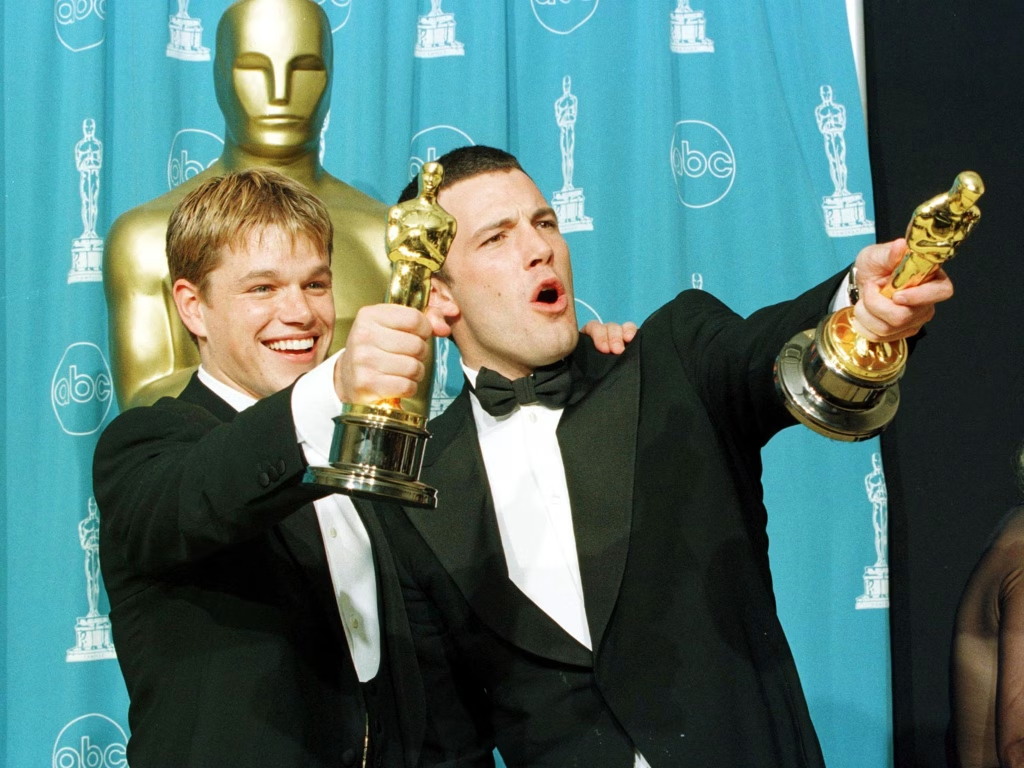
Notably, ben and Matt each earned approximately $325,000 for the screenplay. The film grossed $225 million on a $10 million budget. They won the Academy Award for Best Original Screenplay. Affleck was twenty-five years old. The joint bank account had paid off.
The Oscar opened every door in Hollywood simultaneously, which is another way of saying it removed every filter. Affleck went from auditioning for small parts to choosing between blockbusters. Armageddon (1998) grossed $553 million. Pearl Harbor (2001) grossed $449 million. The salaries escalated: $10 million for Changing Lanes, $10 million for The Sum of All Fears, $11.5 million for Daredevil, $12.5 million for Gigli, $15 million for Paycheck. The numbers were enormous. By contrast, the films were not. The mid-2000s represented the most spectacular overcorrection in modern Hollywood: an actor paid like a franchise but cast in films that did not deserve him, could not contain him, or — in the case of Gigli — should not have existed at all.
The Climb: Boiler Room, the Crash, and the Reinvention That Won Best Picture

Between Good Will Hunting’s triumph and the mid-2000s collapse, Affleck delivered one performance that the public barely noticed and the film world never forgot. In Boiler Room (2000), he played Jim Young — the senior recruiter at J.T. Marlin who delivers a speech to new trainees that functions as the film’s thesis and its most enduring scene. “Anybody who tells you money is the root of all evil doesn’t fucking have any,” Young tells a room of twenty-year-olds in cheap suits.
In fact, the speech was modeled on an actual recruitment lecture that director Ben Younger had witnessed at a real Long Island boiler room. Affleck filmed all of his Boiler Room scenes in approximately a day and a half. He appears in almost no frames alongside the other principal cast members. The performance is a cameo in duration and a lead in impact — a prophet who delivers the gospel, disappears, and leaves the converts to discover for themselves that the gospel is a con.
The Bennifer era — the tabloid relationship with Jennifer Lopez that dominated magazine covers from 2002 to 2004 — consumed the public’s perception of Affleck so completely that his actual abilities became invisible. However, the broken engagement, the paparazzi saturation, and the Gigli disaster produced a narrative of decline so thorough that industry insiders began using his name as a shorthand for squandered potential. He married Jennifer Garner in 2005. They had three children — Violet, Seraphina, and Samuel. And then, quietly, while nobody was paying attention, Affleck rebuilt his career from the foundation up.
The Turning Point
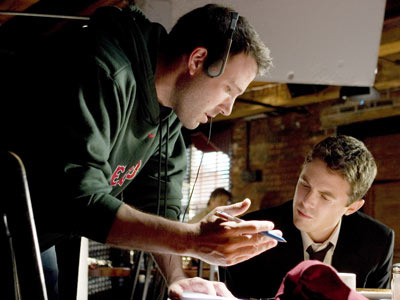
Gone Baby Gone (2007) was his directorial debut — a Boston crime drama starring his brother Casey that demonstrated a command of tone, geography, and moral ambiguity that no one had expected from the guy who made Gigli. The Town (2010) confirmed the debut was not a fluke: a heist film set in Charlestown that grossed $154 million and earned Jeremy Renner a Best Supporting Actor nomination. Then Argo (2012) — a historical thriller about the CIA’s extraction of American hostages from Iran using a fake Hollywood production as cover — won the Academy Award for Best Picture. Affleck directed, produced, and starred. He was forty years old.
Subsequently, the reinvention was complete. The man who had been written off as a tabloid casualty had won Best Picture. His acceptance speech contained the line that best summarizes both his career and his operating philosophy: “You have to work harder than you think you possibly can. You can’t hold grudges. All that matters is you gotta get up.”
The Hamptons Chapter: Batman, Alcoholism, and the $600 Million AI Sale

Affleck played Batman in the DC Extended Universe starting with Batman v Superman: Dawn of Justice (2016), earning an estimated $35 million across the franchise. He appeared in Gone Girl (2014) for David Fincher, delivering a performance as a man accused of murdering his wife that drew on the tabloid’s version of his own persona and turned it into something considerably darker. The Way Back (2020) — in which he played a recovering alcoholic coaching high school basketball — went before cameras shortly after Affleck left rehab and represents the most autobiographically raw performance of his career. His father’s alcoholism, his own alcoholism, and the character’s alcoholism collapsed into a single frame. The reviews were the best of his acting career. The box office was negligible. In particular, the film exists as evidence that Affleck’s talent was never the problem. The problem was the machinery around him.
In 2022, he co-founded Artists Equity with Matt Damon — a production company built on the principle that creative talent should receive equity participation in the commercial success of their projects rather than flat fees. The joint bank account from Cambridge, restructured for a $300 million net worth. Their first major production, Air (2023) — about Nike’s pursuit of Michael Jordan for what became the Air Jordan deal — demonstrated the model: Affleck directed, starred as Phil Knight, and shared backend profits with the crew. The Dunkin’ Donuts Super Bowl commercial, produced through Artists Equity, earned Affleck a reported $10 million for thirty seconds of screen time and generated seven billion media impressions and the company’s highest single-day sales in history.
Behind the Numbers
Meanwhile, in March 2026, Netflix acquired Affleck’s AI filmmaking startup, InterPositive, for $600 million — a company he had quietly built since 2022 that uses artificial intelligence to assist filmmakers in post-production. The Jim Young speech from Boiler Room promised new trainees they’d be millionaires within a year. Affleck did not become a millionaire in a year. He became one of the wealthiest creative executives in Hollywood across three decades — and then sold an AI company to a streaming giant for more than most studios spend on their entire annual slate.
What He Built: Artists Equity, the Marriage Math, and the Architecture of a Comeback
Affleck’s personal life has been as public as his career and considerably more expensive. His divorce from Jennifer Garner was finalized in 2018 after a separation marked by tabloid coverage of his alcoholism. His reconciliation with Jennifer Lopez — Bennifer 2.0 — culminated in a 2022 marriage and a $61 million Beverly Hills mega-mansion with twelve bedrooms and twenty-four bathrooms. The marriage ended in 2024. The real estate portfolio that remains includes an 87-acre Georgia estate purchased for $7.11 million and a $20.5 million Pacific Palisades property.
Nevertheless, the financial architecture of Affleck’s $300 million fortune demonstrates three distinct accumulation strategies operating simultaneously. Phase one (1997-2006): acting salaries, escalating from $325,000 to $15 million per film, with minimal creative control and maximum tabloid exposure. Phase two (2007-2022): directing and producing, with lower per-project fees but significantly higher prestige, critical acclaim, and backend participation. Specifically, phase three (2022-present): equity ownership through Artists Equity and technology ventures, with revenue models that are not dependent on Affleck’s physical presence in a frame. The progression from actor to director to CEO mirrors the broader evolution of Hollywood talent from employees to owners — the same transformation that Jim Young’s Boiler Room speech was selling, except Affleck actually delivered the goods.
The Soft Landing: $300 Million, Three Kids, and the Man Who Keeps Getting Up
Ben Affleck’s net worth stands at approximately at $300 million. The fortune began with $325,000 split from a screenplay about a janitor and has grown to include acting salaries exceeding $150 million across fifty-plus films, directing fees from five features including a Best Picture winner, the Dunkin’ partnership, the Artists Equity production slate, and the InterPositive exit. He won his first Oscar at twenty-five for writing. He won his second at forty for directing. As a result, he survived the Gigli years, the Bennifer tabloid cycle, rehab, divorce, a second marriage, a second divorce, and the specific American sport of building a person up, tearing them down, and then celebrating their comeback as if the destruction had been accidental rather than recreational.
The Boiler Room connection is structural rather than biographical. Affleck did not play Jim Young because the role defined his career. He played Jim Young because he was available, the script was sharp, and he could film everything in a day and a half. But the speech Young delivers — the promise that money solves everything, that wanting it is sufficient qualification for having it, that the only sin is poverty — is the speech that the mid-2000s version of Affleck’s career seemed to believe. He took every paycheck. He ignored every signal. Similarly, he crashed. And then he did what Jim Young’s trainees could not: he got out, rebuilt on a different foundation, and came back with something worth more than the commission.
The Hidden Detail
Indeed, two Oscars. Three children. A production company built on equity rather than exploitation. A $300 million fortune that started with a joint bank account in Cambridge and a kid who understood, at ten years old, that the only way out was together. He is still together with Damon. The bank account is now called Artists Equity. The tickets are no longer purchased by train. But the principle is identical: pool the money, share the ride, and never stop getting up.
Related: Boiler Room True Story: The Long Island Pump-and-Dump That Hollywood Told Twice · Giovanni Ribisi Net Worth · Vin Diesel Net Worth · Wall Street (1987) True Story · The Wall Street Movies That Rewired How America Thinks About Money
If you’ve ever crashed, rebuilt, and come back with something better than what you lost — then you already understand the world Social Life Magazine covers. Not just the arrival. The return. Reach out to our editorial team to be featured.
Want to position your brand alongside the culture that values reinvention? Submit a Paid Feature and let our editors build something worth reading.
What the Record Shows
Join 82,000+ subscribers who get our take on luxury, culture, and the Hamptons scene before anyone else. Subscribe to our email list.
Experience the intersection of sport, style, and status at Polo Hamptons — Bridgehampton’s premier luxury polo event, now in its seventh year with BMW as title sponsor.
Never miss a print issue. Subscribe to Social Life Magazine and get five summer issues delivered from Memorial Day to Labor Day.
Love what we do? Support Social Life Magazine and help us keep covering the culture that matters.